A comprehensive guide to stainless steel 17-4PH
What is stainless steel 17-4PH?
Stainless steel 17-4PH, also known as SUS630, is a precipitation hardening stainless steel.1 By adding elements such as copper, molybdenum, and niobium, precipitation hardening is achieved, so that it can maintain high hardness and strength after quenching. It has excellent mechanical properties and processing properties and is widely used in aerospace, chemical equiPment, medical equipment and other fields.
Chemical composition of stainless steel 17-4PH
| Periodic | Content |
| C | ≤0.07 |
| Si | ≤1.00 |
| Mn | ≤1.00 |
| C | 15.00-17.50 |
| Ni | 3.00-5.00 |
| P | ≤0.04 |
| S | ≤0.03 |
| Cu | 3.00-5.00 |
| Nb | 0.15-0.45 |
Physical properties of stainless steel 17-4PH
| Properties | Values |
| Density | 7.75 g/cm³ (0.280 lbs/in³) |
| Specific Heat | 0.46 J/g°C |
| Electrical Resistivity | 6.4 x 10^-7 Ωm |
| Melting Range | 1400-1440°C (2560-2625°F) |
| Thermal Conductivity (at 100°C) | 18 W/m·K |
| Elastic Modulus | 190-210 GPa |
| Average Coefficient of Thermal Expansion | 10.8 x 10^-6 /°C |
Mechanical Properties of Stainless Steel 17-4PH
Stainless Steel 17-4PH possesses high strength and hardness, while also exhibiting good toughness and ductility. The main mechanical properties are as follows:
- Tensile Strength: 1100-1300 MPa
- Yield Strength: 950-1050 MPa
- Rate of Reduction In Area: ≥40%
- Elongation: 10-15%
- Hardness: 28-38 HRC
Advantages of Stainless Steel 17-4PH
- High Strength and Hardness: After precipitation hardening treatment, 17-4PH can achieve very high strength and hardness, with a yield strength of up to 1100-1300 MPa (160-190 ksi).
- Excellent Corrosion Resistance: In most corrosive environments, 17-4PH stainless steel alloy exhibits superior corrosion resistance, surpassing other standard hardened stainless steels. Therefore, it is widely used in food preparation equipment, aerospace components, oil and gas, and chemical processing industries.
- Good Machinability and Weldability: It can be easily processed using traditional machining methods such as cutting and welding.
- Stable Heat Treatment Performance: Its mechanical properties can be adjusted through various heat treatment processes.
- High Customizability: 17-4PH stainless steel is highly customizable. Particularly through Powder Metallurgy injection molding, the alloy can be tailored to specific task requirements, making it an ideal choice for various industrial applications.
- Excellent Durability: 17-4PH stainless steel is renowned for providing excellent toughness and strength at various temperatures. It has a low thermal expansion rate and can achieve high magnetic permeability, making it suitable for high-performance applications, including cores and efficient motor laminations.
Disadvantages of Stainless Steel 17-4PH
- High Cost: Due to its excellent performance, the cost of 17-4PH is relatively high.
- Requires Precise Heat Treatment Process: To achieve optimal performance, the heat treatment process needs to be strictly controlled.
- Limited Toughness: Although it has high strength, its toughness is relatively low, which may lead to fracture under impact loads.
Heat Treatment of Stainless Steel 17-4PH
Age hardening, also known as precipitation hardening, uses existing particles or solid impurities to increase the strength of the alloy. 17-4 stainless steel is very suitable for this process.
To age-harden 17-4 stainless steel PH, solution treatment is used first, followed by quenching and aging. The treatment is carried out at 1050°C for 30 minutes. To complete precipitation hardening, the temperature range is 480°C to 760°C, typically requiring two to four hours.
The following are the mechanical properties of 17-4PH stainless steel under different heat treatment conditions:
Physical Properties | |||||
Condition | Tensile | Yield | Enlongation | Reduction of Area | Hardness |
H900 | 190KSI | 170KSI | 10% | 35% | 35HRC |
H1025 | 155KSI | 145KSI | 12% | 45% | 40HRC |
H1075 | 145 | 125 | 13 | 45 | 33-39HRC |
H1150 | 135 | 105 | 16 | 50 | 28-37HRC |
H1150D | 125 | 105 | 16 | 50 | 25-33HRC |
Processing Methods
- Hot Forming: For hot forming stainless steel 17-4PH, the forming temperature should be controlled. Hot forming can be performed at 1100-1200°C, but rapid cooling is required to avoid coarse grains.
- Cold Forming: Due to its high strength, cold forming is more difficult and usually requires intermediate annealing.
- Laser Cutting: Suitable for precision machining of 17-4PH, laser cutting offers high precision and high speed, making it ideal for cutting complex shapes.
- Welding: Stainless steel 17-4PH has good weldability and can use low heat input welding processes, such as TIG welding or laser welding.
- CNC Machining: High-strength materials are suitable for CNC machining, but high-hardness tools are required.
- Wire EDM: Wire Electrical Discharge Machining (EDM) is suitable for precision cutting of high-hardness materials, achieving high precision and good surface quality.
- Grinding: Grinding can be used for the finishing of parts, achieving high precision and good surface finish, requiring high-hardness grinding tools.
- MIM: Metal Injection Molding (MIM) is suitable for manufacturing small, complex parts.
Performance table of stainless steel 17-4Ph material in MIM process
| Material | Density (g/cm³) | Tensile Strength (MPa) | Yield Strength (MPa) | Elongation (%) | Hardness (HRC) | Thermal Conductivity (W/m·K) | Electrical Resistivity (Ωm) |
| 17-4PH Stainless Steel | 7.75 | 1100-1300 | 950-1050 | 10-15 | 28-38 | 18 | 6.4 x 10^-7 |
| 316L Stainless Steel | 7.99 | 480-620 | 170-310 | 30-40 | 20-25 | 16.3 | 7.4 x 10^-7 |
| 304L Stainless Steel | 7.85 | 515-740 | 210-310 | 40-50 | 20-25 | 16.2 | 7.2 x 10^-7 |
| 440C Stainless Steel | 7.70 | 760-2000 | 450-1900 | 2-3 | 57-60 | 24.2 | 5.5 x 10^-7 |
| 420 Stainless Steel | 7.74 | 520-700 | 400-600 | 10-20 | 50-55 | 24 | 5.3 x 10^-7 |
| 430 Stainless Steel | 7.74 | 450-700 | 310-345 | 22-30 | 35-45 | 25 | 5.8 x 10^-7 |
Applications of 17-4PH in MIM Products
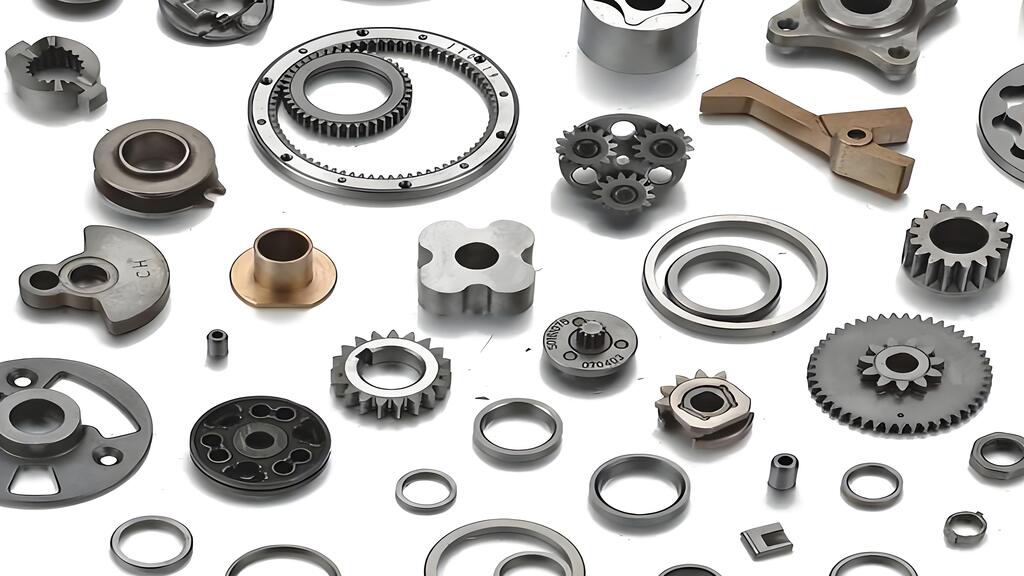
Metal Injection Molding (MIM) technology has enabled the widespread use of 17-4PH material in the production of small and complex parts. These parts are widely used in electronic devices, medical equipment, the automotive industry, and aerospace. For example:
- Medical Devices: Used for manufacturing surgical instruments, implants, and other high-demand components.
- Electronic Devices: Used for producing precision parts in mobile phones, laptops, and other electronic products.
- Automotive Industry: Used for manufacturing high-strength parts such as engine components and transmission system parts.
- Aerospace: Used for producing high-performance parts such as aircraft structural components and engine parts.
FAQ
What is Stainless Steel 17-4PH?
Stainless Steel 17-4PH is a precipitation-hardening stainless steel with high strength and good corrosion resistance.
Is 17-4 stainless steel magnetic?
Like all alloy steels, 17-4 stainless steel becomes magnetic after hardening.
Does 17-4 stainless steel rust?
This alloy is considered to have strong rust resistance, especially compared to other types of stainless steel. However, if 17-4PH stainless steel is exposed to harsh environments for extended periods and not properly maintained, it can still rust under certain conditions.
What is the tensile strength of 17-4 stainless steel?
The minimum tensile strength of this alloy is 160,000 PSI (pounds per square inch), and it can reach up to 210,000 PSI under age-hardened conditions.
What are the main chemical components of stainless steel 17-4PH?
The main components include Chromium (15.0-17.5%), Nickel (3.0-5.0%), Copper (3.0-5.0%), and Niobium (0.15-0.45%).
What is the density of 17-4PH stainless steel?
Its density is 7.75 g/cm³.
What processing methods can be used for 17-4PH stainless steel?
It can be processed through hot forming, cold forming, laser cutting, welding, CNC machining, Wire EDM, grinding, and MIM.
What are the main advantages of 17-4PH stainless steel?
Its advantages include high strength, excellent corrosion resistance, and good mechanical properties.
In which fields is 17-4PH stainless steel primarily used in the MIM process?
It is mainly used in aerospace, medical devices, precision instruments, and automotive parts.