

Introduction
Sourcing injection molding services in China in 2026 requires more than comparing tooling quotes or factory profiles. Buyers must account for supplier capability, material control, mold design quality, production volume, lead times, communication standards, and risk management before committing to a partner. This guide explains how to define sourcing goals, evaluate manufacturers, verify quality systems, manage costs, and reduce common delays in Chinese injection molding projects. It is designed for companies preparing new product launches, transferring production, or improving an existing supply chain, providing a practical framework for choosing reliable suppliers and moving from initial inquiry to stable production with fewer surprises.
Define Sourcing Goals and Supplier Requirements
Establishing a successful injection molding supply chain in China requires precise alignment between project constraints and supplier capabilities. In 2026, the manufacturing landscape demands a rigorous approach to sourcing, where buyers must clearly define their operational targets before initiating contact with potential vendors. A lack of clarity at this foundational stage often leads to mismatched partnerships, compromised quality, and costly production delays.
Set product, volume, budget, and timeline targets
The first step in any sourcing initiative is quantifying the exact parameters of the project. Buyers must establish strict targets for production volume, budget allocations, and delivery schedules. For example, prototype tooling (often referred to as T0) typically requires a lead time of 15 to 25 days, whereas high-volume production tooling can span 30 to 45 days. Clearly defining the Minimum Order Quantity (MOQ) and Estimated Annual Usage (EAU) allows suppliers to recommend the most cost-effective mold classifications and cavitation strategies.
Budget targets must account for both the initial Capital Expenditure (CapEx) for tooling and the ongoing Operating Expenditure (OpEx) for piece-part pricing. Establishing these thresholds early prevents time wasted on vendors whose cost structures do not align with the project's financial models.
Define what makes a reliable injection molding partner
A reliable injection molding partner in China extends beyond basic manufacturing capabilities; reliability is measured by financial stability, export experience, and robust quality management systems. Buyers should prioritize suppliers who maintain comprehensive in-house tooling capabilities rather than those who outsource mold fabrication, as in-house control significantly reduces tooling modification lead times.
Furthermore, reliability metrics must be quantified. Industry-standard expectations often dictate an Acceptable Quality Limit (AQL) of less than 1.5% for major defects. Suppliers demonstrating a historical adherence to such strict defect rate thresholds are better positioned to maintain consistent yield rates over the lifecycle of the product.
Clarify communication, engineering, and service expectations
Cross-border manufacturing frequently suffers from communication bottlenecks and timezone disparities. To mitigate these issues, buyers must formalize their expectations regarding engineering support and project management. This includes requiring suppliers to assign dedicated, English-speaking CAD engineers to the account, ensuring that technical nuances are not lost in translation.
Service Level Agreements (SLAs) should be established during the initial engagement phase. For instance, buyers might require a 24-to-48-hour turnaround time for Design for Manufacturability (DFM) reports and quote revisions. Setting these expectations early filters out unresponsive vendors and establishes a cadence for proactive communication.
Specify Technical and Manufacturing Requirements
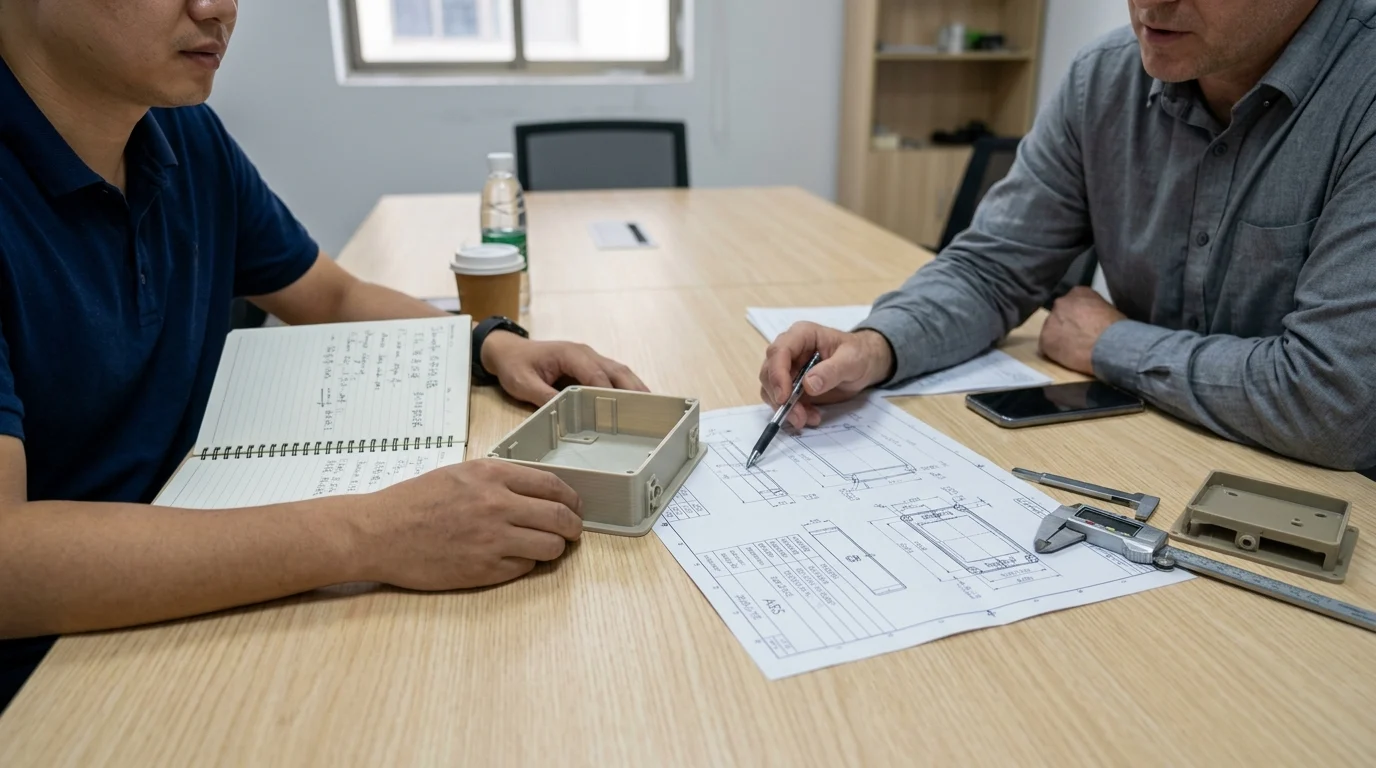
Technical specifications dictate the choice of machinery, tooling materials, and quality control frameworks. Providing granular engineering data ensures that suppliers quote accurately and design molds capable of surviving the intended production lifecycle without premature degradation.
Review resin selection, tolerances, and tooling steel
Selecting the appropriate tooling steel is a direct function of the chosen polymer and the projected production volume. Abrasive resins, such as glass-filled nylon (PA66+GF30), require hardened tool steels to prevent rapid gate and runner wear. Buyers must explicitly state the Society of Plastics Industry (SPI) mold classification required for their project.
| SPI Class | Typical Tool Steel | Hardness (HRC) | Expected Cycles | Ideal Application |
|---|---|---|---|---|
| Class 101 | S136, H13 (Hardened) | 48-52 | 1,000,000+ | Extremely high volume, abrasive resins |
| Class 102 | H13, 1.2344 | 44-48 | 500,000 - 1,000,000 | High volume, standard production |
| Class 103 | P20, 718H | 28-32 | Under 500,000 | Medium volume, non-abrasive resins |
| Class 104 | Aluminum, P20 | < 28 | Under 100,000 | Low volume, prototyping |
Specifying the correct steel and corresponding hardness prevents suppliers from underquoting using inferior materials that will fail before reaching the EAU targets.
Check design-for-manufacturing details before quoting
Before any metal is cut, a comprehensive Design for Manufacturability (DFM) review must be executed. This process identifies part geometry issues that could lead to sink marks, warpage, or short shots. Buyers should verify that the supplier's DFM process rigorously evaluates draft angles—typically requiring a minimum of 1 to 2 degrees for standard finishes, and up to 5 degrees for heavy textures.
Additionally, the DFM must address wall thickness uniformity. Variations in wall thickness exceeding 25% can induce severe internal stresses during the cooling phase. By demanding a detailed DFM report prior to quoting, buyers can assess the technical competence of the engineering team.
Compare tooling capability, press size, and production capacity
The physical capabilities of the manufacturing facility must align with the size and volume of the molded components. Press tonnage in a typical Chinese injection molding facility ranges from 50T to 3000T. However, micro-molding applications require specialized, high-precision electric presses under 50T, while large automotive fascia require massive hydromechanical presses exceeding 2000T.
Buyers must evaluate not only the size of the presses but also the overall production capacity. A facility operating at 95% capacity has little room to accommodate sudden spikes in demand or rush orders. Assessing the machine park's age and brand also provides insight into process repeatability, as newer electric presses offer superior shot-to-shot consistency compared to aging hydraulic systems.
Evaluate China Injection Molding Suppliers
Distinguishing between actual manufacturers and intermediaries is critical for supply chain transparency, cost control, and accountability. The evaluation phase must aggressively filter out unqualified vendors through structured audits and highly detailed Request for Quotation (RFQ) packages.
Compare factories, trading companies, and mold makers
The Chinese manufacturing ecosystem comprises direct factory manufacturers, dedicated mold makers, and trading companies. While trading companies offer excellent English communication and broad product sourcing, they typically add a 15% to 30% margin markup to unit costs and often obscure the actual location of production. This lack of transparency can be detrimental when resolving complex technical defects.
For injection molding, partnering directly with a factory that possesses in-house mold-making capabilities is generally the optimal route. It eliminates the margin stacking of intermediaries and provides direct access to the engineers responsible for modifying the tool during the T1 and T2 sampling phases.
Use factory audits to verify real production capability
Desktop research is insufficient for verifying a supplier's true capabilities; factory audits remain a mandatory step. Whether conducted in person or via a trusted third-party auditing firm (such as SGS or TÜV), the audit must verify the existence and condition of the equiPment claimed on the supplier's equipment list.
Auditors should look for baseline quality management certifications, notably ISO 9001:2015, or IATF 16949 for automotive components. Furthermore, the audit should evaluate the facility's raw material storage—ensuring resins are properly dried and segregated to prevent cross-contamination—and the maintenance logs for the injection molding machines.
Run a clear RFQ process to reduce errors and
rework
A poorly structured RFQ invites inaccurate pricing and future disputes. To run a clear RFQ process, buyers must provide a comprehensive data package. This includes 3D CAD files (STEP or IGES formats), 2D engineering drawings in PDF format detailing Critical to Quality (CTQ) dimensions, and specific material data sheets.
The RFQ must explicitly state required tolerances. For instance, standard commercial tolerances might be +/- 0.15mm, but precision components may require +/- 0.05mm or tighter. Forcing suppliers to quote based on standardized RFQ templates ensures that all bids are evaluated on an apples-to-apples basis, significantly reducing the likelihood of mid-project cost escalations.
Control Quality, Compliance, and Risk
Risk mitigation in cross-border manufacturing demands rigorous quality frameworks, strict regulatory adherence, and robust legal protections. Without these controls, buyers expose themselves to intellectual property theft, non-compliant materials, and inconsistent product quality.
Verify certifications and regulatory requirements
Depending on the end-market and application, injection molded parts must comply with various international regulations. For electronics, materials must be RoHS and REACH compliant to ensure the absence of hazardous substances. For medical or food-contact applications, resins must meet strict FDA standards, such as 21 CFR 177.1520 for polyolefins.
Buyers must require suppliers to provide Certificates of Analysis (CoA) and material traceability reports for every batch of resin used. Relying solely on a supplier's verbal assurance of compliance is a severe risk; documented proof from the resin manufacturer must be integrated into the inbound quality control process.
Manage samples, inspections, and process validation
The transition from tooling fabrication to mass production is governed by the sampling and validation process. During the first shots (T0), the focus is purely on mold functionality and identifying gross defects. By the T1 and T2 phases, the supplier must provide a First Article Inspection (FAI) report that measures 100% of the dimensions called out on the 2D drawing.
For critical dimensions, process validation should include statistical process control metrics. Buyers should demand a Process Capability Index (Cpk) of greater than 1.33 for all CTQ features during a pilot run of at least 300 to 500 units. This statistical proof guarantees that the molding process is stable and capable of producing parts within tolerance before authorizing full-scale mass production.
Protect IP, tooling ownership, and technical data
Protecting Intellectual Property (IP) in China requires specific legal instruments. Standard Western Non-Disclosure Agreements (NDAs) are generally unenforceable. Instead, buyers must execute NNN agreements (Non-Disclosure, Non-Use, Non-Circumvention) drafted in bilingual format and subject to Chinese jurisdiction.
Equally important is the protection of physical assets. The manufacturing contract must contain explicit clauses regarding tooling ownership. It should clearly state that the buyer owns the mold once paid for, and that the mold cannot be modified, moved, or used to produce parts for third parties without written consent. The tool should also be physically tagged with the buyer's company name and an asset tracking number.
Make the Final Sourcing Decision
The final selection of an injection molding partner requires a holistic evaluation of Total Cost of Ownership (TCO) rather than a simple comparison of the lowest piece prices. Strategic sourcing balances immediate financial outlay with long-term supply chain stability.
Compare tooling, material, labor, and logistics costs
A comprehensive cost comparison must isolate tooling CapEx, material costs, labor overhead, and logistics. Because tooling is a sunk cost, buyers must amortize it over the EAU to understand the true unit price. Furthermore, logistics costs can drastically alter the TCO.
| Cost Component | Typical Share of TCO | Key Drivers & Variables |
|---|---|---|
| Tooling (CapEx) | 10% - 25% | Mold steel, cavitation, hot vs. cold runner, complexity |
| Resin Material | 40% - 60% | Polymer grade, scrap rates, regrind allowances |
| Processing/Labor | 15% - 20% | Cycle time, machine hourly rate, automation level |
| Logistics & Tariffs | 10% - 15% | Ocean freight rates, import duties (e.g., Section 301 tariffs) |
For example, while ocean freight from Shenzhen to the US West Coast generally takes 25 to 35 days, the associated costs and potential import tariffs must be factored into the landed cost model before awarding the contract.
Assess lead time, scalability, and supply chain resilience
Beyond cost, the supplier's ability to scale operations in response to market demand is a critical factor. A vendor capable of efficiently producing 10,000 units per month must also demonstrate the infrastructure to scale to 100,000 units per month if the product succeeds. This requires assessing their machine utilization rates; an ideal partner operates at roughly 70% to 80% capacity, leaving a buffer for scale and emergency orders.
Supply chain resilience also involves evaluating the supplier's raw material sourcing network. Suppliers who maintain localized, diversified resin supply chains are less susceptible to global material shortages, ensuring uninterrupted production.
Use a decision matrix to balance price, quality, and
risk
To eliminate bias in the final selection, sourcing teams should deploy a weighted decision matrix. This matrix assigns numerical values to various performance categories based on project priorities. A standard weighting might allocate 30% to Landed Cost, 40% to Quality and Technical Capability (verified via Cpk and DFM quality), 15% to Communication and Responsiveness, and 15% to Risk and Compliance.
By scoring each shortlisted supplier against these strict, quantifiable criteria, buyers can objectively identify the partner that offers
Key Takeaways
- The most important conclusions and rationale for China Injection Sourcing Guide 2026
- Specs, compliance, and risk checks worth validating before you commit
- Practical next steps and caveats readers can apply immediately
Frequently Asked Questions
What should I define before contacting an injection molding supplier in China?
Define product specs, resin, tolerances, MOQ, estimated annual usage, tooling budget, target part price, and delivery timeline. This helps suppliers quote accurately and recommend the right mold class.
How can I identify a reliable China injection molding partner?
Look for in-house tooling, export experience, stable quality systems, clear engineering communication, and proven defect control. A reliable supplier should provide DFM support, mold maintenance plans, and transparent project updates.
What tooling lead time should I expect in China?
Prototype tooling often takes about 15 to 25 days. High-volume production tooling usually takes 30 to 45 days, depending on part complexity, steel selection, mold cavitation, and DFM changes.
Why is DFM review important before quoting?
A DFM review checks risks such as sink marks, warpage, short shots, draft angles, and wall thickness issues. It helps avoid mold rework, delays, and unexpected production costs.
Which mold steel should I choose for high-volume or abrasive resins?
For high-volume or abrasive materials like PA66+GF30, use hardened steels such as S136, H13, or 1.2344. They resist wear better and support longer mold life.
References
- How to Choose a Reliable Injection Molding Machine from China (2026 ...
- 4 Steps To Help Getting An Accurate Plastic Mold And Plastic Parts Offer ...
- Complete Guide to Find China suppliers in China 2026
- Top 10 China Injection Molding Manufacturers 2026: Choosing The ...
- Injection Molding Supplier Sourcing Guide (2026): RFQ, Costs & Quality
- Sourcing Injection Molds from China Guide | PDF | Audit - Scribd
- Tooling Management for Plastic Injection Molds in China - Sofeast
- Guide to Buying Chinese Injection Molding Machines
- Guide to Purchasing Injection Moulds from Chinese Suppliers
- Injection Molding – Guide to Buying Manufacturing in China