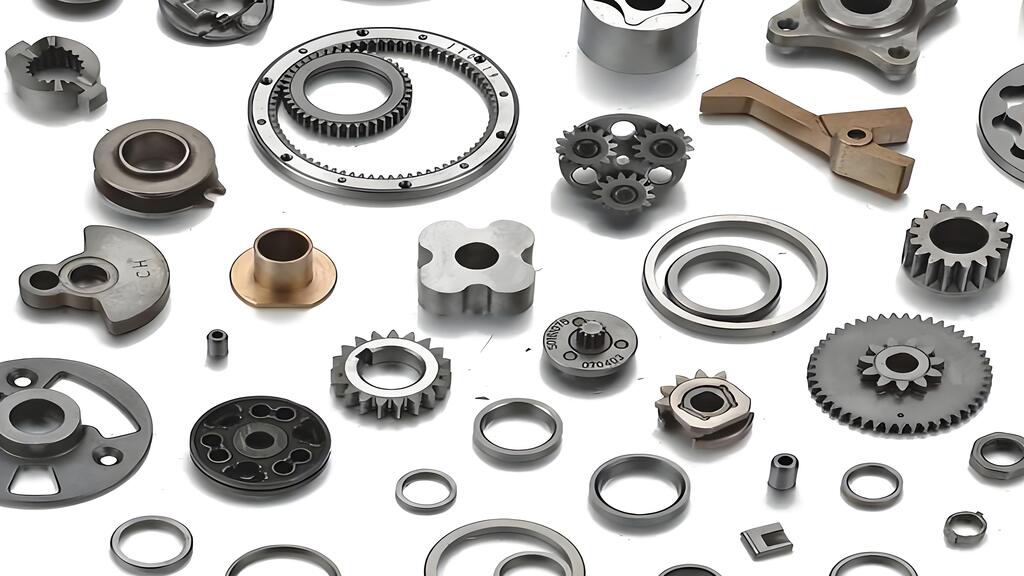


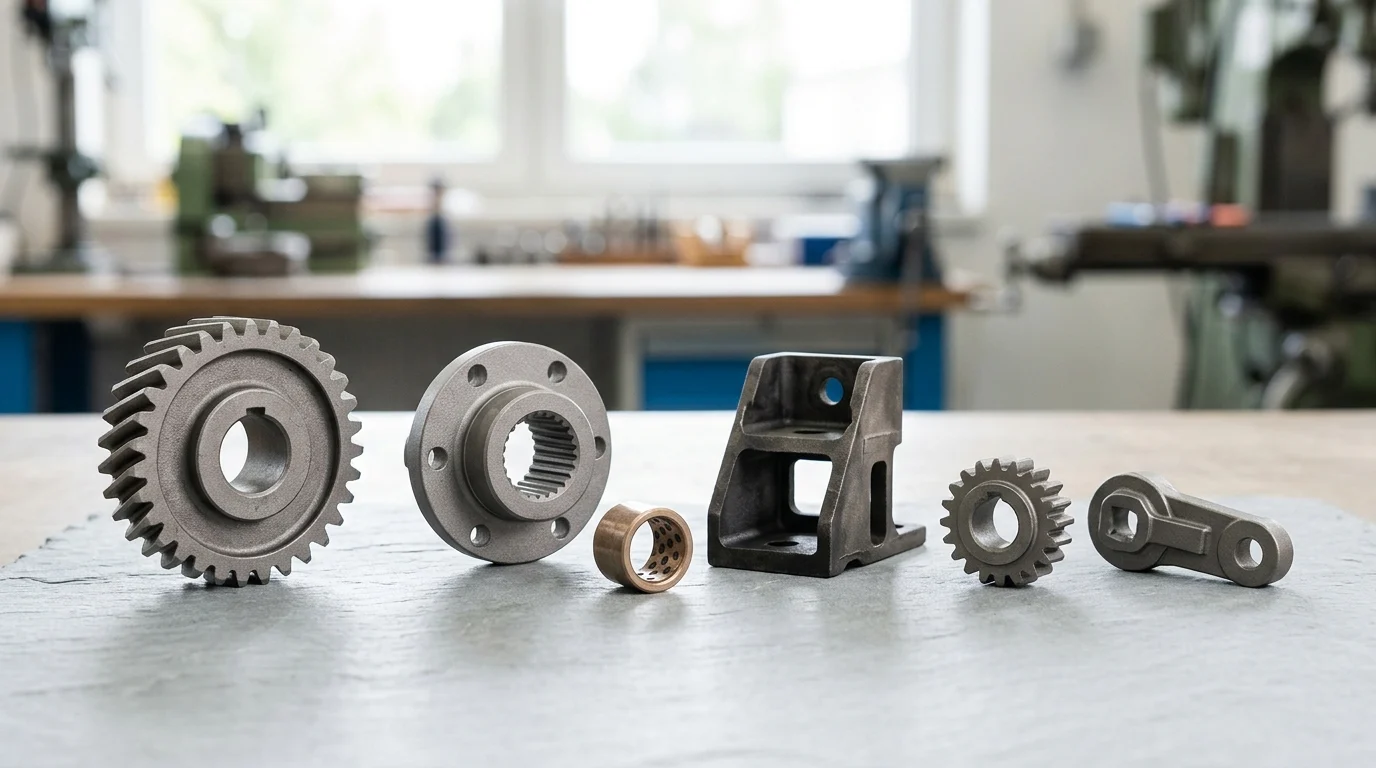
In high-volume gear production, every gram of wasted steel and every machining pass compounds into real cost.Sintered Powder Metallurgy components offer a compelling alternative by forming complex gear geometries close to final dimensions, often achieving 95% to 98% material utilization versus the far lower yield of forged-and-machined routes. This article compares powder metallurgy with conventional forging through the lens of structural gears: process flow, strength trade-offs, porosity, self-lubrication, production economics, and application fit. For manufacturers balancing durability, repeatability, and unit cost, understanding where PM excels—and where forging still holds the advantage—is essential to making a practical sourcing decision.
Why Sintered Powder Metallurgy Components Are a Strategic Alternative
For high-volume manufacturing of structural gears, the choice of production methodology fundamentally dictates unit economics, material efficiency, and mechanical performance. As automotive, industrial, and consumer goods sectors demand tighter margins and higher output, sintered powder metallurgy components have emerged as a highly strategic alternative to traditional forging.
What sintered powder metallurgy components are
Sintered powder metallurgy (PM) is a highly automated manufacturing process that converts finely powdered metals—typically iron blended with carbon, copper, nickel, or molybdenum—into precision components. The process begins with the cold compaction of the powder mixture within rigid precision dies at extreme pressures, generally ranging from 400 to 700 MPa (30 to 50 tons per square inch). This creates a "green" part that holds its shape but lacks structural integrity.
The green parts are subsequently passed through a continuous belt furnace for sintering in a controlled atmosphere at temperatures just below the melting point of the base metal. For common iron-based alloys, this sintering temperature is approximately 1,120°C. During this thermal phase, metallurgical bonds form between the powder particles through solid-state diffusion, yielding a high-strength, rigid component ready for application or secondary finishing.
Why near-net shape production matters
The primary strategic value of powder metallurgy lies in its near-net shape capability. Traditional manufacturing of a forged gear requires cutting a steel billet, heating and forging it, and then subjecting the forged blank to extensive subtractive machining (such as hobbing, broaching, and shaving) to form the final gear teeth and internal splines.
This conventional route typically results in material utilization rates of just 40% to 50%, meaning over half the raw material is lost as machined chips. In contrast, powder metallurgy boasts a material utilization rate of 95% to 98%. By pressing the complex gear geometry directly into the tool die, PM eliminates the need for primary rough machining, drastically reducing both cycle times and raw material waste while lowering the overall carbon footprint of the manufacturing cycle.
Sintered Powder Metallurgy Components vs Forged Gears

Evaluating sintered powder metallurgy components against traditional forged gears requires a close look at the trade-offs between mechanical strength, production speed, and overall lifecycle costs. While forging has historically dominated high-stress applications, PM offers distinct advantages in specific operating envelopes.
Process, material, and performance comparison
Forged gears are known for their continuous grain flow, which provides exceptional ultimate tensile strength and high fatigue resistance. However, this comes at the cost of extensive secondary processing. Sintered components, by their nature, contain inherent micro-porosity (typically 10% to 15% by volume for standard press-and-sinter parts). While this porosity lowers the ultimate tensile strength compared to fully dense wrought steel, it provides a unique performance benefit: self-lubrication. The interconnected pores can be impregnated with oil, reducing friction and wear in gearbox applications.
| Metric | Sintered Powder Metallurgy | Traditional Forging |
|---|---|---|
| Material Utilization | 95% - 98% | 40% - 50% |
| Typical Porosity | 10% - 15% | < 0.1% (Fully Dense) |
| Tooling Cost | $15,000 - $40,000 | $5,000 - $15,000 |
| Secondary Machining | Minimal to None | Extensive |
| Production Rate | 500 - 1,500 parts/hour | 100 - 300 parts/hour |
Key cost drivers
The economic viability of PM is heavily dependent on volume. The specialized compaction dies required for PM are highly complex and engineered to withstand extreme pressures. Consequently, PM tooling costs can range from $15,000 to over $40,000. To amortize this upfront capital expenditure, manufacturers typically require Minimum Order Quantities (MOQs) of 10,000 to 50,000 units per year.
Conversely, forging dies are generally less expensive to produce but wear out significantly faster, requiring frequent replacement. When production volumes scale beyond 50,000 units, the elimination of secondary machining costs allows PM to offer a per-part cost reduction of 20% to 40% compared to equivalent machined forgings.
Near-net shape design advantages
Near-net shape processing allows engineers to incorporate complex geometric features that would be prohibitively expensive to machine. Asymmetrical hubs, blind holes, keyways, and intricate involute splines can be pressed directly into the component in a single stroke.
Furthermore, sintered PM components routinely achieve dimensional tolerances of IT7 to IT9 straight out of the sintering furnace. If tighter tolerances are required for gear meshing, a secondary sizing or coining operation can achieve IT5 to IT6 tolerances without the need for slow, costly CNC grinding.
Strength, Density, and Reliability Considerations
The primary engineering hesitation when transitioning from forged to sintered powder metallurgy components centers on mechanical strength. Understanding how to manage density and validate part reliability is critical for successful implementation in structural applications.
Density, porosity, and case hardening
Density is the most critical determinant of a sintered component's mechanical properties. Standard PM parts achieve a density of 6.8 to 7.2 g/cm³. When higher strength is required, advanced compaction techniques can push the density to 7.3 - 7.5 g/cm³. Because lower density equates to higher porosity, heat treatment processes must be carefully managed.
Conventional gas carburizing can cause issues in highly porous parts, as the carbon atmosphere penetrates deeply into the interconnected pores, leading to through-hardening and a brittle core. To mitigate this, low-pressure vacuum carburizing or plasma nitriding is often utilized, allowing for precise control of case depth and maintaining a tough, ductile core.
Key process variants
When standard press-and-sinter properties are insufficient for high-torque gear applications, industry engineers turn to advanced process variants. Warm compaction involves heating the powder and the die to approximately 130°C to 150°C, which increases the green density by up to 0.15 g/cm³ and improves yield strength by 10% to 15%.
For ultimate performance, Powder Forging (PF) is deployed. In this variant, a sintered preform is subjected to a hot forging strike in a closed die. This collapses the internal pores, achieving near-full theoretical density (>7.8 g/cm³). Powder forged connecting rods and transmission gears offer fatigue strengths comparable to wrought steel while maintaining the material utilization benefits of PM.
Quality control and testing requirements
Given the potential for micro-cracks during the ejection of the green part from the die, rigorous quality control is mandatory. Traditional visual inspections are inadequate for PM gears. Instead, Non-Destructive Testing (NDT) methods are employed.
Resonant Acoustic Method (RAM) testing is widely used in high-volume PM production, allowing for 100% inline inspection of components. By striking the part and analyzing its natural resonant frequency, manufacturers can instantly detect internal flaws or density variations. For automotive powertrain components, suppliers are typically held to strict defect thresholds of less than 50 Parts Per Million (PPM).
How to Source and Validate Sintered Components
Procuring sintered powder metallurgy components requires a distinct approach compared to sourcing standard machined parts. Because the material properties are created simultaneously with the part geometry, the supplier's process control capabilities are just as critical as their dimensional accuracy.
Supplier qualification steps
The first step in supplier qualification is evaluating their press tonnage capacity and automation infrastructure. A supplier must possess presses that align with the required part footprint; structural gears typically require CNC hydraulic or mechanical presses ranging from 200 to 800 tons. Beyond equipment, engineering support is vital.
Buyers should audit the supplier's in-house tooling design capabilities, as tool deflection during compaction directly dictates the final part quality. Additionally, for automotive and heavy industrial applications, sourcing from facilities with active IATF 16949 or ISO/TS 16949 certifications ensures that the necessary Statistical Process Control (SPC) frameworks are in place.
Compliance and specification checks
Material specifications for PM parts cannot be copied directly from wrought steel equivalents (e.g., simply specifying AISI 4140 is invalid). Instead, buyers must reference specialized PM standards, such as MPIF (Metal Powder Industries Federation) Standard 35 in North America or ISO 5755 internationally.
Procurement documents must explicitly state the minimum acceptable density (e.g., 7.0 g/cm³ minimum), the apparent hardness (measured on the macroscopic surface), and the particle micro-hardness (measured on individual powder grains to verify heat treatment efficacy). Failure to specify both hardness metrics can lead to premature gear wear in the field.
Logistics and powder supply risks
Supply chain resilience requires an understanding of PM-specific logistics. Raw powder prices—particularly for alloys utilizing high concentrations of molybdenum, nickel, or copper—can be subject to significant commodity market volatility. Buyers should negotiate material indexing clauses in long-term contracts.
Lead times also present a unique risk profile. While steady-state production lead times are a highly efficient 4 to 6 weeks, the initial design, fabrication, and validation of custom compaction tooling can take 10 to 14 weeks. Buyers must factor in these extended tooling lead times during the New Product Introduction (NPI) phase and maintain strategic buffer stocks of critical gears to prevent line-down situations in the event of catastrophic tool failure.
When to Choose Sintered Powder Metallurgy Components
Deciding between sintered powder metallurgy components and traditional forged gears ultimately requires a holistic analysis of the application's operating environment, expected production lifespan, and commercial targets. PM is not a universal replacement for forging, but it dominates specific manufacturing niches.
Decision matrix for volume, load, and cost
To simplify procurement and engineering decisions, buyers should utilize a matrix that balances annual volume, mechanical stress, and unit cost. If the gear experiences extreme shock loads or contact stresses exceeding 1,200 MPa, traditional forging or powder forging is necessary. However, for moderate load applications, standard PM offers unparalleled cost efficiency.
| Annual Volume | Load / Stress Profile | Recommended Process | Cost Efficiency |
|---|---|---|---|
| < 10,000 units | High (> 1,200 MPa) | Machined Forging | High |
| 10,000 - 50,000 units | Moderate (800 - 1,000 MPa) | High-Density PM | Medium |
| > 50,000 units | Low to Moderate (< 800 MPa) | Standard PM | Very High |
| > 100,000 units | High (> 1,200 MPa) | Powder Forging (PF) | High |
Final engineering and sourcing recommendations
The most successful transitions to PM occur through Early Supplier Involvement (ESI). Engineers should collaborate with powder metallurgy specialists during the initial CAD phase, rather than attempting to directly convert a part designed for machining into a sintered component. Design modifications—such as eliminating undercuts, increasing draft angles, and rounding sharp internal corners—are essential to ensure uniform powder flow and prevent tool fracture.
By aligning high production volumes (exceeding 50,000 units annually) with parts designed specifically for vertical compaction, manufacturers can leverage sintered powder metallurgy components to eliminate secondary machining, drastically reduce material waste, and achieve a highly stable, cost-effective supply chain for structural gears.
Key Takeaways
- Use powder metallurgy for high-volume structural gears when near-net shape production can replace rough machining and reduce total part cost.
- Expect material utilization of about 95% to 98% with sintered PM, compared with only 40% to 50% for many forged-and-machined gear routes.
- Account for standard PM micro-porosity of roughly 10% to 15%, which can reduce peak strength but enable oil impregnation and self-lubricating behavior.
- Choose traditional forging for gears that require the highest tensile strength, fatigue resistance, and fully dense continuous grain flow.
- Evaluate compaction pressure, alloy blend, sintering atmosphere, and secondary finishing early because these variables strongly influence PM gear performance.
Frequently Asked Questions
What is a sintered powder metallurgy component?
It is a precision part made by compacting metal powder in a die and sintering it below the melting point, often around 1,120°C for iron-based alloys, to create metallurgical bonding and usable strength.
Why is powder metallurgy considered near-net shape manufacturing?
PM forms much of the final gear geometry directly in the tooling, reducing rough machining, scrap, and cycle time compared with forging followed by hobbing, broaching, or shaving.
How much material can powder metallurgy save compared with forging?
Typical PM material utilization reaches 95% to 98%, while forged gear production may use only 40% to 50% of the starting material after machining losses.
Are sintered PM gears as strong as forged gears?
Forged gears generally offer higher ultimate tensile and fatigue strength because of continuous grain flow, while standard press-and-sinter PM parts contain about 10% to 15% porosity.
When is powder metallurgy best suited for structural gears?
PM is especially valuable for high-volume gears where tight cost control, repeatable geometry, reduced machining, and high material efficiency matter more than maximum forged-steel density.