

Introduction
Choosing a molding partner affects far more than part production; it influences tooling life, material performance, lead times, defect rates, and total program cost. A strong evaluation process helps you separate capable manufacturers from suppliers that may look competitive on price but create risk through weak engineering support, poor process control, or limited capacity. This guide explains the practical factors to review before committing to a custom plastic injection molding manufacturer, including project requirements, tooling standards, quality systems, production capabilities, communication, and cost transparency. With these criteria in place, you can compare vendors more confidently and build a supplier relationship that supports consistent output from prototype through full-scale production.
Why the Right Custom Plastic Injection Molding Manufacturer Matters
Selecting a custom plastic injection molding manufacturer is a critical supply chain decision that dictates product quality, unit economics, and speed to market. Partnering with the wrong vendor can lead to compromised tool integrity, excessive scrap, and production bottlenecks.
Define Your Custom Molding Requirements
Before evaluating external partners, manufacturers must establish rigid internal baselines. This involves calculating precise annual volume expectations, mapping out peak production demands, and selecting the appropriate tooling class. For example, a project requiring 1,000,000 or more cycles demands an SPI Class 101 mold constructed from high-hardened steel (H13 or S7). Conversely, short runs of 10,000 units may only necessitate an SPI Class 104 aluminum tool, drastically altering the capital expenditure profile.
Understand the Business Risks of a Poor Supplier Choice
The financial and operational hazards of an incompatible supplier extend far beyond initial tooling costs. A poorly vetted molder can introduce systemic defects, leading to scrap rates well above the industry acceptable threshold of 1% to 3%. If a high-volume production run of 500,000 parts yields a 6% scrap rate due to inadequate thermal management in the mold, the compounded resin waste and machine time will rapidly erode profit margins. Additionally, misaligned IP protections and ambiguous tool ownership clauses can trap companies in hostile vendor lock-in scenarios.
Technical Capabilities to Evaluate
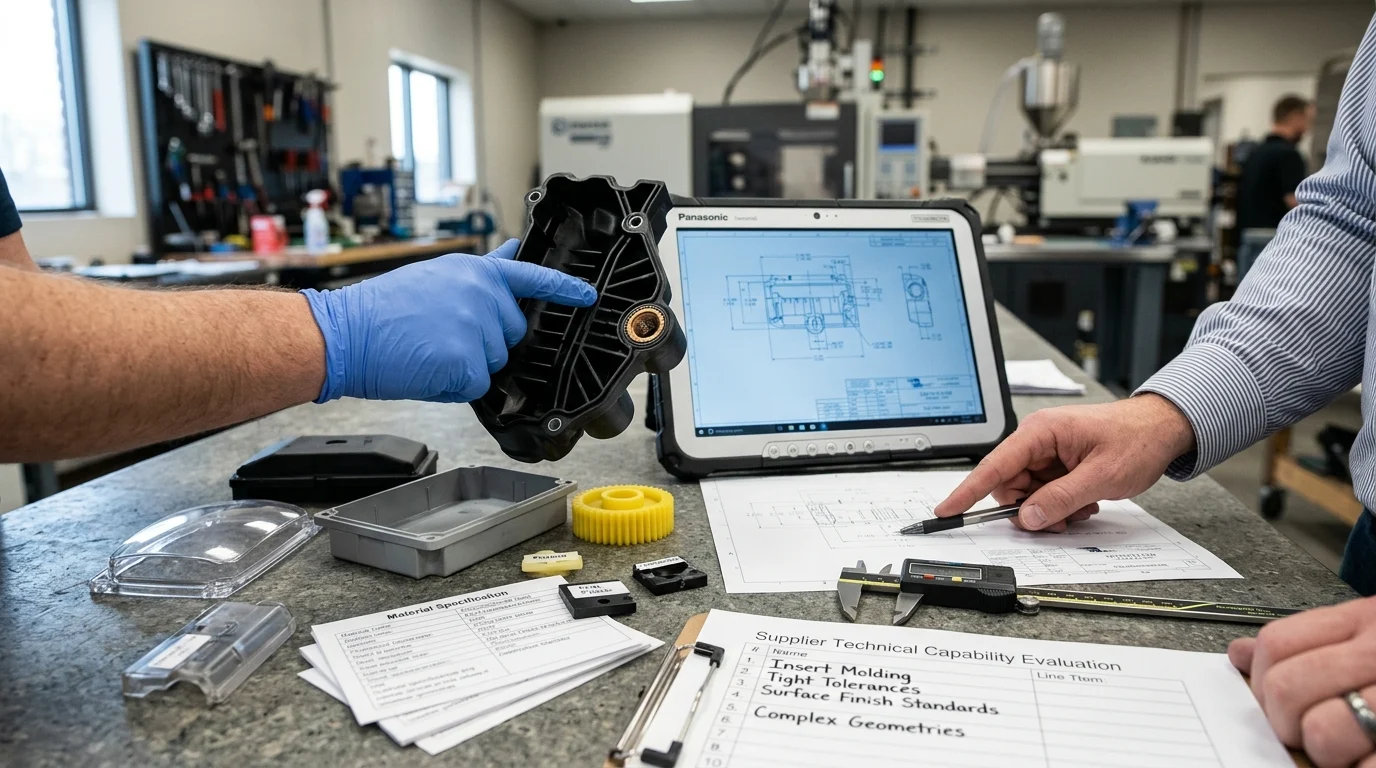
A custom plastic injection molding manufacturer is only as capable as its engineering foundation and physical infrastructure. Evaluating a supplier's technical depth requires looking beyond basic press availability to scrutinize their engineering methodologies and equiPment sophistication.
Review Mold Design, Resin Selection, and Tolerance Control
Superior part quality begins with rigorous Design for Manufacturability (DFM) and mold flow analysis. Evaluators must verify that the supplier utilizes advanced simulation software to predict sink marks, weld lines, and warpage based on specific resin shrinkage rates. Furthermore, precision tolerance control is a non-negotiable metric. While standard injection molding tolerances hover around ±0.005 inches, specialized medical or aerospace components often demand tight tolerances of ±0.001 inches or less, requiring highly calibrated tooling and closed-loop process controls.
Assess Prototype, Bridge, Low-Volume, and Production Capacity
Production capacity must align with the product's lifecycle stage. A versatile molding partner should offer a scalable pathway from low-volume bridge tooling to high-volume automated production. Evaluators must review the facility's press tonnage range to ensure compatibility with the part's physical dimensions and cavity counts. Press sizes typically range from 50 tons for micro-molding to over 3,000 tons for large automotive panels. A facility lacking machines in the 300-ton to 500-ton mid-range may struggle to optimize multi-cavity runs for consumer electronics or industrial housings.
Compare Equipment, Automation, and Secondary Services
Modern injection molding relies heavily on automation to minimize labor costs and cycle times. Manufacturers should look for facilities equipped with 3-axis or 6-axis robotic sprue pickers and automated part-handling systems. Additionally, in-house secondary operations—such as ultrasonic welding, pad printing, and insert molding—can consolidate the supply chain and reduce overall lead times.
| Press Tonnage | Typical Part Size | Example Application | Estimated Clamp Force Required |
|---|---|---|---|
| 50 - 150 Tons | Small (Under 5 sq in) | Medical connectors, gears | 2 - 5 tons per sq in |
| 200 - 500 Tons | Medium (10 - 50 sq in) | Consumer device housings | 3 - 4 tons per sq in |
| 600 - 1,500 Tons | Large (50 - 150 sq in) | Appliance panels, trays | 2.5 - 3.5 tons per sq in |
| 2,000+ Tons | Extra Large (150+ sq in) | Automotive bumpers, bins | 2 - 3 tons per sq in |
Quality, Compliance, and Process Control Checks
Technical capability must be governed by stringent quality management systems. Without robust compliance and process control frameworks, even the most advanced machinery will produce inconsistent yields.
Verify Certifications, Inspection Systems, and Documentation
Certifications provide a baseline indicator of a custom plastic injection molding manufacturer's operational maturity. Suppliers should hold, at minimum, an active ISO 9001:2015 certification. Depending on the industry, specialized credentials such as ISO 13485 for medical devices or IATF 16949 for automotive components are mandatory. Beyond certificates, physical inspection systems require verification. Facilities must deploy Coordinate Measuring Machines (CMM) and vision systems capable of resolving dimensions down to 0.0001 inches to ensure compliance with critical-to-function (CTF) dimensions.
Review DFM, Mold Validation, and Process Validation Methods
The transition from mold design to continuous production hinges on scientific molding principles and structured validation. Top-tier manufacturers execute comprehensive Installation, Operational, and Performance Qualification (IQ/OQ/PQ) protocols. During the PQ phase, process capability must be statistically proven. Evaluators should demand a Process Capability Index (Cpk) of 1.33 or higher, which statistically guarantees that 99.99% of the manufactured parts will fall within the specified dimensional limits, effectively eliminating variation-induced defects.
Confirm Traceability, Change Control, and Corrective Action Processes
Even in highly controlled environments, deviations occur. A reliable partner must utilize digital Manufacturing Execution Systems (MES) to maintain strict lot traceability from raw resin batches to finished goods. Furthermore, clear Corrective and Preventive Action (CAPA) procedures and 8D problem-solving methodologies must be established. If a material change is required, the supplier must enforce a rigid Engineering Change Order (ECO) process to prevent unauthorized modifications that could compromise regulatory compliance or part integrity.
Cost, Lead Time, Logistics, and Supplier Fit
Commercial viability is the ultimate test of a manufacturing partnership. A thorough analysis of cost structures, geographical advantages, and supplier responsiveness ensures that the chosen custom plastic injection molding manufacturer aligns with overall business objectives.
Break Down Tooling, Resin, Labor, and Secondary Operation Costs
Injection molding quotes must be deconstructed to reveal the true total cost of ownership. Tooling costs represent the largest upfront capital expenditure, ranging from $5,000 for a single-cavity aluminum prototype mold to upwards of $150,000 for a 32-cavity hardened steel production tool. Evaluators must also isolate resin pricing, machine rate (hourly press cost), and direct labor. A transparent supplier will break down cycle times, typically measured in seconds (e.g., a 15-second vs. 25-second cycle), as this metric directly dictates the per-unit amortization rate.
Compare Domestic, Nearshore, and Offshore Manufacturing Options
Geographic location drastically influences both lead times and total landed costs. Offshore manufacturing, particularly in Asia, often yields tooling cost reductions of 30% to 50%, but introduces extended ocean freight lead times of 8 to 12 weeks. Conversely, domestic or nearshore options provide accelerated speed-to-market and lower shipping costs, albeit with higher hourly labor rates. Companies must weigh the cost of capital tied up in transit against upfront tooling savings.
| Region | Avg. Tooling Cost Index | Production Lead Time | IP Protection Risk | Best For |
|---|---|---|---|---|
| Domestic (US/EU) | High (100%) | 4 - 6 Weeks | Low | IP-sensitive, fast-iteration parts |
| Nearshore (Mex/EEU) | Medium (70 - 85%) | 5 - 7 Weeks | Low to Medium | Heavy/bulky parts, balanced costs |
| Offshore (Asia) | Low (40 - 60%) | 8 - 12 Weeks | Medium to High | High-volume, labor-intensive parts |
Qualify Suppliers Through RFQs, Samples, Audits, and References
Supplier qualification should follow a structured funnel. Initial RFQs evaluate pricing transparency and responsiveness. Promising candidates should then provide First Article Inspection (FAI) reports and T1 (first tryout) samples. The industry standard expects an approved part within 1 to 3 tooling iterations. Conducting on-site or virtual audits of the facility, coupled with checking references from clients with similar volume profiles, minimizes the risk of partnering with a financially unstable or technologically deficient molder.
Final Supplier Selection and Contract Setup
The culmination of the evaluation process requires objective decision-making frameworks and legally binding agreements to safeguard the project's future.
Use a Weighted Scorecard to Compare Suppliers
To eliminate subjective bias, procurement teams should deploy a weighted scorecard to rank finalists. A standard matrix might allocate 35% to Quality Systems and Cpk history, 30% to Total Landed Cost, 20% to Lead Time and Capacity, and 15% to Communication and Engineering Support. By quantifying these variables, organizations can definitively identify the supplier that offers the highest aggregate value, rather than simply defaulting to the lowest initial tooling bid.
Set Clear Contracts, Quality Agreements, and Communication Rules
The final step is translating expectations into a Master Supply Agreement (MSA) and a comprehensive Quality Agreement. These documents must explicitly define tool ownership, stipulating that the buyer retains full rights to transfer the mold at their discretion without hidden release fees. Furthermore, the contract should establish Service Level Agreements (SLAs), such as a 98% On-Time Delivery (OTD) threshold and a maximum allowable defect rate of 500 Parts Per Million (PPM). Clearly defined communication cadences, including quarterly business reviews, ensure the partnership remains aligned through the product's entire lifecycle.
Key Takeaways
- The most important conclusions and rationale for Custom Plastic Injection Molding Manufacturer
- Specs, compliance, and risk checks worth validating before you commit
- Practical next steps and caveats readers can apply immediately
Frequently Asked Questions
What should I define before contacting a custom plastic injection molding manufacturer?
Prepare annual volume, part drawings, material requirements, tolerance needs, surface finish, tooling budget, and launch timeline. This helps the manufacturer recommend the right mold class, resin, press size, and production plan.
How do I know if a manufacturer can meet tight tolerances?
Ask for DFM review, mold flow analysis, inspection equipment details, process control methods, and examples of similar parts. For high-precision work, confirm they can hold tolerances near ±0.001 inches if required.
Why is mold ownership important when choosing a supplier?
Clear mold ownership prevents vendor lock-in. Your agreement should state who owns the tool, where it is stored, who maintains it, and whether it can be transferred to another manufacturer.
What production capabilities should I check?
Confirm the manufacturer supports your volume stage, from prototype or bridge tooling to full production. Check press tonnage range, cavity capacity, automation, resin handling, and secondary services like insert molding or ultrasonic welding.
What quality certifications or controls should I ask about?
Ask for quality certifications, inspection procedures, material traceability, first article inspection, process documentation, and scrap-rate tracking. Strong suppliers should provide consistent records and corrective action processes.
References
- How to Choose a Custom Injection Molding Manufacturer
- How Do You Evaluate a Custom Plastic Injection Molding Service?
- How to Choose the Perfect Custom Plastic Injection Molding Service
- Top Plastic Injection Molding Companies: Here's What to Look For
- Top Five Guidelines for Selecting a Plastic Injection Molding Manufacturer
- How To Choose Materials for Injection Molding? - Arterex
- How to choose an injection mold manufacturer - Quora
- What are the best injection molding companies? : r/manufacturing - Reddit
- How to Find Reliable Plastic Injection Molding Companies Near You (And ...