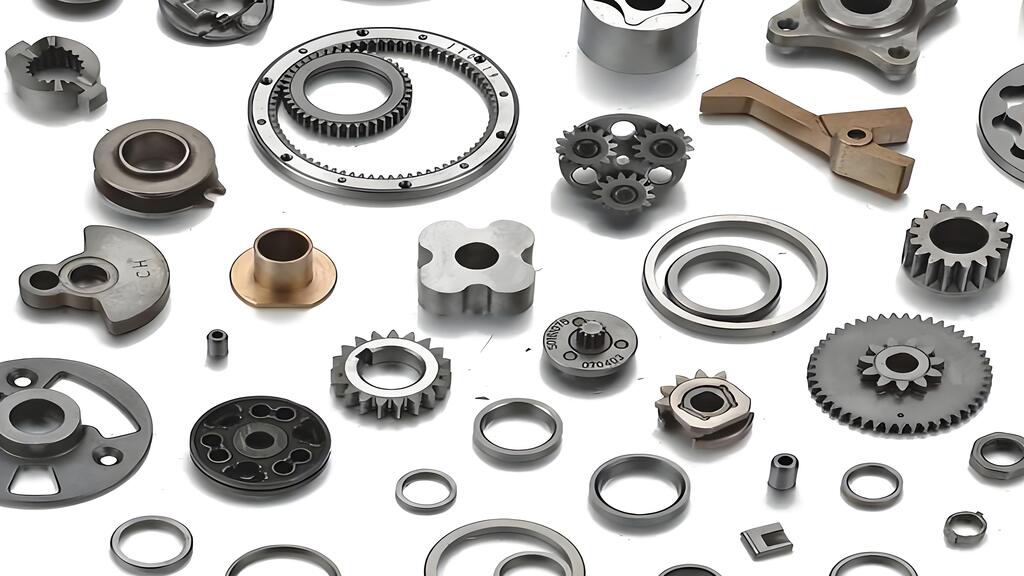


Why Powder Compacting Fails: Hidden Factors Affecting Metal Part Quality

Metal powder compacting utilizes pressures ranging from 80 psi to an astonishing 1,000,000 psi (0.55 to 6,894.8 MPa) to transform loose metal particles into shaped components. These extreme forces create "green compacts" that remain quite fragile. Their strength matches everyday items like Life Savers candy and aspirin tablets.
Successful compaction plays a crucial role as the second step in Powder Metallurgy's four-stage manufacturing process, which includes powder mixing, compaction, sintering, and secondary operations. The process pushes dry metal powder in a die at pressures between 20 and 700 MPa. Metal powders don't behave like liquids under pressure in cold dies, which creates major manufacturing hurdles.
The compaction quality shapes the final product's properties and accuracy after sintering. When density isn't uniform or micro-cracks appear, the components can become defective. Manufacturers need to understand why compaction fails to produce consistent, high-quality Metal Parts, whether they use cold or hot pressing techniques. This piece gets into the hidden factors that affect powder metallurgy quality, from die design limits to material properties that can break down compact integrity.
Understanding the Powder Compaction Stage in Powder Metallurgy

The powder compaction stage marks a crucial turning point in powder metallurgy. Raw metal particles come together to form a shaped component with structural integrity. This process serves as the vital second step in the press-and-sinter method that connects powder preparation to sintering.
Role of compaction in the press-and-sinter process
Metal particles mechanically interlock under pressure during powder compaction, which makes the material denser. This pressure creates what manufacturers call a "green compact" – a shaped piece that holds its form through mechanical bonding of irregular particles before heat treatment.
The press-and-sinter process follows these steps:
- Mixing elemental or alloy powders with lubricants and additives to create a homogeneous blend
- Compacting this mixture in a die under controlled pressure
- Sintering the green compact in a controlled-atmosphere furnace
- Applying optional secondary operations to boost properties or features
Compaction plays several key roles. It shapes the part's geometry and creates enough particle-to-particle contact points needed for good sintering. The original density distribution also shapes the final properties.
Manufacturers can use pressures from 138 MPa (10 tsi) to 965 MPa (70 tsi) based on density needs and powder properties. This range lets them adapt the process to match specific material and product requirements.
The process happens in three steps: filling the die with powder, applying pressure, and ejecting the green compact. Each step needs precise control to ensure even density and prevent defects. The pressure must last long enough to bond metal particles without damaging equipment or deforming parts.
Green density and its effect on final part quality
Green density affects almost every aspect of the final component's quality a lot. Higher green density leads to:
- Better material strength and performance
- More precise dimensions
- Higher final sintered density
- Better component durability
Two main factors link green density to final quality. More particle-to-particle contact points exist with higher green density. The material also shrinks less during sintering, which reduces distortion risk.
Uneven green density throughout a part creates quality problems. Different areas shrink at different rates during sintering, which can cause distortion and defects that hurt performance and reliability. These problems show up in two ways: big variations from uneven die filling or pressure, and small variations from powder flaws or poor compression.
Die wall friction largely determines how uniform the green density becomes. Metal powders don't act like liquids in closed dies - they don't spread pressure evenly. The powder mostly flows where pressure pushes it, and friction reduces pressure throughout the compact. This creates one of the biggest challenges in powder compaction.
Making optimal green density requires careful control of particle size, shape, distribution, powder flow, die design, and lubrication. Small changes in these elements can affect part quality by a lot. Understanding these basics helps solve quality issues effectively.
Die Design and Tooling Limitations That Lead to Failure
Die tooling mirrors the final part geometry in powder metallurgy. Tool design becomes crucial for compact parts to be successfully manufactured. Failed compaction often stems from tooling limitations that affect part quality throughout manufacturing.
Single-action vs double-action pressing effects
The way powder gets compressed substantially influences how density spreads within the part. Single-action pressing moves only the upper punch while the lower punch and die stay put. This setup creates density problems - high density at the top near the moving punch that gets lower as you go down.
Single-action compaction works best with thin, flat components that don't have much height. Thicker parts face bigger challenges because pressure doesn't flow evenly through the powder. Metal powders don't behave like liquids. They won't spread pressure in all directions, but mainly flow where you apply the force.
Double-action pressing tackles these challenges by using both upper and lower punches that move toward each other while the die stays still. This creates better density balance with minimum density in the middle rather than at one end. Double-action presses give you more even density but need more expensive equipment.
Let's compare these approaches:
| Pressing Method | Density Distribution | Suitable Applications | Equipment Cost |
|---|---|---|---|
| Single-action | Highly non-uniform | Thin, simple parts | Lower |
| Double-action | More uniform | Complex, thick parts | Higher |
Floating die systems and density uniformity
Floating die systems are a great way to solve density gradient problems. The die moves during compaction while the lower punch stays still, and force comes from the upper punch. When the die moves, it spreads out friction forces to create effects similar to double-action pressing.
On top of that, floating die systems match double-action presses in density uniformity but work with single-action equipment. You won't need expensive machine replacements. Research labs and smaller manufacturing operations find this especially valuable.
Studies that compare floating die with single-action compaction show floating die systems:
- Make density more uniform along the compaction axis
- Need about 50% less compaction load for the same density
- Give up to 10% higher density in the final product
- Cut down on microporosity compared to single-action compaction
Parts with high aspect ratios (height-to-diameter greater than 1.5) benefit the most from floating die compaction. These parts usually give single-action compaction a hard time.
Tool wear and misalignment issues
Tool failure poses a major risk in powder metallurgy production. Compaction tools must handle hundreds of thousands of high-pressure cycles without losing their precise dimensions. Three main types of wear affect powder metallurgy tooling: abrasive, adhesive, and surface fatigue.
Abrasive wear happens most often, especially with hard particle powders that slowly wear down die walls and punch surfaces. Adhesive wear can make punches and dies stick together in the worst cases, leading to complete failure. One case showed a die made 74,042 compacts before the punches got stuck, breaking the upper punch shaft and cracking the die insert.
Die wall friction remains a key issue throughout compaction. This friction affects both energy use and compact quality by changing the pressure distribution. Tools need proper alignment between punches and dies. Poor alignment speeds up wear and can cause early tool failure.
Your choice of tooling material directly affects wear resistance. Research tested three die materials against abrasive particles. Tungsten carbide lasted longer than CPM T15 and 10% vanadium tool steels. Surface treatments and finishing also play a big role in tool life. Polishing to a bright, reflective finish cut wear substantially in nitrocarburized samples.
Good tool design looks at:
- How compaction stresses the tool
- Which features might wear out too much
- What shapes might break under repeated use
- How to design tool edges that won't fail
Material Properties That Reduce Compact Integrity

Material characteristics determine powder metallurgy's success. These characteristics decide if compaction works or fails, whatever the die design or process parameters might be.
Effect of particle shape and size distribution
Particle morphology affects compact integrity and densification a lot. Studies show that powder from centrifugal atomization works better for compacting than gas-atomized spherical powders. This happens because irregular particles create more mechanical interlocking points that improve green strength.
Spherical particles improve flow properties and apparent density better, but don't deform easily during pressing. These particles increase packing density in metal injection molding applications but reduce compressibility. Higher particle sphericity leads to less porosity and better flowability.
Size distribution also plays a key role in compact quality. Small particles fill gaps between bigger ones to increase overall density. Despite that, very fine particles (below 10 μm) can stick together due to Van der Waals forces and don't spread evenly. Research with stainless steel powders shows that smaller particles are 35% harder than bulk materials.
Influence of powder hardness on deformation
Powder hardness shapes how materials deform under compaction stress. Metal powders can respond through elastic deformation, plastic deformation, brittle fracture, or a mix of these responses. Hard materials don't deform easily, which leads to lower compressibility and possibly weaker green density.
Powder particles get their deformation traits from their microstructure. Faster solidification during powder atomization creates materials with smaller grain sizes than bulk versions. This difference in microstructure means powder particles have higher yield strength.
Tests at the micro level reveal that bigger powder particles can be 35% harder than bulk material. This translates to 782 MPa yield strength compared to 580 MPa for bulk. The hardness drops as temperature rises, which explains why warm compaction helps powder compress better.
Chemical composition and alloy behavior during pressing
Chemical makeup is a big deal as it means that it affects how materials compact. Pure element powders compact better than pre-alloyed materials. To cite an instance, aluminum 6061 alloy powder reaches a higher relative density (about 99%) compared to pure magnesium (95.5%) or copper (78%).
Adding alloy elements creates complex effects. Iron added to quickly solidified Al-Si alloys improves rigidity and high-temperature strength through fine intermetallic dispersion. Metal (Ti) and carbon-based (Gr) agents make copper-based powders more compressible, while ceramic reinforcers reduce it because they're brittle.
Matrix and reinforcing particles need to work well together for compact integrity, especially when you have hard particles in softer, more deformable matrices. Engineers must design powder blends carefully to address this challenge.
Process Variables That Cause Density Gradients

Process variables that affect pressure distribution create density gradients in powder metallurgy components. Quality issues can arise even with the best material selection and tooling design because of these process-related factors.
Die wall friction and pressure transmission
Die wall friction plays a direct role in pressure transmission during compaction. Experimental measurements show that axial pressure at any depth (z) drops exponentially with distance from the applied pressure point: Pz=Po×exp(-2zμa/r), where μ represents die wall friction. This exponential decay creates a pressure gradient that leads to density variations.
Single-action pressing shows these effects more clearly. Density drops as the distance from the pressing punch increases. The outer diameter next to the pressing punch shows the highest density, while the opposite end shows the lowest.
Die wall friction behavior changes a lot during compaction. Powder particles first show stick-slip motion against the die walls, then move to continuous sliding as densification increases. A constant friction coefficient fails to model this changing behavior accurately, which can lead to big simulation errors.
Improper die filling and powder flowability
The uniformity of die filling shapes the density distribution before compaction starts. Three mechanisms control die filling: gravity filling, suction filling (from downward lower punch movement), and forced feeding. These mechanisms work together to create a complex process that affects density uniformity.
The relationship between turret speed and paddle speed plays a crucial role in fill consistency for rotary tablet presses. Research shows that higher paddle speeds paired with lower turret speeds help powder flow better and create more uniform filling. Powder particle arrangement angles also affect contact area and force transmission—a 45° arrangement leads to more uneven pressure distribution than 22.5°.
Lubricant type and distribution inconsistencies
Lubricants reduce friction between powder particles and between particles and die walls. At the microscopic level, the lubricant spreads unevenly throughout the compact.
Studies show that a very thin lubricant film (less than 50 Å thickness) forms at tool-powder interfaces, regardless of lubricant content (0.5-3 wt%) or compaction pressure (400-800 MPa). Only lubricant particles that touch the tool walls directly help form this film. Uneven lubricant distribution changes die wall friction, which leads to density gradients.
Post-Compaction Issues That Affect Final Quality

Image Source: Powder Metallurgy
Green compacts face several critical challenges that can compromise final part quality even after successful compaction. These problems between compaction and sintering determine whether a part meets specifications or fails.
Elastic springback and dimensional distortion
Springback happens when compacted powder expands in axial and radial directions after pressure removal. This effect comes from the release of elastic energy stored during compaction. Springback behavior follows non-linear patterns, and most materials show complex elastic responses that make prediction difficult. Research shows that too much springback creates dimensional tolerance problems and leads to serious defects like cracking, delamination, and capping.
Quality control becomes more complex due to the springback's anisotropic nature. Tests reveal that compressive strength changes substantially based on how the specimen orients relative to the compaction direction. Most measurement techniques only look at general axial changes after compaction and miss localized dimensional variations that affect final part quality.
Green strength limitations during ejection
Green compacts are as fragile as chalk, which makes them extremely vulnerable during ejection. Green strength—the mechanical strength of a cold-pressed powder compact—affects how well you can handle the part. Three-point bending tests following ISO-3995 standards measure this strength.
Green compacts have poor tensile properties and remain at risk, especially when you have improper punch deflections or too much elastic springback. The type and amount of pressing agent become crucial factors that boost green strength.
Crack formation due to stress concentration zones
Stress concentration zones (SCZs) are the foundations of damage in powder metallurgy parts. About 5-10% of total metal volume reaches limiting state and develops damage. Cracks often form during pressure release or ejection stages despite successful compaction.
Microcracking starts inside the die during unloading before ejection. These microcracks then interact with stress fields during ejection and can grow into larger cracks or laminations. Many internal cracks remain hidden until after sintering, which wastes substantial material. Research confirms that higher compaction pressures raise the risk of cracking while improving density.
Conclusion
Understanding Powder Compaction Failures: The Path Forward
Multiple interconnected factors cause powder compaction failure rather than a single issue. Manufacturers need to tackle several critical failure mechanisms that emerged from this study to achieve consistent quality in powder metallurgy parts.
Die design plays a major role in successful compaction. Double-action pressing and floating die systems give better density uniformity than single-action methods, though they cost more. The process becomes more complex due to tool wear and misalignment. This makes careful material selection and regular maintenance crucial.
Material properties shape the compact's integrity at a fundamental level. Particle shape, size distribution, and hardness affect how powders behave under pressure. Better mechanical interlocking comes from irregular particles compared to spherical ones. Fine particles boost density by filling gaps between larger ones. The chemical makeup also changes compaction behavior - elemental powders typically compact better than pre-alloyed materials.
Quality outcomes depend heavily on process variables. Die wall friction creates pressure decay throughout the compact exponentially. Parts can have density variations even before compaction starts due to poor die filling. Uneven lubricant spread leads to varying density gradients that weaken the final part.
Post-compaction brings its own set of risks. Parts can get distorted from elastic springback and become vulnerable during ejection due to limited green strength. Successful initial compaction doesn't prevent cracks from forming in stress concentration zones.
Better powder metallurgy parts need an integrated approach. Manufacturers should look at all these factors together instead of individual variables. This task isn't easy, but knowing these hidden factors helps solve existing problems and builds stronger powder metallurgy processes.
The future looks promising with computational modeling to predict density gradients, better die designs that reduce friction, and new powder formulations that improve compressibility and green strength. These advances, combined with better process monitoring, will expand powder metallurgy's practical uses in many industries.
FAQs
Q1. What are the key factors affecting metal part quality in powder compaction? The main factors include particle size and shape, powder hardness, chemical composition, die design, compaction pressure, and lubricant distribution. Smaller irregular particles generally produce better results than larger spherical ones. Die wall friction, improper filling, and inconsistent lubrication can also lead to density gradients and defects.
Q2. What are some common quality issues with powder metal parts? Common issues include density variations, ejection cracks, microlaminations, and poor sintering. Excess oxidation or corrosion can also occur due to voids in the part. These defects often stem from improper compaction, uneven pressure distribution, or issues during the post-compaction stages.
Q3. What compaction pressures are typically used in powder metallurgy? Compaction pressures generally range from 150 MPa to 700 MPa (10 to 50 tons per square inch). The exact pressure depends on the specific material and desired part properties. For components with varying heights, multiple lower punches may be necessary to achieve uniform compression.
Q4. Why does metal sometimes appear rough and "powdery" when it breaks? This appearance is often due to the powder metallurgy manufacturing process. The rough, powdery texture reflects the original particle structure that wasn't fully consolidated during sintering. It can also indicate brittle fracture along particle boundaries, especially if proper bonding wasn't achieved during processing.
Q5. How does elastic springback affect powder metallurgy part quality? Elastic springback occurs when compacted powder expands slightly upon pressure release. This can cause dimensional distortions and tolerance issues. Excessive springback may lead to more serious defects like cracking or delamination. The anisotropic nature of springback further complicates quality control, as it varies based on the compaction direction.