

New Breakthroughs in Powder Metallurgy Materials
Types of powder metallurgy materials
Powder Metallurgy materials can be roughly divided into four categories:iron-based materials, non-ferrous metal materials, Ceramic Materials and composite materials. Among them, iron-based materials are widely used in the automotive manufacturing industry due to their excellent mechanical properties and cost-effectiveness. Non-ferrous metal materials, such as copper, aluminum, titanium, etc., occupy a place in the aerospace and electronics industries due to their unique physical and chemical properties. Ceramic materials are used in the fields of medical devices and cutting tools due to their high hardness and high wear resistance. Composite materials combine two or more materials to bring out their respective advantages and are used in high-performance parts in special environments.
Preparation process of powder metallurgy
The basic preparation process of powder metallurgy includes three main steps: powder preparation, molding, and sintering. Powder preparation is the preparation of metal or other materials into powder by physical or chemical methods. The molding process is to put the prepared powder into a mold and shape it by applying pressure. Sintering is the diffusion and combination of powder particles at a certain temperature to form a solid material.
Application of powder metallurgy materials
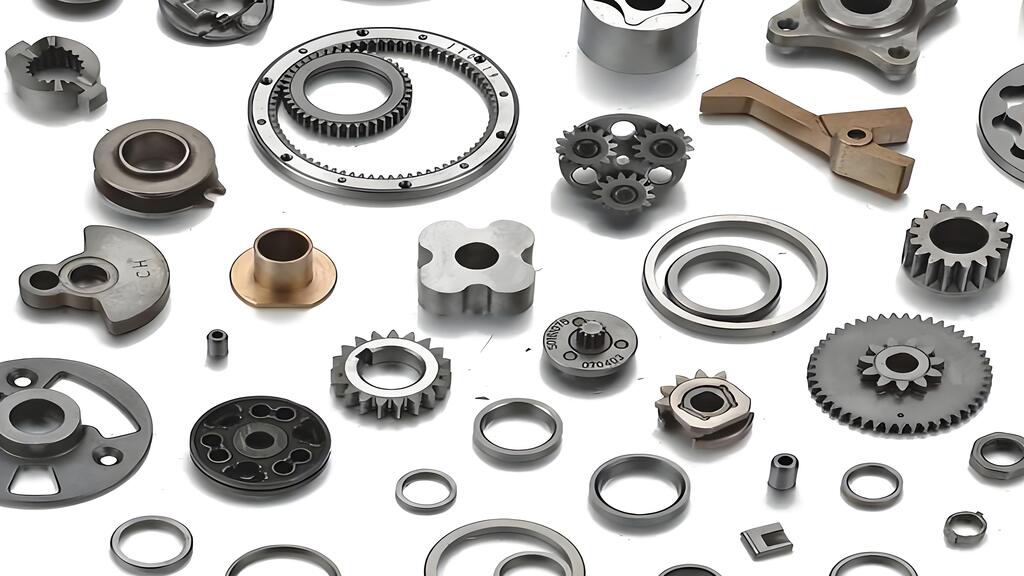
Powder metallurgy materials have found wide applications in many fields due to their unique properties and processing advantages. The following table lists some typical application cases:
| Material Type | Application Field | Typical Uses |
| Iron-based Materials | Automotive Manufacturing | Gears, Crankshafts, Brackets |
| Non-ferrous Metals | Aerospace | Engine Components, Structural Parts |
| Ceramic Materials | Medical Devices | Artificial Bones, Teeth |
| Composite Materials | Electronics Industry | Conductive Connectors Heat Sinks |
Technological innovation and application expansion
With the continuous advancement of science and technology, powder metallurgy technology is also constantly innovating and developing. Modern powder metallurgy technology has been able to achieve high-precision, complex shape manufacturing, such as the application of precision molding, injection molding, and other technologies, making powder metallurgy materials more widely used. For example, in the aerospace field, powder metallurgy materials are used to manufacture aerospace engine parts, spacecraft structures, and other key components. Their lightweight and high-strength characteristics provide important support for the development of aerospace technology.
Environmental protection and sustainable development
The preparation process of powder metallurgy materials does not require a large amount of energy consumption, nor does it produce a large amount of waste gas, waste water and other pollutants, so it is regarded as an environmentally friendly and energy-saving processing technology. In addition, powder metallurgy materials can also achieve efficient use of materials, reduce material waste, and are in line with the concept of sustainable development.
Conclusion
As an efficient and environmentally friendly material processing technology, powder metallurgy materials continue to promote the development and progress of the industrial field. With the continuous innovation of technology and the continuous expansion of applications, it is believed that powder metallurgy materials will play a more important role in the future, bringing more opportunities and possibilities to the development of all walks of life.