

The Comprehensive Guide to Powder Metal
What Are Powdered Metals?
Definition and Basics
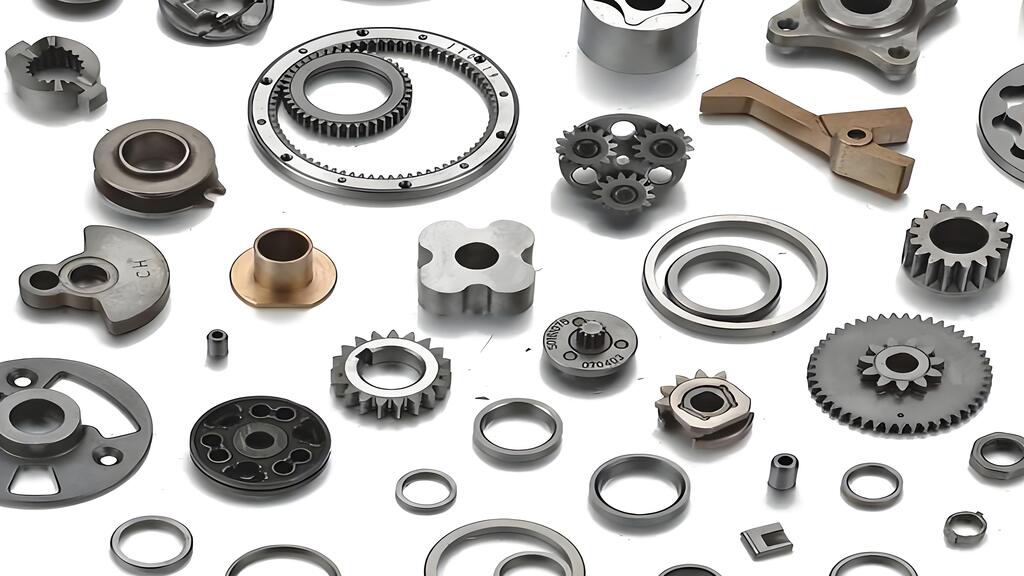
Powder metal (PM) parts are created from a very fine metal powder that is compressed and sintered to achieve its final shape. This is quite different from cast parts, which begin their life as liquefied metal, or from machined or forged parts, which start off as stock metal. The powder metal manufacturing processmakes it possible to create parts with extremely complex geometry. While such parts might be made through casting or machining, the manufacturing costs increase dramatically as complexity rises. Pm Parts, however, remain cost-effective even with intricate geometries and can make parts that are impossible to fabricate using any other methods.
Net or Near Net Manufacturing
Another key benefit of powder metal is that it is a net or near-net manufacturing process that results in minimal waste material. Rather than subtracting geometry and materials to create a part, PM does not waste any metal, making it a much more efficient and environmentally sustainable process. Because PM is closely allied with computer-aided manufacturing, parts can be created to simultaneously optimize weight, strength, stiffness, and hardness. This is vital for applications in industries such as aerospace, where weight must be minimized.
Powder Metal Manufacturing Process
Powder Production
Typical PM parts are made in three basic steps: blending of the metal powder (pulverization), die compaction, and sintering of the product. Additional heat treatment steps may be required after sintering to achieve the appropriate density, dimensions, and surface finish.
Pulverization and Sieving
Pulverization and sieving prepare the metal powders for use in PM. The powders can vary in both shape (some are designed to be spherical) and size. Metallic powders can be produced through various processes, including grinding, crushing, electrolytic deposition, chemical reactions, and atomization. The size and shape of the particles are important factors when designing a part for manufacturing by PM methods.
Die Compaction
Die compaction is accomplished using a predetermined amount of pressure at room temperature. The powder is pressed into a die to form the desired shape.
Sintering
Sintering involves heating the compacted powder at elevated temperatures under controlled atmospheric conditions. This process bonds the powder particles together, increasing the strength and density of the material. Secondary heat processes are often used to enhance mechanical properties and dimensional precision.
Advanced Powder Metal Processes
Traditional PM Processes
Several PM processes have been developed since the 1940s, including powder forging, hot isostatic pressing (HIP), metal injection molding (MIM), and electric current assisted sintering (ECAS).
Powder Forging
In powder forging, a pre-form is made using conventional press and sinter methods, but the part is then heated and hot forged, resulting in a full-density part with as-wrought properties.
Hot Isostatic Pressing (HIP)
HIP involves placing the powder in a metal can, which is then vacuum-sealed and subjected to high temperatures and pressure in a hot isostatic press. This process produces a finished part with the correct shape and full density.
Metal Injection Molding (MIM)
MIM mixes spherical metal powder with a plastic or wax binder, forming a near-solid part that is injection-molded. After debindering and sintering, the part achieves high density and intricate geometry.
Electric Current Assisted Sintering (ECAS)
ECAS uses electric currents to increase the density of the powder, significantly reducing the thermal cycle needed to maintain the strength and density of the final part. This process is suited for relatively simple shapes.
Additive Manufacturing (AM)
Additive manufacturing (AM), or metal 3D printing, is a newer PM method. It builds parts layer by layer using laser sintering or melting of metal powders, allowing for highly complex geometries and customization. AM is used for prototypes and functional parts in aerospace, medical, and automotive industries.
AM Methods
- Electron Beam Manufacturing (EBM): Uses an electron beam to weld metal powder in a vacuum, preventing oxidation.
- Direct Metal Laser Sintering (DMLS): Uses a laser beam in an argon atmosphere to sinter metal powder, creating highly precise parts.
Applications and Advantages of Powder Metal
Industry Applications
Aerospace Industry
PM is used for lightweight, high-strength components in aerospace. Companies like Carpenter Technology Corporation specialize in advanced PM technologies for this sector.
Automotive Industry
PM parts are extensively used in automotive engines, transmissions, and gears, providing excellent wear resistance and strength. GKN Sinter Metals is a leading supplier in this industry.
Medical Devices
PM is ideal for medical implants and prosthetics due to its biocompatibility. Companies like Zimmer Biomet leverage PM for high-quality medical devices.
Electronics
In electronics, PM creates magnetic materials, conductive components, and high-performance parts. Hitachi Powdered Metals Co., Ltd. is known for its innovative use of PM in electronic components.
Advantages of Powder Metal
Material Efficiency
PM minimizes material waste, making it a more efficient and sustainable manufacturing process.
Complex Geometries
PM allows for the production of intricate shapes that are difficult or impossible to achieve with conventional methods.
Consistent Properties
The controlled nature of PM ensures consistent and predictable properties, essential for high-performance applications.
Cost-Effectiveness
PM is cost-effective for large-scale production, offering significant savings in material and processing costs.
Challenges and Future Trends
Technical Challenges
- Porosity Control: Managing and reducing porosity to ensure the integrity and strength of the final product.
- Uniformity of Properties: Achieving uniform material properties throughout the component, particularly in complex shapes.
Innovations and Future Trends
- Additive Manufacturing: Integrating PM with additive manufacturing to produce complex, custom parts with minimal waste.
- Nanoparticle Applications: Utilizing nanoparticles in PM to enhance material properties and enable new applications.
Conclusion
Powder metallurgy is a critical manufacturing technology offering numerous advantages, from material efficiency to the ability to produce complex shapes. As industries continue to demand high-performance components, the future of powder metal looks promising, with ongoing innovations and improvements. Industry professionals are encouraged to consider powder metallurgy for their manufacturing needs, leveraging its unique benefits to achieve superior results.