Understanding the Press and Sinter Process: How Sintered Metal Parts Are Made
Key Takeaways
Understanding the press and Sinter Process reveals how metal powders transform into precision components through controlled pressure and heat, offering unique manufacturing advantages across industries.
• Press and sinter operates at 10,000-120,000 lbs/in² pressure, producing parts from 0.68g to 6800g with 5-15% controlled porosity for specialized applications.
• The three-stage process involves powder compaction at room temperature, followed by Sintering at 70-90% of melting point to bond particles through diffusion.
• Sintered Parts achieve tensile strengths up to 900 N/mm² as-sintered or 1200 N/mm² heat-treated, making them suitable for automotive and aerospace components.
• Controlled porosity enables self-lubricating bearings and filtration systems, while secondary processing like sizing and impregnation enhances performance characteristics.
• This powder metallurgy method reduces material waste, enables complex geometries, and creates unique alloys impossible through traditional melting processes.
The automotive industry consumes 60-80% of sintered mechanical parts, demonstrating the process's critical role in modern manufacturing where precision, cost-effectiveness, and material efficiency drive component selection.  Sintered metal parts are manufactured through a precise powder metallurgy process that transforms metal powder into high-strength components. Press and sintering is the most commonly encountered method in powder metallurgy and can produce parts ranging from 0.68 g to 6800 g (0.0015 lbs to 15 lbs) . The process operates at pressing forces between 10,000 lbs/in² (70 MPa) and 120,000 lbs/in² (800 MPa) typically. This makes it especially suited for moderate to high production volumes of several hundred to several thousand parts per hour . The powder metallurgy process involves three key steps: powder preparation, compaction and sintering. This piece explores how each stage contributes to creating durable sintered powder metal components used in a variety of industries.
What is the Press and Sinter Process

Overview of Powder Metallurgy
The press and sinter method represents the simplest conventional powder metallurgy process. It uses pressure and heat to form precision metal parts and shapes. Powder metallurgy covers a wide range of techniques to make materials or components from metal powders. This manufacturing approach sometimes reduces or eliminates the need for subtractive processes. It lowers material losses and reduces the cost of the final product.
Powder metallurgy proves valuable when melting a material is impractical due to high melting points. It also works when creating alloys of two mutually insoluble materials, such as copper and graphite mixtures. Manufacturers can produce unique materials impossible to get from melting or forming through other methods. Tungsten carbide stands as the largest and most important use of tungsten. It consumes about 50% of the world's supply. Other products include sintered filters, porous oil-impregnated bearings, and electrical contacts.
Key Steps in Press and Sinter Manufacturing
The powder metallurgy process consists of three simple steps: powder blending (or pulverization), die compaction and sintering. Compaction of the powder in the die is performed at room temperature. Sintering is conducted at atmospheric pressure and under controlled atmosphere composition. Secondary processing like coining or heat treatment often follows to get special properties or increased precision.
One of the older methods involves blending fine metal powders (less than 180 microns) with additives and pressing them into a die of the desired shape. The compressed material is then sintered together under a controlled atmosphere . The metal powder is iron, with additives including a lubricant wax, carbon and copper. This produces precise parts with 5-15% porosity and thus sub-wrought steel properties. This method still manufactures around 1 Mt/y of structural components of iron-based alloys.
Materials Used in Sintered Metal Parts
Low alloy ferrous powder metallurgy materials predominate in the press and sinter structural parts sector. These materials are based on water atomized or sponge iron powders with elemental alloying additions. Several other metal systems serve specialized applications beyond ferrous materials:
- Stainless steel powders for sintered filter elements
- Copper alloys processed as structural parts using pre-alloyed powders or elemental mixes
- Aluminum alloy powders available for press and sinter processing, extrusion or metal injection molding
- Titanium and titanium alloy powders in various forms for specialized applications
- Soft magnetic grades including plain iron, silicon-iron and soft magnetic composites
- Hard magnets such as ferrites and Al-Ni-Co or Sm-Co grades
- Electrical materials like metal-graphite carbon brushes and copper-tungsten contact materials
Powder Compaction: Creating the Green Compact

Compaction transforms loose metal powder into a solid form called a green compact. This stage occurs at room temperature and determines the final part's density, dimensional accuracy, and structural integrity.
Die Filling and Powder Flow
Die fill occurs due to gravity and suction fill mechanisms. The powder formulation is filled into a die where rigid punches will compress it. Powder flow properties, including particle size and bulk density, influence how the die fills. The volume of powder used is approximately 2x the volume of the resulting part to account for compaction. Material blends with binders and lubricants improve powder flow and minimize friction between powder and die. The flowability of the powder determines the rate of die filling.
Applying Compaction Pressure
A punch moves towards the powder once the die is filled and applies pressure to compact it to the correct geometry. Clearance between punch and die surfaces is less than 0.001 inch to prevent powder particles from becoming lodged. Pressing force depends on material properties. Aluminum powder requires lower force while iron powder requires higher force. Friction force opposes movement of particles during pressing, so lubrication reduces the required pressing force and causes a more uniform distribution of particles.
Mechanics of Particle Rearrangement
Powder exists at its bulk density when first filled into a die. For a mass of powder with an original packing density of 0.64, up to a 40% green density increase during the first stage occurs by particle rearrangement. Individual particles slide and rearrange to eliminate spaces and gaps. Particle rearrangement continues up to a fractional compact density of 0.92. Plastic deformation of particles begins as compression continues. Contact areas increase through interlocking and plastic flow.
Density Distribution in Pressed Parts
Pressure within the powder decreases with distance from the punch surface. Friction and part geometry cause variations in density throughout the compact. Lubrication helps reduce friction and provides more even flow during compaction.
Green Strength and Handling
Green compacts have green strengths like Life Savers candy and Aspirin tablets. They provide sufficient structural integrity for handling before sintering.
The Sintering Process: Bonding Metal Particles

Delubrication and Binder Removal
Sintering begins with removing binders and lubricants added during compaction. Thermal debinding occurs between 200°C and 550°C. Binders degrade through chemical reactions with furnace gas or evaporate at elevated temperatures. An oxidizing atmosphere in the pre-heat zone oxidizes hydrocarbon lubricant vapors and prevents carbon residue that would interfere with particle bonding.
Oxide Reduction on Particle Surfaces
Metal powders exposed to air carry surface oxides that must be removed for successful sintering. Carbothermal reduction represents the primary mechanism for oxide removal and produces large CO peaks during the process. Hydrogen-assisted reduction occurs during heating but ceases above 700°C. A pronounced mass loss occurs between 680°C and 750°C, linked to CO formation.
Particle Bonding Through Diffusion
Atoms diffuse across boundaries between particles and fuse them together, creating one solid piece. Necks begin forming between powder particles as mass transport occurs from the near-neck region to the neck region. Sintering occurs below the melting point and maintains the pressed component's shape.
Sintering Temperature and Time Requirements
Sintering to work occurs between 70-90% of a material's absolute melting point measured in Kelvin. Sintering at 1250°C achieved low oxygen content and an oxide-free microstructure, while 1120°C left residual oxygen at 0.1%.
Furnace Atmosphere Control
For most continuous belt furnaces, an ideal atmosphere distribution consists of 20% wet or dry nitrogen in the pre-heat zone, 60% nitrogen plus hydrogen in the hot zone, and 20% dry nitrogen in the cooling zone.
Cooling Stage
Controlled cooling prevents geometry distortion and maintains mechanical properties. Cooling rates of 5°C/min were applied during aluminum alloy sintering. The cooling rate has the most important effect on morphology transformation.
Properties and Applications of Sintered Powder Metal

Porosity Characteristics
Porosity characterizes most sintered materials. Full densification is achieved only in special cases. Press and sinter components exhibit 5-15% porosity. Interconnected pores become prevalent when porosity exceeds 5%. Isolated pores dominate below this threshold. Porosity proves beneficial in specific applications. Components absorb 12-30% oil by volume through oil impregnation and create self-lubricating bearings that have been used since the late 1920s. Porous sintered structures made from bronze, stainless steel, titanium and nickel alloys serve filtration and fluid control systems.
Mechanical Properties After Sintering
Ferrous powder metallurgy materials deliver tensile strength up to 900 N/mm² as-sintered or 1200 N/mm² after heat treatment. Yield strength reaches 480 N/mm² as-sintered or 1200 N/mm² heat-treated. Fatigue endurance limits achieve 320 N/mm² in rotating bend mode and 270 N/mm² in axial loading. Ductility remains low. Elongation below 2% is typical.
Common Applications and Industries
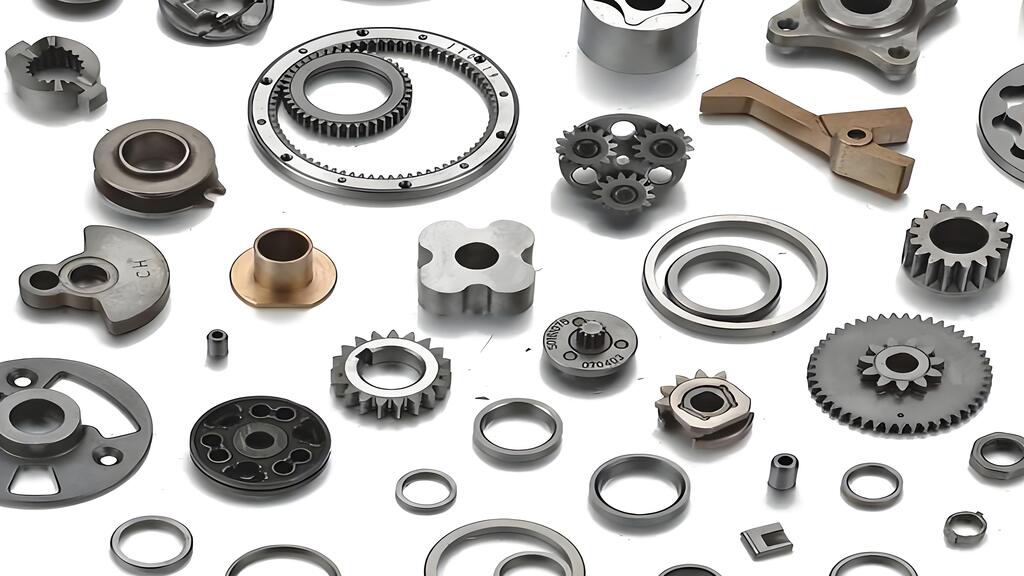
The automotive industry accounts for 60-80% of sintered mechanical parts. Common components include gears, bearings, timing sprockets and valve seats. Sintered titanium alloys serve surgical instruments, dental implants and orthopedic implants due to biocompatibility. Aerospace applications employ high-temperature alloys for turbine components and structural parts.
Secondary Processing Options
Sizing improves dimensional accuracy and achieves 50% higher precision than sintering alone. Impregnation fills pores with oil or resin to improve performance. Steam treatment at 510-570°C creates protective oxide layers and improves corrosion resistance. Plating adds metal layers to protect against corrosion and improve conductivity.
Conclusion
The press and sinter process transforms metal powders into high-performance components through controlled compaction and thermal bonding. Powder preparation and compaction contribute to the final part's mechanical properties, while sintering ensures dimensional accuracy. This manufacturing method delivers budget-friendly production of complex geometries with tailored porosity levels. Applications span automotive, aerospace and medical industries. Sintered metal parts provide reliable performance in these sectors. Secondary processing options further boost these components and make powder metallurgy an indispensable manufacturing technology for modern engineering applications.
FAQs
Q1. What is the press and sinter process in powder metallurgy? The press and sinter process is a manufacturing method that transforms metal powder into solid components through two main stages: compaction (pressing powder in a die at room temperature under high pressure) and sintering (heating the compacted part below its melting point to bond particles together). This process can produce parts ranging from 0.68 g to 6800 g and is ideal for moderate to high production volumes.
Q2. What temperature range is required for effective sintering of metal parts? Effective sintering typically occurs between 70-90% of a material's absolute melting point measured in Kelvin. For example, sintering at 1250°C can achieve oxide-free microstructure in certain materials, while lower temperatures around 1120°C may leave some residual oxygen. The exact temperature depends on the specific metal or alloy being processed.
Q3. What are the typical mechanical properties of sintered metal parts? Sintered ferrous powder metallurgy materials can achieve tensile strength up to 900 N/mm² as-sintered or 1200 N/mm² after heat treatment. Yield strength reaches 480 N/mm² as-sintered or 1200 N/mm² when heat treated. However, ductility remains relatively low, with elongation typically below 2%. These properties make sintered parts suitable for many structural applications.
Q4. Why do sintered metal parts have porosity and is it beneficial? Most sintered materials contain 5-15% porosity because the process doesn't achieve full densification. This porosity can be advantageous for specific applications—porous parts can absorb 12-30% oil by volume, creating self-lubricating bearings. Porous sintered structures are also used for filtration and fluid control systems in various industries.
Q5. What industries commonly use sintered metal parts? The automotive industry is the largest consumer, accounting for 60-80% of sintered mechanical parts, including gears, bushings, bearings, timing sprockets, and valve seats. Other major applications include medical devices (surgical instruments, dental and orthopedic implants using titanium alloys) and aerospace components (turbine parts and structural elements using high-temperature alloys).