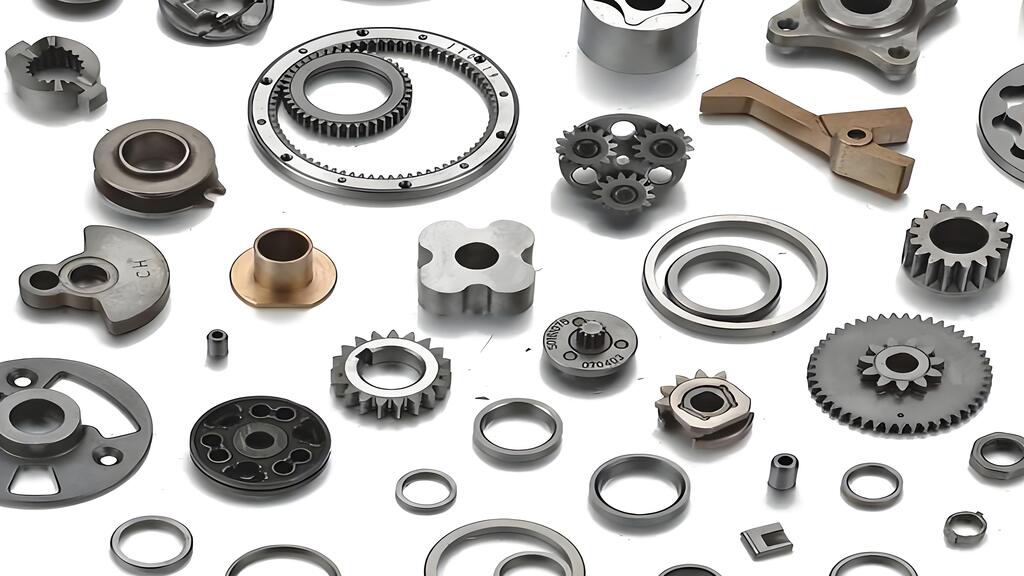


What Are Bearings?
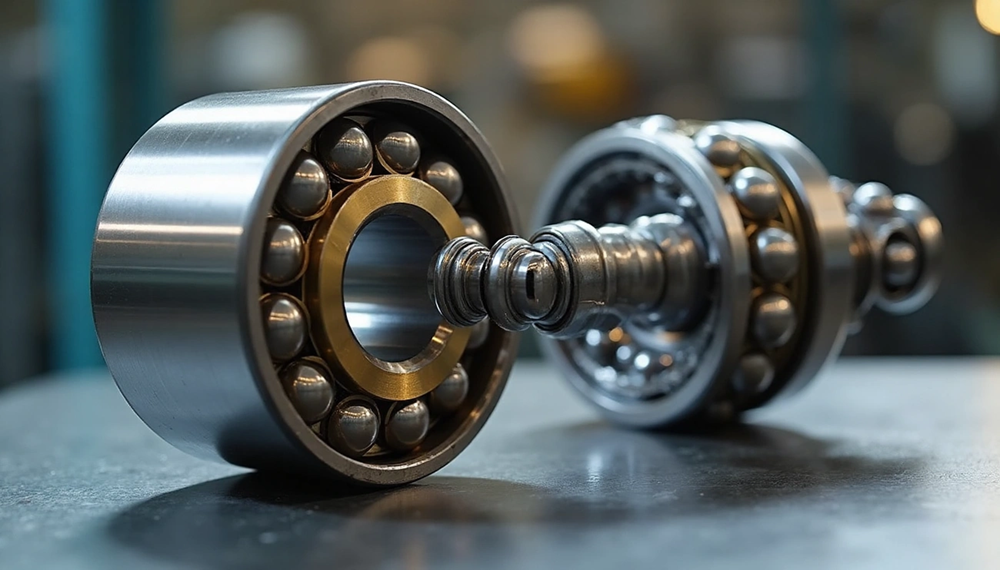
Bearings are everywhere around us. Any object that twists, turns, or moves likely has a bearing in it. These simple mechanical parts work silently as the hidden champions of modern machinery. A typical car needs about 100 to 150 bearings to function properly. You'll find bearings in everything - from toy race cars children play with to massive jet engines that spin 10,000 times per minute in temperatures above 200°C.
The bread and butter of the machine industry serves two main purposes: bearings help transfer motion by supporting and guiding rotating components, and they transmit forces. They also cut down friction significantly. The bearing's story began with Philip Vaughan's first patent in 1794, and Friedrich Fischer took it further by developing precision manufacturing in 1883. Since then, engineers have created different types of bearings to solve various mechanical challenges.
Ball bearings, roller bearings, and plain bearings that use rubbing contact surfaces each play unique roles in modern machinery. This complete guide shows you how bearings work and where they're used. These vital components deliver the precision, reliability, and durability needed everywhere - from high-speed trains cruising at 300km/h to everyday home appliances.
What Are Bearings Used For? Everyday and Industrial Applications
Bearings show up everywhere - from simple devices to complex systems. You might not notice them, but these components make motion possible in anything that spins, slides, or rotates. They're part of many industries and touch almost every part of our modern life.
Automotive: engines, wheels, transmissions
Cars wouldn't work without bearings as they're vital components that keep vehicle systems running smoothly. A typical car has at least 36 bearings, and most models use many more. These parts support everything that moves in the drivetrain and chassis systems.
Engine bearings help the crankshaft rotate and connect moving parts with minimal friction and wear. The transmission uses deep groove ball bearings, cylindrical roller bearings, and tapered roller bearings. These distribute loads evenly so gears mesh perfectly while handling forces from all directions.
Wheels need tapered roller bearings to handle the car's weight and manage forces when you brake or accelerate. You'll find bearings in steering systems, alternators, water pumps, and AC compressors - anywhere something needs to rotate.
Aerospace: jet engines and landing gear
Aerospace bearings just need to work in extreme conditions. Jet engine bearings run at temperatures above 200°C (400°F) and speeds over 10,000 RPm for turbine shafts. Some even hit 30,000 RPM in accessory drives. Wing control surface bearings must work reliably even at temperatures as low as -55°C (-67°F).
Landing gear uses different types of bearings that handle massive loads during takeoff, landing, and taxiing. These include tapered roller bearings, ball bearings, and roller bearings. Aircraft control surfaces like ailerons, elevators, and rudders need bearings for precise movement that keeps flights stable and responsive.
Home appliances: fans, fridges, washing machines
Your home has more bearings than you might think. The average American house has at least fifteen appliances that use them. These parts are what make many everyday devices work.
Washing machine's drum spins smoothly because of bearings, and your dryer works the same way. Your fridge uses bearings in its compressor motor and door hinges. Look around - ceiling fans, vacuum cleaners, blenders, food processors, air conditioners, and even kitchen drawers all need bearings to work.
Your electronics depend on bearings too. DVD players, gaming systems, laptops, and hard drives all use different types of bearings for their spinning parts. Without good bearings, these appliances would get noisy, slow down, or stop working completely.
Wind turbines and renewable energy systems
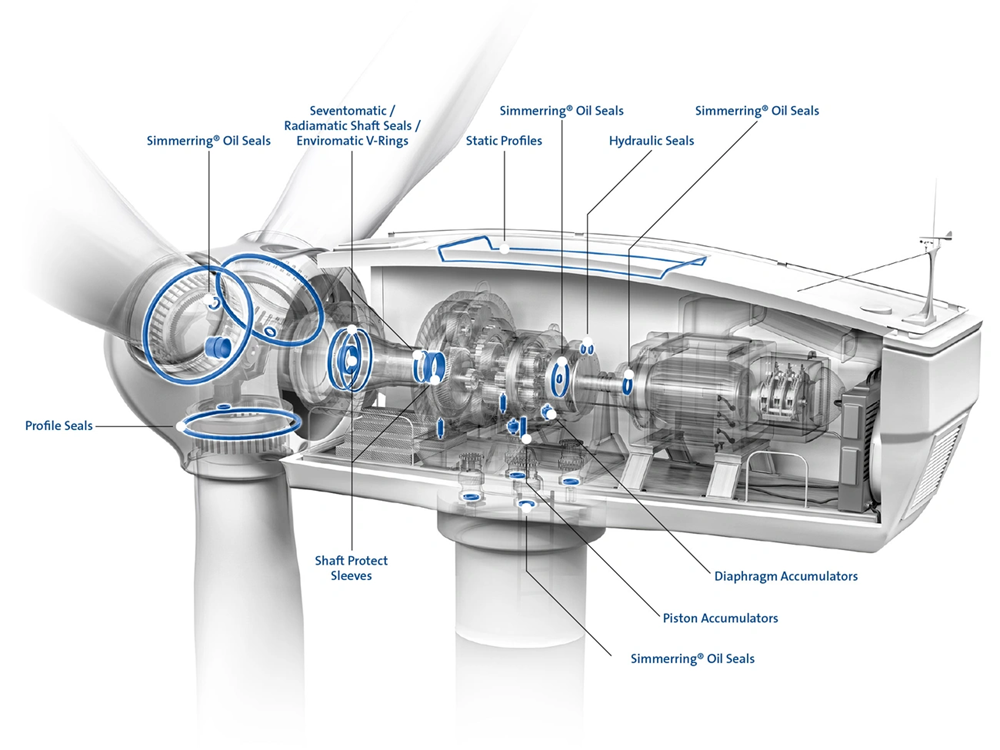
Wind turbines are some of the toughest tests for bearings. Modern turbines use several special bearing types throughout their structure, each built for specific loads.
Mainshaft bearings connect the rotor hub to the gearbox and handle big loads from wind forces. These are usually large spherical, tapered, or cylindrical roller bearings. The turbine's blades adjust their angle using pitch bearings, while yaw bearings let the whole turbine turn to face the wind.
The gearbox has various bearing types that manage forces and speeds while sending power from the rotor to the generator. Generator's bearings support the shaft's rotation while handling unique forces and loads. Together, these parts turn wind into electricity even in harsh conditions.
How Bearings Work: Structure, Motion, and Function
Bearings work through surprisingly simple design principles. Their core function lets parts move only in specific directions while reducing friction between moving components. Looking at how bearings work helps us understand why they're crucial in modern machinery.
Basic structure: rings, balls/rollers, cage
Four main components work together in most bearings. The inner ring connects to a shaft or axle, and the outer ring fits into a housing structure. Rolling elements—either balls or rollers—sit between these rings to help movement. A cage (also called a separator) keeps the rolling elements properly spaced so they don't bump into each other.
Engineers create bearing surfaces with very smooth finishes, especially the raceways where rolling elements move. This smoothness matters because contact forces between rolling elements and rings can reach pressures up to 300,000 psi (2GPa).
Bearings need proper lubrication to work well. Oil creates a tiny cushioning film between rolling elements and raceways, usually 0.00002 to 0.00004 inches thick. This microscopic layer makes bearings last longer by keeping metal surfaces from direct contact.
How motion is supported: rolling vs sliding
Bearings use two main ways to reduce friction: rolling and sliding. Rolling element bearings, which include ball and roller types, turn sliding friction into rolling friction. This change makes movement easier because rolling creates less resistance than sliding.
Plain bearings (sliding bearings) work differently by using rubbing surfaces with lubricant. Though they have more friction than rolling bearings, plain bearings work better for heavy loads, shock absorption, and quiet operation.
The difference in performance is clear. Rolling bearings start moving more easily because their rolling elements create smoother movement with less resistance. This makes them ideal when you need better efficiency and lower power loss.
Radial vs thrust bearings: load direction explained
Load direction determines which bearing works best. Forces on bearings come in two main types—radial and axial (thrust)—and many applications need support for both.
Radial loads push perpendicular to the shaft axis, often from component weight in horizontal machinery. These forces spread unevenly across rolling elements in a bell curve, with the strongest force right under the load point. Radial bearings handle these sideways forces.
Thrust (axial) loads push parallel to the shaft axis. These loads usually spread evenly across rolling elements, though off-center axial loads can create turning forces. Thrust bearings excel at managing these parallel forces.
Most applications combine both radial and axial loads. Engineers use special formulas for these cases: P = XFr + YFa. Here, P shows the equivalent dynamic bearing load, Fr shows the actual radial load, and Fa shows axial load. X and Y values change based on bearing type and force ratios.
These principles help engineers pick the right bearing for each job, which ensures machines run smoothly, reliably, and efficiently.
Types of Bearings: Choosing the Right One for the Job
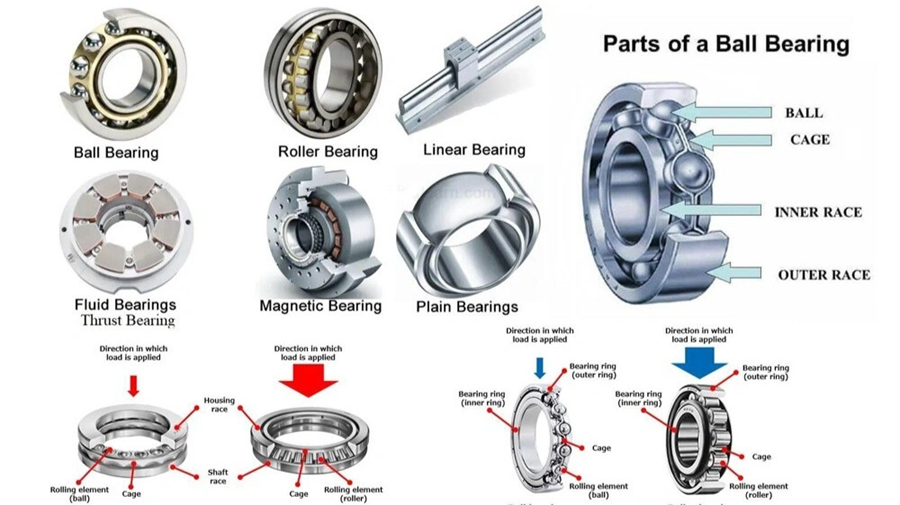
Choosing the right bearing means understanding what makes each type special. Different bearing designs work best in specific conditions and have their own strengths.
Deep groove ball bearings
Deep groove ball bearings are the most accessible bearing type in the market because they work well in many situations. These parts run smoothly with little friction and make very little noise or vibration, which lets them spin at high speeds. They can handle both radial and axial loads from any direction, which makes them highly flexible. Their simple design needs less maintenance than other bearing types.
You'll find these bearings in electric motors, washing machines, ventilators, and home appliances where smooth, reliable operation matters. They come in many forms - single row, double row, stainless steel, and shielded versions - which means they can fit almost any general use.
Tapered and cylindrical roller bearings
Tapered roller bearings have conical rollers set between angled raceways. This setup helps them handle big radial forces while supporting axial loads in one direction. These bearings work best in pairs to handle axial forces from both directions, which makes them perfect for car wheel hubs and transmissions.
Cylindrical roller bearings create a line contact between their rolling parts and raceways to spread out stress better. This design gives them impressive radial load capacity. While they mainly handle radial loads, some models can take on small axial forces too. Their parts come apart easily, which helps when you need to install or fix them in tight spots.
Needle and spherical roller bearings
Needle roller bearings use very thin cylindrical rollers that are three to ten times longer than they are wide. Though small, they can handle bigger loads than many ball bearings. Their slim design leaves room for larger shafts, which works great when space is tight. You'll see them in car transmissions, planetary gears, and connecting rods.
Spherical roller bearings use barrel-shaped rollers that work against a curved outer ring raceway. This design lets them adjust themselves, fixing misalignments between shaft and housing up to 0.15°. They can handle very heavy radial loads and big axial forces in both directions. These features make them ideal for heavy machinery, mining equipment, and wind turbines.
Sliding bearings and special environment bearings
Sliding bearings work differently from rolling bearings by using lubricated surfaces that touch directly. They work in three ways: boundary (surfaces touching), mixed film (partly separated), and full film (completely separated). Though they create more friction than rolling bearings, they shine in high-load, low-speed jobs that need stability and minimal upkeep.
Some bearings are built specifically for tough environments. Ceramic and stainless steel bearings resist corrosion, while hybrid ones mix ceramic balls with steel rings to work in hot or electrically charged settings. These special bearings keep things running smoothly in food processing, medical equipment, semiconductor manufacturing, and other challenging environments.
How to Select a Bearing: Engineering Considerations
Selecting the right bearing requires a thorough review of several engineering factors that affect performance and longevity. Engineers must analyze multiple variables to ensure the bearing works optimally under specific operating conditions.
Load type and direction
Load characteristics are the foundations of bearing selection. Roller bearings can handle heavier loads than the same-sized ball bearings. The primary types of load direction include:
- Radial loads (perpendicular to shaft axis)
- Axial loads (parallel to shaft axis)
- Combined loads (both radial and axial components)
The ratio between axial and radial components determines the best bearing type. Deep groove ball bearings work well for combined loads with light axial components. Bearings with larger contact angles, like angular contact or tapered roller bearings, become essential as axial loads increase. The contact angle relates directly to axial load capacity—higher angles mean greater capacity.
Speed and temperature limits
Operating temperature directly affects a bearing's speed capability. Product specifications list two important ratings: reference speed (based on thermal conditions) and limiting speed (based on mechanical limits).
Proper lubrication becomes vital as the bearing approaches its limiting speed. Ball bearings handle higher speeds than roller bearings because of lower friction. High-speed applications might need oil lubrication instead of grease.
Temperature limits stem from dimensional stability of components, cage materials, seal properties, and lubricant characteristics. High temperatures can break down lubricants and reduce viscosity, which might lead to metal-to-metal contact.
Lubrication and environmental conditions
A critical film (typically 0.00002 to 0.00004 inches thick) created by lubrication separates moving components. Viscosity plays a significant role in lubricant selection—insufficient viscosity prevents proper film formation, while excessive viscosity increases friction and wastes energy.
Environmental factors significantly affect bearing performance. Corrosion and accelerated wear result from moisture and humidity. Dust, dirt, and chemicals damage bearing surfaces and degrade lubricant quality. Bearings with specialized materials or sealed designs work best in harsh environments.
Fit, preload, and rigidity
Preload—a predetermined load applied to bearings—adds stiffness and precision. The benefits include better shaft guidance, less noise, and longer service life. Excessive preload increases friction and shortens bearing life.
Roller bearings provide more rigidity than ball bearings. Full complement bearings (without cages) are stiffer than caged equivalents. Back-to-back arrangements offer greater rigidity because of the longer distance between load centers
. The optimal preload force balances stiffness, bearing life, and operational reliability.
Common Bearing Failures and How to Prevent Them
Quality bearings are built to last, but they'll eventually fail without proper care and maintenance. You can extend bearing life and avoid pricey equipment downtime by knowing the warning signs, why it happens, and how to prevent issues.
Signs of bearing failure
Finding failing bearings early saves both time and money. The first sign that something's wrong usually comes from strange sounds. Squealing, grinding, or clicking noises often mean your bearings need lubrication. On top of that, too much vibration often points to contamination, misalignment, or lubricant breaking down.
Temperature changes are a vital warning sign. Well-lubricated bearings should run below 180°F (82°C). Any temperature above 250°F needs immediate attention. Your equipment needs an emergency shutdown if temperatures hit 300°F to prevent total failure.
A quick look can show blue or brown discoloration on balls and raceways that indicates lubricant breakdown. Leaking lubricant, weird wear patterns, or visible damage are signs that failure is coming soon.
Causes: contamination, misalignment, poor lubrication
Contamination leads to many of the early bearing failures. Tiny particles can do big damage - even ones as small as 5 microns substantially cut bearing life by causing abrasion and fatigue. The pressure between balls and raceways can hit 200,000 psi. This is a big deal as it means that bearings are surprisingly vulnerable to contamination, even with their hardened steel construction.
Misalignment spreads the load unevenly instead of distributing it across bearing surfaces. This speeds up surface fatigue and creates too much heat. Angular misalignment specifically puts stress on the edges, where only part of the bearing handles the load.
Lubrication issues are behind about 80% of bearing failures. Not enough lubrication, wrong lubricant choice, or breakdown from high temperatures all lead to early failure. The lubricant film - just 0.00002 to 0.00004 inches thick - creates needed separation between moving parts.
Preventive maintenance tips
Regular checks are the foundation of good bearing maintenance. You should watch for noise, vibration, temperature, and lubrication conditions regularly. Visual checks can spot leaks, discoloration, or unusual wear.
Good lubrication practices make bearings last much longer. Always use what the manufacturer recommends for lubricant type, amount, and when to replace it. If temperatures go above 70°C, change the lubricant twice as often for every 15°C temperature increase.
Controlling contamination needs several steps. Work areas, tools, and hands must stay clean during installation. Pick the right seals - you can use contact seals, non-contact labyrinth seals, or magnetic seals based on how you're using them. Cast housings might need oil-resistant sealing paint to keep particles out.
Installing bearings correctly prevents many failures. Keep them in original packaging until you're ready to install. Clean mating surfaces well and remove any burrs. Self-aligning bearings might work best where misalignment could be an issue.
Conclusion
Bearings stand as one of engineering's most basic components that power countless parts of our modern world. These precision-engineered parts work behind the scenes in everything from children's toys to massive wind turbines. They know how to reduce friction while supporting loads, which makes them vital in any system with rotation or linear motion.
Different bearing types serve specific purposes based on their unique designs. Ball bearings give you versatility and low friction, while roller variants work best under heavy loads. The right choice depends on load direction, speed needs, environmental conditions, and proper fit. Engineers must balance these factors to get the best performance and life span.
It also helps to know common failure patterns to prevent breakdowns. Most bearing failures come from dirt, misalignment, or poor lubrication - not from design flaws. The right installation steps, regular checks, and proper lubrication extend bearing life by a lot.
Your car, household appliances, and airplanes all run on dozens - maybe even hundreds - of bearings. These modest mechanical parts are the quiet heroes of our technological world. Their progress through better materials and manufacturing will shape machinery's future in any discipline. Bearings aren't just past engineering achievements - they're key parts of tomorrow's mechanical systems too.
Key Takeaways
Understanding bearings is crucial for engineers and anyone working with mechanical systems, as these components enable virtually all rotational motion in modern machinery.
• Bearings reduce friction by converting sliding motion to rolling motion, supporting loads while enabling smooth rotation in everything from car engines to wind turbines.
• Choose ball bearings for versatility and high speeds, roller bearings for heavy loads, and specialized types based on load direction and environmental conditions.
• Proper bearing selection requires evaluating load type, speed limits, temperature ranges, and environmental factors like contamination and moisture exposure.
• Prevent 80% of bearing failures through proper lubrication, contamination control, correct installation, and regular monitoring of noise, vibration, and temperature.
• Modern applications demand bearings that operate under extreme conditions—from jet engines at 200°C and 10,000+ RPM to precision electronics requiring minimal vibration.
The key to successful bearing implementation lies in matching the right bearing type to specific operating conditions while maintaining proper installation and maintenance practices throughout the component's service life.
FAQs
Q1. What is the primary function of bearings in mechanical systems? Bearings serve two key functions: they support and guide components that rotate relative to each other, and they transmit forces while significantly reducing friction. This enables smooth motion in a wide range of applications, from everyday appliances to complex industrial machinery.
Q2. How do I know if my bearings are failing? Signs of bearing failure include unusual noises (squealing, grinding, or clicking), excessive vibration, and increased operating temperatures. Visual inspection may reveal discoloration, leaking lubricant, or unusual wear patterns. If you notice any of these symptoms, it's important to investigate further to prevent potential equipment breakdown.
Q3. What are the main types of bearings and how do they differ? The main types include ball bearings, roller bearings, and plain bearings. Ball bearings are versatile and offer low friction, making them suitable for high-speed applications. Roller bearings excel at handling heavier loads. Plain bearings use sliding surfaces and are good for high-load, low-speed applications requiring stability.
Q4. How often should bearings be lubricated? Lubrication frequency depends on the specific application, operating conditions, and manufacturer recommendations. As a general rule, bearings operating at higher temperatures or speeds require more frequent lubrication. For temperatures exceeding 70°C, it's advisable to reduce the lubricant replenishment interval by half for every 15°C temperature increase.
Q5. What causes most bearing failures, and how can they be prevented? The majority of bearing failures (about 80%) are caused by contamination, misalignment, or inadequate lubrication. Prevention strategies include proper installation techniques, regular inspections, maintaining clean work environments, using appropriate sealing solutions, and following manufacturer guidelines for lubrication type and frequency. Implementing these practices can significantly extend bearing life and prevent costly equipment downtime.