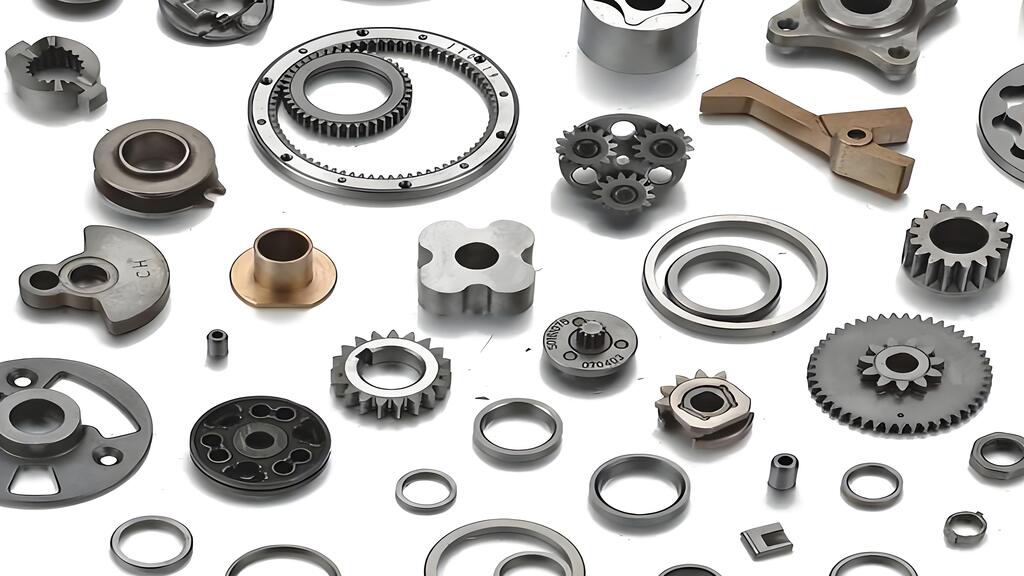


What Are MIM Parts? An Engineer's Guide to Metal Injection Molding
The MIM Manufacturing Process Explained
The Mim Manufacturing process uses four key stages that turn fine metal powders into complex, fully dense metal components.
Raw Material Preparation: Metal Powders and Binders
Mim Technology starts with fine metal powderthat measures less than 20µ in particle size. Manufacturers blend this powder with thermoplastic and wax binders at a specific ratio—about 60% metal powder to 40% binder by volume. Special equiPment like kneaders or shear roll extruders mixes these materials at high temperatures. The mixture cools and becomes granulated into free-flowing pellets called "feedstock," which becomes the raw material for injection molding.
Injection Molding: Creating the Green Part
The feedstock heats up to around 200°C and moves under high pressure into a mold cavity. This stage works like plastic injection molding but needs specialized equipment for metal-polymer mixtures. The molded component—called the "green part"—comes out of the mold after cooling. The part still has all its binder and measures about 20% larger than its final size to allow for shrinkage.
Debinding: Removing the Binder Material
The debinding stage removes most binder components while the part keeps its shape. You can choose from three methods: solvent debinding, thermal debinding, and catalytic debinding. BASF's catalytic process works up to 40 times faster than other methods. The part becomes semi-porous with connected channels after debinding and gets a new name: the "brown part".
Sintering: Transforming Powder into Solid Metal
The brown parts go into a controlled-atmosphere furnace where temperatures reach 85% of the metal's melting point. The remaining binder evaporates and metal particles fuse together, which removes all empty spaces. Parts shrink by 15-20% and become more than 97% dense. A typical sintering cycle runs for 15-20 hours and changes the porous brown part into a solid metal component that matches wrought materials' properties.
MIM Materials Selection and Properties
Material selection is the life-blood of successful MIM manufacturing. Metal powders come in many varieties to create high-performance components.
Ferrous alloys lead the pack in MIM production and make up almost half of all commercial uses. These materials include stainless steels (especially when you have 17-4 PH and 316L), low-alloy steels, and tool steels. It also uses tungsten alloys, hard materials like cemented carbides, and specialty metals such as titanium and molybdenum that make MIM more versatile.
Specific performance needs drive material choices. Stainless steel and titanium alloys work best when strength matters, while tungsten or nickel alloys provide better thermal stability. Stainless steel's protective oxide layer makes it perfect for components that face corrosive environments.
MIM materials maintain impressive integrity even though sintering affects their microstructure. Most MIM products reach about 98% of theoretical density and match the mechanical properties of their wrought counterparts. To cite an instance, MIM 17-4 PH stainless steel in H1025 condition typically hits a yield strength of 980 MPa.
Some important points need attention. Sintering can create coarser grain structures that might reduce ductility and tensile strength. The high vapor pressure of chromium compared to nickel and iron can cause surface evaporation during sintering, which affects stainless steel's corrosion resistance.
Solutions exist to tackle these challenges. Surface treatments and electrochemical processes help restore uniform surface chemistry, which boosts corrosion resistance and biocompatibility for medical applications.
Knowing how to customize material properties adds another advantage to MIM technology. Heat treatments can substantially change mechanical properties. MIM 17-4 PH stainless steel shows this well - its tensile strength ranges from 950 MPa in the sintered state to 1206 MPa after H900 heat treatment.
Material selection in MIM comes down to finding the right balance between required properties and processing considerations for the best component performance.
Common Metal Alloys Used in MIM Technology
The MIM process works with metal alloys of all types. We grouped these into four categories: ferrous alloys, tungsten alloys, hard materials, and special materials. Each type serves unique needs in different industries.
Ferrous alloys lead the MIM market, and stainless steel stands out as the top choice. Stainless steel 316L has excellent corrosion resistance and ductility, which makes it perfect for marine, medical, and food-grade applications. Another popular choice is stainless steel 17-4 PH, which delivers great strength and corrosion resistance with tensile strength reaching 950 MPa after sintering.
Material Density and Porosity Considerations
MIM parts reach 96-99% of theoretical density after sintering, which beats conventional powder metallurgy processes. The higher density comes from using finer powders that reduce porosity. So the physical properties match closely with wrought materials.
Porosity exists in all MIM parts, but manufacturers can control it through process settings. Temperature plays a big role in porosity and oxidation. Studies show that thermal debinding at 400°C creates less oxidation than at 500°C. Parts also show different porosity levels throughout - thin sections and areas far from the gate tend to be more porous.
Mechanical Properties of Finished MIM Parts
Finished MIM parts show different mechanical properties based on their alloy mix and how they're treated afterward. To cite an instance, see stainless steel 17-4 PH - its yield strength ranges from 730 MPa when sintered to 1089 MPa after H900 heat treatment.
Surface quality affects mechanical performance too. Research has shown that smoother surfaces relate to better ultimate tensile strength and yield strength in certain alloys. Porosity levels directly affect hardness distribution - readings vary from 188.7 HV in highly porous zones to 229 HV in areas with almost no porosity.
Some applications actually benefit from porosity. Controlled porosity is a great way to get better lubrication retention. Studies have shown a substantial reduction in friction coefficients when using paraffin-lubricated porous 17-4 PH specimens.
Quality Control in MIM Production
Quality control plays a vital role in MIM technology. It makes sure parts perform consistently across production runs. The quickest way to spot and fix problems is to watch the manufacturing process closely before they show up in final components.
Dimensional Accuracy and Tolerance Management
MIM parts can achieve tolerances of ±0.3% to ±0.5% of nominal dimensions - about ±0.003 inches (±0.076mm) per inch. You need to think about several factors to reach these precision levels. We machined the tooling with high-precision CNC to create molds that can handle ±0.005 inch or finer tolerances.
Material shrinkage during sintering affects dimensional accuracy a lot. The core team needs to control this shrinkage well. They do this by optimizing powder loading and keeping particle sizes uniform, which leads to excellent green part uniformity. The team must also watch injection pressure, temperature, and sintering conditions closely to keep dimensions stable.
Surface Finish Evaluation Methods
MIM components can achieve surface roughness values of Ra < 1.2 without any polishing. Teams usually use profilometry to measure roughness with high precision. This technique measures surface texture by moving a stylus across the component's surface.
A visual check comes first to spot surface defects like cracks, voids, or discolorations. Advanced techniques might follow based on what the application needs and how tight the tolerances must be.
Non-Destructive Testing for MIM Parts
NDT methods check quality without damaging the parts. The main techniques for MIM parts include:
- X-ray and CT scanning to find internal defects like porosity and inclusions
- Resonant Acoustic Method (NDT-RAM™) to check overall structural integrity
- Dye penetrant testing to spot surface breaks
- Dimensional checks using coordinate measuring machines
These methods help ensure MIM components meet specs and stay structurally sound throughout their service life.
Common Defects and Troubleshooting Strategies
MIM parts often face issues like cracking, slumping, warpage, and blistering. These problems usually come from debinding or sintering that isn't done right
. The team can prevent unwanted chemical reactions by controlling the atmosphere carefully and using slow heating rates when sintering begins
.
Problems like edge collapse and surface scratches during injection need better demolding conditions and the right lubricants
. The team can avoid porosity and voids by fine-tuning debinding and sintering processes to remove trapped gases.
Companies can keep quality costs down by using Statistical Process Control (SPC), regular quality checks, and automated inspection. These approaches help catch problems early in production, which cuts down defect rates and keeps part quality consistent.
Comparing MIM to Traditional Manufacturing
Choosing the right manufacturing process needs careful evaluation of technical requirements, production volumes, and economic factors. Traditional manufacturing methods have clear advantages and limitations compared to MIM technology.
MIM vs. CNC Machining: Cost and Capability Analysis
CNC machining cuts away material while MIM builds parts through an additive process that wastes less material. CNC machining gives better control over part properties and works with more materials. The process can get pricey for complex geometries. MIM shines at making intricate components that you can't machine easily. MIM costs less for medium to high-volume production because setup times don't depend much on part complexity.
MIM vs. Investment Casting: When to Choose Each
Investment casting is one of the oldest metalworking techniques. It uses ceramic molds that handle high temperatures, making it perfect for high-quality steel parts. Despite that, MIM allows more design complexity with thinner walls and tighter tolerances up to ±0.005″ per linear inch. MIM's surface roughness reaches 1 μm while investment casting achieves 3.2 μm. MIM works best for small parts under 20 grams and less than 100 mm long. Investment casting suits production runs under 1,000 parts.
MIM vs. Powder Metallurgy: Key Differences
Both processes start with metal powders but have big differences in particle characteristics. Regular powder metallurgy uses larger, irregular particles (50-100 μm). MIM needs finer, spherical powders (2-15 μm). This is a big deal as it means that MIM parts reach densities over 95% while powder metallurgy tops out at 92%. Regular powder metallurgy costs less for certain shapes but can't match MIM's ability to create undercut features. MIM materials cost more because of gas atomization and binder compounding. The technology delivers better mechanical properties and surface finishes for complex, high-precision components.
MIM technology finds its place across multiple industries that require complex, small metal components in medium to high volumes. Engineers think about MIM for parts weighing between 0.5-250 grams, though most applications stay within the 2-30 gram range.
Aerospace and automotive sectors employ MIM parts for fuel injectors, turbocharger components, and sensor housings where precision and material performance matter most. The medical industry depends on MIM to create surgical instruments, orthopedic implants, and dental components that need biocompatibility and complex geometries.
Consumer electronics emerge as another vital application area. MIM technology produces smartphone components, smartwatch parts, and camera mechanisms that just need miniaturization yet deliver resilient performance.
Engineers should evaluate several key factors before choosing MIM as a manufacturing option:
- Production becomes economically viable at 10,000+ parts annually
- Part complexity justifies higher tooling costs (ranging from $20,000-$150,000)
- Material requirements must match available MIM alloys
- Design features should employ MIM capabilities while avoiding limitations
MIM manufacturing's economics become more attractive as production volumes rise. Automotive components produced in quantities that exceed 100,000 units can achieve cost savings of 20-50% compared to machining or investment casting.
MIM technology evolves continuously with innovations in material science and processing techniques. Advancements in nano-scale powders and multi-material capabilities expand application possibilities. The integration with additive manufacturing principles creates hybrid approaches that maintain MIM's density advantages while reducing tooling requirements.
MIM parts stand as a powerful manufacturing solution in the modern engineer's toolkit. They're neither a universal solution nor a specialized niche process, but rather a valuable option for specific design requirements where traditional methods prove either technically inadequate or economically prohibitive.
FAQs
Q1. What is Metal Injection Molding (MIM) and how does it work?
Metal Injection Molding is a manufacturing process that combines fine metal powders with binders to create complex metal parts. The mixture is injected into a mold, the binder is removed, and the part is sintered to achieve a dense metal component with properties similar to traditionally manufactured parts.
Q2. What are the advantages of using MIM technology?
MIM offers several benefits, including the ability to produce complex geometries, high precision, cost-effectiveness for medium to high-volume production, and material versatility. It can achieve tight tolerances and smooth surface finishes while being more economical than traditional manufacturing methods for intricate parts.
Q3. In which industries are MIM parts commonly used?
MIM parts are widely used in aerospace, automotive, medical, consumer electronics, and defense industries. They are particularly suitable for producing components like fuel injectors, surgical instruments, smartphone parts, and other small, complex metal components requiring high precision.
Q4. How does MIM compare to CNC machining and investment casting?
MIM is more cost-effective than CNC machining for complex geometries and medium to high-volume production. Compared to investment casting, MIM allows for greater design complexity, thinner wall sections, and tighter tolerances, making it ideal for small, intricate parts under 20 grams.
Q5. What are the typical material properties of MIM parts?
MIM parts can achieve up to 99.5% of theoretical density, rivaling traditionally manufactured components. They offer mechanical properties comparable to wrought materials, with the ability to customize properties through heat treatments. MIM parts typically have a surface roughness of Ra < 1.2 μm and can achieve tolerances of ±0.3% to ±0.5% of nominal dimensions.