


Introduction
For OEMs balancing tight tolerances, high volumes, and cost pressure, sinter metal parts have become a practical manufacturing choice rather than a niche option. China’s Powder Metallurgy sector now offers advanced compaction, consistent quality control, and strong economies of scale, making it possible to produce complex components with competitive pricing and reliable performance. This article explains how custom sinter metal manufacturing works, where the process delivers the most value, and what to evaluate when selecting a supplier for precision parts, material consistency, and long-term production stability.
Why Choose a Custom Sinter Metal Parts Manufacturer in China
Sourcing custom sinter metal parts from China has evolved well beyond the old "cheap but risky" stereotype. Today, it is a strategic play for OEMs looking to balance aggressive scaling with tight engineering specifications. The powder metallurgy(Pm) sector in China has matured significantly, integrating advanced automation and imported compaction presses.
For buyers, this means accessing a manufacturing ecosystem that routinely delivers 20% to 40% cost reductions over domestic suppliers without compromising the metallurgical integrity of the components. When you need complex geometries produced in high volumes, partnering with the right Chinese manufacturer can transform your supply chain economics.
How custom sinter metal parts support cost and scale
The powder metallurgy process is known as a net-shape or near-net-shape technology. This means buyers achieve material utilization rates pushing 95% or higher, which is a significant advantage when raw metal costs are volatile. Manufacturers in China leverage this inherent efficiency alongside massive economies of scale.
Whether a project calls for an initial rollout of 10,000 pieces or an annual volume of three million structural gears, the infrastructure is built to absorb the volume. Because sinter metal relies on reusable tooling rather than continuous machine time per part, scaling up output simply means running the press longer, keeping the marginal cost per unit incredibly low.
Which buyer priorities drive supplier selection
Savvy procurement teams are no longer just chasing the lowest price per piece. They prioritize suppliers who can prove robust intellectual property protection, consistent dimensional control, and ironclad supply chain reliability.
Buyers know that a cheap component is worse than useless if it causes an assembly line shutdown due to out-of-spec dimensions. Therefore, the priority shifts toward finding a factory that communicates transparently, offers dedicated English-speaking project managers, and treats quality assurance as a baseline expectation rather than a premium add-on.
What Buyers Should Know About Sinter Metal Processes and Materials
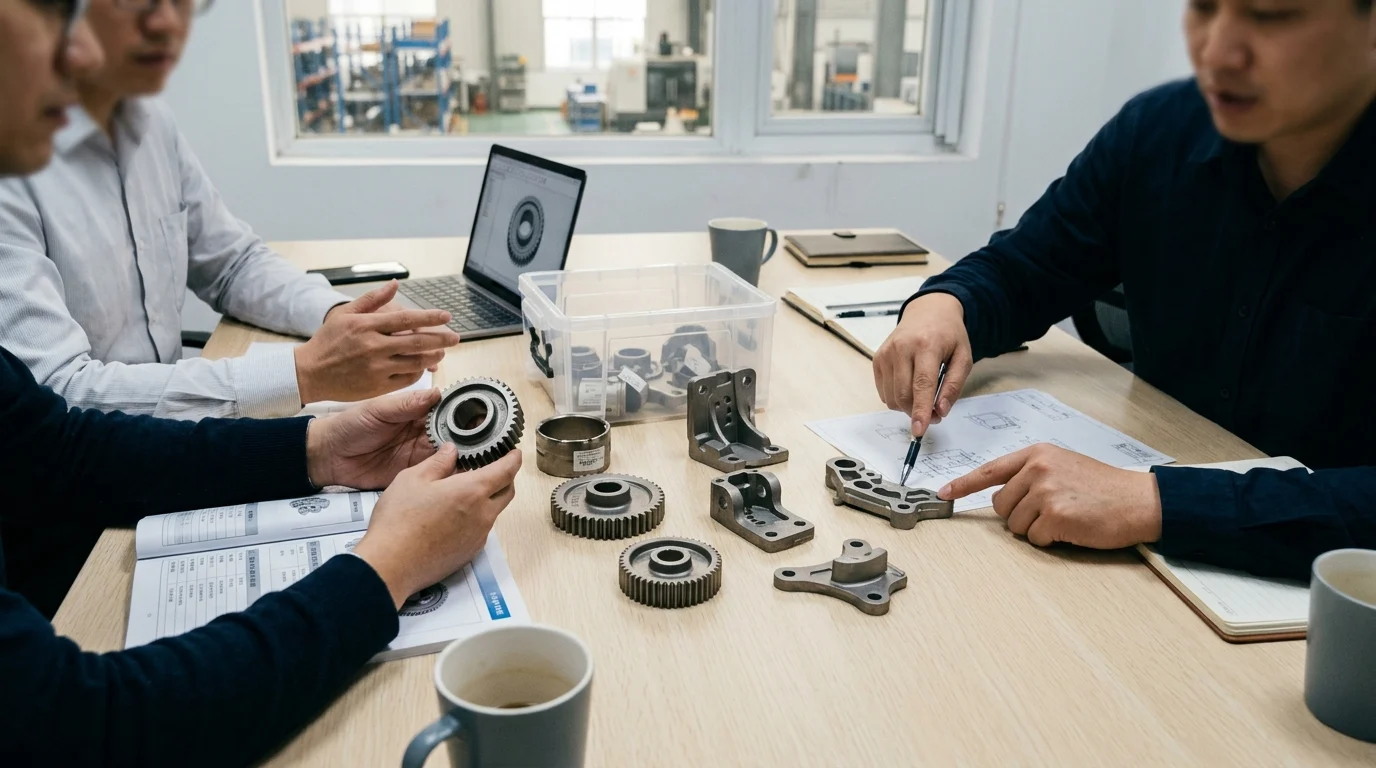
Getting the best results from a custom sinter metal parts manufacturer requires a solid grasp of how the process works. Powder metallurgy is a distinct science that balances particle sizes, compaction forces, and thermal dynamics. Understanding these variables helps buyers set realistic expectations for what the process can and cannot achieve.
How sinter metal parts are manufactured
The journey of a sinter metal part starts in the blending room, where elemental or pre-alloyed metal powders are mixed with specialized lubricants. From there, the powder feeds into a precision die and is compacted under massive pressure—typically ranging from 20 to 50 tons per square inch.
This creates a "green part" that holds its shape but is highly brittle. The real transformation happens in the sintering furnace. Passed through a controlled atmosphere at temperatures usually between 1100°C and 1300°C, the powder particles metallurgically bond together, fusing into a solid, durable component without ever reaching a full liquid melting point.
Which materials, density targets, tolerances, and surface options are available
The primary advantage of custom sinter metal lies in its versatility. Engineers can dial in the exact material properties required for specific applications. Common choices include iron-copper blends for general structural parts, 316L stainless steel for corrosion resistance, and bronze for self-lubricating bearings. Depending on the application, density targets usually sit between 6.4 and 7.2 g/cm³, with higher densities offering greater tensile strength.
Tolerances straight out of the furnace typically hit IT7 to IT8 standards, which is highly accurate for most mechanical applications. If a specific finish or extra wear resistance is needed, surface options like steam treating, black oxide, or zinc plating are readily available.
| Material Grade | Typical Density (g/cm³) | Tensile Strength (MPa) | Common Applications |
|---|---|---|---|
| Iron-Copper (FC-0208) | 6.4 - 6.8 | 250 - 400 | Structural gears, sprockets |
| Stainless Steel (316L) | 6.6 - 7.0 | 300 - 450 | Medical devices, marine parts |
| Bronze (CT-1000) | 6.8 - 7.2 | 100 - 150 | Self-lubricating bearings |
How sinter metal compares with machining and casting
When comparing sinter metal to traditional CNC machining or casting, the differences become clear. Machining a complex gear from a solid billet might result in 50% of the material ending up as scrap chips. Sinter metal eliminates that waste.
Compared to casting, powder metallurgy offers far superior dimensional control and avoids the unpredictable internal voids and porosity issues that plague cast parts. While machining wins on absolute ultra-tight tolerances and casting wins on massive part sizes, sinter metal dominates the middle ground: complex, palm-sized parts produced in high volumes.
How to Evaluate a China Sinter Metal Manufacturer
Finding a factory on a sourcing platform is the easy part; finding a truly capable partner requires thorough due diligence. Evaluating a custom sinter metal parts manufacturer in China means looking past glossy marketing brochures and digging straight into their quality management systems and engineering floor.
Which quality controls and testing methods matter
A top-tier manufacturer will not rely on visual inspections alone. Buyers should look for evidence of Coordinate Measuring Machines (CMM) for complex geometries, dedicated gear testers for sprockets or gears, and rigorous density checks using the Archimedes method.
Ask about their defect tracking. A reliable factory should aim for defect rates well below 50 PPM (parts per million). If they cannot articulate how they monitor batch-to-batch variations in powder flow or compaction weight, that is a major red flag.
How certifications, traceability, and documentation support compliance
Certifications establish a baseline of trust. ISO 9001 is standard, but for the automotive or heavy equipment sectors, look for IATF 16949 certification, which guarantees a much stricter quality management framework.
Beyond the certificates on the wall, ask about traceability. A great supplier can trace a finished gear back to the specific lot of metal powder used, the exact furnace temperature profile on the day of sintering, and the operator who ran the press. This level of documentation is critical for compliance and for isolating issues if a field failure occurs.
Which factory questions reveal engineering and tooling strength
The strength of a sinter metal supplier relies heavily on their tooling capabilities. Ask them directly: "Do you design and cut your own dies in-house?" Factories with in-house wire EDM and CNC tooling centers can iterate much faster and maintain their tools better than those who outsource.
Buyers should also ask about tool life expectancy. A well-made carbide tool should easily last for 100,000 to 200,000 shots before requiring significant maintenance. Understanding how a supplier handles tooling wear and replacement prevents unexpected dimensional drift during production.
What Drives Cost, Lead Time, and Logistics
Nobody likes surprises when it comes to budgets or launch dates. Getting a handle on the real drivers of cost, lead time, and shipping logistics is essential for a smooth powder metallurgy project. Because the process is tooling-dependent, the upfront dynamics differ from buying off-the-shelf components.
How tooling, materials, secondary operations, and MOQ affect cost
The initial hurdle is tooling. Depending on complexity, a custom die set can run anywhere from $2,000 to $10,000. While this is cheaper than plastic injection molding, it still requires volume to amortize the cost. This is why most manufacturers enforce a Minimum Order Quantity (MOQ) of 5,000 to 10,000 pieces.
Material choice also dictates price, with standard iron powders being highly economical while custom stainless blends drive costs up. Finally, secondary operations—like resin impregnation to seal pores, CNC tapping for threads, or specialized heat treatments—will add cents to the unit cost and should be scrutinized during the quoting phase.
How to manage sampling, design revisions, and production timelines
Patience is required during the initial phases. T1 (first article) samples usually take 3 to 5 weeks to produce because the tooling must be designed, cut, and tested. Once samples are received, rapid evaluation is crucial.
If design revisions are needed, tweaking the tooling can add another 1 to 2 weeks. However, once the golden sample is approved, mass production is impressively fast. Most factories can churn out tens of thousands of parts and have them ready to ship in just 4 to 6 weeks.
How China sourcing compares with local and regional options
Comparing a Chinese supplier to a local Western manufacturer comes down to a trade-off between unit cost and logistics speed. Local suppliers offer faster shipping and easier communication across time zones, but often at a steep premium.
China sourcing provides aggressive unit pricing and inexpensive tooling, but buyers must factor 4 to 6 weeks of ocean freight into their inventory planning.
| Sourcing Factor | China Sinter Metal Manufacturer | Local/Western Manufacturer |
|---|---|---|
| Tooling Costs | $2,000 - $6,000 (Typical) | $6,000 - $15,000+ (Typical) |
| Sampling Lead Time | 3 to 5 weeks | 4 to 8 weeks |
| Mass Production Cost | Highly competitive (Baseline) | Often 30-50% higher |
| Logistics Transit | 4 to 6 weeks (Ocean Freight) | 1 to 5 days (Domestic Trucking) |
How OEMs Should Choose the Right Custom Sinter Metal Partner
Choosing who will manufacture your custom sinter metal parts is a decision that impacts product performance and the company's bottom line for years. OEMs need a framework to filter out the noise and select a partner that aligns with their specific engineering and business goals.
Which criteria separate a transactional supplier from a long-term partner
A transactional supplier takes a CAD file, quotes the print exactly as drawn, and waits for a purchase order. A true manufacturing partner pushes back. They will suggest Design for Manufacturing (DFM) tweaks—like modifying a sharp internal corner or adjusting a compaction angle—to make the part easier to press.
These seemingly minor DFM improvements can easily shave 10% to 15% off unit costs and drastically reduce the scrap rate. Long-term partners also invest in understanding the end application, allowing them to recommend alternative powder blends that might perform better or cost less.
What final selection framework helps match precision, volume, and risk
To make the final call, build a selection matrix based on precision, volume, and risk. Does the factory have the tonnage capacity to meet peak volume demands? Do their tolerance capabilities match the drawings without requiring expensive secondary machining?
Assess their financial stability and communication style to gauge risk. A supplier might have the best presses in the world, but if their engineering team cannot clearly communicate regarding a design revision, the resulting delays will wipe out any unit cost savings. Balance these three pillars to secure a custom sinter metal manufacturer equipped to fuel long-term growth.
Key Takeaways
- The most important conclusions and rationale for Sinter Metal
- Specs, compliance, and risk checks worth validating before you commit
- Practical next steps and caveats readers can apply immediately
Frequently Asked Questions
What parts are best suited for custom sinter metal manufacturing?
High-volume, near-net-shape parts like gears, sprockets, bushings, and structural components are ideal. It works best when you need repeatable dimensions and lower unit cost.
What materials can JHPIM supply for sintered metal parts?
Common options include iron-copper blends, 316L stainless steel, and bronze. Material choice depends on your needs for strength, corrosion resistance, or self-lubrication.
What tolerances can sinter metal parts typically achieve?
Standard sintered parts often reach IT7 to IT8 level tolerances. If tighter control is needed, secondary sizing or machining can be added.
How much cost savings can sourcing sinter metal parts from China provide?
Many OEM buyers see about 20% to 40% cost reduction versus domestic supply. Savings are strongest on medium- to high-volume production runs.
What surface treatments are available for sintered metal parts?
Typical options include steam treating, black oxide, and zinc plating. These help improve wear resistance, corrosion protection, or appearance.