


Introduction
For high-volume Metal Parts, choosing a Metal Injection Molding Manufacturer affects far more than unit price. MIM can deliver complex geometries, tight tolerances, and efficient scale, but only when the supplier can control feedstock consistency, tooling accuracy, debinding, sintering, and quality verification across large production runs. The wrong partner can introduce scrap, dimensional variation, missed delivery targets, and costly supply chain disruptions as demand grows. This article explains the practical criteria that separate a dependable manufacturer from a risky one, including technical capability, process control, capacity, quality systems, and communication, so you can evaluate suppliers with clearer benchmarks before committing to long-term production.
Why the Right Metal Injection Molding Manufacturer Matters
Selecting a metal injection molding manufactureris a critical strategic decision for companies requiring complex, high-volume metal components. Metal Injection Molding (MIM) combines the design flexibility of plastic injection molding with the structural integrity of wrought metals, making it ideal for producing intricate parts at scale.
However, the process is highly sensitive to variations in feedstock, tooling precision, and thermal management. A misstep in selecting a manufacturing partner can lead to cascading failures in the supply chain, particularly when production volumes scale beyond 100,000 units annually.
Cost, capacity, and quality risks
The production of MIM components involves significant upfront capital and complex processing parameters. Tooling costs for high-volume production molds typically range from $10,000 to $50,000, representing a substantial initial investment. If a manufacturer lacks the capacity to scale operations or fails to maintain rigorous process controls, buyers face severe cost overruns and delays.
Quality risks in MIM are particularly acute during the debinding and sintering phases, where parts can experience up to 20% volumetric shrinkage. Inexperienced manufacturers may struggle to control this shrinkage uniformly, leading to dimensional warping, internal voids, or unacceptable surface defects that drive scrap rates well above the industry standard of 2% to 3%.
Long-term sourcing impact
The implications of choosing a metal injection molding manufacturer extend far beyond the initial purchase order. MIM molds are often proprietary or customized to a specific manufacturer's equipment and feedstock formulation. Transferring a mold to a new supplier due to performance issues can incur re-validation costs of $5,000 to $15,000 and disrupt production for 12 to 16 weeks.
A reliable manufacturer ensures long-term stability by maintaining tooling to achieve a lifespan of 300,000 to 1,000,000 shots. Furthermore, a stable partnership allows for continuous improvement initiatives, yielding progressive cost reductions and consistent component quality over the product's entire lifecycle.
Technical Capabilities to Evaluate
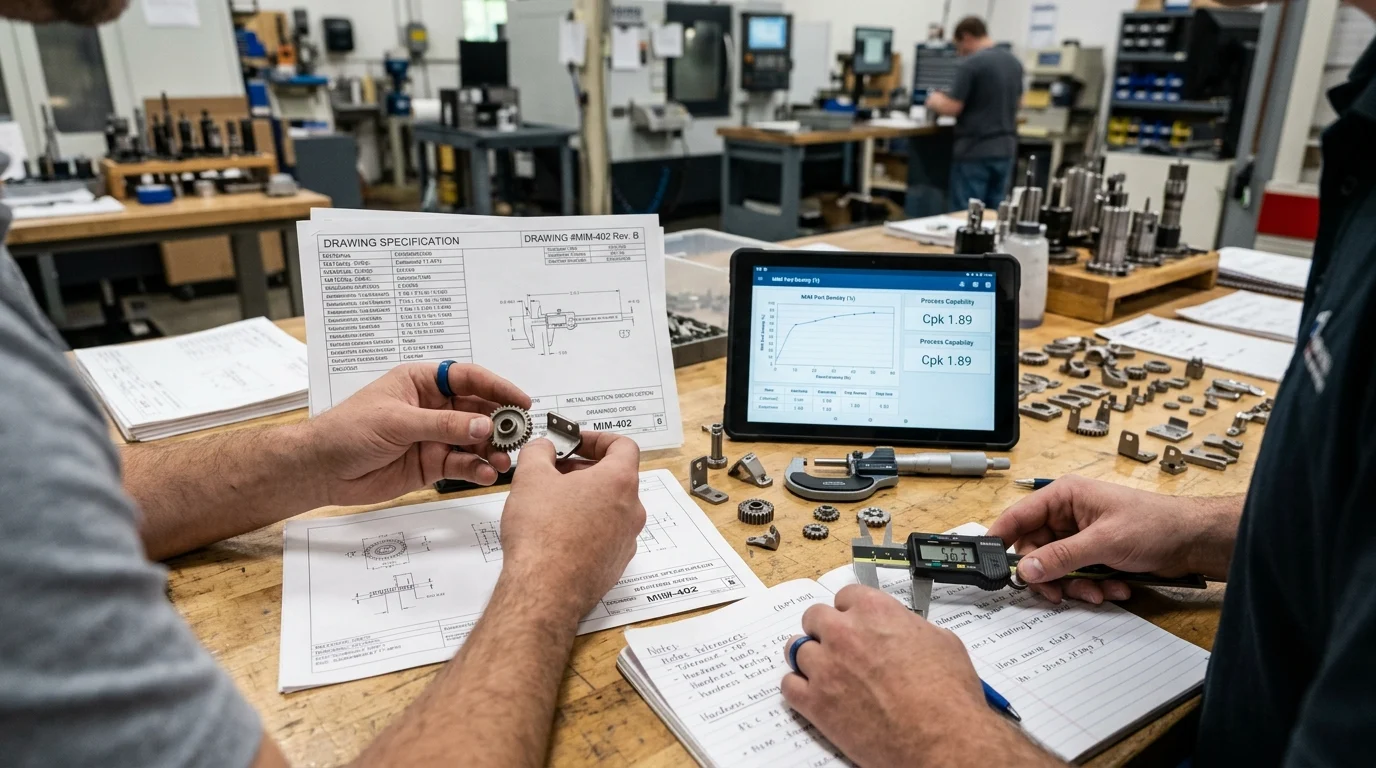
Evaluating a manufacturer's technical capabilities requires a deep dive into their engineering resources and production equipment. A competent facility must demonstrate mastery over the entire MIM workflow, from feedstock preparation to post-sintering secondary operations.
Materials, tolerances, finishes, and part geometry
A premier metal injection molding manufacturer should offer a robust portfolio of standard and custom alloys. Common materials include stainless steels, low-alloy steels, and titanium, each requiring specific handling and processing parameters. The manufacturer must be capable of achieving standard dimensional tolerances of ±0.3% to ±0.5% of the nominal dimension, with the ability to hold tighter tolerances through secondary machining if required.
Part geometry limitations also serve as a critical evaluation metric. While MIM excels at complexity, manufacturers must provide design-for-manufacturing (DFM) feedback to optimize wall thicknesses, ideally ranging from 0.5mm to 5.0mm to ensure uniform debinding and sintering.
| Material Grade | Typical Application | Minimum Sintered Density | Ultimate Tensile Strength (MPa) |
|---|---|---|---|
| 316L Stainless Steel | Medical, Marine | > 96% | 520 |
| 17-4 PH Stainless Steel | Aerospace, Firearms | > 97% | 1150 (Heat Treated) |
| MIM 4605 Low Alloy | Automotive, Industrial | > 95% | 1600 (Heat Treated) |
| Ti-6Al-4V | Aerospace, Medical Implants | > 96% | 850 |
Tooling, process control, debinding, and sintering
Tooling design in MIM is uniquely challenging due to the necessity of calculating precise shrink rates. Manufacturers must utilize advanced mold flow analysis to design tooling that minimizes gate vestige and prevents parting line flash. Once molded, the "green" parts undergo debinding to remove the primary polymer binders. Manufacturers may employ catalytic, thermal, or solvent debinding methods, each impacting the structural integrity of the resulting "brown" part.
Sintering is the most critical phase, requiring highly controlled atmosphere furnaces capable of reaching temperatures up to 1400°C in vacuum, hydrogen, or argon environments. The manufacturer must demonstrate stringent process control over thermal profiling to ensure parts achieve final theoretical densities of 95% to 99% without distortion or metallurgical degradation.
How to Compare Manufacturer Options
With technical baseline requirements established, the focus shifts to systematically comparing potential suppliers. This phase relies on objective data, quality management documentation, and structured evaluation frameworks to separate tier-one manufacturers from less capable vendors.
Certifications, traceability, and validation
Quality assurance in metal injection molding demands rigorous documentation and strict adherence to international standards. At a minimum, a reliable manufacturer must hold an active ISO 9001 certification. Depending on the target industry, specialized certifications such as IATF 16949 for automotive applications or ISO 13485 for medical devices may be non-negotiable prerequisites.
Traceability is equally paramount. The manufacturer must maintain unbroken lot traceability from the incoming raw powder and binder batches through to the final sintered and packaged components. Advanced suppliers will also offer comprehensive validation protocols, including Installation Qualification (IQ), Operational Qualification (OQ), and Performance Qualification (PQ), to guarantee that the manufacturing process consistently yields parts meeting a Cpk (Process Capability Index) of 1.33 or higher.
Supplier comparison criteria
To effectively compare multiple metal injection molding manufacturers, procurement teams should utilize a standardized evaluation matrix. This approach removes subjective bias and highlights areas of operational risk. Key performance indicators (KPIs) should be weighted according to the specific needs of the project, such as precision, volume, or speed to market.
Below is a recommended framework for comparing MIM suppliers across critical operational metrics:
| Evaluation Criteria | Industry Benchmark / Minimum Threshold | Strategic Importance (Weight) |
|---|---|---|
| Quality Defect Rate (PPM) | < 500 Parts Per Million | High (35%) |
| On-Time Delivery (OTD) | > 95% Consistently | High (25%) |
| Production Capacity Utilization | 60% to 80% (Leaves room for scaling) | Medium (20%) |
| Engineering Response Time | < 48 Hours for DFM/RFQ | Medium (10%) |
| Financial Current Ratio | > 1.2 (Indicates financial health) | Low/Medium (10%) |
Commercial and Logistics Factors
Technical prowess and quality certifications must be balanced against commercial realities. High-volume production economics are dictated by complex logistical networks, inventory carrying costs, and regional economic factors that significantly influence the final landed cost of the components.
Total cost of ownership
Evaluating the total cost of ownership (TCO) requires looking beyond the quoted piece price. Direct costs include tooling, raw materials, and processing, but indirect costs often dictate the true financial viability of a partnership. These include freight, import duties, packaging, and the internal administrative cost of managing the supplier relationship.
Minimum Order Quantities (MOQs) also play a major role in TCO. For high-volume MIM production, manufacturers typically require MOQs ranging from 10,000 to 50,000 units per run to absorb the setup costs of continuous sintering furnaces. Buyers must calculate their inventory holding costs against the piece-price discounts offered at higher volume tiers, ensuring that working capital is not unnecessarily tied up in excess stock.
Domestic vs offshore sourcing
The decision between domestic and offshore sourcing involves a complex trade-off between unit cost, lead time, and supply chain resilience. Offshore manufacturers, particularly in Asia, often provide a 20% to 40% reduction in piece price and tooling costs due to lower labor and overhead expenses. However, this cost advantage can be eroded by extended transit times of 8 to 12 weeks for ocean freight, higher inventory pipeline requirements, and potential geopolitical tariffs.
Conversely, domestic sourcing offers shorter supply chains, simplified communication, and stronger intellectual property protection. Lead times for domestic production runs can often be compressed to 4 to 6 weeks. Companies must assess their product lifecycle, demand volatility, and IP sensitivity to determine which geographic strategy aligns best with their risk tolerance and margin requirements.
How to Select a Reliable Manufacturer
The final selection of a metal injection molding manufacturer is the culmination of thorough research, technical auditing, and strategic alignment. Executing a structured qualification process mitigates risk and establishes a foundation for a successful, high-volume production partnership.
Step-by-step qualification process
The qualification process should begin with a Request for Information (RFI) and the execution of a Non-Disclosure Agreement (NDA) to protect proprietary designs. Following this, a detailed Request for Quote (RFQ) is issued, requiring the manufacturer to provide a comprehensive breakdown of tooling, piece price, and lead times.
Once a primary candidate is identified, the buyer should mandate a First Article Inspection (FAI) based on a pilot run of 500 to 1,000 pieces. This pilot run tests the manufacturer's ability to transition from prototype tooling to high-volume production parameters. Only after the FAI samples pass rigorous dimensional and metallurgical testing should the buyer authorize full-scale production.
Final decision criteria
The final decision criteria must encompass technical capability, commercial viability, and the intangible elements of the supplier relationship. A reliable manufacturer acts as an extension of the buyer's engineering team, demonstrating proactive communication and a willingness to invest in continuous improvement.
Ultimately, the chosen partner must possess the financial stability to weather market fluctuations and the scalable infrastructure to support future growth. By rigorously evaluating tolerances, process controls, total cost of ownership, and quality validation frameworks, organizations can confidently secure a metal injection molding manufacturer capable of delivering precision components reliably over the long term.
Key Takeaways
- The most important conclusions and rationale for Metal Injection Molding Manufacturer
- Specs, compliance, and risk checks worth validating before you commit
- Practical next steps and caveats readers can apply immediately
Frequently Asked Questions
What should I ask a metal injection molding manufacturer before starting high-volume production?
Ask about annual capacity, alloy options, tooling ownership, traceability, furnace atmosphere control, and typical scrap rates. Also request DFM support and validation data for similar MIM parts.
How can I verify a MIM manufacturer’s quality control?
Review certifications, inspection methods, lot traceability, density results, and process records for debinding and sintering. A reliable supplier should share validation reports and dimensional capability data.
What tolerances are realistic for metal injection molded parts?
Typical MIM tolerances are about ±0.3% to ±0.5% of nominal dimension. Tighter tolerances usually need secondary machining, so confirm this early during DFM review.
Why is tooling experience important in choosing a metal injection molding manufacturer?
MIM tooling must account for shrinkage, gate design, and parting lines. Experienced manufacturers reduce warping, flash, and rework, which is critical when scaling to 100,000+ parts per year.
How can JHPIM help reduce sourcing risk for MIM parts?
JHPIM can support material selection, DFM optimization, tooling planning, and stable process control across molding, debinding, and sintering. This helps improve consistency and lower transfer risk later.