


Introduction
When heat, abrasion, and corrosive atmospheres push conventional materials past their limits, ceramic rods become a practical solution for maintaining stability and performance. This article explains why alumina and zirconia rods are widely used in high-temperature industrial systems, how their thermal, mechanical, and chemical properties differ, and which applications benefit most from each material. Readers will gain a clear understanding of selection factors such as operating temperature, insulation needs, wear resistance, and dimensional stability, providing a solid foundation for evaluating ceramic rods in furnaces, kilns, semiconductor equiPment, and other demanding environments.
Why Ceramic Rods Matter in High-Temperature Applications
Industrial manufacturing processes frequently operate in extreme environments where conventional metals and polymers fail. In these high-stress settings, ceramic rods provide critical structural integrity, thermal insulation, and chemical resistance. Advanced technical ceramics are engineered to withstand continuous exposure to extreme heat, mechanical wear, and corrosive atmospheres, making them indispensable in metallurgy, semiconductor manufacturing, and aerospace engineering.
The adoption of advanced ceramics is driven by their exceptional physical properties, particularly their high melting points and dimensional stability. While standard steel alloys begin to lose structural integrity around 800°C to 1,000°C, industrial ceramic rods routinely operate at temperatures exceeding 1,500°C, ensuring that production lines maintain tight tolerances without catastrophic component failure.
How alumina and zirconia rods perform in furnaces
In industrial furnaces and kilns, ceramic rods function primarily as heating element supports, thermocouple protection tubes, and structural kiln furniture. Alumina rods are highly favored for their excellent thermal stability and electrical insulation, routinely performing in continuous operating temperatures up to 1,700°C. They prevent electrical shorting between heating elements while maintaining structural rigidity under load.
Zirconia rods, particularly stabilized variants, push these boundaries even further. Capable of withstanding temperatures up to 2,100°C in specialized atmospheric conditions, zirconia is deployed in extreme induction heating and glass melting applications. Its unique crystalline structure allows it to resist the high-temperature creep that typically deforms lesser materials over prolonged furnace cycles.
Which operating conditions increase demand
The demand for advanced ceramic rods spikes significantly when operating conditions involve rapid thermal cycling and highly corrosive atmospheres. Facilities utilizing vacuum furnaces or chemical vapor deposition (CVD) reactors require materials that will not outgas or degrade when exposed to reactive halogens or strong acids at elevated temperatures.
Furthermore, applications requiring high thermal shock resistance drive the specification of specialized ceramics. When a process involves sudden temperature drops—often up to a ΔT of 300°C to 400°C within seconds—standard materials fracture. Engineered zirconia and high-purity alumina mitigate this risk, ensuring continuous operation in environments where thermal gradients would otherwise cause catastrophic spalling or cracking.
Alumina vs Zirconia: Material and Performance Differences
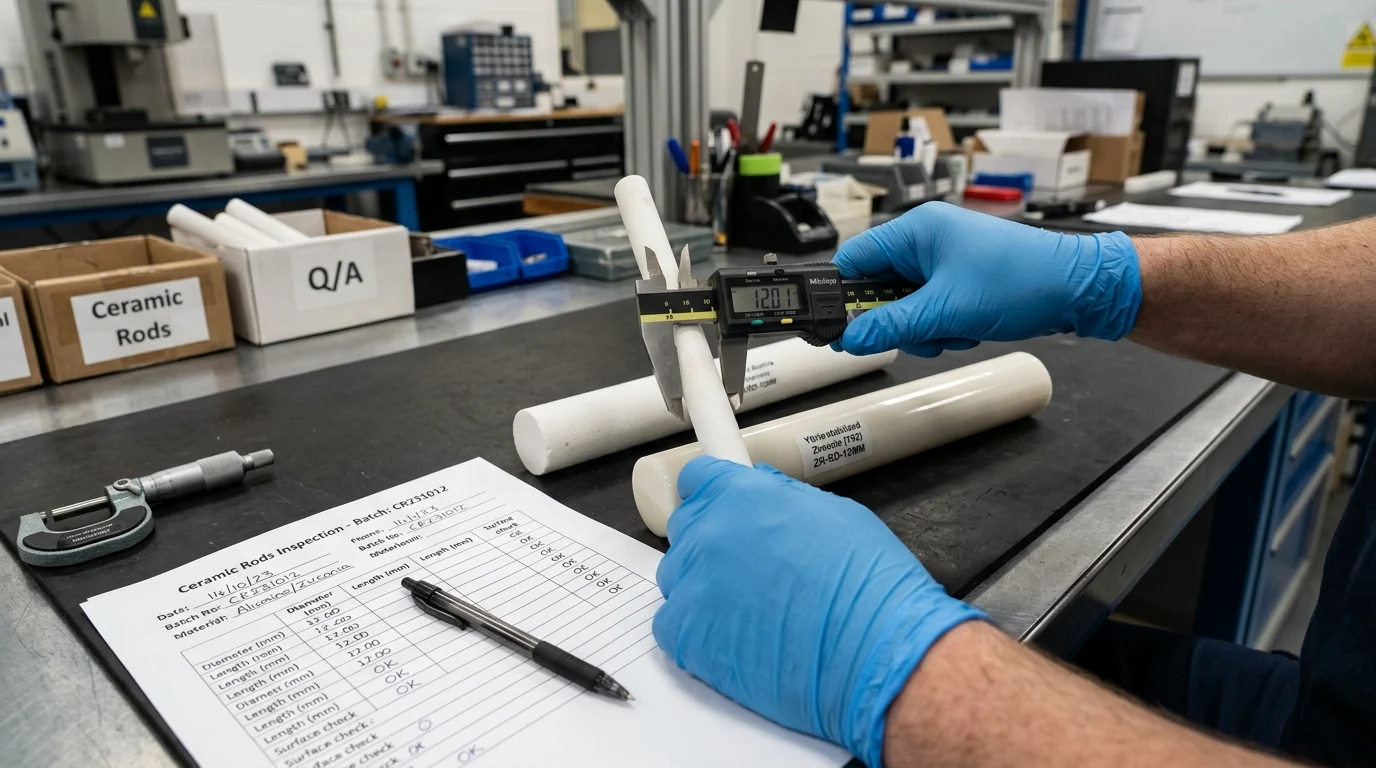
Selecting the appropriate ceramic material requires a precise understanding of the operational environment. Aluminum oxide (alumina) and zirconium oxide (zirconia) represent the two most prominent technical ceramics, yet their microstructural differences dictate distinct performance profiles. Engineers must weigh thermal properties against mechanical toughness to optimize component lifespan and cost-efficiency.
How alumina and zirconia rods compare
Alumina is the industry workhorse, prized for its extreme hardness, excellent dielectric strength, and broad chemical resistance. It is highly rigid, making it ideal for static load-bearing applications in high-heat environments. However, its inherent brittleness makes it susceptible to fracture under sudden mechanical impact.
Zirconia, conversely, is renowned for its exceptional fracture toughness. Through a mechanism known as transformation toughening, yttria-stabilized zirconia (YSZ) undergoes a phase change when subjected to stress, effectively absorbing energy and stopping crack propagation. This makes zirconia rods the superior choice for dynamic applications involving high mechanical impact or severe wear, albeit at a higher raw material cost.
Which specifications matter most
When evaluating material data sheets, several critical specifications determine a rod's suitability for an application. Purity levels are paramount; for instance, upgrading from 95% to 99.8% alumina significantly improves corrosion resistance and maximum operating temperature, though it increases machining difficulty.
Density and flexural strength are equally vital metrics. High-purity alumina typically presents a density of 3.8 to 3.9 g/cm³ with a flexural strength of 300 to 400 MPa. In contrast, stabilized zirconia offers a much higher density of approximately 6.0 g/cm³ and an outstanding flexural strength often exceeding 1,000 to 1,200 MPa, providing structural resilience that rivals certain steel alloys.
What trade-offs a comparison table should show
A comprehensive comparison highlights the necessary trade-offs between thermal capabilities, mechanical strength, and procurement budgets. Engineers must balance the high fracture toughness of zirconia against the superior thermal conductivity and cost-effectiveness of alumina.
| Property | Alumina (99.5%) | Yttria-Stabilized Zirconia (YSZ) |
|---|---|---|
| Max Operating Temp | 1,700°C | 2,100°C |
| Density | 3.8 - 3.9 g/cm³ | 6.0 - 6.05 g/cm³ |
| Flexural Strength | 350 MPa | 1,200 MPa |
| Thermal Conductivity | 25 - 35 W/m·K | 2 - 3 W/m·K |
| Fracture Toughness | 4 - 5 MPa·m½ | 8 - 10 MPa·m½ |
| Relative Cost | Baseline | 3x to 5x Baseline |
As demonstrated in the table, while zirconia vastly outperforms alumina in mechanical resilience, its extremely low thermal conductivity can be a liability in applications requiring rapid heat dissipation. Conversely, alumina's lower cost and higher thermal conductivity make it the default choice unless specific mechanical stresses mandate the use of zirconia.
How to Evaluate a Ceramic Rod Supplier
Procuring technical ceramics requires rigorous vetting of a supplier's manufacturing capabilities. Because the properties of ceramic rods are locked in during the Sintering Process, inconsistent green machining or poor thermal profiling will result in catastrophic failure during end-use. Evaluating a supplier involves auditing their production methods, quality assurance protocols, and custom fabrication capabilities.
Which manufacturing and quality controls indicate reliability
Reliable suppliers utilize advanced forming techniques such as isostatic pressing or precision extrusion to ensure uniform density throughout the rod. Variations in green density lead to uneven shrinkage during sintering, resulting in warped or structurally compromised rods.
Post-sintering inspection is equally critical. Premium manufacturers employ coordinate measuring machines (CMM) and laser micrometers to verify dimensional tolerances. Furthermore, they utilize ultrasonic testing or dye penetrant inspections to detect micro-cracks that are invisible to the naked eye, ensuring that only flawless components reach the end user.
What certifications and test documents to request
To guarantee material integrity, buyers must request comprehensive documentation. ISO 9001:2015 certification establishes a baseline for quality management, but specific material validations are required for technical ceramics.
Suppliers should provide Material Test Reports (MTRs) detailing the chemical composition and physical properties of the batch. Key documents include X-ray Diffraction (XRD) reports to verify phase composition, and density reports proving an apparent porosity of less than 0.1%, which is critical for preventing gas permeability in vacuum furnace applications.
How custom fabrication affects lead time and scrap
Custom fabrication introduces significant variables into procurement. Because fully sintered ceramics are exceptionally hard, achieving tight tolerances (e.g., ±0.01 mm) requires diamond-tooled centerless grinding. This secondary machining is time-intensive and highly specialized.
Consequently, custom tooling and precision grinding can extend lead times to 4 to 8 weeks and increase costs due to tool wear. Furthermore, intricate custom geometries increase the scrap rate during both green machining and final grinding. Buyers must work closely with suppliers to optimize designs for manufacturability, thereby minimizing scrap and controlling unit costs.
Commercial and Logistics Factors in Ceramic Rod Sourcing
Sourcing technical ceramics involves navigating a complex landscape of international logistics, fluctuating raw material costs, and stringent packaging requirements. Procurement professionals must align their purchasing strategies with production schedules to mitigate supply chain disruptions and optimize total landed costs.
How volume, packaging, Incoterms, and freight affect cost
Order volume dictates unit pricing through economies of scale. Manufacturers typically enforce Minimum Order Quantities (MOQs) ranging from 50 to 100 units for standard dimensions, scaling up to 500 or 1,000 units for custom runs to offset tooling setup costs.
Logistics costs are heavily influenced by the fragility of the product. Ceramic rods require specialized packaging, such as custom foam inserts and rigid wooden crating, to prevent fracture during transit. Additionally, the choice of Incoterms and freight methods dramatically affects the final price. While sea freight can reduce transportation costs by 60% to 70% compared to air freight, it adds 30 to 45 days to the lead time, requiring buyers to maintain larger safety stocks.
Which sourcing channels and regional options to consider
The global supply chain for technical ceramics is segmented by regional expertise. The Asia-Pacific region, particularly China and Japan, dominates the processing of raw powders and bulk manufacturing, offering highly competitive pricing for high-volume, standard-dimension rods.
Conversely, suppliers in North America and Western Europe often specialize in high-mix, low-volume precision machining and proprietary aerospace-grade formulations. While their unit costs are higher, these regional suppliers offer rapid prototyping, robust intellectual property protection, and localized technical support, making them ideal for specialized, mission-critical procurement.
How to Select the Right Ceramic Rods
Finalizing the selection of ceramic rods requires synthesizing mechanical requirements, thermal conditions, and supplier reliability into a cohesive procurement strategy. A systematic approach ensures that the chosen material meets performance benchmarks without over-engineering the solution, thereby optimizing the total cost of ownership.
What step-by-step process helps match material to application
The selection process begins with a rigorous definition of the operating environment. Engineers must map the maximum continuous operating temperature, the frequency of thermal cycling, and the presence of corrosive agents. Next, mechanical loads—including static weight and dynamic impact—must be calculated to determine required flexural strength.
| Application Environment | Recommended Material | Key Selection Criterion |
|---|---|---|
| High-Voltage Insulation | 99.5% Alumina | Dielectric strength and high resistivity |
| Continuous Furnace (1,600°C) | 99.8% Alumina | Creep resistance and thermal stability |
| High-Wear Pump Shafts | Yttria-Stabilized Zirconia | Fracture toughness and low friction |
| Rapid Thermal Cycling | Silicon Nitride / Zirconia | Low thermal expansion and shock resistance |
Once the material and purity are selected using an application matrix, buyers must define acceptable dimensional tolerances. Specifying extreme precision where standard tolerances would suffice forces unnecessary centerless grinding, which drives up the unit price and extends lead times.
Which criteria should guide final supplier selection
With specifications locked, final supplier selection hinges on operational transparency and historical performance. A robust supplier audit should evaluate their raw material sourcing, in-house machining capabilities, and batch-to-batch consistency.
Ultimately, procurement should be guided by the Total Cost of Ownership (TCO) rather than the initial unit price. A cheaper rod that suffers a 2% defect rate can cause thousands of dollars in unplanned downtime and equipment damage. Partnering with a supplier capable of maintaining a defect rate below 0.5% through stringent quality controls ensures long-term operational stability and cost efficiency.
Key Takeaways
- The most important conclusions and rationale for Ceramic Rods
- Specs, compliance, and risk checks worth validating before you commit
- Practical next steps and caveats readers can apply immediately
Frequently Asked Questions
What is the best ceramic rod material for continuous high-temperature use?
Use alumina for cost-effective continuous service up to about 1,700°C. Choose stabilized zirconia for more extreme conditions, severe thermal cycling, or higher mechanical impact.
How do alumina and zirconia rods differ in furnace applications?
Alumina rods are ideal for heater supports and electrical insulation. Zirconia rods offer higher toughness and better crack resistance in demanding furnace, glass, and induction heating environments.
Which specifications should I confirm before ordering ceramic rods?
Check material grade, purity, diameter, length, tolerance, density, flexural strength, and maximum operating temperature. For harsh atmospheres, also confirm corrosion resistance and thermal shock performance.
Are ceramic rods from JHPIM suitable for corrosive or vacuum environments?
Yes, advanced alumina and zirconia rods are commonly selected for vacuum furnaces, CVD systems, and corrosive high-temperature processes because they resist outgassing, wear, and chemical attack.
When should I choose zirconia instead of alumina ceramic rods?
Choose zirconia when your process involves impact, vibration, rapid temperature changes, or crack-sensitive parts. For stable, high-heat insulation at lower cost, alumina is usually the better fit.