


Introduction
For complex metal parts, the lowest unit price rarely tells the full story. Cost depends on geometry, production volume, material waste, tolerances, finishing needs, and how much tooling investment a program can absorb. This comparison explains where metal injection Molding gains an economic advantage over CNC machining, where machining remains the smarter choice, and how each process affects scalability, lead time, and design freedom. By the end, readers will have a practical framework for judging when MIM delivers real savings for intricate, high-volume components and when CNC is still the better fit for performance, flexibility, or smaller production runs.
Metal Injection Molding vs CNC Machining
Engineers and procurement teams constantly weigh Metal Injection Molding (MIM) against CNC machining when scaling complex metal components. Both methodologies yield high-density, durable parts that perform reliably in demanding environments, but their fundamental mechanics dictate entirely different economic and technical trajectories.
Choosing the wrong process can lead to exorbitant tooling amortization, excessive material waste, or parts that fail to meet dimensional specifications. Understanding the core mechanics of each process is the first step in aligning manufacturing strategy with product lifecycle demands.
Key differences in process and part suitability
CNC machining is a subtractive process where multi-axis mills or lathes carve solid metal billets into precise geometries. It offers unparalleled precision and material versatility, relying on programmed toolpaths to remove excess material. Because it does not require customized molds, it is inherently flexible and adaptable to design iterations.
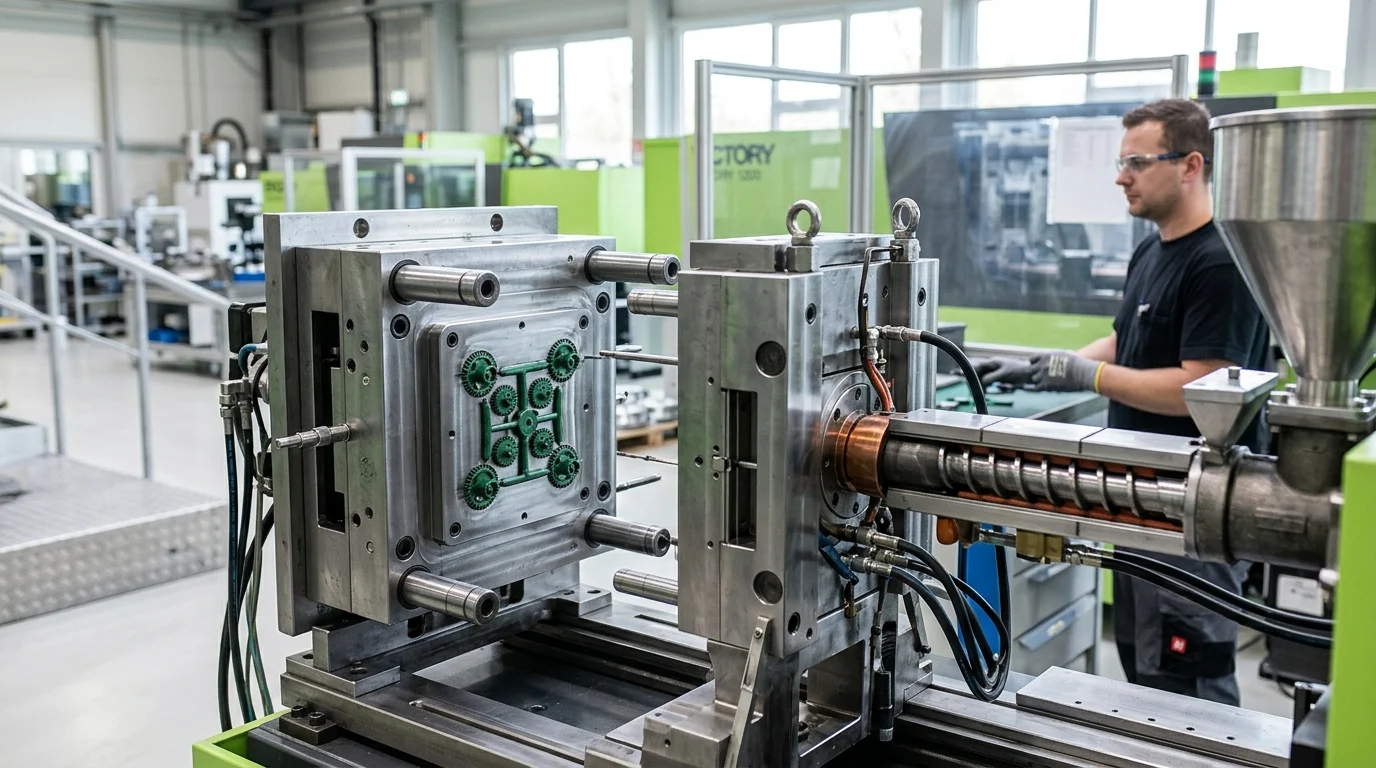
Conversely, Metal Injection Molding is a net-shape molding process that combines plastic injection molding techniques with powdered metallurgy. Fine metal powders are mixed with a thermoplastic binder, injected into a hardened steel mold to form an oversized "green part," and then subjected to debinding and Sintering in a furnace at temperatures often exceeding 1,300°C. During sintering, the binder is removed and the metal particles fuse, creating a dense, solid component. MIM is highly constrained by part mass, typically excelling with components weighing under 100 grams, whereas CNC can handle virtually any size footprint that fits within a machine envelope.
When each method is the better choice
CNC machining remains the undisputed champion for low-volume production, rapid prototyping, and oversized components. It is also mandatory when parts require ultra-tight tolerances straight off the machine without the feasibility of secondary sizing operations. Subtractive manufacturing excels when lead times are tight, as parts can be produced as soon as raw material arrives and programming is complete.
MIM becomes the superior choice when annual volumes exceed the capacity of subtractive methods without exponential machine and labor investment. If a part features intricate internal cavities, asymmetrical geometries, or requires expensive-to-machine alloys like titanium or 17-4 PH stainless steel, MIM eliminates the exorbitant material waste and prolonged cycle times associated with CNC. By molding the complex shape directly, MIM bypasses the need for multiple machine setups and specialized cutting tools.
Cost Drivers and Break-Even Volume
The financial viability of MIM versus CNC machining hinges on a delicate balance between upfront capital expenditure and variable unit costs. Understanding the break-even point is critical for procurement teams aiming to optimize their supply chain budgets over the lifespan of a product.
Tooling, setup, material, and cycle time
MIM requires significant initial capital investment. Hardened steel molds for MIM typically range from $15,000 to $50,000, and lead times for tooling validation can span 4 to 12 weeks. However, once the mold is operational, the cycle time per part drops to mere seconds. Because it is a molding process, material waste is virtually eliminated, which drastically reduces the variable cost per unit.
CNC machining flips this financial equation. Upfront setup costs are minimal, often falling between $500 and $2,000 for programming, custom soft jaws, and initial fixturing. Yet, the cycle time per part remains static; a complex geometry that takes 45 minutes to machine will always take 45 minutes, capping daily output. Furthermore, material waste in CNC can easily exceed 70% for complex aerospace or medical geometries, driving up variable material costs significantly.
Secondary operations, finish, and tolerance costs
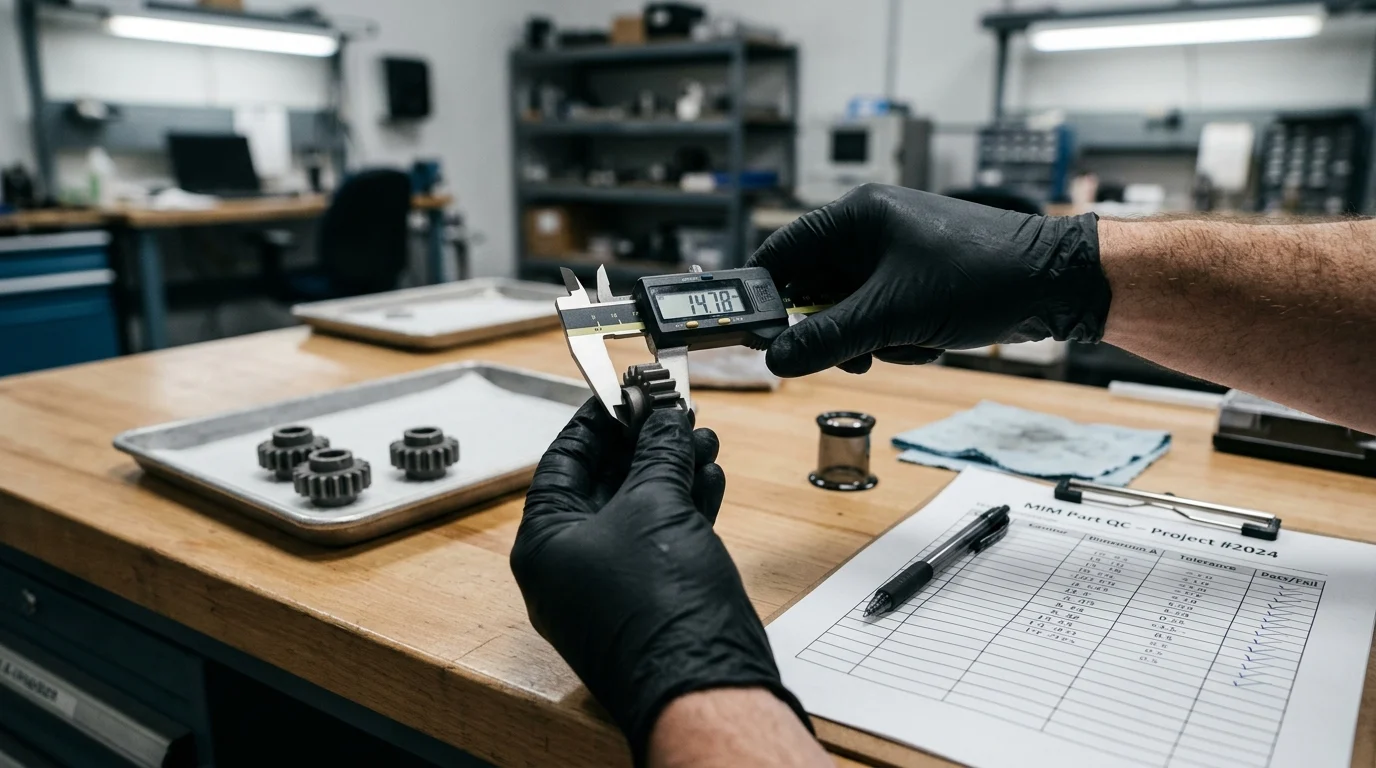
Both processes may incur hidden costs through secondary operations. MIM parts shrink by approximately 15% to 20% during the sintering phase, which can introduce dimensional variations. Achieving tight tolerances on critical bores or mating surfaces often necessitates post-sintering CNC touch-ups, reaming, or grinding, adding distinct steps to the routing and increasing the unit price.
Conversely, CNC machined parts frequently require manual deburring, tumbling, or specialized surface treatments to remove sharp edges and directional tool marks left by end mills. Depending on the complexity of the burrs and the required surface finish, post-processing can add 10% to 15% to the final component cost of a machined part.
Comparing low-, mid-, and high-volume economics
The break-even volume between these two technologies typically falls between 10,000 and 20,000 units annually, depending heavily on part complexity, material type, and regional labor rates. Below 10,000 units, the amortization of MIM tooling makes the unit price uncompetitive against CNC machining. Beyond 20,000 units, MIM's scalable efficiency rapidly outperforms CNC, offering substantial cost savings over multi-year production runs.
| Production Volume | CNC Machining Cost Dynamics | Metal Injection Molding (MIM) Cost Dynamics | Recommended Process |
|---|---|---|---|
| < 5,000 parts/year | Low setup cost, high unit cost | Prohibitive tooling amortization per unit | CNC Machining |
| 10,000 - 20,000 parts/year | Moderate unit cost, high material waste | Tooling justified by variable cost savings | Case-by-Case |
| > 50,000 parts/year | High capacity constraints, static unit cost | Lowest unit cost, highly scalable output | Metal Injection Molding |
Technical Trade-Offs for Complex Metal Parts
Beyond economics, the physical and mechanical requirements of the component dictate the manufacturing method. Engineers must navigate strict design rules, dimensional limitations, and inherent material properties to ensure the chosen process yields a commercially viable and functional part.
Complexity, wall thickness, and feature limits
MIM thrives on geometric complexity, easily producing undercuts, blind holes, hex geometries, and internal threads in a single molding step—features that would require expensive 5-axis CNC setups or specialized broaching. However, MIM is heavily constrained by wall thickness. Ideal MIM designs maintain uniform wall thicknesses between 1.0mm and 3.0mm. Sections thicker than 5.0mm are prone to internal voids and extended debinding times, while sections thinner than 0.5mm risk structural failure during the high-pressure injection phase.
CNC machining faces no such thickness limitations and can easily mill thick blocks or turn large diameter shafts. However, it is restricted by tool access and geometry. Sharp internal corners are impossible to mill without specialized EDM processes, as rotating end mills always leave a radius. Deep, narrow pockets also pose a challenge due to tool deflection and chatter.
Tolerances, properties, and surface finish
When it comes to dimensional accuracy, CNC machining delivers superior precision, routinely achieving tolerances of ±0.005mm to ±0.01mm directly off the machine. MIM standard tolerances are proportional to the part size, typically hovering around ±0.3% to ±0.5% of the nominal dimension. Consequently, a 10mm feature in MIM will generally hold a ±0.05mm tolerance without secondary sizing.
In terms of material density and strength, sintered MIM parts achieve 95% to 99% of theoretical density, providing mechanical properties nearly identical to wrought CNC materials. Surface finish also differs significantly. CNC leaves directional tool marks based on the cutting path (typically Ra 0.8 to 1.6 µm), whereas MIM yields a uniform, slightly matte finish (typically Ra 0.8 to 1.2 µm) right out of the furnace.
| Technical Parameter | CNC Machining | Metal Injection Molding (MIM) |
|---|---|---|
| Standard Tolerance | ±0.005mm to ±0.01mm | ±0.3% to ±0.5% of nominal dimension |
| Optimal Part Weight | Virtually unlimited | 0.1g to 100g (maximum practical ~250g) |
| Material Density | 100% (Wrought Billet) | 95% to 99% (Sintered) |
| Surface Finish (As-made) | Ra 0.8 - 1.6 µm (directional marks) | Ra 0.8 - 1.2 µm (uniform matte) |
Design rules that affect manufacturability
Designing for MIM requires strict adherence to plastic injection molding principles. Draft angles of 0.5 to 2.0 degrees are mandatory to cleanly eject the green part from the mold without damage. Designers must also strategically incorporate gating and venting locations, and account for a flat "setter" surface required to support the part during sintering to prevent distortion under extreme heat.
Conversely, designing for CNC prioritizes minimizing tool changes, standardizing hole sizes, and avoiding geometries that require the part to be unclamped and repositioned multiple times. Optimizing a part for CNC means reducing the volume of material that must be cut away, whereas optimizing for MIM means ensuring uniform material flow and consistent thermal mass.
How Buyers Should Evaluate the Best Option
Transitioning a design from prototyping to mass production requires rigorous supplier evaluation. Buyers must align their technical specifications with the manufacturing partner's specific equipment capabilities, quality assurance protocols, and available production capacity.
Supplier capability, quality systems, and capacity
Evaluating a MIM supplier involves scrutinizing their end-to-end infrastructure: compounding, molding, debinding, and sintering. Buyers should verify the supplier's furnace capacity and atmosphere control, as variations in sintering temperature by even 5°C can alter final part dimensions and mechanical yield strength. Quality management systems like ISO 9001 or IATF 16949 are non-negotiable for automotive, aerospace, or medical components.
For CNC suppliers, evaluation focuses on machine park diversity. Assessing the ratio of 3-axis to 5-axis machines, spindle uptime, and automated pallet-changing systems reveals their ability to scale. Furthermore, automated inspection capabilities, such as Coordinate Measuring Machines (CMM) capable of verifying tolerances down to a single micron, are essential to guarantee compliance with strict geometric dimensioning and tolerancing (GD&T) callouts.
A practical selection framework for OEM teams
OEM procurement teams can utilize a tiered framework to finalize their sourcing decision. Step one is a strict physical audit: if the part exceeds 250 grams, measures larger than 100mm in its longest dimension, or requires baseline tolerances tighter than ±0.02mm without the budget for secondary operations, CNC is the default choice.
Step two is a volume threshold analysis. If the annual demand is below 10,000 units, the initial MIM tooling cost will likely inflate the amortized unit price beyond the CNC quote. Step three involves assessing material utilization and machinability. If the component is designed from titanium, Inconel, or high-performance superalloys and requires significant material removal (a high buy-to-fly ratio), MIM's net-shape capability offers substantial savings by entirely eliminating scrap metal costs and slow machining cycle times.
Key Takeaways
- The most important conclusions and rationale for Metal Injection Molding
- Specs, compliance, and risk checks worth validating before you commit
- Practical next steps and caveats readers can apply immediately
Frequently Asked Questions
When does Metal Injection Molding usually cost less than CNC machining?
MIM usually wins when annual volume is high and part geometry is complex. Tooling is expensive upfront, but per-part cost drops sharply once production scales.
What kinds of parts are best suited for MIM?
MIM fits small, complex metal parts, typically under 100 grams, especially with fine features, internal shapes, or costly alloys like 17-4 PH stainless steel.
Why can CNC machining be more expensive for complex parts?
CNC often needs longer machine time, multiple setups, and removes a lot of material. For intricate parts, labor and scrap can push unit cost much higher.
Does MIM require secondary machining after sintering?
Sometimes. Critical bores, threads, or tight mating surfaces may need sizing, reaming, or CNC finishing after sintering to meet final tolerance requirements.
Can JHPIM help evaluate whether MIM or CNC is the better choice?
Yes. JHPIM can review your part geometry, material, tolerance, and forecast volume to suggest the most cost-effective process for production.