

Metal Sintering Explained: From Powder to Finished Parts

Metal Sintering turns regular metal powders into strong, precision-engineered components with exceptional strength properties. The sophisticated manufacturing process boosts tensile strength by 30%, bending fatigue strength by 15%. The effect on energy is even more dramatic - an impressive 50% increase at high temperatures.
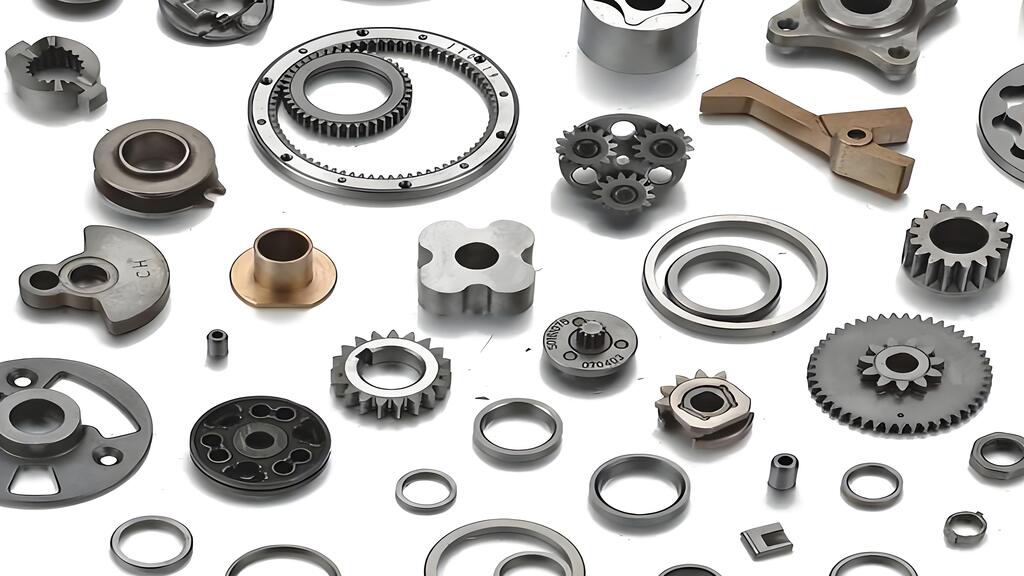
The process works by fusing compacted metal powder particles. This happens through carefully controlled heating between 750°C and 1300°C, without melting the material. Sintered Metal Parts offer unique value through their versatility and precision. Complex shapes emerge that conventional methods simply can't produce, all while keeping high-dimensional accuracy. The process stands out as a green technology that creates minimal waste and harmful emissions. The applications are extensive - from automotive engine components and sintered gears to medical instruments and aerospace parts. Metal powder sintering serves industries of all types. This piece looks at the complete process from raw powder to finished sintered parts and explains each key step in this fascinating manufacturing technique.
From Metal Powder to Green Part: The First Two Steps

The powder metallurgy process starts when manufacturers select raw materials carefully. These materials shape the final properties of sintered components. The process turns loose metal powders into solid parts through two main steps: powder preparation and compaction.
Powder Composition: Iron, Copper, Nickel, and Additives
Iron serves as the base material in powder metallurgy. Manufacturers combine it with copper, nickel, and other metallic elements to create alloys with specific properties. Iron-copper materials usually contain about 2% copper, which makes them perfect for medium-strength structural applications. Iron-nickel compositions contain 1-4% nickel and create components that balance strength, wear resistance, and impact properties well.
Manufacturers use powders with purity levels between 99-99.9%. Most particle sizes range from 1-45 μm, though materials like tungsten come in larger mesh sizes (325 mesh). The process needs graphite and dry lubricants to cut down friction during processing.
Mixing and Homogenization of Metal Powders
The quality of finished parts depends heavily on how well metal powders blend with additives. Gentle agitation works best since rough blending can make particles smaller and increase apparent density. Double Planetary Mixers do this job well and complete the blending in 36 revolutions.
Powders with different densities create unique challenges during homogenization. Poor mixing leads to separation during transport or storage. The solution lies in high-shear counter-current mixers that achieve complete uniformity in about three minutes.
Compaction Pressures: 400–1500 MPa for Green Strength
The mixed powder becomes a "green" compact through compaction. This step needs pressures between 400 and 1500 MPa (about 30-50 tons per square inch). These high pressures help achieve the right green density, which shapes the mechanical properties of the final part.
Manufacturers can choose from several compaction methods including uniaxial pressing, isostatic pressing, or metal injection molding. Particles rearrange, change shape, and sometimes break before final consolidation. The success of sintering depends on this step's quality since uneven density can cause distortion and defects.
Better sintered properties come from higher green density. Standard pressing methods can only reach densities of about 7.2g/cm³, while fully dense wrought steel reaches 7.85g/cm³.
Sintering Process: Heating Without Melting

The sintering process stands at the core of powder metallurgy. This fascinating technique bonds particles without complete melting. The process creates strong metallurgical bonds through solid-state diffusion at temperatures below the metal's melting point, unlike casting or forging.
Controlled Furnace Atmosphere to Prevent Oxidation
The furnace atmosphere does more than just keep air out. It helps remove lubricant from the green compact and reduces surface oxides on metal powder particles. The atmosphere controls carbon potential and gives uniform heat transfer throughout the process.
Most operations use zoned atmospheres with specific gas compositions in each furnace section. The typical setup has 20% wet or dry nitrogen in the pre-heat zone, 60% nitrogen-hydrogen mixture in the hot zone, and 20% dry nitrogen in the cooling zone. This setup puts hydrogen where it works best—in the reduction zone.
Poor atmosphere control can stop proper particle bonding due to incomplete oxide reduction. Many manufacturers use zirconia-based oxygen probes to monitor and adjust gas flow rates based on oxidation/reduction potential.
Solid-State Diffusion and Neck Formation
The sintering mechanism starts when small contact points called necks form between adjacent particles. These necks grow as material from the particles moves through diffusion and other mass transport processes.
The process relies on several diffusion mechanisms:
- Surface diffusion (atoms move across particle surfaces)
- Volume diffusion (movement through particle interior)
- Grain boundary diffusion (movement along particle boundaries)
- Evaporation-condensation (material moves through vapor phase)
The necks' cross-section grows larger as particles move closer together. This creates a well-laid-out microstructure with clear grain boundaries.
Sintering Temperature Range: 750–1300°C
The best sintering temperatures usually fall between 60-80% of a material's melting point. Iron-based materials with a melting point of ~1538°C need temperatures from 750-1300°C. Most ferrous alloys sinter at 2050-2100°F (1120-1150°C).
Higher temperatures boost mass transport mechanisms and improve oxide reduction. Recent trends show growing interest in higher sintering temperatures (1250-1280°C). This is a big deal as it means that oxygen content drops from about 0.1% to 0.01%, which leads to better mechanical properties.
Post-Sintering Operations and Finishing Techniques

Sintered metal parts need extra work after they come out of the furnace. These extra steps boost their mechanical properties, make them more precise, and protect their surface.
Coining and Resizing for Dimensional Accuracy
Metal parts become more precise through sizing operations. Parts placed in specially shaped dies under moderate pressure can be up to 50% more accurate. This cold repressing technique gives parts straighter profiles, smoother surfaces, and tighter tolerances for both inner and outer diameters.
Coining works differently and uses much higher pressures that match or exceed initial compaction forces. This makes parts more precise and stronger at the same time. The dies used must be top quality because they face tough wear conditions. Some demanding projects need a specific process. Manufacturers first do pre-sintering, then coining, and finally full sintering. They might add a sizing step at the end to get perfect precision.
Steam Treatment and Oil Impregnation
Steam treatment creates a protective oxide layer on metal surfaces. Parts heat up above 700°F before steam comes in. The temperature matters a lot - anything below 300°F creates unwanted Fe₂O₃ (pink color) instead of the better Fe₃O₄ (blue-black magnetite). Parts stay at 1000°F for 30-60 minutes based on what they're needed for.
This process comes with several benefits:
- Surface hardness goes beyond HRC45 on the Rockwell scale
- Parts resist corrosion and wear better
- A nice blue-black finish looks better
- Powder metal components get sealed pores
Oil impregnation uses vacuum to create self-lubricating parts. When these parts work, shaft rotation heat pulls oil to where it's needed. The oil then goes back through tiny spaces. This works great for sintered bearings in cars, computer parts, and electric motors.
Machining, Grinding, and Surface Plating Options
Sintered parts often need machining for complex features like threads, angular grooves, and undercuts. The porous nature of these parts creates a challenge. Cutting tools hit the surface unevenly and wear out faster. Adding manganese sulfide (MnS) helps with machining and doesn't change part size during sintering.
Surface plating adds protection through electroplating, electroless plating, or immersion plating. These methods coat parts with nickel, copper, or gold to make them last longer, resist corrosion better, and reduce friction. Plating these parts needs careful rinsing between steps. Trapped liquids in pores can cause dark spots that ruin the part.
Applications of Sintered Metal Parts Across Industries

Sintered metal parts have become significant components in many industries because they allow complex designs with excellent mechanical properties. These versatile components solve complex engineering challenges in different sectors. Their unique combination of strength, precision, and affordability makes them indispensable.
Sintered Gears in Automotive and Robotics
Automotive manufacturers employ sintered gears in engine components, transmission systems, and power tools. These components deliver superior performance characteristics that include internal damping and optimized gear root designs. Sintered planetary gear carriers excel in applications that range from tractors to powered medical devices. The automotive industry has increasingly adopted sintered gears to achieve higher fuel efficiency and reduce emissions. Electric vehicles benefit from these components as they help reduce drivetrain weight while maintaining structural integrity.
Sintered gears enable precise movements in robot joints, actuators, and grippers in robotics. These gears maintain dimensional stability under varying loads, making them perfect for automation systems that need reliable operation over extended periods.
Self-Lubricating Bearings and Filters
Self-lubricating sintered bearings contain 20-25% porosity by volume and lubricant oil impregnation. This unique structure removes the need for external lubrication because oil within the pores provides constant lubrication between the bearing and shaft. These components work under hydrodynamic conditions with remarkably low friction coefficients.
These bearings are used in various applications, including automotive components, electric motors, gearboxes, and household appliances. They perform exceptionally well in challenging environments where traditional lubrication systems often fail.
Sintered metal filters excel in environments that need chemical inertness and high-temperature resistance. These components filter gases and liquids effectively in pharmaceuticals, chemical processing, and food production. Some variants withstand temperatures up to 700°C, making them essential in petroleum refinement.
Medical and Aerospace Component Use Cases
The medical industry depends on sintered metal to manufacture osteoporosis pen ratchets, flow control spring seats, and surgical stapler planetary gear systems. Ningbo JIEHUANG provides design and production solutions for sintering products that meet medical applications' strict requirements. These components must be biocompatible, sterilizable, and corrosion-resistant.
Aerospace applications include aircraft engine components, landing gear parts, and structural elements. Sintered metal parts' high strength-to-weight ratio makes them ideal for applications where weight reduction matters. Metal powders like titanium and nickel help manufacture critical components such as compressor blades and turbine disks that must withstand extreme operating conditions.
Conclusion
Conclusion: The Future of Metal Sintering Technology
Metal sintering stands as the lifeblood of manufacturing processes in many industries today. This amazing technique turns regular metal powders into high-performance components through temperature-controlled processes without melting them completely. The process from loose metal particles to finished parts needs several key stages. Powder preparation, compaction, sintering, and post-processing all play vital roles in shaping the final product's properties.
Sintered components are a great way to get solutions for everything from automotive transmissions to medical devices. These parts combine strength, precision, and budget-friendly features to solve engineering challenges that traditional manufacturing can't handle. More industries keep finding new uses for these components as technology moves forward.
The green benefits make sintering even more appealing. Compared to regular machining methods, this process creates minimal waste and lines up with today's sustainability goals. You can create complex shapes while keeping tight tolerances, which makes it perfect for high-precision work.
Companies looking for an edge will keep improving their sintering processes. Better mechanical properties and precise measurements are possible through higher sintering temperatures, better atmosphere control, and advanced post-processing. Ningbo JIEHUANG helps you design and produce sintering products that meet tough specifications in industries of all sizes.
Metal sintering technology ended up becoming the perfect mix of science and engineering. It fuses raw materials into components that power the devices we use every day. The basic principles from decades ago keep growing through research and real-world use, which means this manufacturing method will stay important for generations.
FAQs
Q1. What is metal sintering and how does it work? Metal sintering is a manufacturing process that transforms metal powders into solid parts by heating them to temperatures below their melting point. The process involves compacting metal powders, then heating them in a controlled atmosphere, causing the particles to bond together through solid-state diffusion without fully melting.
Q2. What are the main steps in the metal sintering process? The metal sintering process typically involves four main steps: powder preparation (mixing and homogenization), compaction to form a "green" part, sintering in a controlled furnace, and post-sintering operations like sizing or surface treatments.
Q3. What temperatures are used in metal sintering? Metal sintering temperatures typically range from 750°C to 1300°C, which is about 60-80% of the material's melting point. For iron-based materials, sintering often occurs between 1120°C and 1150°C, with recent trends showing interest in higher temperatures up to 1280°C for improved properties.
Q4. What industries use sintered metal parts? Sintered metal parts are widely used across various industries, including automotive (for gears and engine components), robotics (for precise movements in joints and actuators), medical (for surgical instruments and implants), and aerospace (for lightweight structural elements and engine parts).
Q5. What are the advantages of using sintered metal parts? Sintered metal parts offer several advantages, including the ability to create complex shapes with high dimensional accuracy, excellent mechanical properties, cost-effectiveness for high-volume production, and environmental benefits due to minimal waste. They also allow for the creation of self-lubricating components and parts with specific porosity for filtration applications.