


Planetary Gear Drives

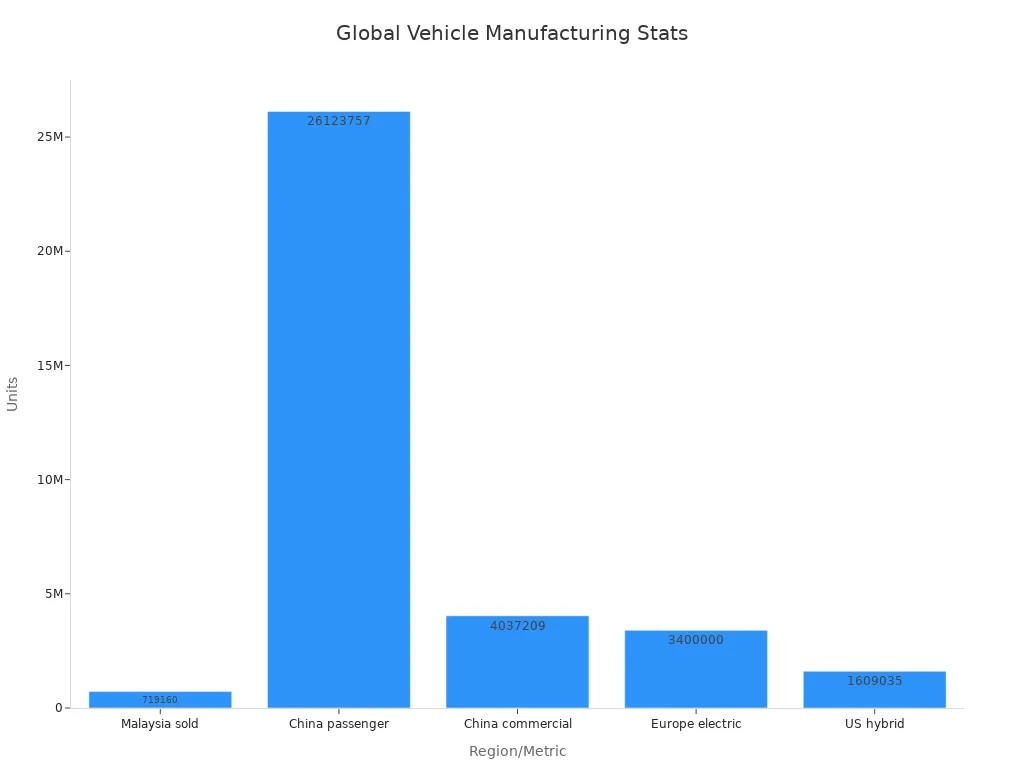
Planetary gear drives use a central sun gear, planet gears, and an outer ring gear to transmit power efficiently. Engineers value these systems for their compact design and high torque capacity. Demand continues to rise worldwide, with the global market reaching US$ 3.12 billion in 2024 and projected to hit US$ 4.04 billion by 2030. A bar chart below highlights the rapid growth in vehicle production, which drives adoption of these advanced gear systems.
Key Takeaways
- Planetary gear drives use a sun gear, planet gears, and a ring gear to deliver high torque in a compact design, making them efficient and space-saving.
- These gear systems share loads evenly among planet gears, which improves durability, reduces wear, and boosts overall efficiency.
- Planetary gear drives offer flexible speed and direction control by fixing different components, supporting many applications like vehicles and robotics.
- Powder metallurgy manufacturing enhances gear strength and precision, leading to longer-lasting and more reliable planetary gear systems.
- Regular maintenance, including proper lubrication and inspection, is essential to keep planetary gear drives running smoothly and extend their lifespan.
Key Components and Working Principle of Planetary Gear Drives

Sun Gear, Planet Gears, and Ring Gear
Planetary Gear Drives rely on three main components: the sun gear, planet gears, and ring gear. The sun gear sits at the center and transmits input power. Surrounding the sun gear, several planet gears rotate and mesh with both the sun and the ring gear. The ring gear forms the outermost circle and features internal teeth that engage with the planet gears.
Researchers have validated the operational precision of these gears through advanced experimental setups. For example, modal testing and spinning tests use accelerometers and encoders to measure vibrations and rotational speeds of each component. These tests show that the measured natural frequencies of the sun, planet, and ring gears closely match analytical models, with most results agreeing within a 5% margin. This high level of agreement demonstrates the accuracy and reliability of the gear set under real-world conditions.
Note: Engineers often use cross-sectional diagrams and detailed labeling in test gearboxes to identify and analyze each component. This approach helps isolate specific power losses and optimize gear design.
Carrier and Power Flow
The carrier holds the planet gears in place and rotates to transfer torque between the sun and ring gears. The carrier's design plays a crucial role in distributing power efficiently throughout the system. Static torque analysis shows that the sum of torques on the sun gear, ring gear, and carrier must equal zero. This balance ensures smooth operation and effective power transfer.
A combination of Finite Element Method (FEM) analysis and load distribution calculations helps engineers understand how the carrier deforms under load. Torsional deformation, or twisting, of the carrier affects how force distributes among the planet gears. By integrating FEM results with ISO6336-1 Annex E calculations, engineers can optimize the carrier design for better load sharing and minimal misalignment.
| Aspect | Description |
|---|---|
| Carrier Deformation | FEM analysis models complex deformation and its impact on load sharing. |
| Torsional Twist | Circumferential displacement of planet pins influences load distribution. |
| Load Distribution | Calculated using standardized methods combined with FEM data. |
| Pin Mounting Variants | Different mounting methods affect load sharing and are analyzed for optimal performance. |
| Visualization | 3D models help engineers understand and correct misalignments in the carrier and gear set. |
Recent studies also use Computational Fluid Dynamics (CFD) to model power losses caused by lubricant flow and gear motion. These simulations, validated by experimental data, confirm that precise power flow management leads to significant efficiency improvements in industrial planetary gearboxes.
Simple Analogies for Understanding
To visualize how Planetary Gear Drives work, imagine a playground merry-go-round. The sun gear acts like the central post, the planet gears resemble children holding onto the post while moving around it, and the ring gear represents the outer edge of the platform. When the central post turns, the children (planet gears) walk along the edge, causing the entire platform (ring gear) to rotate. This analogy helps illustrate how input at one component can produce motion at another, depending on which part remains stationary or moves.
Mathematical models and multi-body simulations further clarify these dynamics. Researchers simulate start-up, emergency stops, and variable speeds to study how the gears interact under different conditions. These models, supported by experimental data, show that Planetary Gear Drives maintain stable and efficient power transmission even during rapid changes in speed or load.
Tip: Engineers often use strain gauges on segmented sun gears to measure how torque and speed affect load sharing among planet gears. This method provides direct data on operational stability and helps refine gear design for maximum performance.
Main Advantages and Unique Features of Planetary Gear Drives
High Torque Density
Planetary Gear Drives deliver exceptional torque density, making them a preferred choice in demanding applications. Their design allows for high gear ratios within a compact footprint. Research shows that these drives achieve starting torques below 2% of nominal input torque, which is much lower than the 10-27% seen in other compact gearboxes. This feature leads to higher efficiency, especially at partial loads. Advanced topologies, such as Wolfrom variants and Gear Bearing Drive systems, further enhance torque density by optimizing tooth geometry and improving load sharing among multiple planet gears. Comparative studies confirm that these characteristics enable Planetary Gear Drives to outperform traditional systems like cycloidal and strain wave drives, particularly in next-generation robotics.
Compact and Space-Saving Design
Engineers often select Planetary Gear Drives for their compact and space-saving design. The coaxial arrangement of the sun, planet, and ring gears allows the system to transmit significant power without occupying much space. This configuration supports high power-to-weight ratios, which is essential in industries where space and weight constraints are critical. For example, automotive and aerospace sectors benefit from the reduced size and mass, enabling more efficient layouts and lighter assemblies. The integration of multiple planet gears around a central sun gear also contributes to a balanced and symmetrical structure, which simplifies installation and maintenance.
Load Distribution and Efficiency
Efficient load distribution stands as a hallmark of Planetary Gear Drives. Multiple planet gears share the transmitted load, reducing stress on individual teeth and enhancing overall durability. Experimental studies on herringbone planetary gearboxes with journal bearings demonstrate a maximum relative error of only 1.72% between measured and predicted structural noise. This low error validates the accuracy of dynamic load distribution models, confirming reliable performance under various operating conditions. Numerical methods using strain gauge measurements on sun gear tooth roots provide direct evidence of effective load sharing, even when gear phasing or positional errors occur. Dynamic models that account for carrier flexibility further support the claim that Planetary Gear Drives maintain optimal load distribution and efficiency, ensuring consistent operation in real-world scenarios.
Note: Accurate load sharing not only improves efficiency but also extends the service life of the gearbox, making it a cost-effective solution for many industries.
Versatility in Speed and Direction
Engineers value planetary gear systems for their remarkable flexibility in controlling both speed and direction. By selecting which component—sun gear, ring gear, or carrier—remains stationary, operators can achieve a wide range of speed ratios and reverse the direction of output. This adaptability makes these gear drives suitable for applications that demand precise motion control.
Technical research demonstrates that holding different central members stationary directly influences the speed ratio and direction of rotation. For example, fixing the ring gear while driving the sun gear produces a different output speed and direction compared to holding the carrier. This principle allows designers to tailor gearboxes for specific performance requirements.
The ability to vary speed and direction also depends on the dynamic response of the system. Researchers have modeled transmission error and mesh stiffness variations, which affect vibration behavior. These models provide a technical foundation for understanding how gear drives maintain stability and performance across a range of operating conditions.
Active vibration control further enhances versatility. Studies applying pole placement theory predict the control forces and power needed to stabilize the system at various speeds. This approach enables engineers to mitigate resonance and maintain precise speed ratios, even under fluctuating loads. Feedback gains can be transformed between rotating and fixed frames, supporting real-world implementation of these advanced control strategies.
A practical example of this versatility appears in the NuVinci CVP transmission. This system uses rotating and tilting balls to seamlessly vary the speed ratio, offering infinite gear ratios within a defined range. The technology simplifies manufacturing and improves efficiency, making it suitable for commercial trucks, bicycles, and wind turbines. The NuVinci CVP highlights how planetary gear systems adapt to diverse applications, delivering reliable speed and directional control with fewer components.
| Control Method | Speed Ratio Range | Directional Control | Application Examples |
|---|---|---|---|
| Fixed Member Selection | Discrete | Yes | Industrial gearboxes |
| Active Vibration Control | Continuous | Yes | Robotics, automation |
| NuVinci CVP | Infinite | Yes | Vehicles, wind turbines |
Tip: Selecting the right control method ensures optimal performance and extends the operational life of the gear system.
Types of Planetary Gear Drives
Simple Planetary Gear Sets
Simple planetary gear sets form the foundation of many mechanical systems. These sets typically include a single sun gear, several planet gears, a ring gear, and a carrier. Designers often use three to five planet gears, which allows for basic load sharing and straightforward dynamic behavior. The gear ratio in these sets usually ranges from 3:1 to 10:1. When higher ratios are needed, engineers may add more stages, which increases system complexity. The Epicyclic Load Sharing Map (ELSM) provides a numerical method to compare load sharing in simple versus more complex planetary systems. ELSM curves show that increasing the number of planet gears and system stiffness improves load sharing and reduces load inequalities. Simple planetary gear sets offer torque capacity improvements of 30-50% over equivalent spur gear designs.
| Design Aspect | Simple Planetary Gear Sets | More Complex Epicyclic Systems |
|---|---|---|
| Number of Planets | Fewer (3-5) | 3 to 7+ |
| Load Sharing | Basic | Detailed, improved |
| Gear Ratio Range | 3:1 to 10:1 | Wider, multi-stage possible |
Compound Planetary Gear Sets
Compound planetary gear sets expand on the basic design by including multiple sun gears, ring gears, or planet gear stages within a single assembly. This configuration enables higher gear ratios and greater torque transmission. Engineers can optimize these sets by adjusting the helix angle, which can raise torque capacity by up to 20%. Compound designs also allow for more flexible arrangements, supporting a broader range of applications. Multi-stage or helical compound sets further enhance load sharing, reduce noise, and increase torque capacity. These features make compound planetary gear sets ideal for demanding industrial and automotive uses.
Note: Compound planetary gear sets provide designers with a wider range of design variables and geometric constraints, allowing for automated optimization and improved performance.
Epicyclic Gear Trains
Epicyclic gear trains represent the most advanced form of planetary gear systems. These trains can include several interconnected planetary stages, each contributing to overall performance. Engineers validate the efficiency of epicyclic gear trains through experimental measurements of gear mesh power losses and overall system efficiency. Studies report overall efficiency values around 89.56% for simple epicyclic systems. Optimization of gear parameters, such as module and material, further reduces load failure and improves reliability. Industrial applications, including concrete mixers, benefit from the high mechanical efficiency and reduced input power requirements of epicyclic gear trains. These systems also demonstrate strong resistance to common failure modes, such as bending and abrasive wear, due to their superior load sharing and dynamic response.
- Instantaneous efficiency calculations consider gear geometry and planet gear phasing.
- Power flow diagrams and loss factor calculations help quantify internal losses and guide design improvements.
Planetary Gear Drives, in all their forms, offer engineers a versatile toolkit for achieving high torque, compactness, and efficiency across a wide range of applications.
Powder Metallurgy Planetary Gear Drives
Powder Metallurgy (P/M) technology has transformed the manufacturing of planetary gear systems. Engineers use this process to produce gears with precise shapes and consistent material properties. The method involves compacting metal powders into a die, then sintering the compacted shape at high temperatures. This approach enables the creation of complex gear geometries that would be difficult or costly to achieve with traditional machining.
Market analysis shows a growing demand for powder metallurgy gears, especially in sectors such as automotive, aerospace, industrial machinery, and renewable energy. Manufacturers rely on P/M gears for transmissions, power steering systems, aircraft engines, wind turbines, and various industrial equiPment. The push for fuel-efficient vehicles and the expansion of renewable energy projects have increased the need for reliable, high-performance gears. Continuous improvements in powder metallurgy materials and processes further support this trend.
Recent research highlights significant advances in the mechanical properties of P/M gears. For example, Hitachi's studies reveal a 32% increase in bending fatigue strength and a 3.5-fold improvement in contact fatigue strength for rolled, case-hardened AISI 4600 P/M steel. The contact fatigue strength of this material reaches 96% of that found in traditional wrought steel gears. Advanced compaction methods, such as warm compaction and rotopressing, raise gear density to as much as 97% of conventional steel, resulting in up to 30% higher tooth strength. The ausrolling process reduces surface porosity from 14% to less than 2%, boosting rolling contact fatigue strength more than tenfold.
| Process/Property | Improvement Achieved |
|---|---|
| Warm Compaction | Density up to 95%, +30% tooth strength |
| Rotopressing | Density up to 97% |
| Ausrolling | Surface porosity <2%, 10x fatigue strength |
| Roll Forming | AGMA Q9 gear quality rating |
Dimensional control techniques, such as roll forming, allow manufacturers to achieve high gear quality ratings, reduce noise, and extend gear life. These advancements make powder metallurgy planetary gear systems a reliable choice for demanding, high-volume applications.
Common Applications and Industries Using Planetary Gear Drives
Automotive Transmissions
Automotive manufacturers rely on planetary gear drives to deliver smooth and efficient power transmission in modern vehicles. These gear systems appear in automatic transmissions, hybrid drivetrains, and electric vehicles. Their compact design and ability to handle high torque make them essential for efficient power management and smooth gear shifts. The growing popularity of electric and hybrid vehicles has increased the demand for advanced planetary gear systems, which help optimize energy use and improve driving performance.
| Aspect | Details |
|---|---|
| Applications | Automatic transmissions, hybrid systems, electric vehicles (EVs), differential drives, electric drivetrains |
| Key Benefits | Compact design, high efficiency, smooth gear shifts, increased torque capabilities |
| Market Drivers | Global vehicle production growth, EV and hybrid adoption, technological advancements in materials and manufacturing |
| Product Types | Helical gears, Spur gears, Bevel gears |
| Regional Dominance | Asia Pacific, North America, Europe |
| Distribution Channels | OEMs, Aftermarket |
| Material Trends | Steel, Aluminum, Composites |
| EV Impact | Efficient power distribution in electric drivetrains |
| Hybrid Vehicles | Efficient power management and fuel efficiency |
Planetary gear drives support the automotive industry’s shift toward electrification by enabling precise torque control and efficient energy transfer.
Industrial Machinery
Industrial sectors such as construction, agriculture, and manufacturing depend on planetary gear drives for reliable power transmission in heavy machinery. These gear systems play a critical role in equipment like excavators, tractors, and conveyor systems. Their robust construction and ability to distribute loads evenly allow them to handle demanding conditions and heavy loads.
| Aspect | Details |
|---|---|
| Report Name | Planetary Half Axle Gear Market |
| Market Growth | CAGR of 8.3% from 2024 to 2033 |
| Applications | Automotive, Agricultural Machinery, Construction Equipment, Industrial Machinery |
| Role in Machinery | Critical for power transmission, load-bearing, torque optimization |
| Market Drivers | EV expansion driving demand for compact, efficient planetary gear systems |
| Material Focus | Steel dominates due to strength and durability for heavy load conditions |
| Regional Insights | Asia-Pacific leads due to manufacturing presence in automotive and industrial machinery sectors |
Manufacturers choose planetary gear drives for their durability and efficiency, which help reduce downtime and maintenance costs in industrial operations.
Robotics and Automation
Robotics and automation systems require gear solutions that offer high precision, compactness, and reliability. Planetary gear drives meet these needs by providing high torsional stiffness, accurate transmission, and efficient load sharing. Recent research highlights that single-stage planetary gearboxes deliver high efficiency and low design complexity, which are vital for robotic arms and automated machinery. Innovations such as eccentric cycloid gearing further increase transmission ratios and torque capacity, allowing robots to perform complex tasks with greater accuracy.
Technical reviews show that combining planetary and cycloidal gears enhances load distribution and minimizes backlash, supporting advanced motion control in robotics. These features make planetary gear drives a preferred choice for next-generation automation and robotic applications.
Tip: Engineers often select planetary gear drives for robotics because they ensure smooth, precise movements and can handle rapid changes in speed and direction.
Aerospace and Defense
Aerospace and defense sectors demand gear systems that deliver exceptional reliability and efficiency under extreme conditions. Engineers select advanced planetary gear systems for helicopters, military aircraft, and defense vehicles because these systems can handle high loads and variable speeds while maintaining compactness. Technical journals such as Mechanism and Machine Theory and the Journal of Applied Mechanics publish research that supports the use of planetary gear systems in these applications. For example, studies analyze the influence of ring gear flexibility on fatigue reliability in heavy helicopters. Researchers use hybrid finite element methods and gear tooth lifetime tests to assess how ring gear rim flexibility affects the overall fatigue reliability of planetary gear systems. These studies establish reliability assessment models based on stress-strength interference theory, providing valuable data for defense engineers.
Additional research focuses on load sharing, dynamic modeling, and fault analysis. These efforts help engineers understand how planetary gear systems perform under operational stresses typical in aerospace defense contexts. The resulting statistical data and predictive models guide the design of gear systems that meet strict safety and performance standards. Aerospace manufacturers rely on these findings to ensure that gear systems deliver consistent performance during demanding missions.
Note: Reliability and efficiency remain top priorities in aerospace and defense. Engineers use advanced modeling and testing to ensure gear systems meet mission-critical requirements.
Renewable Energy Systems
Renewable energy systems, especially wind turbines, benefit greatly from the use of planetary gear motors. These motors feature a compact design and high torque output, which allows them to distribute load evenly and reduce wear. This capability proves essential in wind turbine applications, where gear systems must handle high loads while maintaining efficiency. The design of planetary gear motors minimizes energy losses during power transmission. This enables better control of speed and torque, directly improving energy conversion efficiency and overall system performance.
The wind power industry continues to grow as demand for renewable energy rises. Technological advancements have led to the development of high-efficiency gearboxes for offshore turbines and the use of durable, lightweight components. Research and development investments focus on improving the reliability and efficiency of wind turbine gear systems. These improvements underscore the critical role of advanced gear drives in boosting system efficiency within wind power generation.
Tip: Engineers in renewable energy prioritize gear systems that offer high efficiency, durability, and low maintenance to maximize energy output and reduce operational costs.
Maintenance Essentials for Planetary Gear Drives
Lubrication Requirements
Proper lubrication stands as a cornerstone for reliable gear operation. Engineers recognize that lubrication quality directly affects gear longevity and performance. Research highlights several key findings:
- Life distribution models predict gear system fatigue life by analyzing gear bending fatigue and order statistics. These models show that lubrication performance and wear significantly impact the reliability of sun, planet, and ring gears, especially under high-speed and heavy-load conditions.
- Tooth surface wear changes oil film thickness and temperature, which accelerates gear wear and shortens service life. Life-cycle wear degradation models, supported by finite element analysis and run-to-failure tests, provide quantitative insights into how lubrication and wear interact over time.
- Torsional dynamics models reveal that accumulated wear alters vibration responses, emphasizing the need for consistent lubrication throughout the gear's life cycle.
Tip: Regularly monitor lubricant condition and replace it according to manufacturer recommendations to maximize gear system longevity.
Inspection and Wear Monitoring
Effective maintenance relies on advanced inspection and monitoring techniques. Condition-based maintenance uses cyclostationary analysis and numerical modeling to detect faults early. Fault diagnostic frameworks, such as those using long short-term memory (LSTM) models, classify faults from raw sensor data. Quantifiable indicators like weighted cyclostationary correntropy and transmission error-based metrics help predict remaining useful life.
Vision-assisted systems now enable in-situ monitoring of gear wear. These systems extract metrics such as pit area, height, and width, tracking wear progression on each gear tooth. Deep learning networks automate defect annotation, supporting predictive maintenance. Although challenges exist, such as oil vapor contamination of camera lenses, ongoing research continues to improve these systems for planetary gearboxes.
Common Operational Issues
Operators frequently encounter issues such as unusual noises, vibrations, leakage, oil contamination, overheating, and starting difficulties. The following steps support effective troubleshooting:
- Begin with a visual inspection of seals, bearings, gears, and lubrication points to identify damage or misalignment.
- Conduct functional tests by running the gearbox at various speeds and loads, monitoring temperature, noise, and vibration for abnormal behavior.
- Use diagnostic tools like vibration analyzers, oil analysis kits, and temperature sensors to pinpoint faults.
- Address common problems with lubrication maintenance, gear alignment, and seal or bearing inspection.
- Implement preventive maintenance and monitoring systems to detect issues early.
Documented data shows that resolving excessive load, improving lubrication, and ensuring precise alignment can reduce downtime by 50% and extend motor lifespan. For persistent or complex issues, professional diagnosis ensures accurate root cause identification and effective repair.
Planetary Gear Drives offer unmatched torque density, compactness, and efficiency. Engineers use these systems in automotive, robotics, aerospace, and renewable energy sectors. Key advantages include high power transmission, real-time monitoring, and durability from advanced materials.
- Applications span electric vehicles, industrial automation, and wind turbines.
- Efficiency can reach 97%, with operational speeds up to 40,000 rpm.
- Integration with smart technologies supports predictive maintenance and smooth operation.
These features make Planetary Gear Drives essential for modern, sustainable engineering solutions.
FAQ
What makes planetary gear drives different from other gear systems?
Planetary gear drives use a central sun gear, planet gears, and a ring gear. This unique arrangement allows for high torque density and compact design. Other gear systems often lack this level of load sharing and efficiency.
How does powder metallurgy improve planetary gear drives?
Powder metallurgy enables precise gear shapes and consistent material properties. Engineers achieve higher strength and durability by using advanced compaction and sintering techniques. This process also supports complex designs that traditional machining cannot easily produce.
Where do engineers commonly use planetary gear drives?
Engineers install planetary gear drives in automotive transmissions, industrial machinery, robotics, aerospace, and renewable energy systems. These drives support applications that require high torque, compact size, and reliable performance.
How often should planetary gear drives receive maintenance?
Manufacturers recommend regular inspections and lubrication checks. The frequency depends on operating conditions and load. Most systems benefit from monthly visual inspections and annual detailed maintenance.
Can planetary gear drives handle high-speed applications?
Yes. Planetary gear drives operate efficiently at high speeds. Engineers design these systems to maintain stability and performance, even at rotational speeds up to 40,000 rpm.