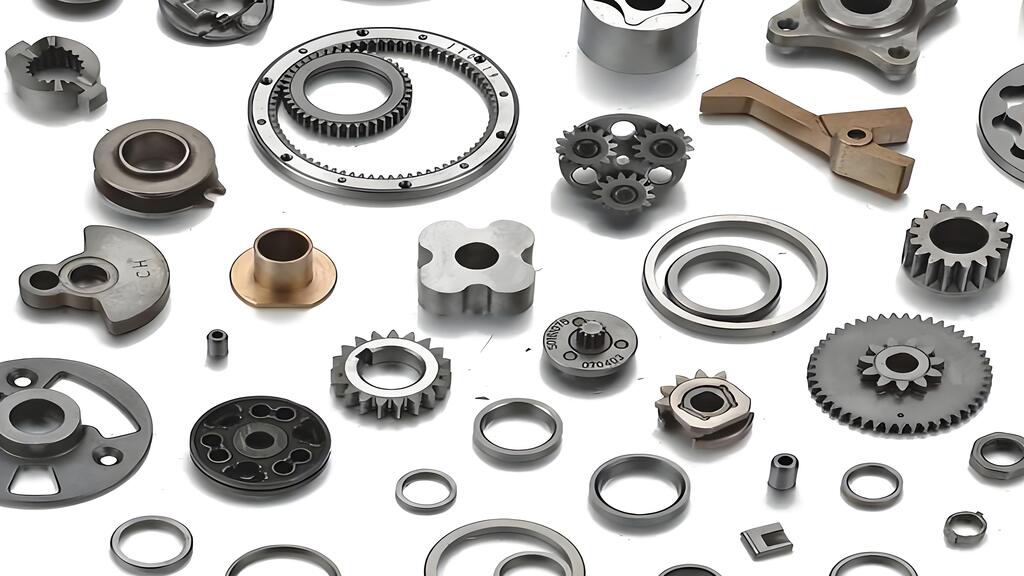


Welding powder metal

Welding Powder Metal presents distinct challenges that set it apart from traditional solid metals. Researchers have found that changes in welding current and ion gas levels can alter melt pool flow, making control difficult. Advanced models demonstrate a 97.4% accuracy in predicting these complex dynamics. Enhanced techniques, such as beam oscillation at 0.8 mm amplitude and 300 Hz frequency, can reduce macrosegregation by up to 300%. These findings highlight the importance of understanding material behavior when welding powder metal.
Key Takeaways
- Porosity is the biggest challenge in welding powder metal, as pores weaken welds and trap gases. Controlling heat input and cleaning parts well helps reduce these defects.
- Choosing the right welding method matters. TIG and resistance welding offer precise heat control and strong joints, while laser welding suits complex parts needing high accuracy.
- Preheating powder metal parts before welding lowers cracking risks by driving out moisture and softening the material. Post-weld heat treatment also improves strength and reduces stress.
- Proper joint design and material preparation improve weld quality. Using simulation tools and selecting suitable alloys help create durable, fatigue-resistant welds.
- Careful control of heat input during welding ensures stable molten pools and strong bonds. Monitoring voltage, current, and travel speed prevents defects and boosts weld reliability.
How Powder Metal Parts Are Made
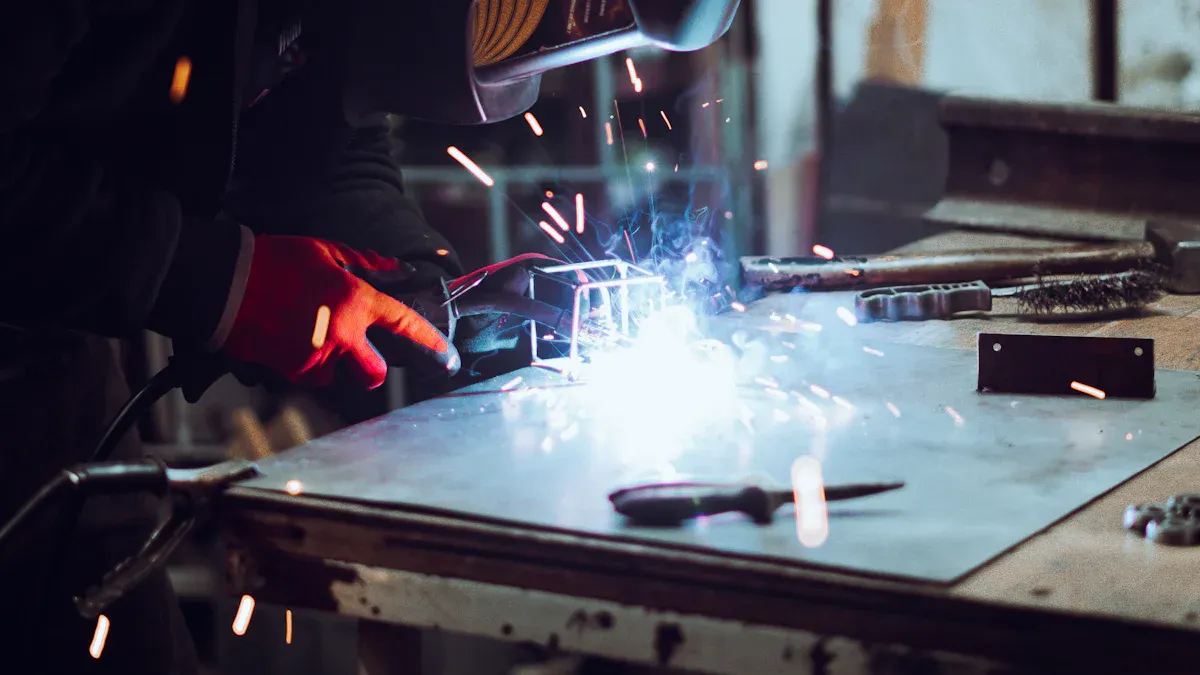
Powder Metallurgy Process Overview
Powder Metallurgy stands as a cost-effective and versatile manufacturing process. This method dates back to ancient times, with roots as early as 3000 BC. Today, it enables the production of complex and high-performance components. The process typically follows a well-defined sequence:
- Manufacturers produce metal powders using techniques such as ball milling or gas atomization. These methods yield fine powders suitable for advanced applications.
- The next step involves mixing the powders with additives to achieve desired properties.
- Compaction forms the mixed powders into a specific shape using high pressure.
- Sintering heats the compacted part in a controlled atmosphere, bonding the particles and increasing strength.
- Secondary processing, such as forging or machining, further enhances the part’s properties or achieves precise dimensions.
Several manufacturing techniques exist within powder metallurgy. The table below summarizes the most common methods and their characteristics:
| Manufacturing Technique | Description | Production Statistics / Notes |
|---|---|---|
| Press-and-Sinter | Blends fine metal powders with additives, presses into a die, then sinters. Produces parts with 5–15% porosity. | Dominates global PM volume with a 93% share in 2019. |
| Powder Forging (PF) | Hot forges a preform made by press-and-sinter to full density. | Improves density and mechanical properties. |
| Hot Isostatic Pressing (HIP) | Fills powder in a metallic can, evacuates, seals, heats, and applies high gas pressure. | Produces fully dense parts; used industrially since the 1970s–80s. |
| Metal Injection Molding (MIM) | Mixes fine powder with binder, injects into molds, removes binder, then sinters. | Produces 95–99% dense parts with fine surface finish. |
| ECAS | Uses electric currents to sinter powders rapidly. | Enables fast production but limited to simple shapes. |
Key Properties of Powder Metal Parts
Powder metal parts display unique characteristics that influence their performance and suitability for various applications. Researchers have studied a wide range of metal powders, including stainless steel, zinc, tin, aluminum, copper, manganese, iron, bronze, titanium, and molybdenum. These studies provide detailed statistical data on particle size distribution, morphology, and flow properties.
- Particle size and shape play a critical role in flowability, packing density, and sintering behavior.
- Flow indexes, measured with devices like the Ring Shear Tester and Powder Flow Tester, show that results depend on both the material and the testing method.
- Packing density and green strength affect shrinkage and final product density.
- The type of powder and its cohesiveness significantly impact the mechanical properties of the finished part.
- Precise characterization of powders supports consistent quality, especially in additive manufacturing and advanced powder metallurgy.
Note: Understanding these properties helps manufacturers select the right process and optimize part performance.
Challenges in Welding Powder Metal
Porosity and Density Issues
Porosity remains one of the most significant obstacles in welding powder metal. Powder metallurgy parts often contain interconnected pores that reduce thermal conductivity and weaken the bonds between particles. These pores act as stress concentrators, making the heat-affected zone more susceptible to cracking during welding. Researchers use metrics such as pore volume, pore count, equivalent pore diameter, and sphericity index to characterize porosity. A sphericity index close to 1 indicates spherical pores, while lower values reveal irregular shapes that can further compromise mechanical behavior.
Studies using finite element modeling and 3D X-ray tomography have shown that pore morphology and distribution directly affect tensile properties and ductility. Pore clustering reduces tensile strength and fatigue resistance. In laser powder bed fusion (LPBF) processes, observed densities in 316L stainless steel parts can reach up to 99.63%, but the porosity structure depends heavily on laser power and energy density. Even small changes in build rate, such as from 0.2 to 0.5 mm³/s, can significantly alter defect formation and density. Defects like lack of fusion, balling, and keyhole porosity often arise from improper process parameters. These defects lower fracture toughness and elongation, making precise control of welding parameters essential for high-quality results.
Note: Porosity-related defects in powder metal welds can persist even after post-processing, emphasizing the need for careful parameter optimization.
Contaminants and Oxides
Contaminants present another major challenge in welding powder metal. Lubricants, plating fluids, and oils often become trapped in the internal pores of powder metal parts. If not removed before welding, these contaminants can degrade weld quality and introduce unwanted inclusions. Cleaning the parts thoroughly before welding is critical to minimize these risks.
Welding fumes generated during the process contain various metal oxides, including manganese and iron oxides. Research indicates that manganese oxides contribute to neurotoxicity, while iron oxide (Fe2O3) can promote lung tumors in animal studies. The type of filler material used during welding also influences the concentration of contaminants and oxides in the fumes. For example, metal cored wires tend to emit higher levels of manganese and carbon monoxide compared to self-shielded wires, which may have higher concentrations of phosphorus and aluminum. These differences affect both the toxicity of the fumes and the overall weld quality.
| Welding Parameter | Metal Cored Wire Emissions | Self-Shielded Wire Emissions | Key Contaminants Highlighted |
|---|---|---|---|
| Total Dust | Higher | Lower | Particulate matter exposure |
| Carbon Monoxide (CO) | Elevated | Lower | Gas phase pollutant differences |
| Manganese (Mn) | High | Lower | Mn oxides linked to neurotoxicity |
| Phosphorus (P) | Lower | Higher | Elemental variation by filler material |
| Aluminum (Al) | Lower | Higher | Metal oxide presence affecting toxicity |
Tip: Removing surface and internal contaminants before welding powder metal parts improves weld integrity and reduces health hazards.
Carbon Content and Alloying Elements
The composition of powder metal parts, especially carbon content and alloying elements, plays a crucial role in weldability and final properties. Parts with less than 0.5% carbon are generally easier to weld. Higher carbon content increases the risk of cracking and makes the welding process more challenging.
Chromium, titanium, and niobium are common alloying elements in powder metal parts. In stainless steel weld metals, chromium promotes carbide formation at grain boundaries, which increases hardness but can also make the weld more brittle. Experimental data show that adding carbon nanotubes and increasing chromium content can boost hardness by up to 32% compared to base stainless steel. In nickel-based alloys, higher carbon levels lead to the formation of carbides such as (Nb, Ti)C and Cr23C6. These carbides enhance tensile strength and hardness but reduce plasticity.
Minor elements like titanium and niobium improve tensile strength and elongation, while elements such as sulfur, phosphorus, and boron can segregate at grain boundaries, causing embrittlement and lowering ductility. Molybdenum and niobium also promote the formation of Laves phases, which refine grain boundaries and improve ultimate strength. The complex interplay between carbon and alloying elements requires careful control during welding powder metal to achieve the desired mechanical performance.
Best Welding Methods for Welding Powder Metal
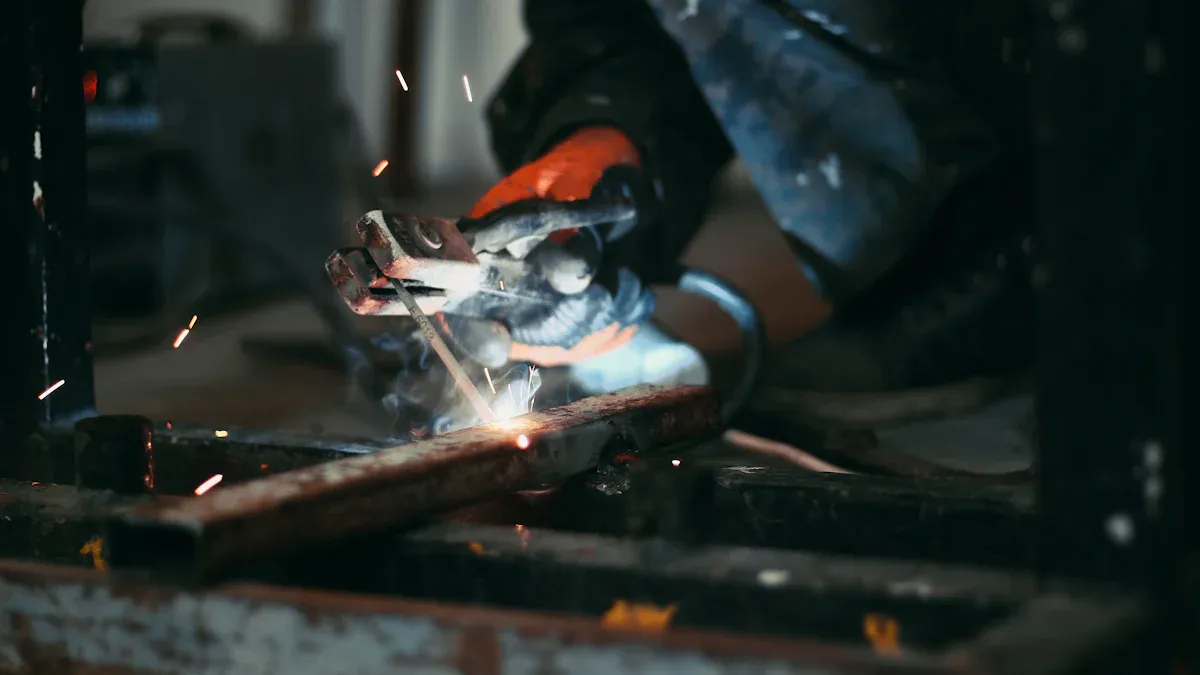
Selecting the right welding method is essential for achieving strong, reliable joints in powder metal parts. Each technique offers unique advantages and addresses specific challenges related to porosity, contaminants, and alloy composition. The following sections outline the most effective welding methods for powder metal applications.
TIG Welding
Tungsten Inert Gas (TIG) welding provides precise control over heat input and arc stability. Operators often choose TIG welding for powder metal parts that require clean, high-quality welds. The non-consumable tungsten electrode produces a focused arc, which helps minimize the risk of overheating and distortion. TIG welding works well with stainless steel, nickel alloys, and other powder metal compositions that demand careful temperature management.
TIG welding allows for the use of filler materials that match the base metal. This compatibility reduces the risk of brittle welds and improves mechanical properties. The inert shielding gas, usually argon or a mixture with helium, protects the weld pool from atmospheric contamination. This protection is especially important for powder metal parts, which may contain residual oxides or trapped gases.
Tip: For best results, operators should preheat powder metal parts before TIG welding. Preheating helps drive out moisture and reduces the risk of porosity in the finished weld.
MIG Welding
Metal Inert Gas (MIG) welding offers high productivity and ease of automation. MIG welding uses a continuously fed wire electrode and a shielding gas to create a stable arc. This method suits powder metal parts with moderate to high density, where consistent weld quality is required for large production runs.
MIG welding can bridge small gaps and accommodate minor surface irregularities. The process delivers higher deposition rates than TIG welding, making it suitable for thicker sections or parts with complex geometries. Operators can select filler wires that match the chemical composition of the powder metal, which helps maintain strength and ductility in the welded joint.
MIG welding requires careful control of voltage, wire feed speed, and shielding gas flow. Improper settings can lead to excessive spatter, incomplete fusion, or increased porosity. Regular cleaning of the workpiece surface and removal of lubricants or oxides further improve weld quality.
Note: MIG welding works best on powder metal parts with low to moderate porosity. High porosity can trap gases and lead to weld defects.
Resistance Welding
Resistance welding uses electrical current and pressure to join powder metal parts. This method includes spot welding, seam welding, and projection welding. Resistance welding excels at joining high-volume components, such as automotive gears and electrical contacts, where speed and repeatability matter.
Repeated resistance seam welding can significantly improve the mechanical properties of powder metal joints. Scientific studies on Al 1060 powder metal show that after ten welds, porosity drops from nearly 1% to less than 0.02%. Grain size decreases from 34.3 μm to 8.7 μm, while dislocation density more than doubles. Ultimate tensile strength rises from 63.5 MPa to 93.3 MPa, and elongation increases from 4.5% to 34.3%. These improvements demonstrate the effectiveness of resistance welding in reducing defects and enhancing ductility.
| Parameter | R0 Sample (Initial) | R10 Sample (After 10 Welds) |
|---|---|---|
| Porosity (%) | 0.998 | 0.017 |
| Grain Size (μm) | 34.3 | 8.7 |
| Dislocation Density (m⁻²) | 4.355 × 10¹⁴ | 9.436 × 10¹⁴ |
| Ultimate Tensile Strength (MPa) | 63.5 ± 0.5 | 93.3 ± 0.5 |
| Elongation (%) | 4.5 ± 0.1 | 34.3 ± 0.1 |
Resistance welding also minimizes the introduction of foreign materials, since it does not require filler metals or shielding gases. This feature makes it ideal for applications where cleanliness and electrical conductivity are critical.
Callout: Resistance welding can transform the microstructure of powder metal parts, leading to stronger, more ductile welds with minimal porosity.
Laser Welding
Laser welding stands out as a highly precise and efficient method for joining powder metal components. This technique uses a concentrated laser beam to create a small, controlled molten zone, which results in minimal heat-affected areas and reduced distortion. Operators can adjust welding speed, laser power, and beam offset to optimize joint quality. Quantitative studies show that these parameters directly influence the formation of intermetallic compounds and the mechanical strength of the weld. For example, tensile strengths in aluminum-iron powder metal joints can reach up to 160 MPa when operators fine-tune the process. Offset laser beam positioning further reduces brittle phases, enhancing joint durability.
Researchers have used both empirical and numerical approaches to analyze laser welding in powder metal applications. High-power laser welding on thick steel plates demonstrates a clear link between thermal cycles and microstructural evolution. Numerical modeling tools, such as SYSWELD, help engineers predict and minimize deformations and defects. Metallographic tests validate these models, confirming that precise control over laser parameters leads to improved weld quality. Studies also highlight the importance of ultrasonic treatment, which refines grain structure and mitigates defects. These findings provide a scientific foundation for optimizing laser welding processes in powder metallurgy.
Note: Laser welding offers unmatched precision for powder metal parts, but success depends on careful parameter selection and process control.
Projection Welding
Projection welding uses localized heat and pressure to join powder metal parts at specific points. Engineers design small projections or raised areas on one or both workpieces. When current passes through these projections, they concentrate heat generation, causing rapid melting and solidification at the contact points. This method ensures consistent weld nugget formation and minimizes distortion in the surrounding material.
Projection welding excels in high-volume manufacturing environments, such as the automotive and electrical industries. The process delivers repeatable results and supports automation. Powder metal parts benefit from this technique because it limits the exposure of the entire component to high temperatures, preserving the integrity of the base material. Operators can join complex assemblies with multiple welds in a single cycle, increasing productivity.
A key advantage of projection welding lies in its ability to accommodate variations in part geometry and density. The process tolerates minor surface irregularities and porosity, which are common in powder metallurgy. By focusing heat at discrete points, projection welding reduces the risk of large-scale defects and maintains the mechanical properties of the joint.
Tip: Proper design of projections and careful alignment of electrodes are critical for achieving strong, reliable welds in powder metal assemblies.
Powder Welding Techniques
Powder welding techniques encompass a range of processes that use metal powders as filler material to build up or repair surfaces. Common methods include laser cladding and plasma transferred arc (PTA) welding. In these processes, operators feed metal powder into a molten pool created by a heat source, such as a laser or plasma arc. The powder melts and fuses with the substrate, forming a dense, metallurgically bonded layer.
Scientific studies provide detailed performance data on powder welding methods. For instance, laser cladding produces coatings with refined microstructures and enhanced wear resistance. Researchers report improvements in hardness and corrosion resistance, supported by statistical analyses of mechanical properties. Plasma transferred arc welding achieves similar results, with the added benefit of high deposition rates and strong metallurgical bonds.
Market research reports offer a comprehensive overview of powder welding techniques, segmenting the industry by application, material type, and region. These reports combine qualitative insights from industry experts with quantitative data from laboratory testing and field performance. The findings confirm that powder welding techniques deliver reliable results across diverse industries, including aerospace, automotive, and heavy machinery.
Callout: Powder welding techniques enable the restoration and enhancement of powder metal parts, extending their service life and improving performance.
Tips for Successful Welding Powder Metal
Preheating and Post-Heating
Preheating stands as a critical step in welding powder metal. Raising the temperature of the workpiece before welding reduces the risk of cracking by lowering hardness in the heat-affected and fusion zones. Studies show that preheating gray cast iron between 300°C and 600°C prevents the formation of brittle microstructures, such as martensite and carbides. Post-weld heat treatment further enhances machinability and relieves residual stresses. Research confirms that controlled preheating and post-heating slow the cooling rate, which leads to improved weld quality and fewer cracks. Operators should monitor temperatures closely, as higher preheating levels produce better results in both hardness reduction and microstructure control.
Tip: Always combine preheating with proper shielding gas coverage to protect the weld pool from atmospheric contamination and minimize porosity.
Joint Design Considerations
Effective joint design directly influences the strength and durability of welded powder metal parts. Engineers use fatigue data from hundreds of tests on various joint types—such as single V-butt, double V-butt, cruciform, and T-joints—to optimize performance. Plate thickness, weld size, and electrode selection all play vital roles. For example, simulation data reveal that weld sizes must increase by up to 50% under higher loads to maintain structural integrity. Safety factors between 2 and 3 are recommended for critical applications, including aerospace and nuclear sectors. The use of CAD modeling and real-time simulation allows for iterative adjustments, ensuring welds withstand dynamic and cyclic loads. Accurate material property data and advanced modeling techniques help predict deformation and optimize joint design, reducing material waste and testing costs.
- Key joint design strategies:
- Select appropriate joint type based on load and application.
- Adjust weld size and electrode type to match service conditions.
- Use simulation tools to refine design and improve fatigue resistance.
Material Selection and Preparation
Material selection and preparation form the foundation of successful welding powder metal. Research recommends using nickel-based, cobalt-based, or iron-based alloy powders with tailored chemical compositions for high-temperature performance and crack resistance. Operators must control process variables, such as tempering temperatures and current stability, to ensure consistent results. Proper cleaning and slag removal after each welding layer prevent defects. Metallographic preparation, including microscopic checks, helps control porosity and supports quality control. Laser Metal Deposition studies highlight the importance of optimizing laser power, scanning speed, and powder feed rates for efficient deposition. These practices, combined with regular equipment maintenance and adherence to industry standards, lead to durable, high-quality welds.
Note: Certified welders and inspectors, along with structured training programs, further enhance weld quality and safety in welding powder metal applications.
Controlling Heat Input
Precise control of heat input stands as a cornerstone for the successful welding of powder metal parts. Excessive heat can cause rapid temperature rise, leading to an unstable molten pool and defects such as porosity, cracking, or even structural collapse. Insufficient heat, on the other hand, may result in incomplete fusion and weak joints. Operators must monitor and adjust heat input in real time to maintain weld quality.
Modern welding systems use feedback mechanisms to regulate heat input. Sensors track molten pool temperature, size, and deposition height. Advanced controllers, such as PID or state feedback systems, automatically adjust laser power or current to keep the molten pool stable. This approach ensures uniform track morphology and consistent part quality, especially in additive manufacturing processes.
Heat input is not just a qualitative factor; it is measured using specific formulas. The American system calculates heat input in Joules per inch or millimeter. The formula is:
Heat Input = (Voltage × Current × 60) / Travel Speed For example, welding at 24 volts, 120 amps, and a travel speed of 9 inches per minute results in a heat input of 19.2 kJ/inch. This value directly influences cooling rates, microstructure, and mechanical properties of both the weld and the heat-affected zone.
Tip: Operators should always record and review heat input values during welding. Consistent monitoring helps prevent defects and ensures that each weld meets mechanical performance standards.
A well-controlled heat input strategy leads to stronger, more reliable powder metal welds. It also reduces the risk of costly rework or part failure in demanding applications.
Successful welding of powder metal parts depends on a clear understanding of material properties, careful planning, and the use of advanced welding techniques. The table below highlights critical factors that influence weld quality:
| Critical Factor | Summary of Findings | Recommended Parameters / Notes |
|---|---|---|
| Porosity | Weakens welds and reduces thermal conductivity. | Minimize porosity for better results. |
| Contaminants | Cause weld failure if present. | Keep parts clean before welding. |
| Carbon Content | High carbon complicates welding. | Maintain carbon at 0.5% or less. |
| Density | Higher density yields stronger welds. | Target at least 6.8 g/cc. |
| Welding Techniques | Some methods reduce defects and emissions. | Use pulsed plasma arc or resistance projection welding. |
| Planning & Skill | Knowledge and experience are essential. | Invest in training and preparation. |
Advanced welding methods, such as pulsed spray GMAW, lower hazardous emissions and operational costs while improving weld quality. Real-time monitoring and data-driven optimization further enhance process reliability. Post-weld validation uses visual inspection, leak testing, mechanical tests, and non-destructive evaluation to confirm weld integrity and performance. For critical applications, consulting experts or conducting thorough testing ensures the highest standards of quality and safety.
FAQ
What is the main challenge when welding powder metal parts?
Porosity presents the biggest challenge. Pores reduce strength and can trap gases, leading to weak welds. Operators must control heat input and prepare surfaces carefully to minimize these defects.
Can all powder metal parts be welded successfully?
Not every powder metal part welds well. High porosity, excessive carbon, or certain alloying elements can make welding difficult. Engineers should evaluate material composition and density before choosing a welding method.
Which welding method works best for powder metal components?
TIG and resistance welding often deliver the best results. These methods provide precise heat control and minimize contamination. Laser welding also offers high precision for complex or delicate parts.
How should operators prepare powder metal parts before welding?
Operators should clean parts thoroughly to remove oils, lubricants, and oxides. Preheating the workpiece helps drive out moisture and reduces the risk of cracking or porosity.
Are special safety precautions needed when welding powder metal?
Yes. Welding powder metal can release hazardous fumes, including manganese and iron oxides. Operators should use proper ventilation, wear protective gear, and follow safety guidelines to reduce exposure risks.