

What is Iron Powder?

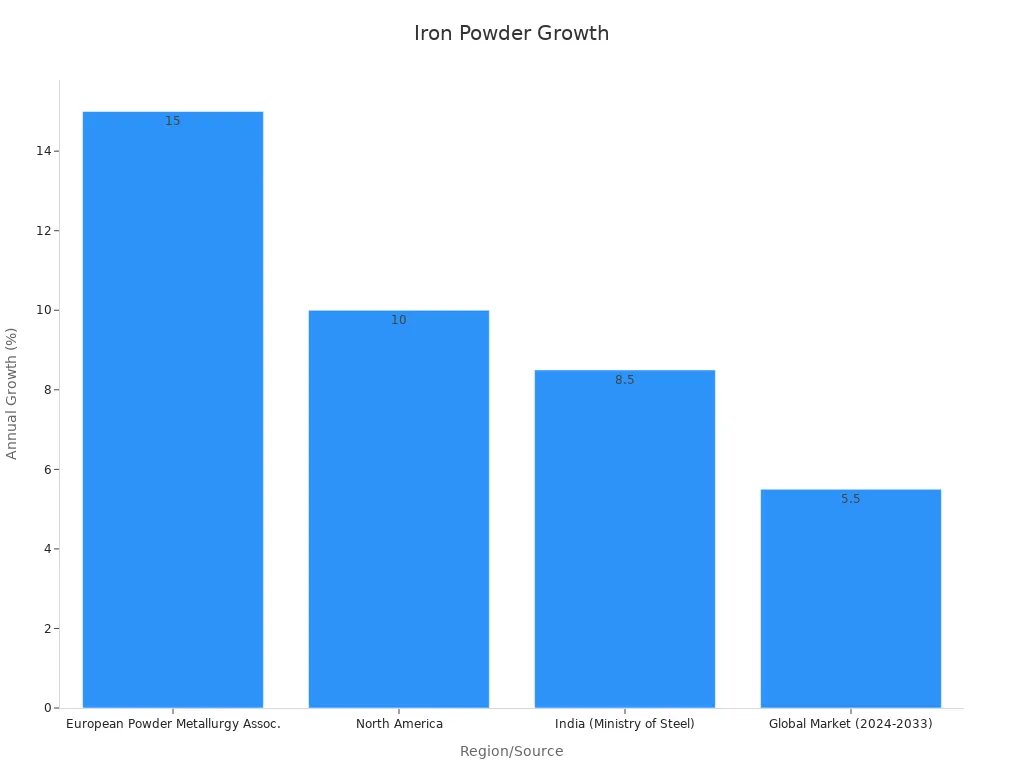
Iron powder consists of finely divided metallic iron particles. Manufacturers and engineers value this material for its versatility and performance in critical applications. Industries such as metallurgy, electronics, pharmaceuticals, and automotive drive global demand, which reached $4.5 billion in 2023 and is projected to grow steadily. The following chart illustrates the annual growth rates of iron powder usage across major regions:
Key Takeaways
- Iron powder comes in several types—atomized, reduced, electrolytic, and carbonyl—each with unique purity, particle size, and shapes suited for different industries.
- Advanced production methods like atomization, reduction, electrolysis, and carbonyl processes control powder quality, purity, and particle characteristics for specific applications.
- Iron powder plays a vital role in powder metallurgy, chemical manufacturing, magnetic materials, additive manufacturing, and food fortification, driving strong market growth.
- Safe handling and storage of iron powder require dust control, proper ventilation, sealed containers, and employee training to prevent accidents and maintain quality.
- Choosing the right iron powder and supplier involves evaluating technical needs, market trends, certifications, and supplier performance to ensure consistent quality and success.
Types of Iron Powder
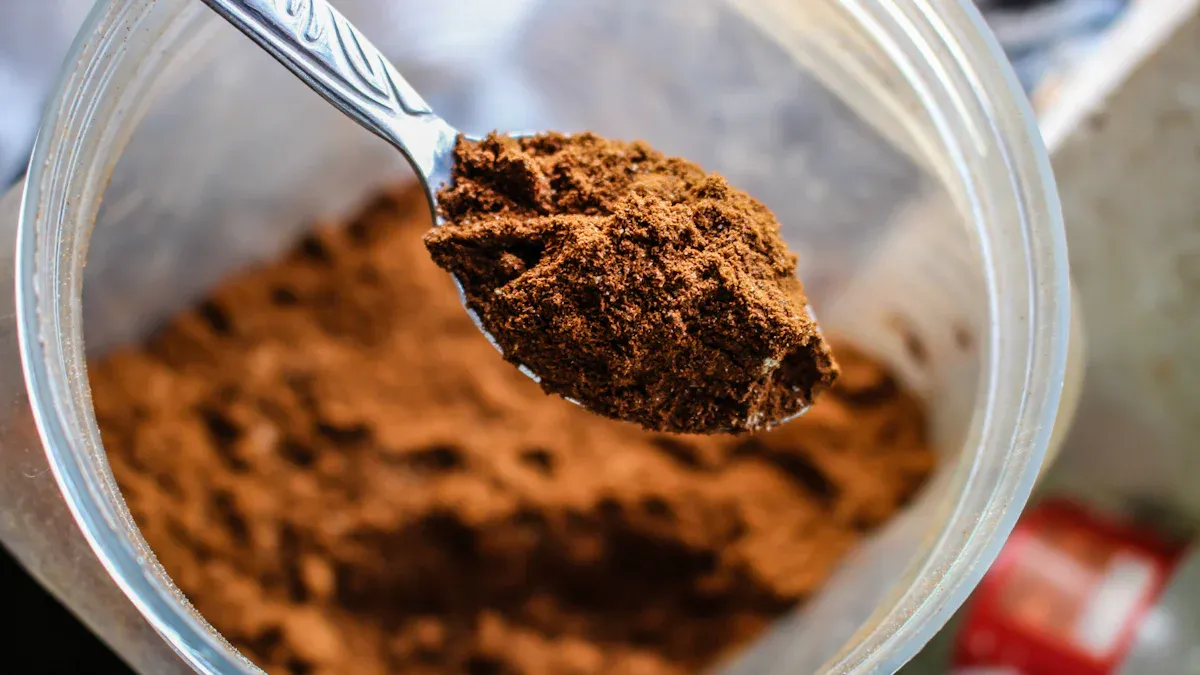
Iron powder comes in several forms, each with unique characteristics and applications. Manufacturers classify these powders based on their production methods and resulting properties. The most common types include atomized, reduced, and electrolytic iron powders.
Atomized Iron Powder
Atomized iron powder dominates the global market due to its high purity and consistent particle morphology. Producers typically use water or gas atomization to create fine particles. Water atomization remains the most prevalent method, offering a balance between cost and quality. Gas atomization produces finer powders with better shape but at a higher cost. The Asia-Pacific region, especially China, leads in atomized powder production because of advanced industrial capabilities.
Atomized iron powder supports industries such as automotive, aerospace, and additive manufacturing. Its applications range from powder metallurgy and welding to magnetic materials and chemical manufacturing. The powder’s particle size distribution, flowability, and density make it ideal for high-performance components.
| Metric / Aspect | Details / Values |
|---|---|
| Market Share | Largest among the iron powder types |
| Dominant Production Technology | Water atomization |
| Key Application Segments | Powder Metallurgy, welding, and additive manufacturing |
| Regional Production Dominance | Asia-Pacific (notably China) |
Reduced Iron Powder
Reduced iron powder results from the chemical reduction of iron ore. This process yields a powder with irregular particle shapes and moderate purity. The automotive and metallurgy sectors rely on reduced iron powder for its cost-effectiveness and steady supply. Market trends show stable demand, especially in regions with strong automotive industries.
- Key features:
- Irregular particle shape
- Moderate purity
- Cost-effective for large-scale applications
Electrolytic Iron Powder
Electrolytic iron powder stands out for its exceptional purity and controlled particle size. Manufacturers use electrolysis to deposit iron onto cathodes, then collect and process the resulting powder. Scientific studies confirm that annealed electrolytic iron powders offer superior ductility, compressibility, and surface area compared to other types. These properties make electrolytic iron powder valuable in electronics, magnetic materials, and specialized metallurgy.
| Parameter | Specification/Value |
|---|---|
| Purity (Assay) | Minimum 99% |
| Lead | Less than 1 pPm |
| Arsenic | Less than 1 ppm |
| Mercury | Less than 1 ppm |
| Certifications | ISO 9001, ISO 14001, GMP, HALAL, KOSHER |
Electrolytic iron powder’s high purity and low impurity levels support its use in demanding applications where quality is critical.
Iron Powder Production Methods
Iron powder manufacturers use several advanced production methods to achieve specific particle characteristics and purity levels. Each method influences the powder’s morphology, density, and suitability for different applications.
Atomization Process
The atomization process stands as the most widely adopted technique for producing iron powder with near-spherical particles and high purity. In this method, molten iron is disintegrated into fine droplets by a high-pressure jet of water or inert gas. These droplets rapidly solidify into powder particles. Gas atomization produces powders with particle sizes mainly between 10 and 150 microns, while water atomization can yield a broader range. The process achieves atomization yields of 50% or higher, making it cost-effective for large-scale production. Chemical purity often exceeds 99% for inert gas atomized powders, and the resulting microstructure benefits additive manufacturing and metal injection molding.
Atomized powders offer high bulk density and excellent flowability, supporting their use in 3D printing and powder metallurgy.
| Performance Indicator | Description | Typical Value/Range |
|---|---|---|
| Particle Size Distribution | Size range of powder particles | 10–150 µm (gas atomization) |
| Atomization Yield | Ratio of compliant powder to initial metal charge | 50% or higher |
| Chemical Purity | Purity level of powder | >99% |
Reduction Process
The reduction process produces iron powder by chemically reducing iron oxides, typically using hydrogen or carbon monoxide as reducing agents. This method yields powders with irregular, sponge-like particles and high purity. The process involves three main steps: direct reduction to produce carbon-free direct reduced iron (DRI), melting separation to remove impurities, and slag refining for further purification. Hydrogen-based reduction at elevated temperatures achieves high desulfurization rates (96–98%) and produces iron with purity up to 99.99%. The process efficiently removes impurities such as carbon, sulfur, and phosphorus, making the powder suitable for powder metallurgy and chemical catalysis.
| Element | Pure Iron (Reduction) | Commercial Electrolytic Iron |
|---|---|---|
| C | 0.0024% | 0.0057% |
| S | 0.0005% | 0.0018% |
| Fe | 99.99% | 99.92% |
Electrolytic Process
The electrolytic process creates iron powder with the highest purity and controlled particle size. In this method, iron is deposited onto cathodes from an electrolyte solution and then collected as powder. The process consumes about 1.83 kWh per kilogram of iron, with additional energy required for overpotential and electrolyte management. Electrolytic iron powder features dendritic, flaky particles and purity levels above 99%. The process allows precise control over impurities and particle morphology, making it ideal for high-end components, electromagnetic shielding, and chemical catalysts.
Electrolytic iron powder production offers a unique combination of purity and particle control, supporting demanding applications in electronics and specialized metallurgy.
Carbonyl Process
The carbonyl process produces some of the purest and most uniform iron powders available. This method relies on a chemical reaction between carbon monoxide gas and finely divided iron at elevated temperatures. The process forms iron pentacarbonyl, a volatile compound that decomposes upon heating to yield extremely fine iron particles.
Manufacturers prefer the carbonyl process for applications that demand high purity and precise particle control. The process involves several key steps:
- Reaction: Carbon monoxide reacts with iron to form iron pentacarbonyl gas.
- Purification: The gas passes through filters to remove impurities.
- Decomposition: Controlled heating breaks down the iron pentacarbonyl, depositing pure iron powder.
- Collection: The resulting powder is collected and classified by particle size.
Note: The carbonyl process can produce particles as small as 1 micron, which supports advanced applications in electronics and magnetic materials.
The carbonyl process offers several advantages:
- Produces highly spherical particles with narrow size distribution.
- Achieves purity levels above 99.5%.
- Allows precise control over particle size and morphology.
| Feature | Carbonyl Iron Powder Value |
|---|---|
| Typical Purity | >99.5% |
| Particle Size Range | 1–10 µm |
| Particle Shape | Spherical |
| Main Applications | Electronics, magnetic materials, catalysts |
Engineers often select carbonyl iron powder for electromagnetic interference (EMI) shielding, radar absorbing materials, and high-performance catalysts. The powder’s unique properties also make it suitable for specialized 3D printing and advanced metallurgy.
Tip: Due to its fine particle size and high reactivity, carbonyl iron powder requires careful handling and storage to prevent oxidation and ensure safety.
Key Properties of Iron Powder
Particle Size and Shape
Particle size and shape play a crucial role in determining the performance of iron powder in industrial applications. Manufacturers use advanced measurement techniques such as dynamic imaging analysis, laser diffraction, and scanning electron microscopy to characterize these properties. Each method provides unique insights into particle morphology, with dynamic imaging analysis offering high-throughput data on size and shape parameters like aspect ratio and sphericity. Laser diffraction estimates size distributions based on light scattering, while sieve analysis remains common for coarser powders.
The following table summarizes how particle size and shape influence application outcomes:
| Property | Specification / Range | Influence on Application |
|---|---|---|
| Particle Size & Distribution | 10–150 microns | Affects surface finish, flowability, and processing |
| Particle Shape | Spherical or sponge-like | Impacts density, flowability, and product quality |
Spherical particles typically provide better flowability and higher density, which benefit additive manufacturing and powder metallurgy. Irregular or sponge-like shapes enhance compressibility, making them suitable for sintered components.
Purity and Composition
Purity and composition define the suitability of iron powder for specialized uses. High-purity grades, with iron content above 99%, support sensitive applications in electronics and advanced metallurgy. Compositional analysis often includes parameters such as phosphorus, sulfur, oxygen, and titanium content. Advanced testing methods like X-ray fluorescence and inductively coupled plasma analysis ensure quality control.
| Parameter | Standard/Threshold | Application/Notes |
|---|---|---|
| Iron Content | >69% (high purity) | Electronics, renewable energy, metallurgy |
| Phosphorus | <0.03% | Specialty alloys |
| Oxygen Content | <0.005% | Magnetic powders |
| Metallic Iron Purity | Up to 99.5% | Advanced processing facilities |
Regional standards and processing methods can affect these thresholds. Manufacturers tailor iron powder grades by controlling impurities to meet the demands of different industries.
Magnetic and Chemical Properties
Magnetic and chemical properties set iron powder apart from other materials. Vibrating sample magnetometers measure magnetic strength, providing values for saturation magnetization and magnetic anisotropy. For example, saturation magnetization values range from 205 to 280 Am²/kg, depending on particle size and surface chemistry. These measurements confirm the strong magnetic response required for electromagnetic applications.
Chemical reactivity also matters. Surface hydrides and amido ligands on iron nanoparticles influence both magnetization and stability. The presence of these species can enhance or reduce the powder’s effectiveness in catalytic or magnetic roles.
Note: High magnetic strength and controlled chemical reactivity make iron powder essential for applications in electronics, catalysis, and magnetic materials.
Iron Powder Applications
Powder Metallurgy
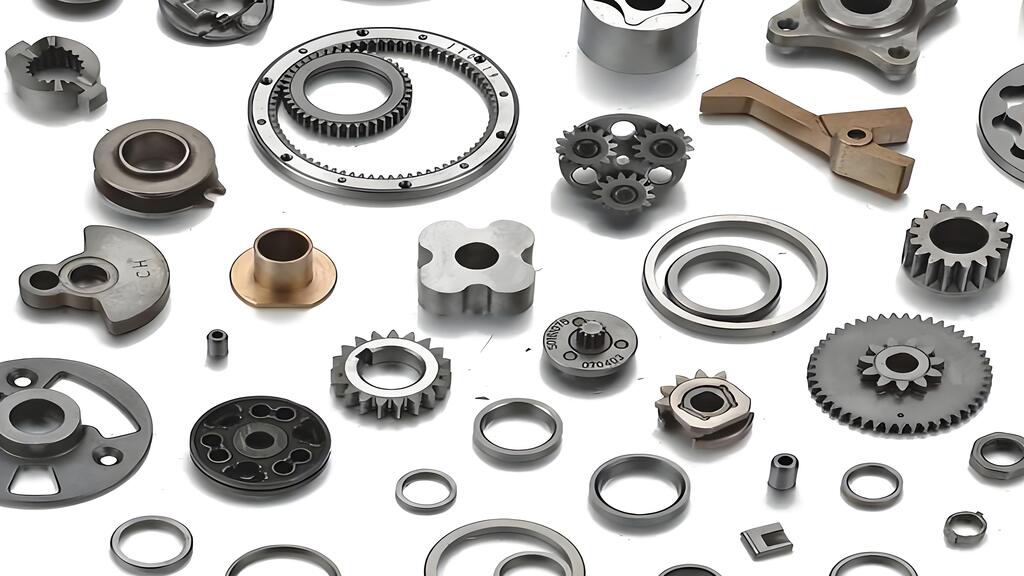
Powder metallurgy stands as the largest application segment for iron powder, accounting for about 80% of its global use. This process enables manufacturers to produce complex, near net shape components with minimal waste and reduced need for secondary machining. Automotive and industrial sectors rely heavily on powder metallurgy for parts such as synchronizing hubs, clutch cones, and gears.
Engineers select iron powder for powder metallurgy because it offers excellent compressibility and strength. By controlling powder characteristics, compacting pressure, and sintering conditions, they can tailor the density and mechanical properties of finished parts. Advances in sintering and powder treatment have improved microstructure homogeneity, which enhances fatigue strength and load-bearing capacity—critical for automotive and structural applications.
Powder metallurgy with iron powder delivers cost-effective solutions, strong wear resistance, and high production efficiency. These benefits drive its adoption in the automotive sector, which held a 43.2% market share in 2023.
The following table summarizes key performance figures and market statistics for powder metallurgy applications:
| Metric/Characteristic | Value/Description |
|---|---|
| Market Share of PM Parts | About 80% of iron powder applications |
| Particle Size Range | 20-200 μm |
| Iron Purity | >99% Iron |
| Efficiency Improvements | Near net shape parts, reduced machining, strong wear resistance |
| Automotive Sector Share (2023) | 43.2% |
| Global Market Size (2024) | USD 6.9 billion |
| CAGR (2024-2033) | 5.5% |
Emerging trends include the use of prealloyed iron powders, which allow for heat-treatable, high-strength components without sacrificing compressibility. Hot isostatic pressing (HIP) after sintering further reduces porosity, improving strength and fatigue resistance.
Chemical Industry
The chemical industry represents a significant and growing market for iron powder, particularly in regions with robust industrial bases such as Asia Pacific. Manufacturers use high purity iron powder as a catalyst and reducing agent in various chemical processes. Its superior reactivity and minimal impurities make it ideal for producing pharmaceuticals, dyes, and specialty chemicals.
Market reports highlight the importance of product purity in chemical applications. High purity iron powder dominates demand in the chemical, pharmaceutical, and food sectors. The Asia Pacific region leads global production and consumption, driven by industrial growth in China, India, and Japan.
The chemical sector continues to drive demand for high-quality, environmentally friendly iron powder products. Regulatory and technological advancements further support its critical role in chemical manufacturing.
Year-on-year growth rates and market share by application segment confirm the chemical industry's increasing reliance on iron powder. Producers respond to this demand by offering tailored grades that meet stringent purity and performance requirements.
Magnetic Materials
Iron powder plays a vital role in the development of advanced magnetic materials. Researchers and engineers use it to produce soft magnetic composites, transformer cores, sensors, and electromagnetic devices. The magnetic properties of iron powder, such as high saturation magnetization and permeability, make it suitable for next-generation energy and electronic systems.
- Studies confirm that powder characteristics and sintering parameters directly influence magnetic properties like coercivity and permeability.
- Grain size and domain structure optimization enhance the performance of soft magnetic materials.
- Advanced sintering techniques improve the homogeneity of magnetic domains, supporting applications in transformers, sensors, and recording media.
Iron powder enables the production of magnetic materials with tailored properties, supporting innovation in energy, automotive, and electronics industries.
The following market data highlights the broader impact of iron powder in magnetic and related applications:
| Market Segment / Region | Key Statistic / Performance Figure |
|---|---|
| Automotive Sector | 43.2% market share in 2023 |
| Asia-Pacific Region | 38.6% market share valued at USD 1.9 billion in 2023 |
| Global Market Size (2023-24) | USD 6.43 to 6.9 billion |
| CAGR (2024-2033) | Approximately 5.2% to 5.5% |
| Projected Market Revenue (2033) | USD 11.2 billion |
Engineers continue to optimize iron powder for magnetic applications, ensuring high performance in demanding environments such as automotive electrification and renewable energy systems.
Additive Manufacturing
Additive manufacturing (AM), often called 3D printing, has transformed how industries design and produce metal components. Engineers use metal powders as the primary feedstock for AM processes such as selective laser melting (SLM) and binder jetting. The performance of these powders directly affects the quality and reliability of printed parts.
Manufacturers rely on consistent material characteristics to ensure high-quality AM builds. During repeated use, metal powders can change in shape, size, and chemistry. For example, particles may shift from spherical to angular, and oxygen content may increase. These changes can tighten particle size distribution and alter flow properties, which impacts packing density and the integrity of finished parts. To address these challenges, manufacturers implement rigorous testing protocols. They use sieving, laser scattering, and scanning electron microscopy to monitor particle morphology. Alloy chemistry analysis and flow rate tests help maintain stable performance during powder reuse.
Advanced powder testing reduces the need for costly print trials. By measuring properties like flowability, compressibility, and cohesion, engineers can predict printability and optimize AM processes. The FT4 Powder Rheometer, for instance, evaluates dynamic and shear properties, combining them into an AM Suitability (AMS) factor. This factor correlates with print performance, allowing for thicker layers and fewer blockages. As a result, throughput and part quality improve.
Industry leaders such as ExOne have established robust powder specifications using these testing protocols. They analyze elemental composition with Inductively Coupled Plasma (ICP) and measure oxygen and nitrogen content through combustion or inert gas fusion. Physical properties like particle size distribution and flowability are assessed using laser diffraction and dynamic avalanche rheometry. These methods provide reproducible data that link powder characteristics to printability and mechanical properties. This comprehensive approach supports the reliable use of metal powders in additive manufacturing, ensuring consistent quality and enhanced mechanical performance.
| Testing Method | Purpose | Impact on AM Quality |
|---|---|---|
| Sieving, Laser Scattering | Particle size and morphology | Controls packing and flow |
| Alloy Chemistry Analysis | Elemental composition | Ensures chemical consistency |
| FT4 Powder Rheometer | Flowability, compressibility, cohesion | Predicts printability |
| ICP, Combustion Analysis | Oxygen and nitrogen content | Maintains purity |
| Dynamic Avalanche Rheometry | Flow and spreadability | Improves layer uniformity |
Note: Consistent powder quality and thorough testing protocols are essential for achieving high-performance results in additive manufacturing.
Food and Nutrition
Elemental iron powders play a crucial role in food fortification and nutritional supplementation. Since the 1940s, public health authorities have used iron fortification to combat iron deficiency, a widespread nutritional concern. Food manufacturers commonly add hydrogen-reduced elemental iron or ferrous sulfate to staple foods such as flour and cereals. These compounds help increase dietary iron intake without causing significant changes in taste or appearance.
Researchers continue to optimize the bioavailability of iron in fortified foods. They aim to maximize absorption while minimizing adverse effects like food discoloration. Regulatory changes, including the Nutrition Labeling and Education Act of 1990, have improved transparency in food labeling. This supports consumer awareness and enhances food safety.
- Studies of iron-containing supplements reveal variability between declared and actual iron content. Many supplements contain more or less iron than stated on the label.
- Approximately 69.73% of tested supplements exceed declared iron values, while 11% fall short. This inconsistency highlights the need for better manufacturing practices.
- Manufacturers use different chemical forms of iron, such as ferrous sulfate, ferrous fumarate, and elemental iron. Each form offers unique bioavailability and safety profiles.
- Regulatory frameworks in Europe treat food supplements differently from medicines. This often results in less stringent quality testing, which can affect product safety.
- Quality assessments in countries like Poland, Palestine, and Libya show a high percentage of supplements failing to meet acceptable standards. This underscores the importance of regulatory oversight.
Quality control remains critical for ensuring the safety and efficacy of iron-fortified foods and supplements. Proper regulation and manufacturing standards help protect consumers and support public health goals.
| Aspect | Observation/Statistic |
|---|---|
| Iron fortification strategy | Used since the 1940s to address iron deficiency |
| Common iron compounds | Hydrogen-reduced iron, ferrous sulfate |
| Labeling improvements | Nutrition Labeling and Education Act of 1990 |
| Supplement content accuracy | 69.73% exceed, 11% fall short of declared values |
| Regulatory challenges | Less stringent testing for supplements in some regions |
Tip: Consumers should choose iron-fortified foods and supplements from reputable sources and check for regulatory certifications to ensure product quality.
Safe Handling and Storage of Iron Powder
Health and Safety Precautions
Handling iron powder requires strict attention to workplace safety. Facilities must control dust and maintain clean work areas. In 2011, three fatal accidents at the Hoeganaes plant resulted in five deaths and several injuries. Investigations identified several critical failures:
- Inadequate dust control measures
- Poor housekeeping practices
- Lack of combustible gas monitoring
- Insufficient employee training
The Chemical Safety Board (CSB) highlighted these issues as key contributors to the incidents. The CSB recommends following National Fire Protection Association (NFPA) standards to prevent dust accumulation. They also urge regular inspections and targeted training for employees. The Occupational Safety and Health Administration (OSHA) has begun developing specific standards for combustible dust in metal powder facilities.
Safety Tip: Regular training and strict adherence to dust control protocols can significantly reduce accident risks.
Storage Guidelines
Proper storage preserves the quality and safety of iron powder. Facilities should store powder in sealed, moisture-proof containers. Storage areas must remain dry, cool, and well-ventilated. Operators should avoid sources of ignition, such as open flames or sparks, near storage sites. Clear labeling and restricted access help prevent unauthorized handling.
A simple checklist for safe storage:
- Use airtight, labeled containers
- Keep storage areas dry and cool
- Maintain good ventilation
- Restrict access to trained personnel
- Inspect containers regularly for leaks or damage
Environmental Considerations
Environmental management plays a vital role in iron powder handling. Life Cycle Assessment (LCA) studies show that ecotoxicity and greenhouse gas emissions are significant concerns. For every tonne of iron ore processed, mining and processing release about 11.9 kg of CO2 equivalent and consume roughly 153 MJ of energy. Loading and hauling contribute half of these emissions. Countries like South Africa and Canada report the highest environmental impact intensities.
- Dust monitoring near mining and storage sites helps control air quality.
- Policy measures encourage sustainable practices, such as emissions trading and international cooperation.
- Importing countries share responsibility for pollution generated abroad.
Note: Improving diesel engine technology and adjusting industrial structures can help reduce the environmental footprint of iron powder production and handling.
Choosing the Right Iron Powder
Factors to Consider
Selecting the optimal material for a project requires a structured approach. Decision-makers often rely on comprehensive market research, competitor analysis, and trend identification to guide their choices. They evaluate pricing, market potential, and profitability to ensure alignment with business goals. The following table summarizes key aspects that influence the selection process:
| Aspect | Description |
|---|---|
| Decision-Making Models | Market research, competitor analysis, pricing, actionable insights, profitability, cost structure |
| Market Trends | Revenue shares, sales forecasts, CAGR projections, product segmentation |
| Competitive Landscape | Key players, product innovations, regional dynamics, collaborations, mergers |
| Market Segmentation | Manufacturer, product type, application, region |
| Research Methodology | 81-84% primary research, 13-16% secondary research |
| Business Impact | Minimizes risks, identifies opportunities, supports investments, aligns with market demands |
Professionals also consider technical requirements such as particle size, purity, and morphology. Application-specific needs, like compressibility for powder metallurgy or magnetic properties for electronics, play a significant role. Continuous market research helps organizations minimize risks and seize new opportunities.
Tip: Regularly reviewing market trends and competitor strategies can reveal emerging opportunities and help avoid costly mistakes.
Selecting a Supplier
Choosing a reliable supplier ensures consistent quality and timely delivery. Industry leaders recommend evaluating suppliers based on several critical factors:
- Certification compliance with MPIF and ISO standards
- Verification of production technology, including atomization methods
- Control over particle size distribution and morphology
- Availability of technical support and metallurgical expertise
- Packaging standards to prevent contamination
- Transparency in lead times and delivery logistics
A structured evaluation process often includes the following performance metrics:
- On-time delivery performance
- Defect rate of received units
- Lead time variability
- Cost of quality management
- Supplier corrective action request (SCAR) rate
- On-time and in-full (OTIF) performance
- Return material authorization (RMA) rate
- Supplier relationship index (SRI)
Strong supplier relationships, supported by clear communication and responsiveness, contribute to long-term success. Companies that prioritize these criteria reduce the risk of production delays and quality issues.
Iron powder remains essential in modern manufacturing due to its versatility and performance. The table below highlights how different types vary in purity, particle size, and density, influencing their suitability for applications such as powder metallurgy, filtration, and electromagnetic shielding.
| Iron Powder Type | Purity (%) | Particle Size (μm) | Particle Shape | Apparent Density (g/cm³) |
|---|---|---|---|---|
| Carbonyl | >99 | 3-15 | Spherical | 2-5 |
| Electrolytic | >98 | 20-300 | Sponge-like | 2.5-5 |
| Reduced | >85 | 20-180 | Porous | 2-3 |
| Atomized | >99 | 20-150 | Irregular | 3-4 |
Selecting the right grade depends on application needs and safety requirements. Proper system design, sealed containment, and fire safety measures ensure reliable and compliant use.
FAQ
What is the shelf life of iron powder?
Manufacturers typically recommend using iron powder within 1–2 years. Proper storage in sealed, dry containers helps maintain quality. Exposure to moisture or air can cause oxidation, which reduces effectiveness.
Can iron powder be recycled after use?
Yes, many industries recycle iron powder. Facilities collect and process used powder to recover valuable material. Recycling reduces waste and lowers production costs.
Is iron powder hazardous to health?
Iron powder can pose inhalation risks if dust becomes airborne. Workers should use protective equipment and follow safety protocols. Direct skin contact rarely causes harm, but ingestion or inhalation may lead to health issues.
How do you test the purity of iron powder?
Laboratories use techniques such as X-ray fluorescence and inductively coupled plasma analysis. These methods measure elemental composition and detect impurities. High-purity grades require strict quality control.
Tip: Always request a certificate of analysis from suppliers to verify purity and safety.