

Aluminum 6061 t6 vs t6511
Aluminum 6061 T6 and T6511 are two popular temper designations within the 6061 aluminum alloy family. Understanding their differences is crucial for engineers and manufacturers when selecting materials for specific applications. For instance, while both grades exhibit similar tensile strengths of approximately 310 MPa, their dimensional stability varies significantly. Aluminum 6061 T6 tends to be less stable due to internal stresses, whereas T6511 benefits from stress relief during processing, resulting in enhanced stability. This knowledge can inform better choices in material selection.
Key Takeaways
- Aluminum 6061 T6 and T6511 are two important temper designations of the 6061 aluminum alloy, each with unique properties.
- T6 offers higher ultimate tensile strength (310 MPa) compared to T6511 (290 MPa), making it ideal for high-stress applications.
- T6511 benefits from stress relief during processing, resulting in better dimensional stability and reduced machining distortion.
- Both alloys are widely used in industries like aerospace, automotive, and marine due to their strength and corrosion resistance.
- When choosing between T6 and T6511, consider factors like strength requirements, machinability, and budget constraints.
- Aluminum 6061 T6 is known for its good machinability, while T6511 may offer improved machinability due to its processing.
- Selecting the right temper can enhance performance in specific applications, ensuring optimal results and longevity.
- Always evaluate the unique demands of your project to make an informed material choice between T6 and T6511.
Understanding Aluminum 6061
Definition of Aluminum 6061
Aluminum 6061 is a versatile aluminum alloy known for its excellent mechanical properties and corrosion resistance. It belongs to the 6000 series of aluminum alloys, which primarily consist of magnesium and silicon as their alloying elements. This alloy is widely used in various industries due to its favorable characteristics, making it a popular choice for structural applications.
Key Properties of Aluminum 6061
Aluminum 6061 exhibits several key properties that contribute to its widespread use. The following table summarizes its chemical composition according to ASTM standards:
| Element | Percentage |
|---|---|
| Al | 97% |
| Cu | 0.3% |
| Si | 0.6% |
| Mn | 0.2% |
| Fe | 0.7% Max |
| Mg | 1% |
| Zn | 0.3% Max |
| Ti | 0.2% Max |
| Cr | 0.2% Max |
| Other | 0.2% |
In terms of physical and mechanical properties, Aluminum 6061 offers impressive performance. The following table highlights some of its most significant properties:
| Property | Metric | Imperial |
|---|---|---|
| Yield strength | 276 MPa | 40000 psi |
| Tensile strength | 310 MPa | 45000 psi |
| Shear strength | 207 MPa | 30000 psi |
| Elastic modulus | 68.9 GPa | 10000 ksi |
| Fatigue strength | 96.5 MPa | 14000 psi |
| Poisson’s ratio | 0.33 | 0.33 |
| Hardness, Brinell | 95 | 95 |
| Elongation | 12-17% | 12-17% |
These properties make Aluminum 6061 suitable for a variety of applications, particularly where strength and durability are essential.
Common Applications of Aluminum 6061
Aluminum 6061 finds extensive use across multiple industries. Its lightweight nature and strength make it ideal for applications such as:
- Aerospace: Used in airplane wings, fuselage, and critical components.
- Automotive: Commonly found in wheels, engine blocks, and transmission cases.
- Construction: Utilized for building facades, roofing, and structural components.
- Marine: Employed in boat hulls, masts, and decks.
Additionally, this alloy is frequently used in heavy-duty structural applications, including truck frames, rail coaches, and military bridges. Its versatility and reliability make Aluminum 6061 a preferred choice in various sectors.
Exploring Aluminum 6061 T6
Definition of T6 Temper
The T6 temper represents a specific heat treatment process applied to aluminum 6061. This process enhances the alloy's mechanical properties, making it suitable for demanding applications. The T6 designation indicates that the aluminum has undergone solution heat treatment followed by artificial aging. This combination significantly improves strength and hardness.
Properties of Aluminum 6061 T6
Aluminum 6061 T6 exhibits impressive mechanical properties that make it a preferred choice in various industries. The following table summarizes the tensile and yield strength values reported by material suppliers:
| Source | Ultimate Tensile Strength (MPa) | Tensile Yield Strength (MPa) |
|---|---|---|
| Glemco | 310 | 276 |
| Modulus Metal | 290 - 338 | 240 - 280 |
| Ferguson | 290 | 241 |
| Aluminum Land | 310 | 276 |
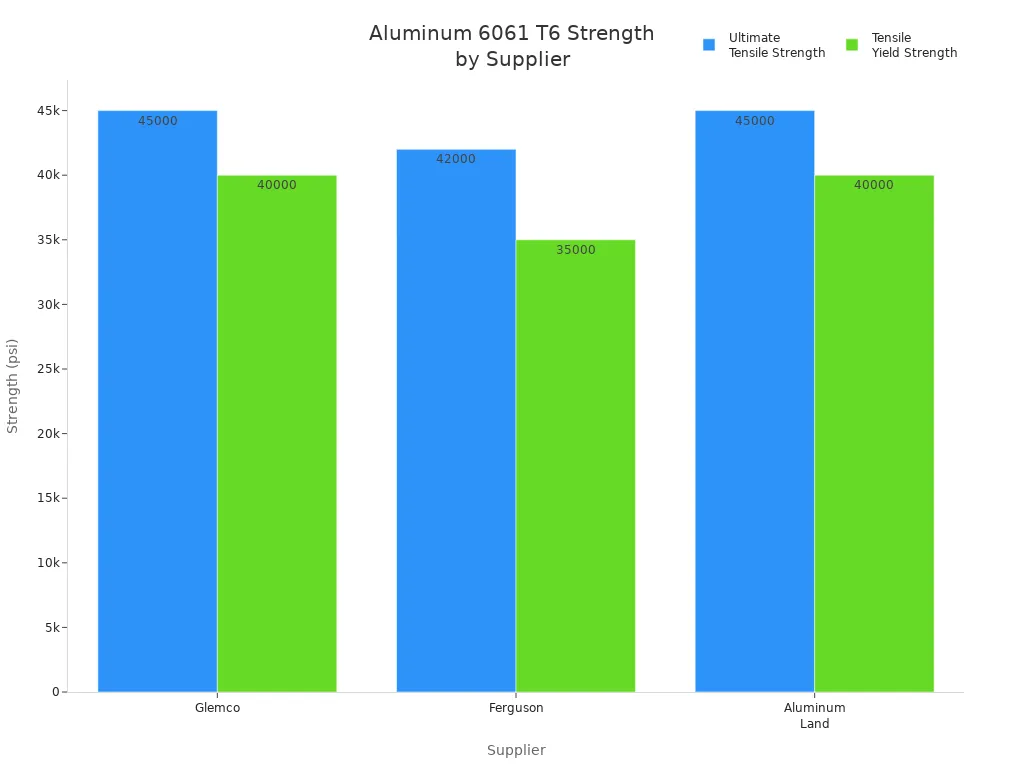
These values highlight the strength of aluminum 6061 T6, which typically features a yield strength of around 276 MPa and an ultimate tensile strength of approximately 310 MPa. Such properties make this alloy ideal for applications requiring high strength and durability.
Advantages of Aluminum 6061 T6
Aluminum 6061 T6 offers several advantages that enhance its appeal in various sectors:
- High Strength-to-Weight Ratio: This alloy provides structural integrity while adhering to strict weight limitations, making it ideal for aerospace applications.
- Corrosion Resistance: Its excellent resistance to corrosion enhances durability in harsh environments, particularly in marine and automotive applications.
- Good Machinability: Aluminum 6061 T6 allows for complex designs and excellent surface finishes, facilitating the production of intricate components.
- Versatile Applications: Commonly used in aerospace structures, automotive parts, and consumer electronics, this alloy meets diverse industry needs.
Applications of Aluminum 6061 T6
Aluminum 6061 T6 finds extensive use across various industries due to its exceptional mechanical properties and versatility. Its high strength-to-weight ratio makes it ideal for applications where weight savings are crucial without compromising structural integrity. Below are some notable applications of Aluminum 6061 T6:
-
Aerospace Components: The aerospace industry frequently utilizes Aluminum 6061 T6 for manufacturing aircraft structures, including wings, fuselage frames, and landing gear components. Its lightweight nature contributes to fuel efficiency and overall performance.
-
Automotive Parts: In the automotive sector, manufacturers employ Aluminum 6061 T6 for producing engine blocks, transmission housings, and suspension components. The alloy's corrosion resistance enhances durability, making it suitable for various vehicle applications.
-
Marine Applications: Aluminum 6061 T6 is a popular choice in marine environments. Boat builders use it for hulls, masts, and other structural components. Its resistance to saltwater corrosion ensures longevity in harsh marine conditions.
-
Construction and Structural Applications: The construction industry benefits from Aluminum 6061 T6 in the form of structural beams, columns, and frames. Its strength and lightweight properties facilitate easier handling and installation, making it a preferred material for modern buildings.
-
Consumer Electronics: Manufacturers of consumer electronics often choose Aluminum 6061 T6 for enclosures and casings. The alloy's machinability allows for intricate designs, while its aesthetic appeal enhances product appearance.
-
Sports EquiPment: The sporting goods industry also utilizes Aluminum 6061 T6 for various equipment, including bicycle frames, golf clubs, and fishing rods. The alloy's strength and lightweight characteristics improve performance and user experience.
Tip: When selecting Aluminum 6061 T6 for specific applications, consider factors such as load requirements, environmental conditions, and desired finish. This ensures optimal performance and longevity.
Delving into Aluminum 6061 T6511
Definition of T6511 Temper
Aluminum 6061 T6511 is a heat-treated variant of the 6061 alloy. This temper designation indicates that the alloy has undergone a specific heat treatment process to enhance its mechanical properties. The T6511 temper improves the material's strength, ductility, and machinability, making it suitable for precision engineering applications.
Properties of Aluminum 6061 T6511
Aluminum 6061 T6511 exhibits impressive mechanical properties that contribute to its popularity in various industries. The following table summarizes its key properties:
| Property | Value |
|---|---|
| Tensile Strength (UTS) | 290 MPa (42 x 10^3 psi) |
| Yield Strength (Proof) | 270 MPa (40 x 10^3 psi) |
These values highlight the alloy's strength, making it a reliable choice for demanding applications.
The T6511 temper is achieved through a series of processes, as outlined in the table below:
| Step | Description |
|---|---|
| Solution Heat Treatment | Involves heating the alloy to dissolve magnesium and silicon, enhancing ductility and machinability. |
| Stress Relieving | The material is mechanically stretched to relieve stresses from heating and quenching. |
| Artificial Aging | The material is heated at 180°C for several hours to complete the tempering process. |
Advantages of Aluminum 6061 T6511
Aluminum 6061 T6511 offers several advantages that make it a preferred choice in various sectors:
- Enhanced Machinability: This alloy has a machinability rating of 50%, allowing for cost-effective and precise machining.
- Strength Retention: With a yield strength of 35,000 psi, it ensures that projects remain strong over time.
- Reduced Machining Distortion: The stretch process minimizes warping, maintaining stability under pressure.
- Lower Tool Wear: The alloy's properties lead to less friction, reducing tool wear and extending tool lifespan.
- Precision Compatibility: It maintains tight tolerances and shape under pressure, ensuring higher accuracy in machining.
Aluminum 6061 T6511 finds extensive use across various manufacturing sectors. The following table lists common applications:
| Manufacturing Sector | Common Products |
|---|---|
| Aerospace | Structural and mechanical parts |
| Automotive | Trucks and vehicle components |
| Marine | Marine vessels |
| Construction | Tanks, pipelines, structural components |
| Consumer Goods | Bicycles, furniture, sporting equipment |
These advantages make Aluminum 6061 T6511 an excellent choice for applications requiring high strength, durability, and precision.
Applications of Aluminum 6061 T6511
Aluminum 6061 T6511 serves a wide range of applications across various industries due to its excellent mechanical properties and versatility. Below are some notable sectors where this alloy is commonly utilized:
-
Aerospace Industry:
- Aluminum 6061 T6511 is crucial in manufacturing aircraft components. Its lightweight nature and high strength make it ideal for structural parts, such as fuselage frames and wing structures.
- The alloy's resistance to corrosion ensures longevity in harsh environments, contributing to overall aircraft performance.
-
Automotive Sector:
- In the automotive industry, manufacturers use Aluminum 6061 T6511 for producing components like chassis, engine blocks, and suspension parts.
- The alloy's strength-to-weight ratio enhances fuel efficiency and performance, making it a preferred choice for modern vehicles.
-
Marine Applications:
- Boat builders frequently select Aluminum 6061 T6511 for constructing hulls, masts, and other structural elements.
- Its resistance to saltwater corrosion ensures durability, making it suitable for marine environments.
-
Construction and Structural Engineering:
- The construction industry employs Aluminum 6061 T6511 for various structural applications, including beams, columns, and frames.
- Its lightweight properties facilitate easier handling and installation, while its strength supports heavy loads.
-
Consumer Products:
- Manufacturers of consumer goods often choose Aluminum 6061 T6511 for products such as bicycles, furniture, and sporting equipment.
- The alloy's machinability allows for intricate designs, enhancing the aesthetic appeal of these items.
-
Industrial Equipment:
- In industrial settings, Aluminum 6061 T6511 is used for fabricating tanks, pipelines, and machinery components.
- Its strength and durability make it suitable for demanding applications that require reliable performance.
Tip: When selecting Aluminum 6061 T6511 for specific applications, consider factors such as load requirements, environmental conditions, and desired finish. This ensures optimal performance and longevity.
Comparative Analysis of T6 and T6511
Strength Comparison
When comparing the ultimate tensile strength of aluminum 6061 T6 and T6511, notable differences emerge. According to material datasheets, aluminum 6061 T6 boasts an ultimate tensile strength of 310 MPa, while aluminum 6061 T6511 has a slightly lower value of 290 MPa. This difference indicates that T6 may provide superior performance in applications requiring maximum strength.
| Material | Ultimate Tensile Strength (MPa) |
|---|---|
| 6061-T6 | 310 |
| 6061-T6511 | 290 |
Both alloys exhibit the same yield strength of 276 MPa, making them comparable in terms of resistance to deformation under load. However, the slight edge in tensile strength for T6 may influence material selection for high-stress applications.
| Property | Aluminum alloy 6061-T6 | Aluminum alloy 6061-T651 |
|---|---|---|
| Yield Strength | 276 MPa | 276 MPa |
Machinability Comparison
Machinability plays a crucial role in the manufacturing process, especially for precision components. Aluminum 6061 T6 is known for its good machinability, although it can gum up if not heat-treated properly. In contrast, aluminum 6061 T6511 offers similar machinability characteristics, with potential improvements due to the stress relief process it undergoes.
| Alloy | Machinability Characteristics |
|---|---|
| 6061-T6 | Good machinability, but can gum up if not heat-treated. |
| 6061-T6511 | Similar to T6, with potential for slightly improved machinability due to stress relief. |
Additionally, when considering surface finish outcomes, 6061 T6 is noted to yield better surface finishes compared to other tempers. The specific outcomes for T6511 are less documented, indicating a need for further research in this area.
- 6061-T6 is noted to be easier to machine than other tempers, which suggests it may yield a better surface finish.
- The specific surface finish outcomes for T6511 are not detailed, indicating a lack of comparative data.
Cost Considerations
Cost is a significant factor in material selection. The average market price for aluminum 6061 T6 ranges from $1.8 to $3.0 per kilogram. In contrast, T6511 typically incurs higher processing costs due to additional steps involved in its production. These steps include stretching and straightening, which enhance its dimensional stability but also increase manufacturing expenses.
| Alloy Type | Average Price per kg |
|---|---|
| Aluminum 6061 T6 | $1.8 - $3.0 |
| Aluminum 6061 T6511 | Higher than T6 due to processing costs |
Manufacturers should consider these factors when selecting between T6 and T6511. The T6511 temper may be more suitable for applications requiring enhanced machinability and dimensional stability, despite its higher cost.
- The T6511 temper involves additional processing steps such as stretching and straightening, which increases its processing costs compared to T6.
- T6511 is typically used for extruded profiles and may have a cost that is comparable to or slightly higher than T651, depending on the complexity of the profile.
- T651 aluminum undergoes extra stretching for stress relief, contributing to its higher processing costs relative to T6.
Suitability for Specific Applications
Aluminum 6061 T6 and T6511 serve distinct roles in various industries due to their unique properties. Understanding the specific applications for each temper can guide manufacturers and engineers in selecting the right material for their projects.
Aluminum 6061 T6 Applications
Aluminum 6061 T6 excels in applications requiring high strength and lightweight characteristics. Its superior tensile strength makes it ideal for:
- Aerospace Components: Aircraft structures, including wings and fuselage frames, benefit from the alloy's strength-to-weight ratio.
- Automotive Parts: Engine blocks and suspension components utilize this alloy for its durability and resistance to corrosion.
- Marine Structures: Boat hulls and masts leverage the alloy's ability to withstand harsh marine environments.
- Construction: Structural beams and frames in buildings rely on the strength and lightweight nature of 6061 T6.
Tip: When selecting aluminum 6061 T6 for aerospace or automotive applications, consider factors such as weight restrictions and environmental exposure to ensure optimal performance.
Aluminum 6061 T6511 Applications
Aluminum 6061 T6511 is particularly suited for precision engineering applications. Its enhanced machinability and dimensional stability make it a preferred choice for:
- Aerospace Manufacturing: Structural and mechanical parts that require tight tolerances benefit from the alloy's stress-relief process.
- Automotive Manufacturing: Components like chassis and vehicle frames utilize T6511 for its strength and reduced machining distortion.
- Marine Construction: Similar to T6, T6511 is used in marine vessels, but its precision makes it ideal for critical components.
- Industrial Equipment: Tanks, pipelines, and machinery parts leverage the alloy's durability and strength retention.
| Application Area | Preferred Temper | Reason |
|---|---|---|
| Aerospace | 6061 T6 | High strength and lightweight properties |
| Automotive | 6061 T6511 | Enhanced machinability and dimensional stability |
| Marine | 6061 T6/T6511 | Corrosion resistance and structural integrity |
| Industrial Equipment | 6061 T6511 | Strength retention and precision machining |
Note: The choice between T6 and T6511 often depends on the specific requirements of the application, such as strength, machinability, and cost considerations.
Choosing the Right Temper
Factors to Consider
Selecting the appropriate temper of aluminum 6061 requires careful consideration of several factors. Each factor influences the performance and suitability of the material for specific applications. The following table summarizes key factors to evaluate when choosing between aluminum 6061 T6 and T6511:
| Factor | 6061-T6 | 6061-T651 | 6061-T6511 |
|---|---|---|---|
| Geometry Complexity | Cost-effective for simple parts | Preferred for complex designs | Best for long extrusions |
| Tolerance Requirements | Sufficient for moderate tolerances | Reduces warping risks for tight tolerances | Ensures accuracy for precision assemblies |
| Dimensional Stability | Prone to movement during machining | Reliable stability for plates and bars | Highest stability for extrusions |
| Budget Considerations | Most economical and widely available | Slightly more expensive but saves on rework | Most specialized and higher in price |
Understanding these factors helps engineers and manufacturers make informed decisions. For instance, if a project involves complex geometries, T6511 may be the better choice due to its enhanced machinability and reduced warping risks. Conversely, for simpler designs where cost is a primary concern, T6 may suffice.
In summary, aluminum 6061 T6 and T6511 exhibit distinct characteristics that influence their applications. The following table highlights their key differences:
| Temper | Description | Properties |
|---|---|---|
| T6 | Solution heat treated and artificially aged | Good strength, good machinability |
| T651 | T6 with additional cold working | Higher strength, reduced machinability |
| T6511 | T651 with minor straightening | Similar to T651, but with improved straightness |
Selecting the appropriate temper depends on specific project requirements. Engineers should consider factors such as strength, machinability, and dimensional stability to ensure optimal performance in their applications.
Tip: Always evaluate the unique demands of each project before making a material choice.
FAQ
What is the main difference between aluminum 6061 T6 and T6511?
Aluminum 6061 T6 undergoes solution heat treatment and artificial aging, while T6511 includes additional cold working. This process enhances T6511's dimensional stability and machinability.
Which temper has higher tensile strength?
Aluminum 6061 T6 typically exhibits a higher ultimate tensile strength of 310 MPa compared to T6511's 290 MPa, making T6 preferable for high-stress applications.
Is aluminum 6061 T6511 more expensive than T6?
Yes, aluminum 6061 T6511 generally incurs higher processing costs due to additional steps like stretching and straightening, which enhance its properties.
Can aluminum 6061 T6 be used in marine applications?
Absolutely! Aluminum 6061 T6 is widely used in marine environments due to its excellent corrosion resistance and strength, making it suitable for boat hulls and masts.
What industries commonly use aluminum 6061 T6511?
Aluminum 6061 T6511 finds applications in aerospace, automotive, marine, construction, and industrial equipment sectors, where precision and strength are critical.
How does the machinability of T6 compare to T6511?
Both aluminum 6061 T6 and T6511 offer good machinability. However, T6511 may provide slightly improved machinability due to its stress-relief process.
What factors should I consider when choosing between T6 and T6511?
Consider factors such as strength requirements, dimensional stability, machinability, and budget constraints when selecting between aluminum 6061 T6 and T6511 for specific applications.
Are there any specific applications where T6511 is preferred over T6?
Yes, T6511 is preferred for precision engineering applications requiring tight tolerances and reduced machining distortion, such as aerospace and automotive components.