


Comparing 6061 Aluminum Tempers
6061 Aluminum Tempers exhibit significant differences in strength, hardness, and machinability due to specific heat treatments and processing routes. The table below illustrates how properties such as yield strength and hardness can vary:
| Property | 6061-T6 Typical Value | Comments/Notes |
|---|---|---|
| Yield Strength | ~276 MPa | Indicates strength differences |
| Ultimate Tensile Strength | ~310 MPa | Reflects tensile strength variation |
| Elongation at Break | 12% | Shows ductility differences |
| Hardness (Brinell) | 95 | Supports strength differences |
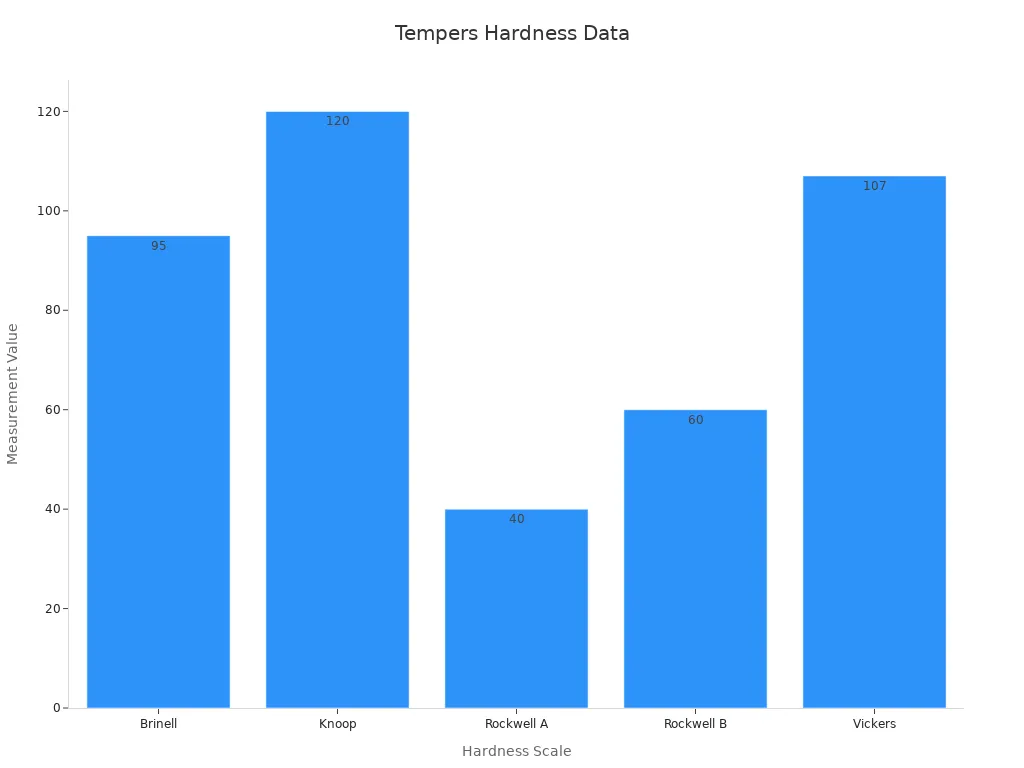
Dynamic impact testing and machining studies confirm that the selection of a specific temper directly affects material performance in demanding applications.
Key Takeaways
- 6061 aluminum tempers show different strength, hardness, and formability based on heat treatment and processing.
- The T6 temper offers the highest strength and hardness, making it ideal for structural and high-stress applications.
- The O temper is the softest and most ductile, perfect for complex bending and shaping tasks.
- T651 and T6511 tempers provide better machinability and dimensional stability, great for precision parts.
- Welding 6061-T6 reduces strength in the heat-affected zone, so post-weld heat treatment may be needed.
- All 6061 tempers resist corrosion well, but surface treatments improve protection in harsh environments.
- Choosing the right temper depends on project needs like strength, formability, weldability, and cost.
- Using temper comparison tables and testing small batches helps ensure the best material choice for your project.
Overview of 6061 Aluminum Tempers
What Is a Temper?
A temper describes the specific thermal and mechanical treatment history of an aluminum alloy. This designation indicates how the material was processed after its initial fabrication, which directly influences its mechanical properties such as strength, hardness, and ductility. Industry standards, including ANSI H35.1 and EN 515, define temper categories for aluminum alloys. These standards use suffixes like O, T, and H to indicate whether the alloy has been annealed, heat-treated, or strain-hardened. For example, the T temper series refers to heat-treated conditions that stabilize mechanical properties, while the O temper refers to a fully annealed, soft state. The Aluminum Association and international standards organizations regularly update these definitions to ensure consistency across industries.
Note: The temper designation system helps engineers and manufacturers select the right material for specific applications by providing a clear understanding of the alloy’s processing history and expected performance.
Common 6061 Aluminum Tempers
6061 Aluminum Tempers appear in several forms, each tailored for different performance requirements. The most widely used tempers include:
6061-O (Annealed)
This temper undergoes a full annealing process, resulting in the softest and most ductile form of 6061 aluminum. It offers the lowest tensile strength but provides excellent formability, making it suitable for complex bending and shaping operations.
6061-T4 (Solution Heat-Treated and Naturally Aged)
Manufacturers' solution: heat-treat this temper and allow it to age naturally at room temperature. The T4 temper achieves moderate strength and good ductility, which makes it ideal for applications requiring forming before final hardening.
6061-T6 (Solution Heat-Treated and Artificially Aged)
The T6 temper stands as the most common and widely used form. It undergoes solution heat treatment followed by artificial aging, which maximizes strength and hardness. Industries such as aerospace, automotive, and marine frequently select 6061-T6 for structural components due to its excellent balance of mechanical properties.
6061-T651 (Stress-Relieved)
This temper starts as T6 but receives additional stretching to relieve internal stresses. The process improves dimensional stability, making T651 a preferred choice for precision machining and critical structural parts.
6061-T6511 (Extruded and Stress-Relieved)
Manufacturers extrude and stress-relieve this temper, which further enhances dimensional accuracy and surface finish. It is commonly used for extruded profiles where tight tolerances and straightness are essential.
Industry standards such as ASTM B221 and AMS QQ-A-200/8A document the requirements and mechanical property limits for these tempers, ensuring consistency in manufacturing and application.
How 6061 Aluminum Tempers Affect Material Properties
The choice of temper significantly alters the mechanical properties of 6061 aluminum. For instance, the T6 temper delivers the highest strength and hardness, with typical Brinell hardness values ranging from 95 to 97.5 and ultimate tensile strength near 310 MPa. In contrast, the O temper provides maximum ductility but much lower strength. Each temper’s unique combination of heat treatment and mechanical processing tailors the alloy’s performance for specific uses. Mechanical property testing, hardness checks, and ultrasonic inspections validate these differences, as outlined in both ASTM and European standards. Manufacturers rely on these standardized temper designations to match material properties with application requirements, ensuring safety and reliability in critical industries.
Side-by-Side Comparison Table of 6061 Aluminum Tempers
Mechanical Properties
Mechanical properties define how each temper of 6061 aluminum performs under stress, load, and repeated use. The table below presents a clear comparison of the most common tempers:
| Temper | Ultimate Tensile Strength (MPa) | Yield Strength (MPa) | Elongation (%) | Fatigue Limit (MPa) | Thermal Conductivity (W/m·K) |
|---|---|---|---|---|---|
| 6061-O | ≤ 150 | ≤ 110 | 10 - 18 | N/A | N/A |
| 6061-T4 | 180 - 210 | ≥ 110 | 10 - 16 | N/A | N/A |
| 6061-T6 | ≥ 290 (typical ~310) | ≥ 240 (typical ~270) | 8 - 10 | 97 (at 500 million cycles) | ~152 |
Engineers often select 6061-T6 for its high strength and fatigue resistance. The T4 temper offers a balance between strength and ductility, making it suitable for forming operations. The O temper provides the highest elongation, which allows for extensive shaping but limits its use in structural applications.
Note: The mechanical properties of each temper result from specific heat treatments and aging processes. These differences directly impact the suitability of each temper for various engineering tasks.
Corrosion Resistance
All 6061 aluminum tempers display good corrosion resistance due to the alloy’s natural oxide layer. However, the degree of resistance can vary slightly based on temper and surface condition.
- 6061-O and 6061-T4 tempers maintain excellent corrosion resistance in most atmospheric and marine environments.
- 6061-T6 and T651 tempers also resist corrosion well, but surface treatments such as anodizing or painting further enhance protection, especially in aggressive or saltwater conditions.
- Stress-relieved tempers, such as T651 and T6511, show no significant reduction in corrosion resistance compared to T6, provided the surface remains intact and free from deep scratches.
Tip: For applications exposed to harsh chemicals or saltwater, consider additional protective coatings to maximize the lifespan of 6061 aluminum components.
Machinability
Machinability describes how easily a material can be cut, shaped, or finished using machine tools. 6061 Aluminum Tempers, especially T6, are well-known for their favorable machining characteristics.
- 6061-T6 offers excellent machinability. Its low density and high thermal conductivity allow for higher feed rates and faster cutting speeds than steel. Machinists can achieve surface roughness values as low as Ra 0.2 with optimized tools and parameters.
- The T6 temper produces easy-to-remove chips, reduces tool wear, and supports high productivity. Machining speeds can reach up to three times those used for steel.
- Surface finish depends on tool type, cutting speed, feed rate, and cooling method. Diamond and superfinishing tools can further improve surface quality.
- 6061-T4 provides good machinability but excels in formability, making it better for parts requiring complex shapes before final hardening.
- The O temper, while soft and ductile, may gum up tools and produce less desirable surface finishes, requiring careful tool selection and slower speeds.
Note: Selecting the right temper and optimizing machining parameters ensures high precision, reduced costs, and superior surface quality for finished parts.
Weldability
Engineers often select 6061 Aluminum Tempers for projects that require welding. The alloy’s composition allows for a range of welding techniques, including TIG (tungsten inert gas) and MIG (metal inert gas) welding. Most tempers, such as T4 and O, respond well to welding because their lower strength and higher ductility reduce the risk of cracking in the heat-affected zone. Welders find that these softer tempers maintain good joint integrity and minimize post-weld distortion.
The T6 temper, known for its high strength, presents unique challenges during welding. The heat from welding can locally reduce the strength and hardness in the affected area. This softening occurs because the artificial aging process that gives T6 its strength is reversed by the welding heat. As a result, the welded region may exhibit mechanical properties similar to the T4 temper unless a post-weld heat treatment restores the original strength. For critical structural applications, engineers often specify post-weld aging or design joints to compensate for the reduced strength.
Stress-relieved tempers like T651 and T6511 offer improved dimensional stability after welding. These tempers resist warping and distortion, which benefits precision assemblies and machined parts. However, the same post-weld strength reduction seen in T6 also applies to these tempers.
Tip: To achieve the best weld quality, operators should use filler alloys compatible with 6061, such as 4043 or 5356. These fillers help maintain corrosion resistance and minimize cracking.
Welded assemblies made from 6061 Aluminum Tempers often serve in marine, automotive, and structural applications. The alloy’s natural oxide layer provides additional protection against corrosion at welded joints, especially when combined with proper surface treatments.
Typical Applications
6061 Aluminum Tempers support a wide range of industries due to their balance of strength, corrosion resistance, and machinability. Field reports and industry data confirm their use in demanding environments where reliability and performance matter.
The T6 temper stands out for its enhanced tensile strength, reaching up to 42,000 psi. This property, combined with improved corrosion resistance and high thermal conductivity, makes it a preferred choice for aerospace and automotive structural components. Manufacturers rely on T6 for parts that must withstand high loads and fatigue, such as aircraft frames, automotive chassis, and marine fittings. The alloy’s ability to meet precision machining tolerances and fatigue strength standards ensures its suitability for these critical roles.
The T4 temper offers improved ductility, which benefits applications that require forming before final hardening. Engineers use T4 for hydraulic equiPment, decorative hardware, and components that need complex shapes. The O temper, with its maximum ductility, serves best in parts that undergo extensive bending or shaping, such as camera bodies and intricate electronic housings.
Stress-relieved tempers like T651 and T6511 provide dimensional stability for precision-machined parts. These tempers appear in electronics, electrical connectors, and industrial machinery where tight tolerances and minimal distortion are essential.
Industry standards, including ASTM, AMS, and ASME, validate the use of 6061 Aluminum Tempers in the following areas:
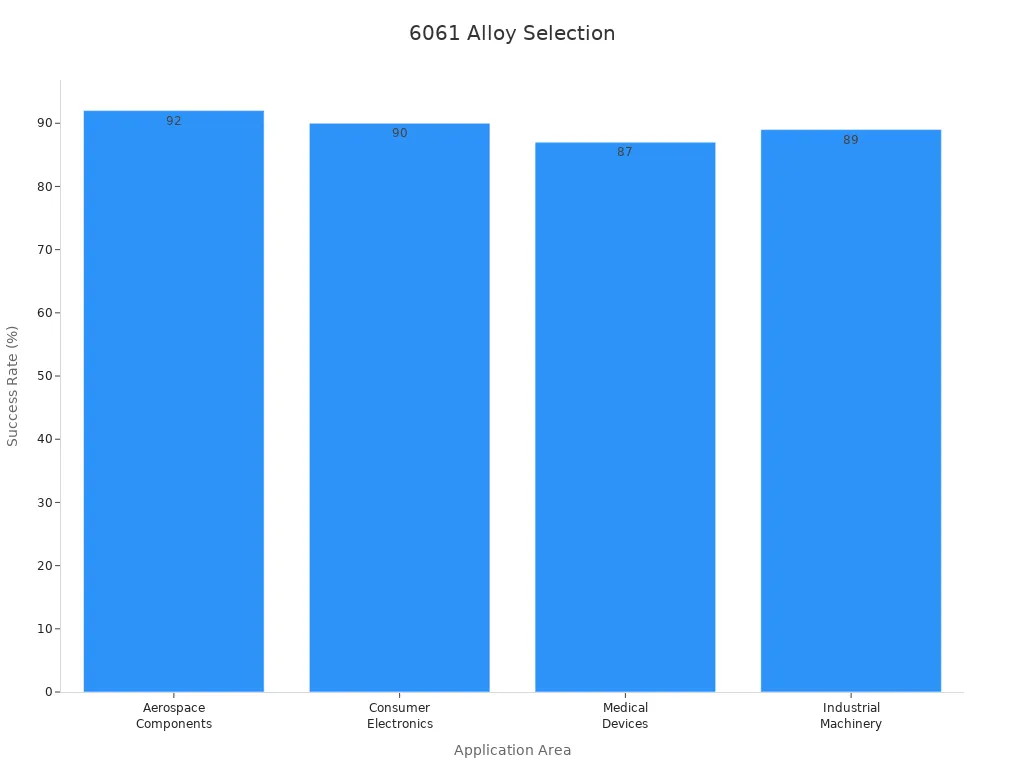
- Aerospace components
- Marine fittings and hardware
- Electronics and electrical connectors
- Decorative and architectural hardware
- Hydraulic equipment
- Cameras and optical housings
Manufacturers in the construction industry also value this alloy for its corrosion resistance, weldability, and machinability. The versatility of 6061 Aluminum Tempers allows them to serve as a general-purpose solution for a variety of structural, mechanical, and decorative applications.
Note: The combination of strength, workability, and wear resistance makes 6061 Aluminum Tempers a reliable choice for engineers across multiple industries.
Detailed Comparison by Property for 6061 Aluminum Tempers
Strength & Hardness
Tensile Strength Differences
Tensile strength measures how much force a material can withstand before breaking. Different 6061 Aluminum Tempers display distinct tensile strengths due to their unique heat treatment and processing methods. The T6 temper achieves the highest tensile strength, making it suitable for demanding structural applications. T651 and T6511 tempers follow closely, with only slight reductions in strength because of additional stress-relief processes.
| Property | 6061-T6 | 6061-T651 | 6061-T6511 |
|---|---|---|---|
| Tensile Strength | ~310 MPa | ~305 MPa | ~290 MPa |
| Yield Strength | ~275 MPa | ~270 MPa | ~260 MPa |
| Elongation at Break | 8-12% | 8-10% | 10-12% |
| Hardness | ~95 HB | ~92 HB | ~90 HB |
| Machinability | Good, but lowest | Better than T6 | Best among the three |
The table above summarizes the results of multi-test evaluations. The T6 temper stands out for its superior strength, while T651 and T6511 offer slightly lower values but improved machinability and dimensional stability.
Hardness Ratings
Hardness indicates a material’s resistance to indentation and wear. The Brinell Hardness (HB) scale provides a standard measure for aluminum alloys. T6 temper reaches approximately 95 HB, which means it resists surface deformation well. T651 and T6511 tempers show marginally lower hardness, at 92 HB and 90 HB, respectively. These small differences result from the stress-relief and extrusion processes, which slightly reduce hardness but improve other properties such as machinability.
Fatigue Strength
Fatigue strength describes how well a material resists repeated loading cycles. 6061-T6 exhibits a fatigue limit of about 97 MPa at 500 million cycles. T651 and T6511 tempers maintain similar fatigue performance, making them reliable choices for parts exposed to vibration or fluctuating stresses. Engineers often select these tempers for aerospace, automotive, and marine components that require long-term durability.
Note: The combination of high tensile strength and reliable fatigue resistance makes these tempers suitable for safety-critical applications.
Machinability
Ease of Cutting and Shaping
Machinability refers to how easily a material can be cut, drilled, or shaped using machine tools. Among the 6061 Aluminum Tempers, T6511 offers the best machinability. The extrusion and stress-relief processes in T6511 reduce internal stresses, allowing for smoother cutting and less tool chatter. T651 also performs well, while T6, although strong, can be slightly more challenging to machine due to its higher hardness.
- T6511: Best machinability, ideal for high-precision extruded profiles.
- T651: Better machinability than T6, suitable for precision parts.
- T6: Good machinability, but may require more frequent tool changes.
Tool Wear and Surface Finish
Tool wear and surface finish depend on the temper’s hardness and internal stress. T6511’s lower hardness and stress-relieved structure minimize tool wear, extending tool life and reducing maintenance costs. Machinists achieve superior surface finishes with T6511, often reaching Ra 0.2 or better. T651 also supports excellent finishes, while T6 may produce slightly rougher surfaces and increase tool wear over time.
Tip: Using sharp carbide tools and proper lubrication further improves surface quality and reduces tool wear, especially when machining harder tempers like T6.
Weldability
Suitability for Welding Processes
6061 Aluminum Tempers demonstrate excellent weldability, especially with TIG and MIG welding methods. These processes allow for strong, clean joints with minimal porosity. The alloy maintains structural stability in the heat-affected zone, with only minor strength loss compared to other aluminum alloys. For example, 6061 outperforms 6082 in weldability, as 6082 is more prone to hot cracking and greater mechanical property degradation after welding.
T6 and T651 tempers both respond well to welding, but T651 offers improved dimensional stability due to its stress-relieved nature. Welders often choose T651 for precision assemblies where minimal distortion is critical.
Post-Weld Strength Considerations
Welding alters the microstructure of 6061 Aluminum Tempers in the heat-affected zone. The T6 temper, known for its high strength, loses some of its mechanical properties after welding. The affected area often reverts to a condition similar to T4, with reduced strength and hardness. Post-weld heat treatment can restore much of the original strength, but this step adds time and cost to the fabrication process.
T651 and T6511 tempers experience similar strength reductions in the welded zone. However, their stress-relieved state helps maintain overall dimensional accuracy and reduces the risk of warping. For critical applications, engineers may specify post-weld aging or design joints to compensate for localized strength loss.
Callout: Always select filler alloys compatible with 6061, such as 4043 or 5356, to maintain corrosion resistance and minimize the risk of cracking at the weld.
Corrosion Resistance
Performance in Different Environments
Corrosion resistance plays a critical role in determining the longevity and reliability of aluminum components. Different tempers of 6061 aluminum respond uniquely to environmental exposure due to their microstructural characteristics. Immersion corrosion tests show that under-aged tempers are more susceptible to intergranular corrosion. Over-aged tempers, on the other hand, tend to develop pitting corrosion. These differences arise from the evolution of precipitates during the aging process.
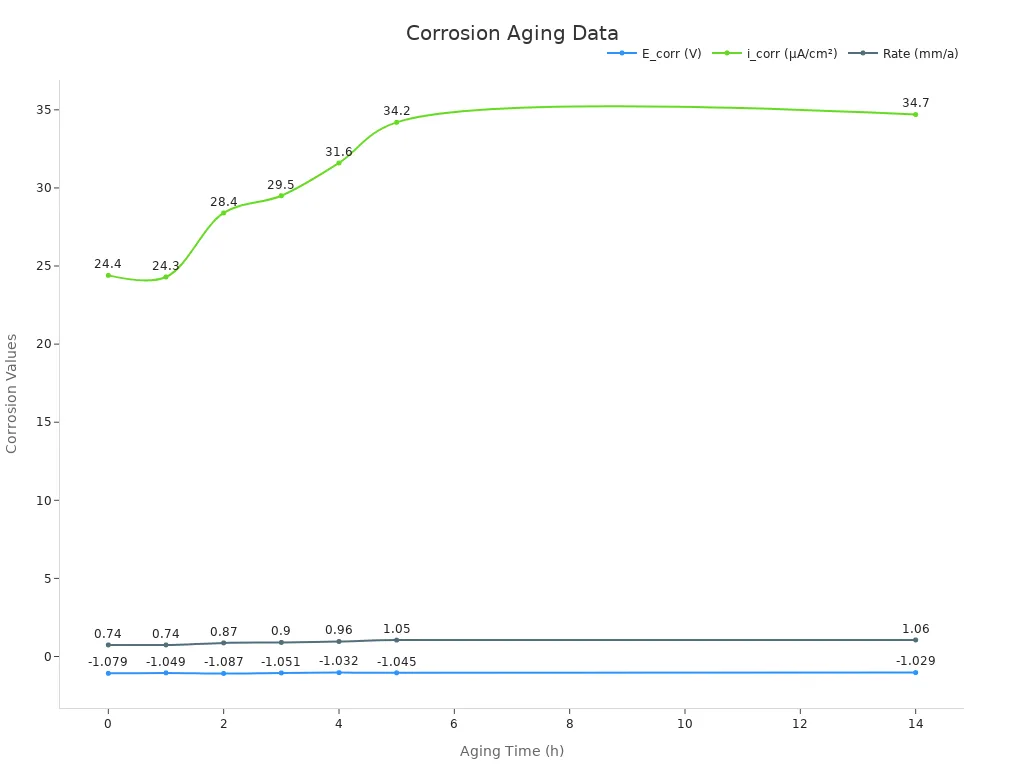
Electrochemical testing, such as potentiodynamic polarization in neutral and alkaline solutions, reveals that corrosion current density and corrosion rate increase as aging time extends. The following table summarizes key parameters observed during accelerated aging tests:
| Aging Time (h) | Corrosion Potential (E_corr, V) | Corrosion Current Density (i_corr, μA/cm²) | Corrosion Rate (mm/a) |
|---|---|---|---|
| 0 | -1.079 | 24.4 | 0.74 |
| 1 | -1.049 | 24.3 | 0.74 |
| 2 | -1.087 | 28.4 | 0.87 |
| 3 | -1.051 | 29.5 | 0.90 |
| 4 | -1.032 | 31.6 | 0.96 |
| 5 | -1.045 | 34.2 | 1.05 |
| 14 | -1.029 | 34.7 | 1.06 |
The data shows a clear trend: as aging time increases, both corrosion current density and corrosion rate rise. This pattern indicates that the formation and growth of Mg₂Si precipitates during aging reduce corrosion resistance. Corrosion potential changes only slightly, suggesting that the overall tendency for corrosion remains stable, but the rate at which it occurs accelerates.
Microstructural changes, such as the development of clusters, Guinier–Preston (GP) zones, and β″ phase, influence both hardness and corrosion behavior. Under-aged tempers are more likely to experience intergranular corrosion, while over-aged tempers face increased risk of pitting. These findings highlight the importance of selecting the appropriate temper for the intended service environment.
Tip: In marine or industrial atmospheres, over-aged tempers may require additional protection due to their higher pitting susceptibility.
Protective Measures
Engineers often implement protective strategies to enhance the corrosion resistance of aluminum components. The natural oxide film (Al₂O₃) on the surface provides a basic level of protection, but defects introduced by precipitates can compromise its effectiveness. Surface treatments, such as anodizing, create a thicker and more stable oxide layer, significantly improving resistance to both intergranular and pitting corrosion.
Other common protective measures include:
- Painting or powder coating: These barriers shield the metal from moisture and aggressive chemicals.
- Cathodic protection: This method uses sacrificial anodes to divert corrosive reactions away from the aluminum.
- Regular maintenance: Cleaning and inspection help detect early signs of corrosion and prevent progression.
Note: The choice of protective measure depends on the specific environment and the criticality of the application. For high-risk settings, combining multiple methods offers the best defense.
Formability
Bending and Shaping Capabilities
Formability describes how easily a material can undergo plastic deformation without cracking. The temper condition greatly influences this property. The O temper, which is fully annealed, offers the highest ductility. Fabricators can bend and shape this temper into complex forms with minimal risk of fracture. T4 temper also provides good formability, making it suitable for parts that require significant shaping before final hardening.
T6, T651, and T6511 tempers, while stronger and harder, exhibit reduced formability. These tempers resist deformation and may crack if subjected to tight bends or severe forming operations. Manufacturers often recommend pre-heating or using larger bend radii when working with these harder tempers.
- O temper: Excellent for deep drawing, spinning, and intricate bends.
- T4 temper: Good for moderate forming and subsequent aging.
- T6/T651/T6511: Limited formability; best for simple bends and straight sections.
Callout: Always select the temper that matches the forming requirements of the project. Attempting to bend high-strength tempers without proper precautions can lead to costly failures.
Suitability for Complex Forms
Complex shapes, such as deep channels, tight curves, or multi-axis bends, demand high ductility from the material. The O temper excels in these applications, allowing designers to create intricate geometries without sacrificing structural integrity. T4 temper also adapts well to complex forms, especially when followed by artificial aging to restore strength.
T6, T651, and T6511 tempers, due to their increased hardness, suit applications where the final shape requires minimal forming. These tempers perform best in machined or extruded profiles that do not involve significant post-processing deformation.
- For decorative hardware, electronic housings, and custom enclosures, O and T4 tempers provide the flexibility needed for creative designs.
- For structural beams, rails, and precision-machined parts, T6 and its derivatives deliver the necessary strength and dimensional stability.
Tip: When designing parts with complex forms, consult forming guidelines and consider temper selection early in the process. This approach ensures manufacturability and reduces the risk of defects.
Choosing the Right 6061 Aluminum Temper
Factors to Consider
Project Requirements
Selecting the correct temper begins with a clear understanding of project needs. Engineers assess the required strength, formability, weldability, and fatigue resistance. For example, projects demanding high fatigue strength, such as those involving cyclic loading, benefit from tempers like T6. Studies show that microstructural changes during welding or heat treatment can impact fatigue crack growth rates. Mechanical testing, including tensile and bending tests, helps determine if a temper meets the performance criteria. Quench rate, aging conditions, and microstructure all play a role in the final selection.
Cost and Availability
Cost and material availability influence the decision-making process. 6061 aluminum remains cost-effective compared to higher-strength alloys, such as 7075. The widespread use of 6061 Aluminum Tempers ensures reliable supply chains and competitive pricing. Material cost, combined with ease of machining, can reduce overall project expenses and lead times. When budgets are tight or rapid production is necessary, 6061 often becomes the preferred choice.
Tip: Always balance mechanical requirements with budget constraints and lead times for optimal results.
Best Tempers for Common Applications
The following table summarizes the most suitable tempers for typical applications:
| Application Area | Recommended Temper | Key Properties |
|---|---|---|
| Structural Components | 6061-T6 | High strength, excellent fatigue resistance |
| Machined Parts | 6061-T6511 | Superior machinability, dimensional stability |
| Welded Assemblies | 6061-T4 | Good weldability, balanced strength and ductility |
| Aerospace/Automotive | 6061-T6 | Maximum strength, reliable performance |
| Marine/Electronics | 6061-T6, T4 | Corrosion resistance, good machinability |
Structural Components
6061-T6 stands out for structural parts due to its high tensile and yield strength. It performs well in load-bearing applications, such as frames and supports.
Machined Parts
6061-T6511 offers the best machinability and dimensional accuracy. Manufacturers choose this temper for precision components and complex CNC machining.
Welded Assemblies
6061-T4 provides a balance of strength and ductility, making it ideal for welded structures. Post-weld heat treatment can further enhance performance.
Aerospace and Automotive Uses
6061-T6 is widely used in aerospace and automotive industries. Its strength, fatigue resistance, and corrosion protection meet the rigorous demands of these sectors.
Marine and Electronics Applications
Both T6 and T4 tempers serve marine and electronics applications. They offer corrosion resistance and thermal management, which are essential for these environments.
Practical Selection Tips
- Define all mechanical and environmental requirements before choosing a temper.
- Use comparative tables to match temper properties with project needs.
- Test small batches to verify machinability and surface finish.
- Monitor machining outcomes and adjust parameters for optimal results.
- Consult suppliers about availability and lead times for specific tempers.
Note: A structured approach, using both data and practical experience, leads to the best temper selection for any project.
Selecting the right 6061 Aluminum Tempers ensures optimal performance and cost-effectiveness for any project. The main differences center on strength, machinability, weldability, and application suitability. For example, the table below highlights how T4 and T6 tempers differ in mechanical and thermal properties:
| Property | 6061-T4 | 6061-T6 |
|---|---|---|
| Tensile Strength | ~241 MPa | ~310 MPa |
| Yield Strength | ~145 MPa | ~276 MPa |
| Elongation at Break | 12% | 8% |
| Hardness (Brinell) | ~95 HB | ~160 HB |
| Thermal Conductivity | ~154 W/m-K | ~167 W/m-K |
Engineers should use the comparison table and property breakdowns as a quick reference when choosing a temper for specific engineering needs.
FAQ
What does the temper designation mean in 6061 aluminum?
The temper designation indicates the specific heat treatment and mechanical processing applied to the alloy. This code, such as T6 or O, defines the material’s strength, hardness, and formability for different engineering applications.
Can 6061-T6 aluminum be welded without losing strength?
Welding 6061-T6 aluminum reduces strength in the heat-affected zone. The welded area often reverts to properties similar to T4. Engineers may use post-weld heat treatment to restore strength if required for critical applications.
Which 6061 temper offers the best machinability?
6061-T6511 provides the best machinability. The extrusion and stress-relief processes reduce internal stresses, allowing for smoother cutting and improved surface finish. Machinists often select this temper for precision parts.
Is 6061 aluminum suitable for marine environments?
6061 aluminum resists corrosion well in marine environments. Surface treatments, such as anodizing or painting, further enhance protection against saltwater and harsh conditions. Regular maintenance extends component lifespan.
How does the O temper differ from T6 in formability?
The O temper, fully annealed, offers maximum ductility and formability. Fabricators can bend and shape it into complex forms. T6, with higher strength and hardness, resists deformation and suits applications needing rigidity.
What filler metals work best for welding 6061 aluminum?
Filler alloys 4043 and 5356 work best for welding 6061 aluminum. These fillers maintain corrosion resistance and minimize the risk of cracking at the weld joint.
Does the choice of temper affect cost and availability?
Yes. Common tempers like T6 and T6511 are widely available and cost-effective. Specialty tempers may have longer lead times or higher prices due to additional processing.
Can 6061 aluminum be used for electrical applications?
Engineers use 6061 aluminum in electrical connectors and housings. The alloy’s good conductivity and corrosion resistance make it suitable for many electronic and electrical components.