

Common Grades of Magnesium Alloys and Their Applications
Magnesium alloys are lightweight, high-strength materials. Manufacturers form them by combining magnesium with other elements. These alloys are primarily used where weight reduction and good mechanical properties are critical. The global market for these materials demonstrates significant expansion, indicating their growing industrial importance.
| Year | Market Size (USD Billion) | CAGR (%) |
|---|---|---|
| 2020 | 2.93 | - |
| 2027 (Projected) | 6.62 | 9.9% (2020-2027) |
This post will explore their common grades and diverse applications.
Key Takeaways
- Magnesium alloys are very light and strong. They help make products lighter and perform better.
- Magnesium alloys have a great strength-to-weight ratio. This makes them good for high-performance items, like in aerospace.
- New methods help protect magnesium alloys from rust. This makes them useful in more places.
- Magnesium alloys are easy to shape and cut. This helps make complex parts faster and cheaper.
- Magnesium alloys come in two main types: cast and wrought. Each type works best for different uses.
- Different magnesium alloys have special uses. For example, AZ91D is good for car parts, and WE43 works well in hot places.
- Magnesium alloys are used in many fields. These include cars, planes, electronics, and even medical tools.
- New research makes magnesium alloys even better. They will be used in more new products in the future.
Understanding Magnesium Alloys: Key Characteristics
Lightweight Properties of Magnesium Alloys
Density Comparison with Other Metals
Magnesium alloys offer exceptional lightweight properties, a primary reason for their widespread adoption. The density of magnesium is approximately 1.74 g/cm³, making it significantly lighter than many other engineering metals. For instance, magnesium's density is 66% of aluminum's density, which stands at 2.7 g/cm³. Steel, a much denser material, has a density of 7.8 g/cm³. This significant difference highlights magnesium's advantage.
Advantages in Weight Reduction
This substantial density difference provides significant advantages in weight reduction across various industries. Automotive and aerospace industries prioritize reducing mass to improve fuel efficiency, increase payload capacity, and enhance performance. Using these lightweight materials allows manufacturers to create components without compromising structural integrity, leading to enhanced operational efficiency.
Strength-to-Weight Ratio of Magnesium Alloys
Comparison to Aluminum and Steel
Beyond their low density, magnesium boasts an impressive strength-to-weight ratio. This ratio compares a material's strength to its mass, a critical metric for high-performance applications. Magnesium offers a superior strength-to-weight ratio compared to aluminum and steel. While titanium is significantly stronger (around 220 MPa), its higher density means the strength-to-weight ratios for titanium, aluminum, and magnesium often remain similar. High-strength magnesium can resist substantial stress and force while remaining lightweight.
Importance in High-Performance Applications
This characteristic makes magnesium invaluable in demanding sectors where every gram counts. Aerospace components, high-performance sports equiPment, and advanced defense systems frequently utilize these materials. Their ability to provide robust structural support with minimal mass contributes directly to improved speed, agility, and fuel economy in critical applications.
Corrosion Resistance in Magnesium Alloys
Addressing Common Misconceptions
Corrosion resistance in magnesium often faces misconceptions. Many perceive magnesium as highly susceptible to corrosion. Magnesium and its alloys generally possess low corrosion resistance and are chemically active. They are particularly susceptible to galvanic corrosion, which impurities like Fe, Ni, Cu, and Cr in their matrix. For example, ultra-high-purity magnesium immersed in a 3.5% NaCl solution exhibits an intrinsic corrosion rate of 0.25 ± 0.07 mm per year.
Modern Advancements in Protection
However, modern advancements address these challenges effectively. In environments with relative humidity below approximately 80%, such as inside a car or office, these alloys demonstrate low corrosion rates, typically less than 1. Manufacturers employ various surface treatments, protective coatings, and alloy developments to enhance their protection against corrosive elements. These innovations make magnesium suitable for a wider range of applications, dispelling older notions about its limitations.
Formability and Machinability of Magnesium Alloys
Ease of Manufacturing Processes
Magnesium alloys offer distinct advantages in manufacturing processes, particularly regarding machinability. Manufacturers can machine these alloys at high speeds, often requiring less power than other common engineering metals. This characteristic translates into faster production times and reduced tooling wear, making magnesium an attractive material for complex component fabrication. However, formability presents a different scenario. Magnesium alloys exhibit poor formability at room temperature. Their hexagonal close-packed (HCP) crystal structure limits the number of slip systems available for deformation at ambient temperatures.
Despite this room-temperature limitation, formability significantly improves at elevated temperatures. This improvement is reflected in a higher forming limit curve (FLC) at increased temperatures, allowing for more intricate shapes. For example, the AZ31B magnesium alloy achieved its maximum limiting draw ratio (LDR) at a forming temperature of 200°C. This demonstrates the critical role of thermal processing in shaping magnesium components. Recent advancements also address room-temperature formability. A new sheet alloy, ZAXME11100 (USAMP Alloy 2 Plus), developed in a recent USAMP project, demonstrates excellent ductility with 31% tensile elongation and good room temperature formability, indicated by a 7.8 mm Erichsen index, in a solution-treated condition (T4). This innovation expands the potential for cold forming applications.
Design and Production Considerations
The unique formability and machinability characteristics of magnesium alloys necessitate specific design and production considerations. Designers must account for the need for elevated temperatures during forming operations, which influences tooling design and process parameters. This often involves specialized hot forming techniques like hot stamping, warm deep drawing, or extrusion. The excellent machinability, conversely, allows for intricate designs and tight tolerances, providing engineers with considerable flexibility in creating complex parts.
Tip: When designing with magnesium alloys, consider the balance between component complexity and the feasibility of hot forming processes. High-speed machining can often compensate for initial forming challenges.
Engineers also consider the material's response to various manufacturing stresses. The ability to machine magnesium quickly and efficiently reduces overall production costs and energy consumption. This makes magnesium alloys a cost-effective choice for components requiring extensive material removal. The ongoing development of new alloys with improved room-temperature formability further broadens the design possibilities, allowing for more diverse and innovative applications without always relying on elevated temperatures.
Categorization of Magnesium Alloys
Manufacturers categorize Magnesium Alloys into two primary groups: cast alloys and wrought alloys. Each category possesses distinct characteristics and manufacturing processes, making them suitable for different applications. This classification helps engineers select the optimal material for specific design requirements.
Cast Magnesium Alloys
Characteristics of Cast Alloys
Cast magnesium alloys are formed by pouring molten metal into a mold. These alloys often exhibit a heterogeneous microstructure. This microstructure includes a high concentration of precipitates, which can sometimes negatively impact mechanical properties. Generally, cast alloys have lower mechanical strength compared to wrought alloys. This lower strength results from their less refined microstructure. However, cast alloys show significant improvements in mechanical and corrosion performance after appropriate heat treatment. For example, as-cast WE43 typically has a grain size of 25.6 ± 2.8 µm.
Common Casting Methods
Several methods exist for producing cast magnesium components. Die Casting is a popular choice for high-volume production of intricate parts due to its efficiency and ability to create complex shapes with a good surface finish. Sand casting is suitable for larger components or prototypes, offering flexibility in design. Permanent mold casting, also known as gravity die casting, provides better mechanical properties and surface finish than sand casting.
Wrought Magnesium Alloys
Characteristics of Wrought Alloys
Wrought magnesium alloys undergo mechanical deformation processes, such as rolling or extrusion, to achieve their final shape. These alloys possess a refined microstructure. This microstructure is characterized by smaller grain sizes and a more uniform distribution of second-phase particles. Wrought alloys demonstrate superior mechanical strength and higher hardness compared to cast alloys. This enhancement comes from grain refinement and uniform particle distribution. The effect of heat treatment on their mechanical and corrosion properties is relatively minor compared to cast alloys. For instance, wrought (rolled) WE43 shows a significantly smaller grain size of 8.67 ± 1.2 µm and a hardness of 97 ± 3.8 HV.
Common Wrought Processes
Wrought processes transform magnesium ingots into various forms. Extrusion forces the metal through a die, creating profiles like rods, bars, and tubes. Forging shapes the metal using compressive forces, producing strong, dense components. Rolling reduces the thickness of the metal, creating sheets and plates. These processes enhance the material's mechanical properties by refining its grain structure.
| Property | As-Cast WE43 | Wrought (Rolled) WE43 |
|---|---|---|
| Grain Size | 25.6 ± 2.8 µm | 8.67 ± 1.2 µm |
| Hardness | N/A | 97 ± 3.8 HV |
Common Grades of Magnesium Alloys and Their Compositions
Engineers select specific magnesium alloys based on their unique properties and intended applications. Understanding the composition and characteristics of common grades is crucial for effective material selection. This section details several widely used magnesium alloys.
AZ91D Magnesium Alloy
Composition: Mg-9%Al-1%Zn-0.2%Mn
AZ91D is one of the most common Die-Casting magnesium alloys. Its designation provides insight into its composition. The 'A' signifies aluminum, and 'Z' denotes zinc. The number '9' indicates an approximate aluminum content of 9% by weight. The '1' represents an approximate zinc content of 1% by weight. The 'D' serves as a serial number for alloy development. Magnesium makes up the remaining percentage, excluding trace elements and impurities. A small amount of manganese (0.2%) is also present, which helps improve corrosion resistance.
Key Characteristics: Excellent Castability, Good Strength, Moderate Corrosion Resistance
AZ91D offers excellent castability, making it ideal for producing complex parts through die casting. It provides a good balance of mechanical properties. The alloy exhibits good strength for its weight. Its corrosion resistance is moderate, which manufacturers often enhance with surface treatments.
| Property | Typical Value |
|---|---|
| Ultimate Tensile Strength | 230 MPa (33 ksi) |
| Yield Strength (0.2% offset) | 160 MPa (23 ksi) |
| Elongation at Break | 3% – 7% |
These properties make AZ91D suitable for various structural components where weight reduction is critical.
AM60B Magnesium Alloy
Composition: Mg-6%Al-0.2%Mn
AM60B is another popular magnesium alloy, particularly noted for its ductility. Its composition includes approximately 6% aluminum and 0.2% manganese, with the remainder being magnesium. The lower aluminum content compared to AZ91D contributes to its enhanced ductility.
Key Characteristics: Good Ductility, Impact Strength, Moderate Corrosion Resistance
AM60B stands out for its good ductility and high impact strength. These characteristics make it suitable for applications requiring energy absorption. The alloy also offers moderate corrosion resistance, similar to AZ91D. Researchers continue to explore ways to enhance its properties. For instance, adding 0.1 wt.% graphene can increase the yield strength of AM60B by approximately 13.4%. This addition also leads to an 8.8% increase in elongation.
| Property | Value | Unit |
|---|---|---|
| Yield Strength | 130 | MPa |
| Tensile Strength | 230 | MPa |
| Elongation at Break | 11 | % |
Its combination of ductility and strength makes AM60B a preferred choice for safety-critical components.
AS41B Magnesium Alloy
Composition: Mg-4%Al-1%Si-0.2%Mn
AS41B is a magnesium alloy designed for applications requiring performance at elevated temperatures. Its composition includes about 4% aluminum, 1% silicon, and 0.2% manganese, with magnesium as the primary element. The addition of silicon is key to its high-temperature capabilities.
Key Characteristics: Improved Creep Resistance at Elevated Temperatures
AS41B offers significantly improved creep resistance at elevated temperatures compared to other common magnesium alloys. Creep refers to the tendency of a solid material to deform permanently under the influence of mechanical stress over time.
AS41B is a unique and rare magnesium alloy with high-temperature resistance. It also exhibits remarkable corrosion and creep resistance.
This characteristic makes AS41B valuable for components operating in hot environments. Its enhanced creep resistance ensures structural integrity and dimensional stability under sustained stress at higher temperatures.
ZK60A Magnesium Alloy
Composition: Mg-6%Zn-0.5%Zr
ZK60A is a high-strength magnesium alloy. Its composition includes approximately 6% zinc (Zn) and 0.5% zirconium (Zr). Magnesium forms the primary component. Zinc contributes to strength, while zirconium refines the grain structure. This grain refinement enhances both strength and ductility.
Key Characteristics: High Strength, Good Ductility, Often Used in Wrought Forms
ZK60A offers a combination of high strength and good ductility. These properties make it suitable for demanding structural applications. Manufacturers often process ZK60A into wrought forms. These forms include extrusions, forgings, and rolled products. The mechanical working refines the microstructure, further improving its performance.
| Property | Value (ZK60A-T5) |
|---|---|
| Tensile Strength, Ultimate | 365 MPa |
| Tensile Strength, Yield | 305 MPa |
| Elongation at Break | 11 % |
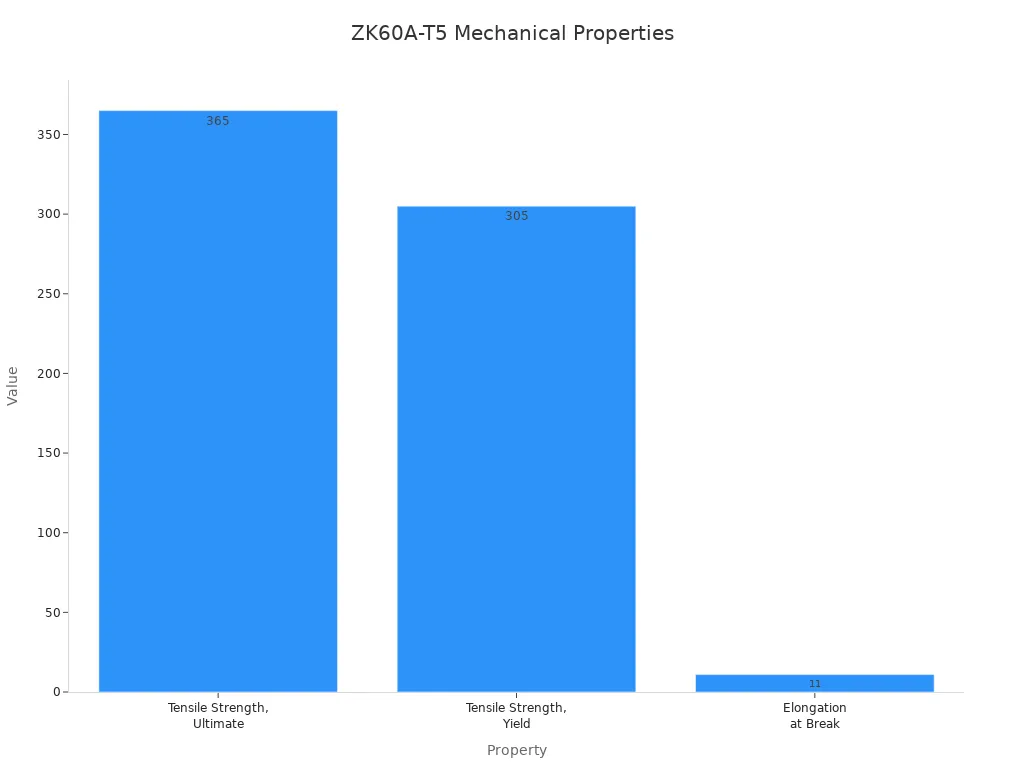
This alloy's impressive strength-to-weight ratio makes it a preferred choice for components where weight reduction is critical without sacrificing structural integrity. Its good ductility also allows for some deformation before fracture, which is important for safety and reliability.
WE43 Magnesium Alloy
Composition: Mg-Y-Nd-Zr
WE43 is a specialized magnesium alloy designed for high-performance applications. Its composition includes magnesium as the base metal. It also contains yttrium (Y), neodymium (Nd), and zirconium (Zr). Yttrium and neodymium are rare earth elements. They significantly enhance the alloy's high-temperature properties. Zirconium refines the grain structure, improving overall mechanical performance.
Key Characteristics: High Strength and Creep Resistance at Elevated Temperatures, Good Corrosion Resistance
WE43 magnesium alloy demonstrates excellent high-temperature strength. It retains a tensile strength exceeding 180 MPa at 300°C. This performance significantly surpasses that of traditional magnesium alloys like AZ91 and ZK60. This makes WE43 a leading commercial heat-resistant magnesium alloy. Its superior stability at elevated temperatures, even above 300°C, is a key characteristic. Furthermore, T6 heat treatment substantially improves both its tensile strength and creep resistance.
WE43 alloy is recognized for its good castability, high strength, and high creep resistance. It also offers good corrosion resistance and ignition/flame resistance. The cyclic creep behavior of PBF-LB/M WE43 was investigated across a temperature range from room temperature up to 300°C. Compressive loading conditions result in higher creep resistance compared to tensile loading. The presence of a fine-grained microstructure and rare earth (RE) precipitates significantly enhances the alloy's high-temperature stability. These characteristics make WE43 ideal for demanding environments.
Other Notable Magnesium Alloy Series
AZ63 and AZ92 for Sand Castings
AZ63 and AZ92 magnesium alloys are primarily utilized for sand castings. These alloys offer good castability, making them suitable for producing larger or more complex components. Sand casting provides flexibility in design and is often used for prototypes or lower-volume production runs. Both AZ92 and AZ63 alloys are employed in sand casting processes. They provide a balance of mechanical properties for general engineering applications.
Mg-Mn Alloy Group (M1A, M1C, M2M, M2S, ME20M)
The Mg-Mn alloy group includes grades like M1A, M1C, M2M, M2S, and ME20M. These alloys are notable for their specific advantages. Their primary advantage lies in high corrosion resistance and good weldability. They show a significantly reduced corrosion rate, especially in seawater. The lowest corrosion rate occurs at approximately 1.5% manganese content. Manganese combines with iron to weaken its adverse effect on corrosion. This group of alloys does not tend to stress corrosion cracking in neutral media. Intergranular corrosion also does not occur.
| Feature | Description |
|---|---|
| Alloy Group | Mg-Mn (grades M1A, M1C, M2M, M2S, ME20M) |
| Primary Advantage | High corrosion resistance and good weldability |
| Corrosion Resistance | Significantly reduced corrosion rate, especially in seawater (lowest at ~1.5% Mn content); Mn combines with iron to weaken its adverse effect on corrosion. |
| Stress Corrosion Cracking | Does not tend to stress corrosion cracking in neutral media |
| Intergranular Corrosion | Does not occur |
| Semi-finished Products | Plates, strips, tubes, bars, profiles, forgings |
| Applications (Plates) | Aircraft and helicopter skins, panels, and internal components |
| Applications (Forgings) | Stressed parts |
| Applications (Pipes) | Pipeline systems (e.g., gasoline, lubricating oil) require corrosion resistance |
| Mechanical Properties | Not exceptionally high; strength limit 210-280MPa |
| Strength Improvement | Primarily from work hardening; good extrusion effect (extruded material has higher strength than rolled) |
| Grain Growth | Manganese hinders grain growth during heating |
| Strength After Hot Working/Annealing | Small decrease in strength properties |
| Casting Properties | Very poor; large solidification shrinkage and hot cracking tendency |
| Typical Mn Content | 1.3% - 2.5% |
These alloys are available as semi-finished products such as plates, strips, tubes, bars, profiles, and forgings. Applications for plates include aircraft and helicopter skins, panels, and internal components. Forgings are used for stressed parts. Pipes made from these alloys are suitable for pipeline systems, such as those for gasoline and lubricating oil, where corrosion resistance is essential. While their mechanical properties are not exceptionally high, with a strength limit of 210-280MPa, work hardening primarily improves their strength. Extruded material often has higher strength than rolled material. Manganese also hinders grain growth during heating, and strength properties show only a small decrease after hot working or annealing. However, their casting properties are very poor due to large solidification shrinkage and a tendency for hot cracking.
Applications of Specific Magnesium Alloy Grades

Engineers leverage the unique properties of various magnesium alloy grades across diverse industries. Each alloy's specific composition and characteristics determine its most suitable applications, ranging from high-performance automotive parts to advanced electronic devices.
AZ91D Magnesium Alloy Applications
AZ91D, a widely used die-casting alloy, finds extensive application where lightweight and structural integrity are paramount. Its excellent castability allows for the production of complex shapes efficiently.
Automotive Components: Instrument Panels, Steering Wheel Armatures
The automotive industry frequently utilizes AZ91D for its ability to reduce vehicle weight, which improves fuel efficiency and performance. Specific applications include dashboard crossbeams, which provide structural support for the vehicle's interior. Manufacturers also use AZ91D for steering wheel armatures, ensuring both strength and reduced mass. Other critical components like seat structures and reduction cover materials for automotive engines, also benefit from this alloy. Furthermore, precision instruments such as instrument panels often incorporate AZ91D.
Electronic Housings: Laptops, Mobile Phones
AZ91D's lightweight nature and good strength make it an ideal material for electronic housings. It provides robust protection for sensitive internal components without adding excessive bulk. For example, the Winmate L156AD laptop utilizes AZ91D magnesium alloy for its main case, which manufacturers describe as a "strong, heavy piece of high-purity die-cast AZ91D magnesium alloy." This application highlights the alloy's suitability for durable yet lightweight consumer electronics, including mobile phones and other portable devices.
Power Tool Casings
Power tool manufacturers also employ AZ91D for casings. The alloy's combination of strength and low density helps create tools that are both durable and comfortable for users to handle over extended periods. This reduces user fatigue and enhances the overall product's lifespan.
AM60B Magnesium Alloy Applications
AM60B is particularly valued for its superior ductility and impact strength, making it a preferred choice for applications requiring energy absorption and resistance to sudden forces.
Automotive Safety Components: Seat Frames, Airbag Housings
The automotive sector extensively uses AM60B in safety-critical components. Its high ductility allows it to absorb significant impact energy during a collision, protecting vehicle occupants. This makes it an excellent material for seat frames, where structural integrity under stress is crucial. Airbag housings also benefit from AM60B, as the alloy can withstand the rapid deployment forces while maintaining its structural form.
Sports Equipment
AM60B's combination of lightweight properties and impact resistance makes it suitable for various sports equipment. Manufacturers use it in components where durability and performance are essential, such as bicycle frames, ski bindings, and other gear that experiences high stress and potential impacts.
AS41B Magnesium Alloy Applications
AS41B stands out for its enhanced performance at elevated temperatures, making it indispensable for specific high-heat environments.
Engine Blocks and Transmission Cases
The improved creep resistance of AS41B at elevated temperatures makes it an excellent material for internal combustion engine components. Manufacturers use it in engine blocks and transmission cases, where parts operate under continuous stress and high thermal loads. This alloy helps maintain dimensional stability and structural integrity, ensuring reliable performance over time.
Components Requiring Elevated Temperature Performance
Beyond engine and transmission parts, AS41B is suitable for any component that must withstand sustained high temperatures without deforming. Its unique composition, including silicon, provides the necessary thermal stability. This characteristic extends its utility to various industrial machinery and aerospace applications where heat management and structural integrity are critical design considerations.
ZK60A Magnesium Alloy Applications
ZK60A is a high-strength magnesium alloy. It finds use in demanding applications. Its properties make it valuable in aerospace and sports.
Aerospace Components: Helicopter Gearboxes, Missile Parts
ZK60A magnesium alloy plays a crucial role in aerospace components. Its high strength-to-weight ratio is essential for these applications. Engineers use ZK60A for:
- Aircraft landing gear components
- Helicopter rotor hubs and transmission parts
- Missile airframes and components
- Satellite structural members
- Aircraft wing panels and ribs
Specific examples include gearbox housings and helicopter transmission cases. Drone chassis and UAV frames also utilize this alloy. Missile guidance systems and radar housings require its strength and lightness.
Bicycle Frames
ZK60A's combination of high strength and good ductility makes it excellent for bicycle frames. Manufacturers create lightweight yet durable frames. These frames withstand the stresses of riding. The alloy's properties contribute to improved performance and rider comfort.
WE43 Magnesium Alloy Applications
WE43 is a specialized magnesium alloy. It excels in extreme conditions. Its high-temperature resistance and strength are key.
Aerospace: Engine Components, Helicopter Transmissions
WE43 magnesium alloy is vital for aerospace applications. It performs well in high-temperature environments. Engineers use it in the transmission and power systems of military aircraft and helicopters. Specific examples include:
- Helicopter transmission casings for Eurocopter EC120 and NH90 helicopters
- Components required for the Sikorsky S92 helicopter
- Parts expected to replace RZ5 in existing helicopters
- Aviation engine and gearbox casings, including large magnesium casings like intermediate compressor casings for turbine engines
Motorsport Applications
Motorsport demands materials that offer both lightness and strength. WE43 meets these requirements. Its high strength and creep resistance at elevated temperatures make it ideal for critical engine and transmission parts in racing vehicles. This helps improve performance and reliability under extreme conditions.
High-Temperature Structural Components
WE43 is a prime choice for high-temperature structural components. This includes parts for aerospace and other industries. Its ability to maintain strength and resist creep at elevated temperatures ensures structural integrity. This makes it suitable for demanding thermal environments.
General Applications of Cast Magnesium Alloys
Cast magnesium alloys offer a cost-effective way to produce complex, lightweight parts. They are common in the automotive industry.
Instrument Panel Structures
Automotive manufacturers use cast magnesium alloys for instrument panel structures. These structures provide support for the dashboard. Their lightweight nature helps reduce overall vehicle weight. This contributes to better fuel efficiency.
Cross-Car Beams
Cross-car beams are important structural components in vehicles. Cast magnesium alloys are suitable for these beams. They offer the necessary strength and stiffness. They also keep the weight down.
Roof Frames
Cast magnesium alloys also find use in roof frames. These frames contribute to vehicle safety and structural rigidity. The lightweight properties of the alloys help maintain a low center of gravity.
Seat Frames
Seat frames are another common application for cast magnesium alloys. The alloys allow for complex designs. They also provide strong, lightweight support for vehicle seats. This enhances both safety and comfort.
Manufacturing Processes for Magnesium Alloys
Manufacturers employ various processes to shape magnesium alloys into their final forms. These methods leverage the unique properties of these materials, optimizing them for specific applications. Understanding these processes helps in selecting the right alloy and manufacturing technique for a given product.
Die Casting of Magnesium Alloys
Die casting is a highly efficient manufacturing process for producing magnesium components. It involves injecting molten metal into a mold cavity under high pressure.
Advantages of Die Casting
Die casting offers numerous benefits for magnesium alloys. This method produces parts with excellent dimensional accuracy and a smooth surface finish. The resulting components exhibit good corrosion resistance and are lightweight. Magnesium alloys also boast a high strength-to-weight ratio and a good stiffness-to-weight ratio. The material supply for magnesium is abundant, and the alloys are recyclable. Unlike aluminum, magnesium can be melted in heat-resistant steel crucibles. Furthermore, magnesium alloys possess high thermal conductivity (approximately 150 W/mK), which is beneficial for heat dissipation. This property makes magnesium suitable for components exposed to high temperatures, such as those found in the automotive and electronics industries.
| Metal | Density (g/cm³) |
|---|---|
| Magnesium | 1.8 |
| Aluminum | 2.7 |
| Titanium | 4.5 |
Common Alloys Used in Die Casting (e.g., AZ91)
AZ91 is a prime example of an alloy frequently used in die casting. Its excellent castability allows manufacturers to create intricate and complex parts with high precision. Other alloys like AM60B also see widespread use in this process, particularly for components requiring good ductility.
Sand Casting of Magnesium Alloys
Sand casting is another traditional method for forming magnesium components. It uses sand as the mold material.
Suitability for Larger Components
Sand casting is particularly suitable for producing larger magnesium parts or prototypes. This method offers greater flexibility in design and can accommodate more complex geometries than some other casting techniques. It is often chosen for lower-volume production runs where the cost of permanent molds is not justified.
Common Alloys Used in Sand Casting (e.g., AZ63, AZ92)
AZ63 and AZ92 are common magnesium alloys for sand casting. These alloys provide a good balance of mechanical properties and castability, making them reliable choices for various industrial applications.
Extrusion and Forging of Magnesium Alloys
Extrusion and forging are mechanical processes that produce wrought forms of magnesium alloys. These methods involve deforming the metal under pressure.
Producing Wrought Forms
These processes transform magnesium ingots into various wrought products like rods, bars, tubes, and sheets. Wrought magnesium alloys offer superior properties and performance compared to castings. They are ideal for components subjected to higher mechanical loads.
Alloys Suited for Wrought Processes (e.g., ZK60A)
Magnesium alloys are noted for their seamless machinability, allowing them to be easily extruded and forged with minimal physical effort. Wrought magnesium alloys exhibit greater tensile strength, better elongation, and higher yield strength. They also possess a more refined grain size. Extruded forging stock is typically preferred over as-cast stock because it results in less porosity and better overall properties, leading to a higher quality forged component. ZK60A is an excellent example of an alloy well-suited for wrought processes. Its high strength and good ductility make it ideal for extruded and forged components in demanding applications.
Future Trends and Innovations in Magnesium Alloys
The future of Magnesium Alloys looks promising. Ongoing research and development efforts continue to push the boundaries of their capabilities. These advancements address previous limitations and open new avenues for application.
Advancements in Corrosion Protection for Magnesium Alloys
Corrosion resistance remains a critical area for improvement. Researchers develop new strategies to enhance the durability of these materials.
New Coating Technologies
Surface modification significantly improves the corrosion resistance of magnesium alloys. This process creates a barrier layer between the alloy and corrosive media. It reduces corrosion thermodynamically and kinetically. Coatings are broadly categorized into inorganic and organic types. Inorganic coatings use methods like chemical conversion, anodization, and micro-arc oxidation. Organic coatings, including degradable polymer coatings, apply via dip coating or self-assembly. Both types enhance corrosion resistance.
| Coating Technology | Description |
|---|---|
| Electroless nanocomposite coatings | Advanced composite coatings applied without external current. |
| Electrophoretic (EPD) coatings | Coatings deposited using an electric field. |
| PVD & CVD coatings | Physical and Chemical Vapor Deposition techniques. |
| Thermal and cold spray coatings | Methods involving spraying coating materials at high speeds. |
| Polymer nanocomposite coatings | Polymer-based coatings reinforced with nanoparticles. |
| Superhydrophobic coatings | Coatings designed to repel water effectively. |
| Self-healing coatings | Coatings capable of repairing damage autonomously. |
| Biocompatible coatings | Coatings suitable for biomedical applications on biodegradable Mg alloys. |
| Multilayer coating strategies | Multiple layers of coatings for enhanced protection. |
Graphene-based materials, such as graphene oxide (GO), increasingly protect surfaces. They offer impermeability, oxidation resistance, high strength, and lubricity. Biomimetic materials also inspire new anti-corrosion coatings. Artificial superhydrophobic coatings, for example, reduce contact between corrosive liquids and the alloy surface.
Alloy Development for Enhanced Resistance
Scientists also develop new alloy compositions. These alloys inherently possess better corrosion resistance. This reduces the reliance on external coatings alone.
Development of New High-Performance Magnesium Alloys
Innovations focus on creating alloys for more demanding environments. They also improve existing properties.
Alloys for Extreme Temperatures
New magnesium alloys perform well at elevated temperatures. These alloys maintain strength and creep resistance.
| Alloy Series | Performance at 200°C |
|---|---|
| MRI230D | Best creep resistance |
| DieMag211 | Good creep resistance |
| DieMag422 | Good creep resistance |
| DieMag633 | Best creep resistance, outstanding strength at 150°C |
Mg–RE–Al alloys show promise for operating between 200–300°C. They achieve a 94 MPa yield strength at 300°C, a 42% increase over benchmark AE44.
Alloys with Improved Ductility and Formability
Researchers develop alloys with enhanced ductility and formability. A rare-earth-free alloy containing 1 wt.% aluminum and 0.1 wt.% calcium shows over four times greater ductility and 40% higher strength than pure magnesium. This development used a quantum-mechanically derived 'treasure map'. Other approaches include:
- Texture or grain size engineering through processes like extrusion.
- Severe plastic deformation to create ultra-fine grained microstructures.
- Increasing the activity of <c+a> dislocation slip, often with rare-earth elements. Dilute additions of zinc (Zn) and calcium (Ca) also improve the ductility of magnesium alloy sheets.
Increased Adoption of Magnesium Alloys in New Industries
New industries recognize the benefits of magnesium alloys. This leads to broader applications.
Medical Implants
Magnesium is the fourth most common mineral in the human body. It is essential for bone reconstruction. Magnesium alloys offer desirable mechanical properties, biodegradability, biocompatibility, and osteopromotive characteristics. They find use in bone tissue engineering scaffolds and bone-related fixation devices. Advanced fabrication techniques, like laser additive manufacturing, enable rapid production of complex, customized porous structures.
Renewable Energy Components
The global renewable energy market projects significant growth. This presents opportunities for high thermal conductivity magnesium alloys. These alloys ensure efficient operation and durability in solar power inverters, wind turbines, and energy storage systems. They contribute to more efficient energy production. Additive manufacturing opens new possibilities for complex, lightweight structures.
Expansion in Consumer Electronics
Magnesium alloys see increasing adoption in consumer electronics. Camera bodies benefit from their thermal conductivity. Cast magnesium alloys are prevalent due to their ease of molding into complex shapes and recyclability. This expansion creates new market opportunities.
FAQ
What makes magnesium alloys a preferred material?
Magnesium alloys are preferred for their exceptional lightweight properties and high strength-to-weight ratio. These characteristics help reduce overall product weight. This leads to improved fuel efficiency in vehicles and enhanced performance in electronics.
How do manufacturers address corrosion in magnesium alloys?
Manufacturers address corrosion through modern advancements. They use various surface treatments and protective coatings. Alloy development also enhances inherent resistance. These methods create a barrier against corrosive elements, improving durability.
What is the difference between cast and wrought magnesium alloys?
Cast magnesium alloys form by pouring molten metal into molds. They generally have lower strength. Wrought alloys undergo mechanical deformation like rolling or extrusion. They possess refined microstructures, offering superior strength and hardness.
Which magnesium alloy is suitable for high-temperature applications?
WE43 magnesium alloy is highly suitable for high-temperature applications. It maintains excellent strength and creep resistance even above 300°C. AS41B also offers improved creep resistance at elevated temperatures, making it useful for engine components.
Are magnesium alloys difficult to machine?
No, magnesium alloys are generally easy to machine. Manufacturers can machine them at high speeds, often requiring less power than other metals. This leads to faster production times and reduced tooling wear, making them efficient for complex parts.
What are common applications for AZ91D magnesium alloy?
AZ91D magnesium alloy is common in automotive components like instrument panels and steering wheel armatures. It also sees use in electronic housings for laptops and mobile phones. Power tool casings also frequently utilize this alloy.
Can magnesium alloys be used in medical implants?
Yes, magnesium alloys show promise in medical implants. They offer desirable mechanical properties, biodegradability, and biocompatibility. Researchers use them in bone tissue engineering scaffolds and bone fixation devices due to their osteopromotive characteristics.