

Magnesium Die Casting for Power Tools and Industrial Equipment
Magnesium Die Casting offers unparalleled advantages for power tools and industrial equipment. This advanced manufacturing process provides an exceptional strength-to-weight ratio and excellent thermal properties. Such capabilities make this technology crucial for meeting the evolving demands of modern industries, where performance and efficiency are paramount.
Key Takeaways
- Magnesium die casting makes power tools and industrial equipment lighter. This helps users and saves energy.
- Magnesium alloys are very strong for their weight. This makes parts tough without being heavy.
- Magnesium die casting helps tools stay cool. It moves heat away from motors and electronics.
- Magnesium parts block electronic interference. This keeps sensitive electronics safe in busy areas.
- Magnesium die casting allows for complex shapes. This means fewer parts and easier assembly.
- Magnesium is a good choice for the environment. It is common and can be recycled many times.
- Magnesium die casting costs more at first. But it saves money over time for making many items.
Why Magnesium Die Casting Excels for Power Tools and Industrial Equipment
Lightweighting for Enhanced Portability and Reduced Fatigue
Magnesium die casting offers significant advantages by reducing the overall weight of tools and equipment. This lightweighting directly translates into improved user experience and operational efficiency.
Benefits for Handheld Tools
Reduced tool weight significantly lessens physical strain on operators. This creates a feeling of near-weightlessness, decreasing muscle fatigue, improving comfort, and enhancing efficiency in tasks such as drilling, grinding, or assembly work. Minimizing strain on hands and wrists helps prevent work-related musculoskeletal disorders (WRMSDs) like carpal tunnel syndrome and tendonitis. This reduction in fatigue and physical exertion directly contributes to increased productivity. Workers can operate at their optimal level without discomfort. Furthermore, it allows for quicker tool changes, streamlining workflows, eliminating downtime, and leading to higher output. Enhanced precision also results from reduced arm, hand, and wrist strain, which is crucial for delicate tasks. Ergonomic tool bags, designed to reduce fatigue and improve tool access, also significantly impact productivity. These bags distribute weight evenly, incorporating features like padded shoulder straps and molded grips to minimize muscle strain. This reduction in physical burden alleviates fatigue during long workdays. Ergonomic tool design, which often incorporates reduced weight, plays a crucial role in mitigating hand tool fatigue and preventing injuries. When professionals use quality ergonomic tools, instances of fatigue and injury decrease, leading to reduced lost time and lower claim costs.
Advantages for Mobile Industrial Machinery
For mobile industrial machinery, lightweight components improve maneuverability and reduce the energy required for operation. Lighter parts contribute to better fuel efficiency in vehicles and less wear and tear on moving parts. This enhances the overall operational ease and extends the lifespan of the equipment.
Superior Strength-to-Weight Ratio in Magnesium Die Casting
Magnesium alloys are notable for their high strength-to-weight ratio, in addition to their low weight, exceptional damping capacity, and ease of machining. Magnesium is the lightest among die-cast metals, providing the best strength-to-weight ratio compared to aluminum and steel alloys. This characteristic allows for lighter parts while maintaining required structural performance.
Creating Robust Components
Magnesium alloys are recognized for their exceptional strength-to-weight ratios. As the lightest structural metal, with a specific gravity of 1.74, magnesium offers significant weight advantages. Cast magnesium alloys can achieve tensile strengths up to approximately 280 MPa and yield strengths reaching 160 MPa. The table below illustrates the strength-to-weight ratios for common magnesium alloys:
| Alloy | Density (g/cm³) | Tensile Strength (MPa) | Strength-to-Weight Ratio (MPa·cm³/g) |
|---|---|---|---|
| AZ91 | 1.81 | 200-260 | 110.5-143.6 |
| AM60 | 1.80 | 190-250 | 105.6-138.9 |
| AM50 | 1.77 | 180-230 | 101.7-129.9 |
| AM20 | 1.75 | 150-220 | 85.7-125.7 |
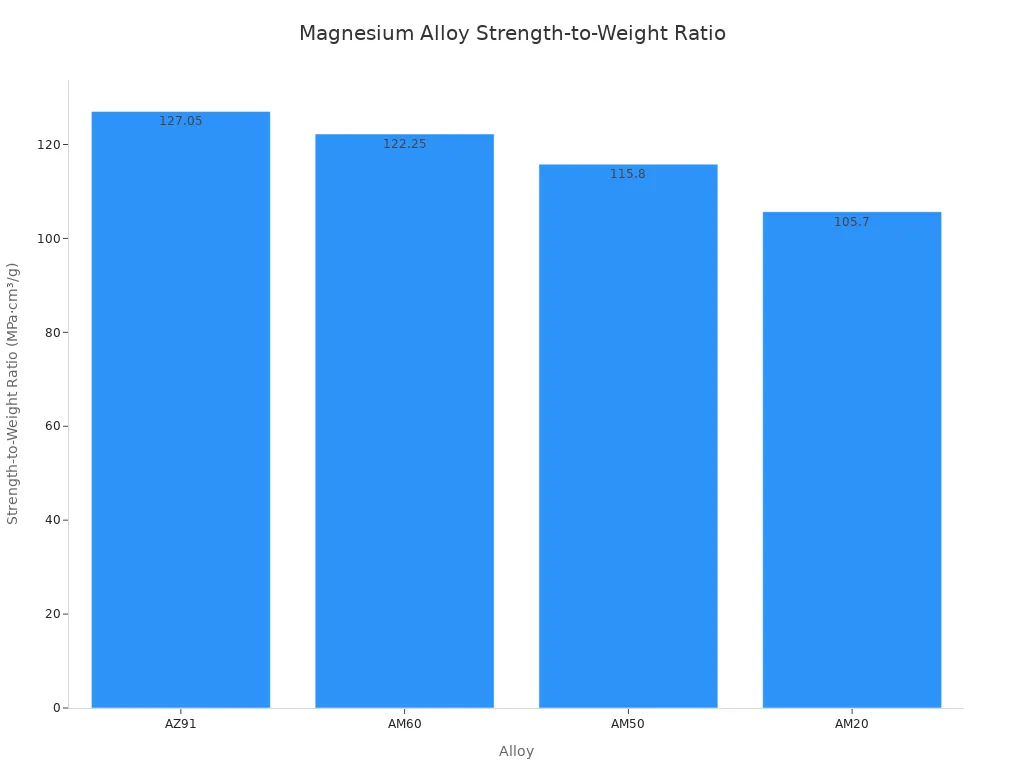
This data demonstrates how magnesium alloys provide excellent structural integrity without the bulk of heavier metals.
Meeting Demanding Application Requirements
The superior strength-to-weight ratio enables components to withstand harsh operating conditions and high mechanical stresses. This ensures reliability and longevity in demanding applications, from high-speed Power Tool Gears to critical industrial equipment frames.
Excellent Heat Dissipation Properties of Magnesium Die Casting
Effective thermal management is crucial for the performance and lifespan of power tools and industrial equipment. Magnesium alloys possess excellent heat dissipation properties.
Managing Heat in High-Performance Motors
The thermal conductivity of magnesium alloy is approximately half that of aluminum. This characteristic provides magnesium alloys with an advantage in heat dissipation performance, making them suitable for applications such as car radiator brackets and dashboard frames. This property helps manage heat generated by high-performance motors, preventing overheating and maintaining optimal operating temperatures. Efficient heat transfer ensures consistent power output and prevents thermal degradation of motor components.
Protecting Electronic Components
Effective heat dissipation also safeguards sensitive electronic components within power tools and industrial equipment. Overheating can lead to component failure and reduced reliability. Magnesium housings and enclosures efficiently draw heat away from electronics, protecting them from thermal damage and ensuring stable operation.
EMI/RFI Shielding Capabilities of Magnesium Die Casting
Magnesium alloys inherently offer excellent electromagnetic interference (EMI) and radio frequency interference (RFI) shielding properties. This characteristic makes them ideal for applications requiring the protection of sensitive electronics.
Protecting Sensitive Electronics
Electronic components in power tools and industrial equipment often operate in environments with significant electromagnetic noise. This noise can disrupt their function or even cause damage. Magnesium's metallic structure effectively blocks and dissipates electromagnetic waves, preventing external interference from affecting internal circuits. This shielding capability ensures the reliable operation of microprocessors, sensors, and communication modules within the equipment. It also prevents the equipment itself from emitting excessive electromagnetic radiation, which could interfere with other devices.
Importance in Industrial Environments
In industrial settings, the presence of numerous electrical motors, power lines, and wireless communication systems creates a complex electromagnetic landscape. Effective EMI/RFI shielding becomes critical to maintain operational integrity and safety. Regulatory bodies establish strict electromagnetic compatibility (EMC) standards to manage this complexity.
- Organizations such as the International Electrotechnical Commission (IEC), its Special Committee on Radio Interference (CISPR), the Federal Communications Commission (FCC), and the Food and Drug Administration’s Center for Devices and Radiological Health (CDRH) set these EMC standards.
- These standards, including those from ISO (International Organization for Standardization), define the maximum emissions a system can produce and the maximum interference a system can withstand.
- Specific EMC standards vary significantly across industries, environments, and countries. Shielding requirements depend on emissions and immunity guidelines set by relevant regulating bodies.
Magnesium enclosures help equipment meet these stringent standards, ensuring compliance and preventing costly operational disruptions or regulatory penalties.
Design Flexibility and Complex Geometries with Magnesium Die Casting
Magnesium Die Casting offers exceptional design flexibility, allowing engineers to create intricate and complex geometries that would be challenging or impossible with other manufacturing methods.
Enabling Intricate Designs
The high-pressure die casting (HPDC) process for magnesium allows for the creation of highly complex geometries, especially with extremely thin walls. This capability provides absolute accuracy for designs featuring thin shapes, small sizes, and fine details. Engineers can optimize performance, functionality, and aesthetics through this flexibility. The process ensures intricate and complex geometries are produced with high accuracy and uniformity, even with minimal porosity and flaws, leading to lightweight yet robust parts. The high injected pressure during molding ensures the part fills completely without porosity and accurately replicates intricately detailed features. This allows for the integration of features like internal channels, mounting points, and complex contours directly into a single component.
Reducing Assembly Steps and Improving Functionality
The ability to cast complex, multi-functional parts significantly reduces the number of individual components required in an assembly. Thixomolding, a specific magnesium casting process, enables the creation of complex geometries. It allows for the consolidation of multiple individual parts into a single component. This consolidation directly simplifies the assembly process for manufacturers. By integrating features that would typically require separate machining or assembly steps, manufacturers can streamline production, lower labor costs, and reduce the potential for assembly errors. This not only improves manufacturing efficiency but also enhances the overall functionality and reliability of the power tool or industrial equipment.
Key Applications of Magnesium Die Casting in Power Tools
Power tool manufacturers increasingly utilize advanced materials to enhance product performance and user experience. This section explores how power tools benefit from components made from lightweight, high-strength materials.
Drills and Impact Drivers Utilizing Magnesium Die Casting
Drills and impact drivers require robust yet lightweight components to ensure durability and user comfort. Manufacturers often select specific materials for critical parts.
Casings and Gearboxes
The material's strength and lightness make it ideal for casings and gearboxes. This significantly reduces the tool's overall weight, which makes handling easier for users during extended operation. The robust nature of the material also protects internal components from impacts and harsh working conditions, extending the tool's lifespan.
Motor Housings
Motor housings made from this material effectively dissipate heat generated by high-speed motors. This prevents overheating, which can damage the motor and reduce its lifespan. The material's structural integrity also provides a stable and protective enclosure for the motor, ensuring consistent performance.
Saws (Circular, Reciprocating, Jigsaws) with Magnesium Die Casting Components
Saws, including circular, reciprocating, and jigsaws, greatly benefit from lightweight yet strong components. These materials contribute to improved balance and reduced fatigue.
Base Plates and Guards
A die-cast footplate offers unmatched durability and flatness, enhancing stability and precision. A high-strength and lightweight upper guard protects users and the blade effectively. These components contribute to the saw's ease of handling and comfort, often resulting in a lighter tool. Components engineered for less weight contribute to superior balance and durability. For instance, a die-cast base, blade guard, and blade cover provide a lightweight design, making the saw easier to maneuver and operate with precision.
Motor Enclosures
Motor enclosures in saws benefit from the material's ability to manage heat. This ensures the motor operates at optimal temperatures, preventing thermal stress and maintaining consistent power output. The strong enclosure also protects the motor from external damage and debris.
Grinders and Sanders Benefiting from Magnesium Die Casting
Grinders and sanders operate under high stress and vibration, making material selection crucial for performance and user comfort.
Housing Components
The material's lightweight properties reduce user fatigue during prolonged use of grinders and sanders. Its strength protects the internal mechanisms from dust, debris, and accidental drops, common in demanding work environments. This ensures the tools remain operational and reliable.
Vibration Dampening Requirements
The material's inherent damping capacity helps absorb vibrations produced by the tool's motor and abrasive action. This significantly reduces user fatigue and improves control, leading to more precise and comfortable operation. Effective vibration dampening also extends the lifespan of internal components by reducing stress.
Nail Guns and Staplers Incorporating Magnesium Die Casting
Nail guns and staplers are essential tools in construction and manufacturing. They require materials that offer both durability and ease of use. The material choice significantly impacts a tool's performance and operator comfort.
Frames and Internal Components
The frames of nail guns and staplers benefit greatly from lightweight, strong materials. A lighter frame reduces the overall weight of the tool. This makes the tool easier for operators to handle during long work periods. Reduced weight minimizes user fatigue and improves maneuverability. This allows for more precise placement of fasteners. The material's inherent strength also provides a robust housing for the complex internal mechanisms. It protects components like pistons, drivers, and firing pins from external damage. This protection ensures consistent operation and extends the tool's service life. The ability to form intricate shapes allows for the integration of multiple features into a single component. This simplifies assembly and reduces the number of parts.
High Impact Resistance Needs
Nail guns and staplers operate under significant impact forces. Each firing cycle generates a powerful impulse. The tool's components must withstand these repetitive shocks without deforming or failing. Materials with high impact resistance are crucial for these applications. They absorb and dissipate the energy from each impact. This prevents stress fractures and material fatigue. The material's toughness ensures the tool maintains its structural integrity over thousands of cycles. This reliability is vital for professional users who depend on their tools daily. It also contributes to the safety of the operator. A tool that resists impact damage performs consistently and reduces the risk of malfunction. This high resistance to impact ensures the tool remains accurate and safe throughout its operational lifespan.
Key Applications of Magnesium Die Casting in Industrial Equipment
Robotics and Automation Components Using Magnesium Die Casting
Robotics and automation systems demand components that are both lightweight and incredibly strong. These characteristics are crucial for achieving high speeds, precision, and energy efficiency.
End Effectors and Structural Parts
End effectors, the "hands" of robots, benefit significantly from lightweight materials. Lighter end effectors allow robots to move faster and handle heavier payloads. This increases productivity and reduces wear on the robot's joints and motors. Structural parts, such as robot arms and frames, also gain from the high strength-to-weight ratio. This ensures rigidity and stability during rapid movements, maintaining accuracy in manufacturing and assembly tasks.
Motor Housings for Precision
Motor housings in robotic systems require excellent heat dissipation to prevent overheating during continuous operation. They also need to provide a stable, vibration-free enclosure for precise motor control. Magnesium alloys offer both properties. Their thermal conductivity helps manage heat, while their inherent damping qualities reduce vibrations. This combination ensures motors operate efficiently and accurately, which is vital for tasks requiring high precision.
Material Handling Equipment Enhanced by Magnesium Die Casting
Material handling equipment, including conveyors, forklifts, and lifting devices, constantly seeks improvements in efficiency, durability, and operational cost.
Components for Conveyors
Conveyor systems benefit from lightweight components. Lighter parts reduce the energy required to move materials, leading to lower operational costs. Magnesium alloys offer one of the highest strength-to-weight ratios, making them ideal for complex, thin-walled, and high-performance parts in conveyor systems. This material is 75% lighter than steel and 33% lighter than aluminum, significantly reducing the overall weight of components. It is comparable in weight to many plastics but offers far superior strength.
Parts for Forklifts and Lifting Devices
Forklifts and lifting devices require robust components that can withstand heavy loads and constant use. Magnesium die casting provides longer tool life, thinner walls, and tighter tolerances compared to aluminum, leading to more precise and durable components. It offers superior noise and vibration-dampening, which can improve the operational smoothness and longevity of material handling equipment. Magnesium castings can achieve tight tolerances that are difficult or impossible with steel, enhancing dimensional stability. The ability to consolidate multiple parts into a single component improves rigidity and reduces assembly costs, contributing to more efficient designs.
Medical Devices (Industrial Scale) with Magnesium Die Casting Housings
Industrial-scale medical devices, from diagnostic equipment to patient care systems, have stringent requirements for performance, reliability, and safety.
Housings for Diagnostic Equipment
Housings for diagnostic equipment, such as MRI machines or X-ray systems, often need to be robust yet manageable. Magnesium alloys provide an outstanding strength-to-weight ratio, offering considerable strength with minimal weight. This is crucial for high-performance parts that need durability without added mass. As the lightest structural metal, it is ideal for applications where weight is a critical factor.
Machinery Requiring EMI Shielding
Many medical devices contain sensitive electronics that require protection from electromagnetic interference (EMI). Magnesium alloys inherently offer excellent EMI/RFI shielding capabilities. This protects internal components from external interference and prevents the device from emitting harmful radiation.
Magnesium die casting effectively addresses the critical requirement for an exceptional strength-to-weight ratio, which is vital for handheld surgical tools, portable diagnostic devices, and ergonomic equipment. It also benefits patient care and mobility devices like hospital beds and wheelchairs due to its lightweight strength, improving portability and durability. Furthermore, magnesium alloys offer superb damping characteristics, reducing vibration in handheld tools.
This ensures the reliable and safe operation of critical medical machinery.
Aerospace Ground Support Equipment Leveraging Magnesium Die Casting
Parts Needing Corrosion Resistance
Aerospace ground support equipment (GSE) operates in highly demanding conditions. It frequently faces outdoor exposure, harsh chemicals like de-icing fluids, and extreme climatic variations, from desert heat to arctic cold. These environmental factors necessitate exceptional corrosion resistance from component materials. While magnesium sometimes carries a reputation for susceptibility to corrosion, modern advancements in alloys and surface treatments used in Magnesium Die Casting effectively overcome this challenge. Manufacturers apply specialized coatings to magnesium parts. These include anodizing, conversion coatings, or even advanced polymer layers. These treatments create a robust, passive barrier. This barrier actively shields the metal from environmental degradation, such as oxidation and galvanic corrosion, which can occur when dissimilar metals are in contact. Furthermore, careful alloy selection plays a crucial role. Specific magnesium alloys, engineered for aerospace applications, offer enhanced inherent corrosion resistance. These comprehensive measures collectively ensure the long-term durability and reliability of GSE components. They significantly reduce the need for frequent maintenance, which is costly and time-consuming in aerospace operations. This also guarantees operational safety and extends the service life of critical equipment, such as mobile stairs, baggage carts, and fueling equipment.
High Performance in Demanding Environments
GSE operates in truly demanding environments. It must endure extreme temperatures, heavy static and dynamic loads, continuous operational cycles, and significant vibrations. Magnesium's unique combination of properties makes it exceptionally suitable for these rigorous conditions. Its inherently lightweight nature allows for easier maneuverability of large mobile platforms and complex maintenance stands. This directly reduces the physical strain on operators during prolonged shifts, enhancing productivity and reducing injury risk. The material's high strength-to-weight ratio ensures superior structural integrity. Components can effectively withstand substantial loads without becoming excessively bulky or heavy. This characteristic is absolutely critical for lifting devices, specialized tools, and structural frames that support aircraft components. Magnesium also offers excellent inherent damping characteristics. This property efficiently helps absorb and dissipate mechanical vibrations generated by engines or heavy machinery. It significantly reduces wear and tear on both the equipment and its internal systems, extending component life. It also markedly improves operator comfort and control, especially for tools used for precision tasks. For instance, magnesium components in aircraft tugs, cargo loaders, or portable diagnostic units contribute to their robust yet agile design. They perform reliably under constant stress and varied operational scenarios, from busy airport tarmacs to remote military bases. This strategic material choice supports the rigorous demands of aerospace ground operations. It ensures equipment performs optimally, safely, and efficiently throughout its operational lifespan.
Advantages of Magnesium Die Casting Over Other Materials and Processes
Magnesium Die Casting Compared to Aluminum Die Casting
Magnesium die casting offers distinct benefits when compared to aluminum die casting, particularly in weight and specific strength.
Significant Weight Savings
Magnesium components provide substantial weight reductions. Magnesium die cast components typically offer a weight saving of approximately 33% to 35% compared to aluminum die cast components. In some specific applications, such as car seat frames and brackets, magnesium parts achieve up to a 31% weight reduction compared to their aluminum counterparts. This weight reduction directly translates to improved portability and energy efficiency in various applications.
Specific Strength Benefits
Magnesium alloys exhibit a significantly higher specific strength compared to both aluminum alloys and steel.
| Feature | Magnesium Alloys | Aluminum Alloys |
|---|---|---|
| Strength-to-Weight Ratio | Excellent | Good |
Magnesium alloys are the lightest structural metals, with a density of approximately 1.8 g/cm³. They offer a superior strength-to-weight ratio, enabling significant weight reduction without compromising strength. Aluminum alloys, while denser at around 2.7 g/cm³, provide a balance of strength and weight. They outperform magnesium alloys in overall strength while still maintaining a relatively low weight.
Magnesium Die Casting Versus Plastics
When comparing magnesium die casting to plastics, the advantages in durability and structural integrity become clear.
Enhanced Durability and Heat Resistance
Magnesium components offer superior durability compared to plastic parts. They withstand higher impact forces and resist wear more effectively. Furthermore, magnesium alloys possess excellent heat resistance. This property allows them to maintain structural integrity and performance in high-temperature environments where plastics would deform or degrade.
Superior Structural Integrity
Magnesium provides significantly greater structural integrity than plastics. It offers a rigid and stable platform for components, resisting flex and deformation under stress. This ensures long-term reliability and consistent performance, especially in demanding industrial applications.
Magnesium Die Casting Against Machined Components
Magnesium die casting presents compelling advantages over traditional machining processes, particularly for high-volume production and complex designs.
Cost-Effectiveness for High-Volume Production
Die casting becomes highly cost-effective for large production runs. Once manufacturers create the initial tooling, the per-unit cost drops significantly. This contrasts sharply with machining, where each component requires individual processing, leading to higher costs for mass production.
Greater Design Complexity
Die casting allows for the creation of intricate and complex geometries in a single step. This enables engineers to consolidate multiple parts into one component, reducing assembly steps and improving overall functionality. Machining often limits design complexity due to tool access and material removal constraints.
Challenges and Considerations in Magnesium Die Casting Implementation
While magnesium die casting offers numerous advantages, manufacturers must also address specific challenges. These considerations ensure successful implementation and optimal performance of components.
Corrosion Resistance in Magnesium Die Casting
Magnesium can be susceptible to corrosion, but effective strategies mitigate this concern.
Importance of Surface Treatment
Surface treatments are crucial for enhancing magnesium's corrosion resistance. Chromate conversion coatings serve as an undercoat for paint adhesion. They also function as standalone films for corrosion protection in storage and mildly corrosive environments. ASTM D1732 and MIL-M-3171 cover this process. Anodizing treatments create a hard, corrosion-resistant coating on magnesium. Examples include Chemical Treatment No. 17, HAE, and Cr-22, with MIL-M-45202 covering magnesium anodizing. Electroplating also provides a protective coating for bare magnesium in corrosive environments.
Alloy Selection Strategies
Choosing the correct alloy significantly impacts corrosion resistance. For magnesium/aluminum alloys in 3.5 wt.% NaCl, AZ80 and AZ91D alloys exhibited the highest corrosion resistance. This was primarily due to the fine β-phase (Mg17Al12) network and the aluminum enrichment on the corroded surface. These factors limited the progression of corrosion. The precipitation of the β-phase (Mg17Al12) along grain boundaries during aging acts as a barrier. This leads to a decrease in the corrosion rate in the initial stages of aging for die-cast magnesium alloy AZ91D.
Cost Implications of Magnesium Die Casting
Cost is a significant factor in manufacturing decisions.
Initial Tooling Investment
Magnesium die casting requires a substantial initial investment in tooling. Molds for die casting are complex and precision-engineered. Their design and fabrication represent a significant upfront cost for manufacturers.
Long-Term Production Savings Analysis
Despite high initial tooling costs, magnesium die casting offers long-term production savings. The process allows for rapid production cycles and high volumes. This efficiency drives down the per-unit cost over time. The ability to cast complex geometries also reduces assembly steps and material waste. These factors contribute to overall cost-effectiveness in mass production.
Processing Expertise for Magnesium Die Casting
Successful magnesium die casting relies on specialized knowledge and careful handling.
Need for Specialized Knowledge
Processing magnesium alloys requires specialized knowledge. Manufacturers must understand the unique metallurgical properties of magnesium. This includes its melting characteristics, flow behavior in molds, and solidification patterns. Expertise ensures high-quality parts and efficient production.
Handling Magnesium Alloys Safely
Magnesium alloys require careful handling due to their reactivity. Molten magnesium can ignite if exposed to air. Therefore, foundries must implement strict safety protocols. These protocols include inert gas atmospheres and specialized fire suppression systems. Safe handling practices protect personnel and ensure a secure manufacturing environment.
The Future of Magnesium Die Casting in Power Tools and Industrial Equipment
The future of manufacturing for power tools and industrial equipment looks toward continuous innovation. Advancements in materials and processes will drive this progress.
Advancements in Magnesium Die Casting Alloys and Coatings
Ongoing research and development focus on enhancing magnesium alloys and their protective coatings. These efforts aim to push performance boundaries.
Improving Performance Characteristics
Scientists develop ultrastrong alloys with nanocrystalline structures. These structures feature finely spaced stacking faults (SF) through long-period stacking order (LPSO) phases or quasi-crystalline structures. Engineers can tailor these SFs to increase both strength and ductility. New die-cast Mg-RE-Al alloys also show improved yield (94 MPa) and tensile strength at temperatures up to 300°C. This represents a 42% increase over previous high-temperature die-cast magnesium alloys.
| Alloy | Key Performance Improvements |
|---|---|
| MRI 153M | Superior elevated-temperature strength and creep resistance (at 130-150°C, 50-85 MPa), better corrosion resistance. |
| MRI 230D | Excellent creep resistance (comparable to A380 aluminum at 150-175°C, 70 MPa), high strength, superior corrosion behavior. |
| General Alloying | Increasing aluminum improves ambient strength and corrosion resistance. Alloying with alkaline earth elements (Ca, Sr) and RE misch metal improves creep resistance and ambient strength, though it can negatively impact ductility. |
Expanding Application Possibilities
These improved performance characteristics open new application possibilities. Enhanced strength and ductility allow for more complex and durable components. Better high-temperature resistance means magnesium can operate in harsher environments. This expands its use in high-performance motors and industrial machinery. Superior corrosion resistance also makes magnesium suitable for outdoor and marine industrial equipment.
Sustainability and Recyclability of Magnesium Die Casting
Sustainability is a growing concern in manufacturing. Magnesium offers significant environmental advantages.
Magnesium's Environmental Benefits
Magnesium is the eighth most abundant element in the Earth's crust. Its extraction and processing require less energy compared to some other metals. The lightweight nature of magnesium components also reduces energy consumption during product use. This applies to both portable power tools and large industrial equipment.
Circular Economy Contributions
Magnesium is 100% recyclable. Manufacturers can re-melt and reuse magnesium scrap without significant loss of properties. This contributes to a circular economy. It reduces waste and minimizes the demand for virgin materials. This recyclability makes magnesium an environmentally responsible choice for future manufacturing.
Growing Demand for Lightweighting Driving Magnesium Die Casting Innovation
The continuous demand for lighter, more efficient products drives innovation in magnesium applications.
Driving Innovation in Power Tools
Consumers and professionals seek lighter power tools. These tools reduce fatigue and improve maneuverability. This demand pushes manufacturers to explore new magnesium alloys and casting techniques. Innovation focuses on creating even lighter, stronger, and more ergonomic tool designs.
Impact on Industrial Equipment Design
Lightweighting also significantly impacts industrial equipment design. Lighter components reduce energy consumption in robotics and material handling systems. They also improve the payload capacity of mobile equipment. This leads to more efficient and cost-effective industrial operations.
Magnesium Die Casting stands as a critical technology for advancing power tools and industrial equipment. It offers a unique combination of lightweight properties, exceptional strength, and superior performance characteristics. This technology effectively meets the evolving demands of modern industries, ensuring future innovation and enhanced efficiency across various applications. Manufacturers leverage these advantages to create more durable, ergonomic, and high-performing products.
FAQ
What makes magnesium die casting ideal for power tools?
Magnesium die casting provides power tools with significant weight reduction, enhancing portability and reducing user fatigue. It also offers superior strength-to-weight ratios and excellent heat dissipation, ensuring durability and consistent performance for high-stress applications.
How does magnesium die casting benefit industrial equipment?
Magnesium die casting improves industrial equipment by enabling lighter, stronger components. This enhances maneuverability, reduces energy consumption, and extends equipment lifespan. It also provides crucial EMI/RFI shielding for sensitive electronics in complex industrial environments.
What are the weight advantages of magnesium die casting over aluminum?
Magnesium die cast components typically offer a 33% to 35% weight saving compared to aluminum die cast components. This significant weight reduction directly translates to improved portability and energy efficiency across various applications.
Does magnesium die casting offer good heat dissipation?
Yes, magnesium alloys possess excellent heat dissipation properties. This helps manage heat generated by high-performance motors and protects sensitive electronic components from thermal damage. Efficient heat transfer ensures stable operation and extends component life.
How does magnesium die casting address EMI/RFI shielding?
Magnesium's metallic structure effectively blocks and dissipates electromagnetic waves. This protects sensitive electronics within power tools and industrial equipment from external interference. It also prevents the equipment from emitting excessive radiation, ensuring compliance with industry standards.
Is magnesium die casting a sustainable manufacturing process?
Yes, magnesium is the eighth most abundant element and is 100% recyclable. Manufacturers can re-melt and reuse magnesium scrap without significant property loss. This contributes to a circular economy, reducing waste and minimizing demand for virgin materials.
Can magnesium die casting produce complex designs?
Absolutely. The high-pressure die casting process allows for intricate and complex geometries, including thin walls and fine details. This design flexibility enables the consolidation of multiple parts into a single component, simplifying assembly and improving overall functionality.