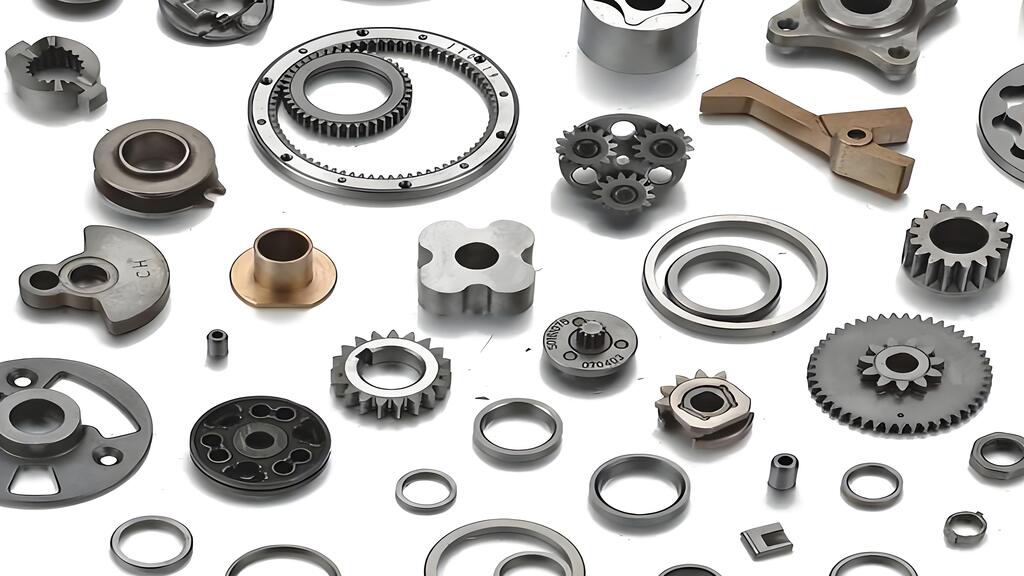


Sinter-Hardening vs. Conventional Sintering
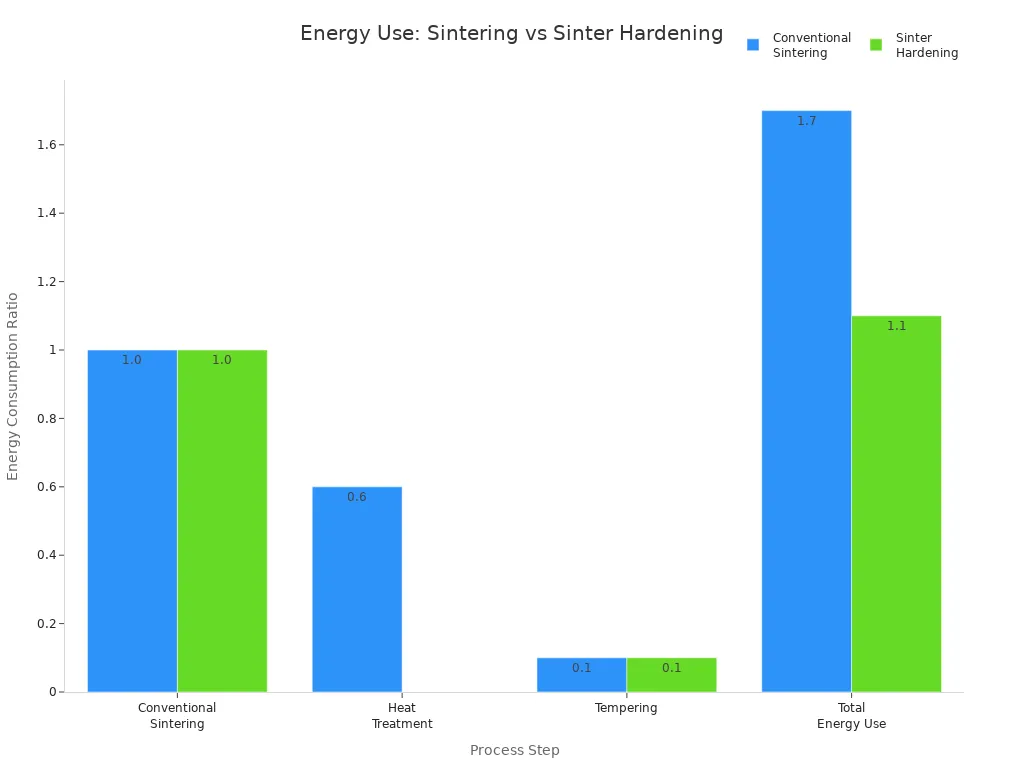
Sinter-Hardening vs. Conventional Sintering presents a critical choice for manufacturers. Sinter-hardening merges sintering and hardening into a single step, while conventional sintering requires separate heat treatment. This difference shapes workflow, cost, and part quality. The table below highlights a 35% reduction in energy use with sinter-hardening, reflecting greater efficiency and lower costs.
| Process Step | Conventional Sintering Energy Consumption Ratio | Sinter Hardening Energy Consumption Ratio |
|---|---|---|
| Conventional Sintering | 1.0 | 1.0 |
| Heat Treatment | 0.6 | 0 |
| Tempering | 0.1 | 0.1 |
| Total Energy Use | 1.7 | 1.1 |
Selecting the right process ensures optimal part performance and meets specific application demands.
Key Takeaways
- Sinter-hardening combines sintering and hardening into one step, saving energy and time while improving part strength and accuracy.
- Conventional sintering requires separate heat treatment steps, which increase energy use, labor, and risk of part distortion.
- Sinter-hardening produces harder, stronger parts with better fatigue resistance due to a martensitic microstructure formed by rapid cooling.
- Choosing the right process depends on part requirements: sinter-hardening suits high-strength, high-volume parts; conventional sintering fits complex shapes and controlled porosity.
- Sinter-hardening reduces environmental impact by lowering energy use and eliminating hazardous oil quenching waste.
Sinter-Hardening vs. Conventional Sintering: Core Differences
Integrated vs. Separate Hardening Steps
Sinter-Hardening vs. Conventional Sintering represents a fundamental distinction in powder metallurgy. Sinter-hardening integrates the sintering and hardening steps into a single operation. Specialized sintering furnaces and engineered powders enable this process. The furnace sinters the Powder Metal and then rapidly cools the parts within the same chamber. This rapid cooling forms a martensitic microstructure, which delivers high hardness and strength. The process eliminates the need for secondary heat treatments such as reheating, quenching, and tempering. As a result, manufacturers save energy, reduce production time, and achieve better dimensional control.
Conventional sintering, on the other hand, separates these steps. After sintering, the parts undergo additional heat treatment. This includes reheating, quenching in oil or gas, and tempering to reach the desired hardness. Each step adds complexity, energy consumption, and potential for dimensional distortion. The separate hardening step also increases the risk of contamination and requires thorough cleaning before and after heat treatment. While sinter-hardening streamlines the process, it may introduce some brittleness, so tempering is sometimes applied to balance hardness and toughness.
Note: Sinter-hardening can save up to 60% of the energy cost compared to conventional heat treatment, while providing comparable mechanical properties and improved dimensional precision.
Impact on Manufacturing Workflow
Integrating hardening into the Sintering Process transforms the manufacturing workflow. Sinter-hardening reduces the number of process steps, which streamlines production and minimizes handling. This integration eliminates the need for separate cleaning, heat treating, oil quenching, and post-quench cleaning. The result is a more efficient workflow with fewer bottlenecks and lower labor requirements.
- Carbon fiber-reinforced carbon (C/C) materials used in sintering furnaces offer high strength at elevated temperatures and low density. These properties allow for faster heating and quenching cycles or larger furnace loads without increasing cycle times.
- C/C materials also minimize distortion, ensuring consistent placement of components and reducing downtime.
- By integrating hardening, manufacturers avoid additional handling and distortion risks associated with separate hardening steps.
- The streamlined process enhances furnace productivity and supports increased production throughput.
The following table summarizes key workflow differences:
| Aspect | Conventional Sintering (Traditional PM) | Sinter-Hardening |
|---|---|---|
| Process Steps | Multiple intermediate steps: cleaning before heat treatment, heat treating, oil quenching, cleaning after quenching | Integrated sintering and hardening in one step with immediate gas quenching; eliminates separate heat treating, oil quenching, and cleaning |
| Bottlenecks | Cleaning complexity, oil drag-out (2-3% of part weight), fumes, energy consumption, multiple cleaning operations | Reduced bottlenecks by eliminating cleaning and heat treating steps; less oil drag-out and fumes; better dimensional control due to gas quench |
| Labor Requirements | Significant labor for cleaning, process control, and handling multiple steps | Lower labor intensity due to streamlined process and fewer steps |
| Energy Consumption | Higher due to reheating and multiple cleaning steps | Reduced by eliminating reheating and cleaning steps |
| Supply Chain & Scheduling | Dependent on external heat-treating operations, causing potential delays | Operations kept in-house, eliminating supply chain issues and schedule delays |
| Material Requirements | Standard alloys with lower hardenability | Requires higher hardenability alloys |
| Secondary Operations | More feasible due to lower hardness after processing | Limited due to high hardness immediately after sinter-hardening |
Effects on Part Properties
The choice between Sinter-Hardening vs. Conventional Sintering has a direct impact on the properties of the finished parts. Sinter-hardening produces a martensitic microstructure through rapid cooling, resulting in higher hardness and improved mechanical strength. The process also leads to a more homogeneous microstructure with less porosity and stronger sintering necks.
| Property | As-Sintered Parts (Conventional) | Sinter-Hardened Parts (Gas Quenched) | Notes/Comments |
|---|---|---|---|
| Hardness (HV30) | 360 - 400 | >450 | Sinter hardening produces a martensitic microstructure, increasing hardness significantly. |
| Impact Energy (J/cm²) | ~13 (approximate) | ~19 - 39 | Impact energy increases by about 6 J/cm²; Ni alloyed steels show highest impact toughness. |
| Microstructure | Mixed phases, often bainitic or ferritic | Martensitic, more homogeneous microstructure | Sinter hardened steels have stronger sintering necks and less porosity. |
| Fatigue Strength | Lower | Improved, especially with Ni alloying | Ni alloying enhances fatigue strength; Mn less effective due to intergranular embrittlement. |
| Density | Lower due to swelling (Mn alloy) | Higher density (Ni and MA alloys) | Sinter hardening combined with alloying affects density and pore morphology. |
Sinter-hardened parts undergo a martensitic matrix transformation during the integrated process. Inert gas cooling immediately after sintering achieves this transformation. The resulting microstructure contains martensite, carbide precipitation, and retained austenite islets. Ni-rich retained austenite islets improve toughness by absorbing impact energy. Hardness decreases with higher tempering temperatures, mainly due to changes in the martensitic matrix. Temper embrittlement can occur at certain temperatures, linked to martensitic transformation and carbide precipitation.
In contrast, conventionally sintered parts typically do not exhibit this martensitic transformation. Their microstructure consists of mixed phases, such as bainite or ferrite, which results in lower hardness and toughness. The differences in microstructure directly influence the mechanical properties, dimensional stability, and performance of the final parts.
Sinter-Hardening: Process and Outcomes
How Sinter-Hardening Works
Sinter-hardening combines powder metallurgy and heat treatment into a single, streamlined process. Manufacturers compact metal powders into precise shapes, then heat them in a controlled furnace. The furnace reaches temperatures high enough to bond the particles, creating a solid structure. Rapid cooling, often with inert gas, follows immediately. This cooling transforms the microstructure, producing martensite and other hard phases. The process eliminates the need for separate quenching and tempering steps. As a result, manufacturers achieve improved dimensional control and reduce the need for secondary machining. Sinter-hardening also supports greater design flexibility and enables the production of high-density parts with less porosity.
Key process parameters influence the final properties of sinter-hardened parts:
- Sintering temperature and dwell time control density, strength, and hardness.
- Pressure during compaction increases density and mechanical performance.
- Particle size affects diffusion rates and uniformity.
- Powder composition and additives determine the final microstructure and properties.
- The gaseous atmosphere prevents oxidation and can enhance surface hardness.
| Parameter | Role/Definition | Influence on Final Part Properties |
|---|---|---|
| Temperature | Controls sintering kinetics and bonding | Affects density, strength, and hardness |
| Dwell Time | Duration at sintering temperature | Balances densification and grain size |
| Pressure | Applied force during sintering | Increases density and strength |
| Particle Size | Size of powder particles | Promotes uniform densification |
| Composition | Powder material makeup and additives | Affects mechanical properties and uniformity |
| Gaseous Atmosphere | Environment during sintering | Prevents oxidation, enhances hardness |
| Heating Rate | Speed of temperature increase | Avoids cracking, controls uniformity |
Key Materials and Alloys
Material selection plays a crucial role in sinter-hardening. Steels alloyed with molybdenum (Mo) and nickel (Ni) show increased hardenability. When Ni content exceeds 0.75% and combines with Mo, hardenability can rise by about 25%. This synergy makes Cr–Si–Ni–Mo steels, such as Ancorsteel 4300, highly suitable for sinter-hardening. Copper (Cu) additions also benefit the process. During sintering, copper forms a transient liquid phase that fills voids, reducing porosity and increasing density. This improvement boosts toughness and mechanical strength. Prealloyed Cr–Mo steels, like FL-5305 and Astaloy CrM, achieve bainitic or martensitic microstructures without secondary quenching. These alloys offer improved toughness, dimensional control, and cost efficiency.
| Material/Alloy | Key Alloying Elements | Microstructure Achieved | Mechanical Properties & Benefits |
|---|---|---|---|
| Prealloyed Cr–Mo steel (FL-5305) | Cr, Mo, C (>0.4%) | Bainitic/martensitic | Toughness, dimensional control, cost-effective |
| Cr–Si–Ni–Mo steel (Ancorsteel 4300) | Cr, Si, Ni, Mo | Martensitic | High hardenability, strength, wear resistance |
| Cu-alloyed steels | Cu | Reduced porosity, higher density | Improved toughness, increased density |
Typical Results and Microstructure
Sinter-hardened components display distinct microstructural features. Martensite dominates the structure, formed by the action of alloying elements like Mo, Ni, Cu, and Cr. These elements enable hardening even at moderate cooling rates. The process produces parts with high density and reduced porosity, which directly improves mechanical strength and service life. Porosity and pore shape remain critical, as smaller, more regular pores enhance performance and durability. The sintering atmosphere, often endogas, influences surface properties by affecting carburization or decarburization. Fracture surfaces in these parts often show brittle features, such as cleavage, which relate to microstructure, microhardness, and carbon gradients. Careful control of powder composition and furnace atmosphere ensures optimal microstructure, resulting in components with superior hardness, toughness, and resistance to failure.
Tip: Consistent process control and alloy selection are essential for achieving the best balance of hardness, toughness, and dimensional accuracy in sinter-hardened parts.
Conventional Sintering: Process and Outcomes
How Conventional Sintering Works
Conventional sintering follows a well-established sequence of steps to transform metal powders into solid components. The process begins with delubing, where the furnace heats parts to between 400°F and 1200°F to remove lubricants. Finish delube oxide reduction, burning off any remaining lubricants and reducing oxides that could interfere with bonding. The core sintering phase then heats the compacted powders above 2000°F, just below their melting point. This temperature enables solid-state diffusion, which bonds the particles together. Controlled cooling stabilizes the microstructure and preserves the integrity of the part. The final cooling step brings the part to room temperature, completing the transformation.
| Process Step / Feature | Conventional Sintering | Sinter Hardening |
|---|---|---|
| Key Zones / Phases | 1. Delubing: Removes lubricants at 400-1200°F to prevent contamination. 2. Finish Delube Oxide Reduction: Burns off remaining lubricants and reduces oxides. 3. Sintering: Heating above 2000°F for solid-state diffusion. 4. Initial Cooling: Stabilizes microstructure. 5. Final Cooling: To room temperature. | Uses a specially configured furnace to rapidly cool parts after sintering. Rapid cooling induces martensitic microstructure formation. Post-furnace tempering may be applied. |
| Process Focus | Solid-state diffusion bonding and controlled cooling to maintain part integrity. | Rapid cooling to form martensitic microstructure for enhanced strength and hardness. |
| Outcome | Finished parts with desired microstructure and mechanical properties through gradual cooling. | Stronger, harder parts achieved cost-effectively without additional post-sintering treatments. |
Materials Commonly Used
Manufacturers rely on a diverse range of materials in conventional sintering. Iron and steel powders serve as the backbone for automotive gears, bearings, and structural parts. Stainless steel finds use in medical implants, kitchenware, and chemical processing equipment due to its corrosion resistance. Tungsten and tungsten carbide provide exceptional hardness for cutting tools and aerospace components. Copper and bronze excel in electrical contacts, bushings, and heat sinks, offering excellent conductivity and self-lubricating properties. Titanium and aluminum support aerospace and medical applications, valued for their strength-to-weight ratios and biocompatibility.
- Iron and low alloy steels: gears, bearings, structural components
- Stainless steels: medical, food, and chemical equipment
- Brass, bronze, copper: filters, bushings, electrical contacts
- Aluminum: lightweight automotive and aerospace parts
Note: The choice of material directly affects the final part’s mechanical properties, corrosion resistance, and application suitability.
Resulting Properties and Limitations
Conventional sintering produces parts with reliable density and strength, but it also presents several limitations. The process achieves higher relative density and flexural strength in materials like yttria-stabilized zirconia due to slow heating and extended dwell times. However, it remains less energy efficient and slower than alternative methods such as microwave sintering. Standard sintering atmospheres can cause alloying elements like chromium and vanadium to form nitrides, which reduces their effectiveness and limits mechanical properties. Typical sintering temperatures do not fully diffuse alloying elements, resulting in inhomogeneous microstructures and reduced performance. Even at higher temperatures, undiffused alloy islands may persist, preventing full utilization of alloy additions. The process does not achieve optimal pore rounding or eliminate large pores, which are critical for mechanical strength and wear resistance. Compared to ultra-high-temperature or microwave sintering, conventional sintering yields lower tensile strength, yield strength, and elongation due to incomplete homogenization and porosity control.
- Slower processing and higher energy consumption than advanced sintering methods
- Incomplete diffusion of alloying elements, leading to uneven microstructures
- Limited mechanical properties due to residual porosity and less effective alloying
- Lower overall strength and toughness compared to sinter-hardening or ultra-high-temperature sintering
Tip: For applications demanding maximum strength, toughness, or wear resistance, manufacturers may need to consider advanced sintering techniques or post-sintering treatments.
Sinter-Hardening vs. Conventional Sintering: Process Comparison
Process Steps and Cycle Time
Manufacturers often compare process steps and cycle time when evaluating Sinter-Hardening vs. Conventional Sintering. Sinter-hardening streamlines production by combining sintering and hardening in a single furnace cycle. Operators load the green parts, sinter them at high temperature, and then rapidly cool them within the same chamber. This approach reduces handling and eliminates the need for separate heat treatment. The total cycle time shortens, supporting higher throughput.
Conventional sintering requires multiple steps. After sintering, parts must cool, then move to a separate heat treatment facility for quenching and tempering. Each transfer introduces delays and increases the risk of distortion. The overall process takes longer, which can slow down production schedules.
Energy Use and Efficiency
Energy consumption plays a critical role in process selection. Sinter-hardening uses less energy by removing the need for a separate heat treatment cycle. Recent studies show that low-carbon, energy-saving sintering processes can reduce sintering time by nearly 22% and electrical energy consumption by over 56% compared to conventional methods. The energy utilization rate jumps from 30.4% to 93.8%, while temperature uniformity improves dramatically.
| Sintering Process | Sintering Time (min) | Electrical Energy Consumption (kW·h) | Energy Utilization Rate (%) | Temperature Uniformity (°C) |
|---|---|---|---|---|
| Conventional sintering process | 41 | 15.2 | 30.4 | 47.3 (900°C), 48 (1080°C) |
| Low-carbon, energy-saving process | 32 | 6.63 | 93.8 | 8.7 (900°C), 11.3 (1080°C) |
Note: Improved temperature uniformity not only saves energy but also enhances part quality and consistency.
Cost Considerations
Cost remains a decisive factor for manufacturers. Sinter-hardening reduces labor and operational costs by eliminating extra handling, cleaning, and heat treatment steps. Lower energy consumption directly translates to reduced utility expenses. The streamlined workflow also minimizes downtime and maintenance needs.
Conventional sintering often incurs higher costs due to additional processing steps, increased energy use, and potential outsourcing of heat treatment. These factors can raise the total cost per part, especially for high-volume production. Companies seeking to optimize efficiency and lower expenses may find sinter-hardening a more attractive option.
Environmental Impact
Manufacturers increasingly consider environmental impact when choosing between sinter-hardening and conventional sintering. Each process affects energy consumption, emissions, and waste generation in unique ways.
Sinter-hardening offers a more sustainable approach. By combining sintering and hardening in one step, this method reduces total energy use. Lower energy consumption means fewer greenhouse gas emissions from power generation. The process also eliminates the need for oil quenching, which produces hazardous waste and requires additional cleaning. As a result, manufacturers generate less wastewater and avoid the disposal of contaminated oils.
Conventional sintering, in contrast, involves multiple heating cycles and additional cleaning steps. These extra stages increase electricity and fuel use. Oil quenching, a common part of conventional hardening, creates oily residues and emissions. Facilities must manage this waste carefully to prevent environmental harm. The need for repeated heating and cooling also leads to higher carbon dioxide emissions.
A comparison of the two processes highlights key environmental differences:
| Aspect | Sinter-Hardening | Conventional Sintering |
|---|---|---|
| Energy Consumption | Lower | Higher |
| Greenhouse Gas Emissions | Reduced | Increased |
| Hazardous Waste | Minimal | Significant (oily waste) |
| Water Use | Lower | Higher (cleaning required) |
Tip: Companies aiming for greener manufacturing often select sinter-hardening to meet sustainability goals and reduce regulatory risks.
Sinter-Hardening vs. Conventional Sintering demonstrates how process choice can shape a company’s environmental footprint. By understanding these impacts, manufacturers can align production with both economic and ecological priorities.
Performance and Application Considerations
Mechanical Strength and Hardness
Mechanical strength and hardness define the suitability of powder metal parts for demanding applications. Sinter-hardening produces a martensitic microstructure, which increases both hardness and strength compared to conventional sintering. However, optimized conventional sintering can also deliver impressive results. For example, 17-4 PH parts processed with longer sintering times and higher temperatures achieve a 5% increase in relative density, a 40% rise in Vickers hardness, and a 10% improvement in compressive yield strength over standard literature values. These gains result from smoother grain boundaries and higher density, reaching up to 98%. While sinter-hardening offers a direct route to high hardness, careful control of conventional sintering parameters can also yield strong, durable components.
Wear and Fatigue Resistance
Wear and fatigue resistance play a critical role in the longevity of sintered parts. Sinter-hardened steels benefit from rapid cooling, which forms martensite and enhances both hardness and strength. Key points include:
- Sinter-hardening relies on cooling rates that form martensite in pre-alloyed steels, boosting wear and fatigue resistance.
- Alloy selection ensures that martensite forms even at moderate cooling rates.
- Fatigue performance depends on porosity and sintering temperature; higher temperatures and spherical pores improve fatigue strength.
- Sinter-hardened parts generally show superior fatigue resistance due to denser microstructures and lower porosity.
- Surface treatments like nitriding further increase wear resistance, especially in sinter-hardened components.
- Larger pores can sometimes trap wear debris, forming protective layers that enhance wear resistance.
Process control and alloying choices directly impact the wear and fatigue performance of both sinter-hardened and conventionally sintered parts.
Dimensional Accuracy and Consistency
Dimensional accuracy and consistency remain essential for high-volume manufacturing. Sintered parts often experience volumetric shrinkage, with slight variations by axis—such as 13.2% in the X-axis, 13.4% in the Y-axis, and 13.8% in the Z-axis for pure copper. These differences arise from gravity and process dynamics. Powder metallurgy sintering achieves tight tolerances, typically around ±0.3% or IT 8-9 as sintered, with further improvement possible after sizing. Stable tooling and statistical process control ensure high repeatability, supporting mass production. Metal injection molding, a related process, can achieve even tighter tolerances, enabling intricate designs with consistent results. Manufacturers must account for directional shrinkage and process variables to maintain accuracy and reliability in finished parts.
Typical Use Cases
Manufacturers select sinter-hardening or conventional sintering based on the specific demands of each application. The choice depends on factors such as required hardness, wear resistance, dimensional stability, and cost efficiency. The following table summarizes common industrial applications, recommended materials, and the performance requirements that influence process selection:
| Industrial Application | Recommended Material(s) | Key Performance Requirements | Reason for Material/Process Choice |
|---|---|---|---|
| Transmission Gears | Fe-2%Cu-0.8%C | Hardness (25-35 HRC), Tensile Strength (500-650 MPa), Wear Resistance | Copper increases strength; carbon provides hardness; balances cost and durability |
| Valve Guides | Cu-10%Sn-10%Pb | Thermal Conductivity (40-60 W/m·K), Excellent Wear Resistance, Self-lubrication | Bronze composition transfers heat and reduces wear; lead improves machinability |
| Connecting Rods | Fe-2%Ni-0.5%Mo-0.5%C | Fatigue Strength (300-380 MPa), Impact Resistance | Nickel and molybdenum enhance fatigue strength for cyclic loading in dynamic environments |
| ABS Sensor Rings | Fe-3%Si | High Magnetic Permeability, Low Coercive Force, Temperature Stability | Silicon content provides precise magnetic properties critical for ABS sensor accuracy |
| Oil Pump Gears | Fe-2%Cu-0.8%C + oil impregnation | Oil Retention (15-20%), Wear Resistance, Dimensional Stability | Porosity allows oil impregnation for self-lubrication; copper enhances strength |
| Hydraulic Valve Seats | 316L Stainless Steel (with HIP) | Corrosion Resistance, Hardness (25-30 HRC), Pressure Rating (up to 40 MPa) | Austenitic stainless steel resists corrosion; HIP densifies material for pressure applications |
| Heavy-Duty Bearings | Cu-10%Sn + 25% porosity (oil filled) | Load Capacity (10-15 MPa), PV Limit (3.5 MPa·m/s), Operating Temp (up to 150°C) | Controlled porosity stores oil for lubrication; bronze matrix provides strength and shaft compatibility |
| Filter Elements | 316L Stainless Steel with 30-40% porosity | Adjustable Pore Size (5-100 μm), Flow Rate (20-200 L/min/m²), Corrosion Resistance | Controlled porosity enables tailored filtration; stainless steel resists corrosive fluids and high temperatures |
| Structural Brackets | Fe-2%Cu-0.8%C + steam treated | Tensile Strength (450-550 MPa), Corrosion Resistance, Fatigue Limit (200-250 MPa) | Steam treatment forms protective oxide layer; copper enhances strength for structural use |
Engineers often choose sinter-hardening for transmission gears and connecting rods. These parts require high hardness and fatigue strength to withstand continuous stress in automotive systems. Sinter-hardening delivers the necessary martensitic structure, improving durability and reducing the need for secondary treatments.
Conventional sintering remains the preferred method for components like valve guides, heavy-duty bearings, and filter elements. These applications benefit from controlled porosity, which enables self-lubrication or precise filtration. Stainless steel and bronze alloys provide corrosion resistance and thermal stability, making them ideal for harsh environments.
Tip: Selecting the right process ensures each component meets its unique performance requirements, whether that means maximizing strength, enhancing wear resistance, or achieving precise dimensional tolerances.
Choosing Sinter-Hardening vs. Conventional Sintering
Application Scenarios for Sinter-Hardening
Engineers often select sinter-hardening for parts that demand high strength, wear resistance, and dimensional stability. Automotive transmission gears, camshaft sprockets, and connecting rods benefit from this process. These components operate under heavy loads and require a martensitic microstructure for durability. Sinter-hardening also suits high-volume production environments. Manufacturers can reduce cycle times and energy costs by integrating hardening into the sintering step. This process works best with pre-alloyed powders that contain elements like nickel, molybdenum, or chromium.
Tip: Sinter-hardening provides a competitive edge for industries seeking to streamline production and improve part performance.
When Conventional Sintering Is Preferred
Conventional sintering remains the preferred choice for parts that require controlled porosity, complex shapes, or secondary machining. Valve guides, bushings, and filter elements often use this method. These components benefit from the ability to tailor porosity for lubrication or filtration. Conventional sintering also allows for a wider range of materials, including stainless steel and bronze. Manufacturers choose this process when parts do not need extreme hardness or when post-sintering treatments, such as infiltration or sizing, are necessary.
A quick comparison:
| Scenario | Preferred Process |
|---|---|
| High hardness, high volume | Sinter-hardening |
| Controlled porosity, complex shape | Conventional sintering |
Manufacturer and Equipment Requirements
Sinter-hardening requires advanced furnaces with rapid cooling zones and precise atmosphere control. Manufacturers must invest in equipment that can handle higher cooling rates and maintain uniform temperatures. They also need to use powders with high hardenability. Conventional sintering uses standard furnaces and supports a broader range of materials. This process fits facilities with limited capital investment or those producing diverse part types. Companies must evaluate their production goals, equipment capabilities, and material needs when deciding between Sinter-Hardening vs. Conventional Sintering.
End-Use and Quality Demands
End-use requirements and quality standards play a decisive role in selecting between sinter-hardening and conventional sintering. Manufacturers must evaluate the final application of each component before choosing a process. Sinter-hardening appeals to industries that demand high strength, superior hardness, and excellent fatigue resistance. Automotive transmission gears, camshaft sprockets, and other high-performance parts often require these enhanced properties. Sinter-hardening achieves these results by merging sintering and heat treatment into a single step. This integration eliminates the need for secondary processing, which increases production efficiency and reduces costs.
Conventional sintering remains a strong choice for parts where adequate mechanical properties meet the application’s needs at a lower cost. Many structural components, bushings, and filter elements do not require the extreme hardness or tensile strength provided by sinter-hardening. These parts benefit from the flexibility of conventional sintering, which allows for a broader range of materials and tailored porosity. Manufacturers can optimize cost and performance by matching the process to the specific quality demands of the end-use.
High-performance applications set stringent quality standards. Sinter-hardening and ultra-high-temperature sintering deliver increased tensile strength, fatigue resistance, and hardness. These properties are critical for components exposed to heavy loads or continuous stress.
Key considerations for process selection include:
- Required mechanical properties such as tensile strength, hardness, and fatigue resistance.
- Production efficiency and the need to minimize processing steps.
- Cost constraints and material availability.
- Application-specific requirements like porosity, corrosion resistance, or machinability.
A careful assessment of end-use and quality demands ensures that each part meets its intended function while optimizing manufacturing efficiency and cost. Manufacturers who align process selection with application needs consistently achieve better product performance and customer satisfaction.
Manufacturers face important choices when selecting a sintering process. Recent studies show that advanced alloy design and process control can achieve higher density and better mechanical properties in less time. To select the best method, teams should consider technical capabilities, quality systems, and total cost—not just material price. They should also track key metrics like throughput and cycle time to ensure the process meets production goals. By following industry guidelines and building strong supplier relationships, companies can match process selection to specific performance, cost, and application needs.
FAQ
What is the main advantage of sinter-hardening over conventional sintering?
Sinter-hardening combines sintering and hardening in one step. This integration reduces energy use, shortens production time, and improves dimensional accuracy. Manufacturers often choose this method for high-volume parts that require superior strength and hardness.
Can all powder metal parts use sinter-hardening?
Not all parts suit sinter-hardening. This process works best with specific alloys that form martensite during rapid cooling. Parts needing controlled porosity or made from non-hardenable materials usually require conventional sintering.
Does sinter-hardening affect part cost?
Sinter-hardening often lowers total part cost. It eliminates separate heat treatment, reduces labor, and saves energy. However, it may require investment in advanced furnaces and high-hardenability powders.
Which industries benefit most from sinter-hardening?
Automotive, industrial machinery, and power tool manufacturers benefit most. These industries need high-strength, wear-resistant parts produced efficiently at scale.
How does conventional sintering support complex shapes?
Conventional sintering allows for greater design flexibility. Manufacturers can create parts with tailored porosity and intricate geometries. This process supports secondary operations like machining or infiltration.