


Sintering vs melting
Manufacturers rely on Sintering vs melting to shape metals and ceramics for advanced applications. Sintering bonds particles at temperatures below their melting point, while melting transforms materials into liquid before solidification. Recent innovations, including plasma atomization and laser sintering, have improved powder quality and efficiency.
| Process | Market Value (2021) | Growth Rate |
|---|---|---|
| Powder Bed Manufacturing | $298 million | 21.5% |
| Direct Metal Laser Sintering | $271.5 million | 22% |
| Selective Laser Sintering (2025) | $4.81 billion | 22.46%* |
*Projected CAGR for 2025–2030
Key Takeaways
- Sintering bonds powder particles below their melting point, saving energy and enabling fast production of complex shapes with controlled porosity.
- Melting fully liquefies materials above their melting point, producing dense, strong, and homogeneous parts ideal for high-performance applications.
- Sintering suits industries needing cost-effective, intricate partslike Automotive Gears and medical implants, while melting fits aerospace, foundry, and precision engineering.
- Sintering uses less energy and simpler powder requirements but may need extra steps to improve strength; melting demands more energy and precise control but yields superior mechanical properties.
- Choosing between sintering and melting depends on desired material strength, production speed, energy use, and application needs to ensure optimal performance and cost-efficiency.
What is Sintering?
Definition of Sintering
Sintering is a thermal process that bonds powder particles into a solid, dense object without melting the main constituent. This technique uses heat, and sometimes pressure, to drive atomic diffusion across particle boundaries. As a result, the particles fuse together, forming a strong and cohesive structure. Sintering transforms weakly compacted powders, known as green bodies, into robust components. Manufacturers rely on this process for ceramics, metals, and some polymers. The method dates back thousands of years, with modern advancements enabling precise control over density and microstructure.
Sintering Process Overview
The sintering process begins with shaping powders into a desired form using methods such as die compaction, injection molding, or extrusion. The shaped body then enters a furnace, where it heats to a temperature below the material’s melting point. During this stage, several mechanisms—such as surface diffusion, grain boundary diffusion, and viscous flow—promote neck formation and growth between particles. The process typically follows three stages: initial neck growth, intermediate grain growth with interconnected pores, and final densification where pores shrink or close. Pressure-assisted techniques, including hot isostatic pressing and spark plasma sintering, further enhance densification and mechanical properties. Control over temperature, pressure, and atmosphere ensures optimal results for each material.
Key Features of Sintering
Sintering offers several advantages that make it essential in advanced manufacturing:
- Enables production of complex shapes and intricate designs.
- Enhances mechanical properties by reducing porosity and increasing density.
- Improves thermal and electrical conductivity.
- Reduces material waste and energy consumption, making it cost-effective and environmentally friendly.
- Allows use of high melting point materials and custom material compositions.
- Provides excellent surface finishes and tight tolerance control.
- Ensures consistency and reliability in mass production.
Sintering effectiveness is confirmed by metrics such as high relative density, controlled porosity, and improved mechanical strength. For example, ceramics can achieve up to 98% of their theoretical density after sintering, resulting in superior durability and performance. These features make sintering a preferred choice in industries like aerospace, automotive, electronics, and medical devices.
What is Melting?
Definition of Melting
Melting is a fundamental physical and thermodynamic process where a solid transforms into a liquid at a specific temperature, known as the melt temperature. This transition occurs when the solid absorbs enough energy to overcome the forces holding its particles in place. The interface between the solid and liquid phases marks the boundary where this change happens. During melting, the system requires an input of latent heat, which is the energy needed to convert the solid into a liquid without raising its temperature further. The Stefan problem, a classic mathematical model, describes melting as a moving boundary problem. In this model, the interface between solid and liquid shifts as heat is applied, illustrating the dynamic nature of the process.
- Vacuum induction melting (VIM) achieves chemical homogeneity through electromagnetic stirring, though it can introduce carbon contamination from graphite crucibles.
- Vacuum arc remelting (VAR) uses a consumable electrode in a water-cooled copper crucible, reducing contamination but often requiring multiple remelts for uniformity.
- The combined VIM/VAR process helps control impurities and meet ASTM standards for specialized alloys.
- Melting also includes methods like electron beam and plasma arc melting, which offer high purity but come with higher costs and less homogeneity.
Melting Process Overview
The melting process typically unfolds in distinct stages. Initially, the material enters a pre-melting phase, where localized regions begin to soften. As the temperature rises, the material reaches its melting point, and a rapid transition to the liquid state occurs. This stage is marked by a sharp peak in the heat capacity curve, indicating a significant energy absorption. After the main melting event, the material enters a post-melting phase, where it fully transitions to a stable liquid.
In advanced manufacturing, techniques such as Selective Laser Melting (SLM) and Laser Wire Directed Energy Deposition (LW-DED) use controlled melting to shape metals and alloys. These processes allow for the creation of complex geometries and reduce material waste. Real-time monitoring technologies, including convolutional neural networks and thermal imaging, track melt pool characteristics like area, width, and temperature. These indicators help ensure process stability and high-quality results.
Key Features of Melting
Melting offers several key features that make it valuable in materials processing:
- Enables the formation of homogeneous materials by thoroughly mixing constituents at the molecular level.
- Supports the production of intricate shapes and complex components without the need for molds, especially in additive manufacturing.
- Allows for precise control of material properties through careful adjustment of processing parameters.
- Facilitates the removal of impurities and the achievement of high purity levels in metals and alloys.
Thermodynamic metrology emphasizes the importance of accurate temperature and pressure measurements during melting. Larger sample sizes and longer experimental durations reduce uncertainty, while regular calibration of sensors ensures reliable data. These practices are essential for maintaining quality and consistency in industrial melting operations.
Empirical studies show that advanced sensor technologies and hybrid modeling approaches improve the prediction and control of melt pool behavior. This leads to better porosity detection and overall quality assurance in products manufactured through melting-based techniques.
Sintering vs melting: Side-by-Side Comparison
Process Differences
The sintering vs melting debate centers on fundamental differences in how each process transforms materials. Sintering bonds powder particles by heating them below their melting point. This process relies on atomic diffusion to create a solid structure. Melting, on the other hand, fully liquefies the material by raising the temperature above its melting point. The liquid then solidifies into a dense, homogenous part.
A direct comparison of process metrics highlights these distinctions:
| Process Metric | Sintering | Melting (LBPF) |
|---|---|---|
| Temperature Range | Below melting point | Above melting point |
| Material Bonding | Bonds powders without melting; porous parts | Fully melts powders; dense, homogenous parts |
| Density | 95-98% (depending on method) | >98%, very dense parts |
| Strength | Moderate strength due to porosity | High strength, often exceeding wrought metals |
| Layer Thickness | Thicker layers, faster build speed | Finer layers (~20 microns), slower build speed |
| Post-Processing | Debinding, sintering, often HIP | Support removal, sometimes annealing |
| Production Speed | Faster, batch sintering | Slower, fine layers and control needed |
| Support Structures | Generally not needed | Required, same material as part |
| Powder Handling | Less strict powder shape requirements | Spherical, uniform powders needed |
| Applications | Mass production, moderate strength parts | High-strength, load-bearing, precision parts |
Sintering often produces parts with some porosity, which can limit strength but allows for faster production and less stringent powder requirements. Melting creates fully dense parts with superior mechanical properties, but the process is slower and requires more precise powder handling.
Note: Sintering suits applications where speed and cost matter more than maximum strength, while melting is ideal for high-performance, load-bearing components.
Temperature and Energy Requirements
Temperature and energy demands set sintering vs melting apart in industrial practice. Sintering heats powders to a temperature below their melting point, causing particles to bond through diffusion and shrinkage. This approach uses less energy than melting, which requires temperatures above the melting point to fully liquefy the material.
The following table summarizes key temperature and energy data:
| Parameter/Aspect | Description/Value | Explanation |
|---|---|---|
| Sintering temperature for nanosized ZrO₂ | ~200 °C lower than bulk | Smaller particles sinter at lower temperatures |
| Sintering temperature difference for nanosized TiO₂ | ~400 °C lower than commercial powders | Nanoscale effects lower energy needs |
| Optimum sintering temperature range | 60%–80% of melting temperature (e.g., 1006–1342 °C for Ti) | Sintering occurs well below melting point |
| Activation energy | Varies by diffusion type | Lower than melting, depends on particle size |
| Energy cost | Lower than melting | Less heat input required |
Sintering benefits from lower energy consumption, especially when using nanosized powders. Rate-Controlled Sintering (RCS) and other optimization techniques further reduce energy use. Melting, by contrast, demands higher energy input to achieve full liquefaction, making it more costly for large-scale production.
Material Properties After Processing
Material properties after processing reveal the practical impact of sintering vs melting. Sintered parts typically show moderate density and strength, with some residual porosity. Melting produces parts with higher density, greater strength, and improved homogeneity.
Experimental results illustrate these differences:
| Property | Sintered Part (50/50 recycled/virgin) | Virgin Powder | Mixed Powder (50% recycled) | Recycled Powder |
|---|---|---|---|---|
| Melting Temperature (°C) | ~182 | 187 | ~188 | 190 |
| Melting Enthalpy (J/g) | 43 | 88 | N/A | 94 |
| Degree of Crystallinity (%) | 20 | 42 | 44 | 45 |
| Ultimate Strength Change | +4.6% (increase after sintering) | N/A | N/A | N/A |
| Ultimate Strain Change | -9.5% (decrease after sintering) | N/A | N/A | N/A |
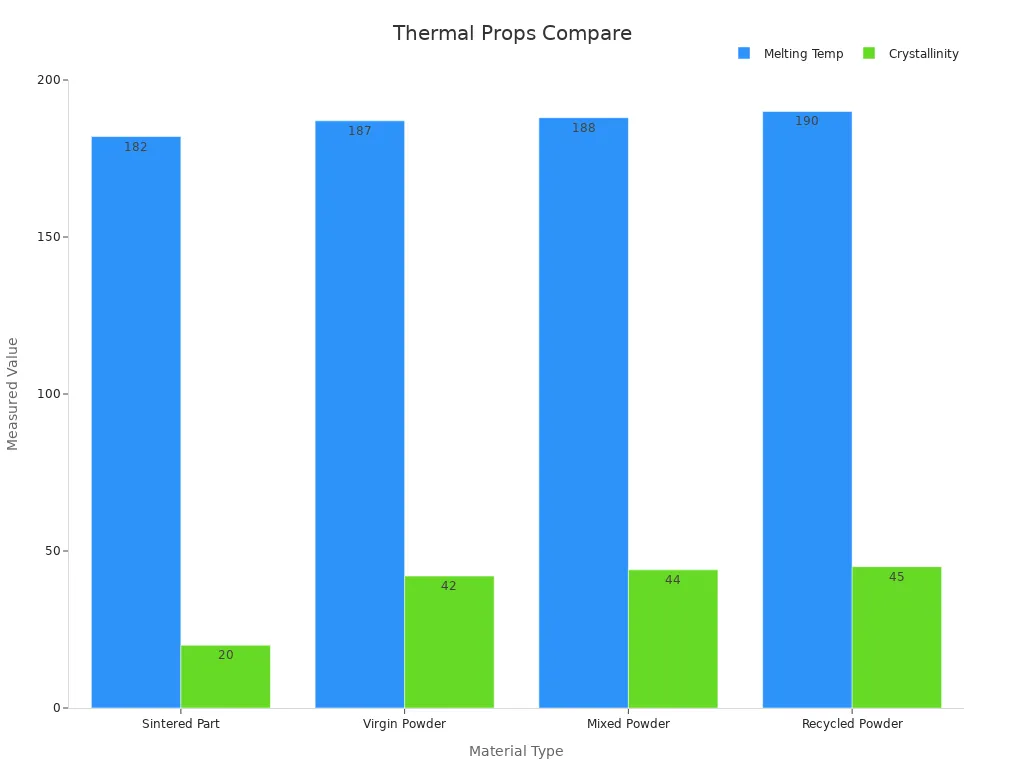
Sintered parts display a lower melting temperature and enthalpy, as well as a reduced degree of crystallinity compared to parts made from virgin or recycled powders. Mechanical testing shows a slight increase in ultimate strength after sintering, but a decrease in ultimate strain, indicating increased brittleness. Melting processes, by contrast, yield parts with higher density, strength, and ductility, making them suitable for demanding engineering applications.
The choice between sintering vs melting depends on the required balance of production speed, energy efficiency, and final material properties.
Typical Applications
Manufacturers and engineers select between sintering and melting based on the requirements of their products. Each process offers unique advantages for specific industries and applications.
Sintering Applications
Sintering plays a vital role in powder metallurgy, ceramics, and advanced manufacturing. Companies use sintering to produce components that require precise shapes, controlled porosity, and tailored material properties. The automotive industry relies on sintered gears and bearings for their strength and wear resistance. Numerical modeling of powder metallurgical manufacturing chains has demonstrated the effectiveness of sintering in producing high-strength gears. Researchers use kinetic Monte Carlo simulations and synchrotron X-ray microtomography to analyze sintering behavior and optimize microstructures. These studies help improve the durability and performance of sintered parts.
In the field of electronics, sintering enables the production of conductive pastes and multilayer ceramic capacitors. Medical device manufacturers use sintering to create biocompatible implants with complex geometries. The steel industry employs belt-type forced-air sintering processes to produce large volumes of sintered ore for further refining. This process involves mixing, ignition, sintering, and cooling, with typical cycle times around 120 minutes. Advanced modeling approaches, including mechanistic and data-driven methods, support process optimization and quality control in industrial sintering.
Sintering allows for the creation of intricate parts with minimal material waste. Manufacturers can adjust process parameters to achieve the desired density and mechanical properties, making sintering a flexible solution for many sectors.
Melting Applications
Melting finds widespread use in industries that demand high-density, homogeneous materials. Aerospace manufacturers use melting-based additive manufacturing, such as Selective Laser Melting (SLM), to produce lightweight, high-strength components for aircraft and spacecraft. The medical sector benefits from melting processes to fabricate custom implants and surgical tools with excellent mechanical properties.
Foundries and metalworking facilities rely on melting to cast engine blocks, turbine blades, and structural components. Vacuum induction melting and vacuum arc remelting ensure chemical homogeneity and purity in specialty alloys. These methods are essential for producing materials that meet strict industry standards.
Additive manufacturing technologies that use melting, like Laser Wire Directed Energy Deposition, enable rapid prototyping and the production of complex parts without traditional molds. Real-time monitoring and advanced sensor technologies help control melt pool characteristics, ensuring consistent quality.
Comparative Overview
The following table summarizes typical applications for each process:
| Application Area | Sintering | Melting |
|---|---|---|
| Automotive | Gears, bearings, bushings | Engine blocks, pistons |
| Aerospace | Turbine disks, structural brackets | Jet engine blades, airframe parts |
| Medical | Dental implants, orthopedic devices | Custom implants, surgical instruments |
| Electronics | Capacitors, magnetic cores | Connectors, housings |
| Industrial Equipment | Filters, cutting tools | Pumps, valves |
| Steel Production | Sintered ore for blast furnaces | Steel ingots, billets |
The choice between sintering vs melting depends on the desired material properties, production speed, and application requirements. Sintering excels in producing parts with controlled porosity and complex shapes, while melting delivers high-density, high-strength components for demanding environments.
Advantages and Disadvantages of Sintering vs Melting
Advantages of Sintering
Sintering offers several compelling benefits for manufacturers and engineers. The process operates at temperatures below the melting point, which leads to significant energy savings and lower operational costs. Sintering enables the creation of complex shapes and near-net-shape parts, reducing material waste and minimizing the need for extensive machining. This method allows for precise control over microstructure and porosity, making it ideal for applications that require tailored properties, such as filters or biomedical implants. Batch sintering and thicker layer processing also contribute to faster production cycles. Sintering supports a wide range of alloys and composite materials, providing flexibility for various industries.
Sintering stands out for its energy efficiency, environmental friendliness, and ability to produce intricate geometries with controlled properties.
Disadvantages of Sintering
Despite its strengths, sintering presents several challenges. Parts produced by sintering often exhibit significant porosity, which can reduce density and mechanical strength. Surface roughness and residual micro-porosity may limit applications that demand smooth finishes or high durability. Shrinkage during cooling can affect dimensional accuracy, leading to inconsistencies in part quality. Variations in powder characteristics can cause inconsistent mechanical properties, especially in complex shapes. Sintered components may require additional processing steps, such as infiltration or hot isostatic pressing, to enhance density and performance. These extra steps can increase production costs and complexity.
- Surface roughness and porosity limit use in high-strength or precision applications.
- Shrinkage and distortion impact dimensional accuracy.
- Additional finishing or densification steps may be necessary.
Advantages of Melting
Melting processes deliver high-density, homogeneous materials with superior mechanical properties. By fully liquefying the material, melting ensures complete mixing and uniformity, which is essential for high-strength applications in aerospace and automotive industries. Advanced melting techniques, such as induction or laser melting, achieve fine layer thickness and high precision, supporting the production of detailed geometries. Melting also enables the removal of impurities, resulting in high-purity alloys and metals. Quality metrics, such as thermal melt curves, provide reliable indicators of product consistency and performance, especially in fields like enzyme production and metallurgy.
| Aspect | Sintering Advantages and Disadvantages | Melting Advantages and Disadvantages |
|---|---|---|
| Process Mechanism | Bonds powdered materials below melting point, enabling complex shapes without full liquefaction. | Heats materials until liquefied, ensuring complete mixing and homogeneity. |
| Energy Efficiency | More energy-efficient due to lower temperatures, leading to significant energy savings. | More energy-intensive, though modern methods like induction melting improve efficiency. |
| Environmental Impact | Lower energy consumption and reduced emissions; can be done in controlled atmospheres to minimize gases. | Traditional melting can produce emissions, but advanced methods reduce harmful outputs. |
| Material Properties | Produces controlled porosity and tailored microstructures, useful for specific applications like filters. | Produces high purity, dense, and homogeneous materials suitable for high-strength applications. |
| Complexity & Precision | Ideal for complex shapes with minimal waste and near-net-shape manufacturing. | Better suited for simpler shapes and bulk production; challenges with intricate designs due to shrinkage and molds. |
| Applications | Used for ceramics, metals, composites, and powder metallurgy with tailored mechanical properties. | Used for metals and alloys in aerospace, automotive, and other high-strength industries. |
The sintering vs melting comparison highlights that each process offers unique strengths, making them suitable for different manufacturing needs.
Disadvantages of Melting
Melting stands as a powerful technique in materials processing, but it brings several notable disadvantages that manufacturers must consider.
1. High Energy Consumption
Melting requires temperatures above the material’s melting point. This process demands significant energy input. Factories often see increased operational costs due to the need for powerful furnaces or lasers. Energy efficiency becomes a concern, especially for large-scale production.
2. Equipment Complexity and Cost
Melting processes use advanced equipment, such as induction furnaces, vacuum chambers, or high-powered lasers. These machines require substantial investment. Maintenance and calibration add to the long-term expenses. Smaller manufacturers may find the initial costs prohibitive.
3. Risk of Contamination and Defects
During melting, materials can absorb gases or impurities from the environment. This risk increases when processing reactive metals. Contaminants may cause defects, such as porosity or inclusions, which weaken the final product. Strict atmosphere control becomes necessary.
4. Shrinkage and Distortion
As molten material cools and solidifies, it often shrinks. This shrinkage can lead to dimensional inaccuracies or warping. Engineers must account for these changes during design and post-processing.
5. Limited Material Compatibility
Not all materials respond well to melting. Some alloys or composites may decompose or segregate at high temperatures. Melting can also alter microstructures, affecting mechanical properties.
⚠️ Note: Melting offers excellent density and strength, but these benefits come with trade-offs in energy use, equipment needs, and process control.
Manufacturers must weigh these disadvantages against the advantages when choosing between sintering and melting. Careful process selection ensures optimal results for each application.
Applications and Choosing Between Sintering vs Melting
When to Use Sintering
Engineers select sintering when they need to produce complex shapes with controlled porosity and tailored microstructures. Sintering excels in applications that demand energy efficiency and cost-effectiveness. Manufacturers often choose this process for automotive components, such as gears and bushings, where moderate strength and wear resistance are essential. The process also suits the production of filters, porous bearings, and medical implants that require specific pore structures for fluid flow or tissue integration.
Simulation-based optimization plays a critical role in determining the best sintering conditions. Studies show that achieving a final density of 94% requires a sintering temperature of about 1200 °C, a heating rate of 6 K/min, and a holding time of 3 hours. Densities above 96% occur at or above 1350 °C. These findings highlight the importance of temperature and time in reaching the desired density and microstructure. Manufacturers calibrate sintering parameters to material-specific constants, such as sintering stress and grain growth rates. They also adjust green part density and temperature-dependent behaviors to predict shrinkage and deformation accurately. Empirical scaling factors and theoretical models help compensate for dimensional changes, ensuring part accuracy.
Key criteria for optimal sintering include:
- Raw material composition, such as iron concentrate powder with high total iron content.
- Use of fluxes like dolomite and limestone.
- Controlled moisture content and precise mixing procedures.
- Sintering temperatures around 1200 °C and carefully managed air flow rates.
- Continuous monitoring of flue gas composition during the process.
Manufacturers integrate experimental data and simulation models to refine sintering conditions for different materials and applications. This approach ensures consistent quality and performance, especially in industries where dimensional accuracy and tailored properties matter most.
Sintering stands out in scenarios where energy savings, material efficiency, and the ability to create intricate geometries are top priorities.
When to Use Melting
Melting becomes the preferred choice when applications require high-density, homogeneous materials with superior mechanical properties. Aerospace and automotive industries rely on melting-based processes to produce structural components that must withstand extreme loads and harsh environments. Melting also supports the fabrication of custom implants and surgical tools in the medical sector, where strength and biocompatibility are critical.
Guidelines for optimal melting scenarios depend on tested metrics such as Melt Flow Rate (MFR) in polymers and process maps in metal additive manufacturing. MFR testing helps engineers select polymer grades for injection molding and extrusion. Higher molecular weight polymers, which have lower MFR values, offer better impact resistance and fatigue performance but are harder to process. Lower molecular weight polymers flow more easily but may compromise mechanical properties. Impact testing during production confirms that using lower-MFR polymers results in consistent part quality, while higher-MFR grades can reduce melt temperature and pressure but degrade impact performance.
In metal additive manufacturing, process maps based on laser power, scan speed, and melt pool morphology guide the selection of stable operating windows. Empirical thresholds, such as width-to-depth ratios of the melt pool, define melting modes and process stability. Physics-based modeling and in-situ sensing calibrate these maps, helping engineers avoid defects like balling or poor layer bonding. This robust framework ensures quality and performance in melting-based manufacturing.
Melting is ideal for applications that demand maximum strength, purity, and dimensional accuracy, especially when producing load-bearing or safety-critical parts.
Industry Examples
Industry reports and performance analyses provide valuable insights for selecting between sintering and melting. The report "Sinter Metal Components Decade Long Trends, Analysis and Forecast 2025-2033" highlights automotive and manufacturing as dominant end-users for sintered components. Innovations in additive manufacturing and selective laser melting influence process selection based on application needs. Key performance factors include strength-to-weight ratio, corrosion resistance, dimensional accuracy, and cost-effectiveness. Environmental regulations and sustainability concerns drive manufacturers toward cleaner, more precise methods. Leading companies invest in R&D and technological advancements, using performance analyses to guide material and process choices. Regional market trends, such as the growth of electric vehicles and demand for lightweight materials, further shape decision-making.
- Additive manufacturing enables complex, customized components, expanding application possibilities.
- Competitive pressures from alternative materials, like plastics, highlight the importance of sintered metals in high-strength, precision applications.
Numerical simulation studies offer quantitative data on thermal behavior and solidification during selective laser melting of alumina. These studies provide insights into temperature gradients, melt pool dynamics, and solidification rates, supporting informed process selection. Experimental and numerical research on selective laser sintering and melting of silicon carbide ceramics demonstrates how laser power and scanning speed affect microstructure and mechanical properties. This data helps manufacturers choose the best process for their needs.
For hard metal parts, such as tungsten carbide-cobalt, experimental investigations show that sintering can produce complex shapes with reduced cost and production time compared to melting. Statistical modeling of selective laser sintering of polymer-coated silicon carbide powders establishes mathematical response surfaces linking process factors to physical and mechanical properties. These findings support parameter optimization for sintering in industrial applications.
The choice between sintering vs melting depends on the specific requirements of each application, including desired material properties, production speed, and regulatory considerations. Industry trends and performance data guide manufacturers in selecting the most suitable process for their products.
Sintering and melting each offer unique benefits for material processing. Sintering enables reduced porosity, enhanced strength, and improved conductivity, especially when precise control over temperature and time is applied. Melting remains essential for casting large or complex parts but often requires more post-processing and struggles with tight tolerances. Engineers should evaluate the desired material properties, production scale, and application requirements to select the most effective method. Careful process selection ensures optimal performance and reliability in demanding industries.
FAQ
What is the main difference between sintering and melting?
Sintering bonds powder particles below their melting point. Melting heats materials above their melting point until they liquefy. Sintering creates solid parts with some porosity. Melting produces fully dense, homogeneous components.
Which process is more energy-efficient?
Sintering uses less energy. The process operates at lower temperatures and requires less heat input. Melting demands higher temperatures and more energy to liquefy materials.
Can both processes create complex shapes?
Both processes can produce complex geometries. Sintering excels at near-net-shape manufacturing with minimal waste. Melting, especially in additive manufacturing, also enables intricate designs but may require support structures.
In which industries are sintering and melting most commonly used?
Sintering appears in automotive, electronics, and medical device manufacturing. Melting dominates aerospace, foundry, and high-performance engineering sectors. Each process serves specific material and performance needs.
How do material properties differ after sintering vs melting?
| Property | Sintering | Melting |
|---|---|---|
| Density | Moderate | High |
| Strength | Moderate | Superior |
| Porosity | Present | Minimal |
Sintered parts often show controlled porosity. Melted parts achieve higher density and strength.