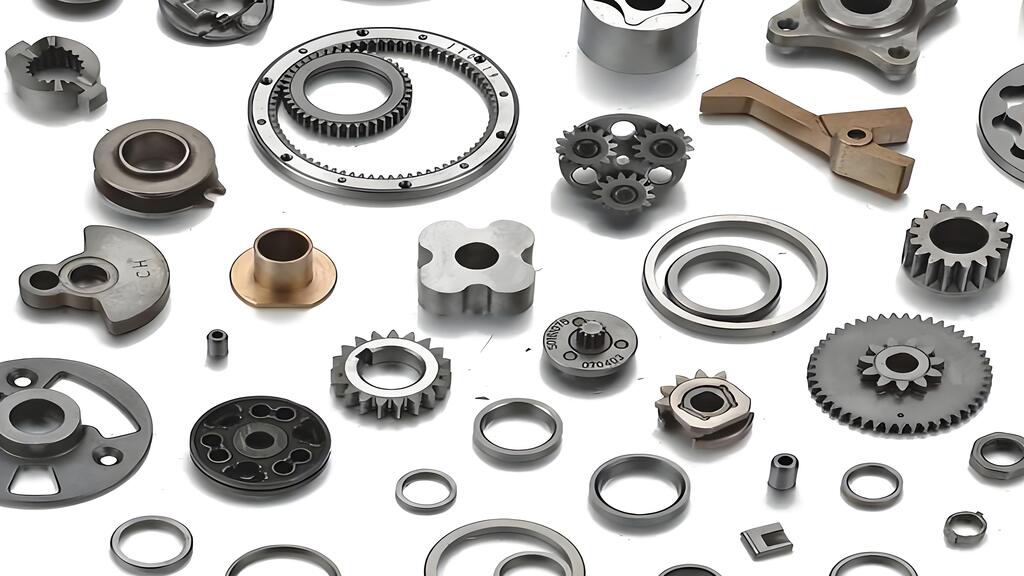


Electrical and Magnetic Properties of Powder Metallurgy Parts
Engineers rely on precise electrical and magnetic properties when selecting Powder Metallurgy parts for demanding applications. These properties influence part performance, efficiency, and reliability in systems such as electric motors and sensors. Advances in powder metallurgy, including improved powder quality and post-processing, allow parts to achieve densities near theoretical maximums, reducing porosity and enhancing both electrical and magnetic behavior. Unlike conventional laminated steel, soft magnetic composites from powder metallurgy support 3D magnetic flux paths and offer greater design flexibility, which can increase power density in electric machines.
Key Takeaways
- Powder metallurgy parts have unique microstructures with controlled porosity that allow engineers to tailor electrical and magnetic properties for specific applications.
- Material selection, alloying, and processing methods like Sintering strongly influence conductivity, permeability, and magnetic losses in powder metallurgy components.
- Soft magnetic composites made by powder metallurgy offer design flexibility and improved efficiency for electric motors and sensors, especially in high-frequency applications.
- Achieving high density and uniform microstructure reduces porosity, which enhances electrical conductivity and magnetic performance in powder metallurgy parts.
- Collaboration with manufacturers and careful design choices help optimize powder metallurgy parts to balance performance, cost, and manufacturability.
Powder Metallurgy Parts and Their Unique Properties
Differences from Conventional Manufacturing
Powder metallurgy parts stand apart from conventionally manufactured components due to their distinct microstructures and production methods. Conventional bulk metals typically display a homogeneous and dense microstructure with minimal porosity. This structure results in higher strength, ductility, toughness, and fatigue resistance. In contrast, powder metallurgy parts often contain some level of porosity because of the sintering process. This porosity can reduce strength, ductility, fatigue, wear, and corrosion resistance. However, engineers can tailor the microstructure of powder metallurgy parts by adjusting powder composition, particle size, and sintering parameters. This flexibility sometimes allows these parts to achieve mechanical properties that surpass those of bulk metals.
- Bulk metals: Homogeneous, dense, minimal porosity, superior mechanical properties.
- Powder metallurgy parts: Controlled porosity, customizable microstructure, potential for enhanced or specialized properties.
- The ability to control porosity is critical in powder metallurgy, while conventional parts benefit from inherent structural integrity.
Binder jet additive manufacturing, a powder metallurgy technique, produces isotropic microstructures but retains about 1.9% porosity. This porosity can lower strength and hardness compared to conventional parts. However, these powder metallurgy parts often show higher ductility due to mechanisms like two-stage work hardening and retained phases. Porosity and grain growth during sintering contribute to lower yield and tensile strength, highlighting the trade-offs between powder metallurgy and traditional manufacturing.
Impact on Electrical and Magnetic Performance
The unique microstructure of powder metallurgy parts directly influences their electrical and magnetic properties. Powder metallurgy enables the production of uniform, fine-grained metal-graphite composites. These composites combine high electrical conductivity with mechanical stability. The uniformity achieved through powder metallurgy cannot be matched by fusion or molten metal methods. Such materials reduce friction and wear by forming stable graphite films, which also maintain good electrical contact. As a result, powder metallurgy parts are widely used in brushes for motors, generators, and other electrical machinery where low electrical losses and high current-carrying capacity are essential.
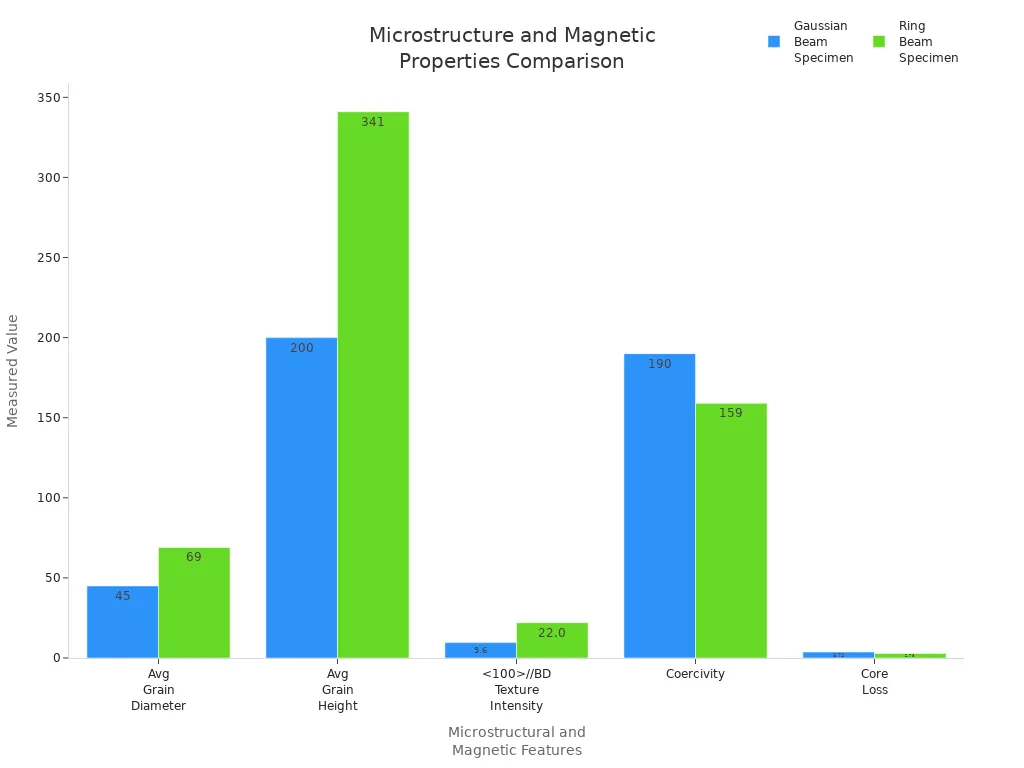
| Microstructural Feature | Gaussian Beam Specimen | Ring Beam Specimen |
|---|---|---|
| Average Grain Diameter (μm) | 45 | 69 |
| Average Grain Height (μm) | 200 | 341 |
| <100>//Build Direction Texture Intensity | 9.6 | 22.0 |
| Coercivity (A/m) | 190 | 159 |
| Core Loss (W/kg) | 3.74 | 2.75 |
Larger grain size and stronger <100>//build direction texture in the ring beam specimen reduce grain boundary area. This change suppresses magnetic domain wall resistance, leading to lower coercivity and core loss. As a result, soft magnetic properties improve, allowing higher magnetic flux density at lower applied fields.
Powder metallurgy parts offer engineers the ability to fine-tune electrical and magnetic performance by controlling microstructure, making them ideal for specialized applications.
Factors Influencing Electrical and Magnetic Properties in Powder Metallurgy Parts
Material Selection and Alloying
Engineers select materials and alloying elements to achieve specific electrical and magnetic properties in powder metallurgy parts. The choice of base metal and alloy additions directly impacts conductivity, permeability, and resistivity. For example, adding silicon to iron increases resistivity but decreases magnetic permeability, while phosphorus enhances saturation induction and reduces coercivity. Nickel and chromium improve corrosion resistance and tailor magnetic response. The table below summarizes common material compositions and their key properties:
| Material Composition | Key Electrical/Magnetic Properties | Additional Notes |
|---|---|---|
| High-purity Iron | Excellent soft magnetic qualities; very low resistivity | Can be coated or insulated for design flexibility |
| Iron-Phosphorus Alloys | High induction, strength, hardness; better resistivity | High ductility allows riveting operations |
| Iron-Silicon Alloys | Better frequency response; impact resistant | Useful for high surface area applications |
| Magnetic Stainless Steels | Corrosion resistance with magnetic properties | Lower induction than iron alloys |
| Prealloyed Iron-Nickel | High permeability, corrosion resistance | Fast response to current |
| Soft Magnetic Composites | Customizable magnetic and electrical properties | Wide performance range |
| Alloying Elements (Mo, Ni, Cr) | Improve structural and magnetic performance | Tailored for the balance of properties |
Alloy powders allow engineers to fine-tune conductivity and permeability for each application.
Density, Porosity, and Microstructure
Density and porosity play a crucial role in determining the electrical and magnetic performance of powder metallurgy parts. As porosity increases, electrical conductivity decreases because pores disrupt the flow of current and force electrons to take longer paths. Sintering and compaction processes control final porosity, which in turn affects resistivity. Microstructure, including grain size and particle shape, also influences magnetic losses. Spherical particles with small contact areas, such as those produced by atomization, have lower coercivity and core loss. Engineers use these relationships to design parts with optimal performance.
Tip: Lower porosity and controlled microstructure lead to higher conductivity and improved magnetic properties.
Processing Methods and Sintering Techniques
Processing methods and sintering techniques determine the final density, microstructure, and properties of powder metallurgy parts. Spark Plasma Sintering (SPS) and Hot Isostatic Pressing (HIP) rapidly densify materials, reduce porosity, and enhance both electrical and magnetic performance. Controlled atmosphere sintering prevents oxidation and maintains purity, which is essential for high-performance applications. Sintering temperature and time must be carefully managed to promote densification without damaging insulating layers in soft magnetic composites. Secondary operations, such as machining, further improve surface quality and support electrical performance. These advanced techniques enable manufacturers to produce parts with tailored properties for demanding applications.
Electrical Properties of Powder Metallurgy Parts
Conductivity and Resistivity
Electrical conductivity and resistivity define how efficiently a material allows the flow of electric current. In powder metallurgy, engineers can tailor these properties by adjusting material composition, processing methods, and microstructure. Conductivity measures a material’s ability to transmit electrical current, while resistivity quantifies its opposition to current flow. High conductivity is essential for components such as electrical contacts and circuit protectors, where energy loss must remain minimal.
Powder metallurgy enables the production of parts with controlled density and microstructure, which directly influence conductivity. For example, copper-based powder metallurgy parts can achieve electrical conductivities approaching 80% of the International Annealed Copper Standard (IACS) when processed with optimized powder rolling techniques. This high level of conductivity results from a homogeneous distribution of alloying elements and minimal macrosegregation. The sintering process also plays a critical role, as it determines the final density and connectivity between particles, both of which impact resistivity.
Key Influencing Factors and Typical Ranges
Several factors influence the electrical properties of powder metallurgy parts. The following table summarizes the main categories and their specific effects:
| Factor Category | Specific Factors | Influence on Electrical Conductivity and Material Properties |
|---|---|---|
| Microstructure | Grain size and distribution | Finer grains reduce electron scattering, improving conductivity |
| Pore size and distribution | Pores interrupt electron flow, lowering conductivity | |
| Powder Characteristics | Particle size and distribution | Fine powders sinter more completely, increasing density and conductivity |
| Particle shape and morphology | Spherical powders enhance packing, compaction, and conductivity | |
| Surface chemistry (oxide content, contamination) | Surface oxides hinder bonding, reducing conductivity | |
| Compaction Techniques | Pressure, rate, tooling design, and lubrication | Higher compaction pressure increases density and conductivity |
| Processing Methods | Powder rolling (in Cu-Fe composites) | Controls element diffusion and microstructure, preserving conductivity |
In practice, copper-based powder metallurgy parts typically reach electrical conductivities between 50% and 90% IACS, depending on processing quality and alloy content. Iron-based parts, often used for magnetic applications, display lower conductivity due to higher resistivity. The presence of pores and oxides can significantly reduce conductivity, so manufacturers focus on minimizing these features through advanced compaction and sintering techniques.
Note: Achieving high density and a uniform microstructure is key to maximizing electrical conductivity in powder metallurgy parts.
Applications Requiring Electrical Performance
Many industries rely on powder metallurgy parts for their electrical performance. The automotive sector, in particular, uses these components extensively in electrical and electronic systems. Common applications include:
- Electrical contacts, voltage regulators, and circuit protectors, where copper and its alloys provide excellent conductivity and durability.
- Relays and contact brushes that require both high conductivity and resistance to arc erosion.
- Rotors and stators in alternators and generators, where soft magnetic composites support efficient current flow and magnetic performance.
- ABS sensor rings and pump angle sensors, which demand reliable electrical properties for accurate signal transmission.
For electrical contact applications, engineers require parts that combine high electrical and thermal conductivity with arc erosion resistance, wear resistance, and corrosion resistance. Mechanical strength also remains important to ensure structural stability under operational loads. Materials such as copper-based and tungsten-based alloys are preferred for their balance of conductivity and durability. The powder metallurgy process allows precise control over these properties, resulting in components that meet demanding performance and reliability standards.
Magnetic Properties of Powder Metallurgy Parts

Soft vs. Hard Magnetic Materials
Engineers classify magnetic materials produced by powder metallurgy into two main categories: soft and hard magnetic materials. Each type serves distinct functions in electrical and electronic systems. Soft magnetic materials, such as silicon steel and iron-nickel alloys, magnetize and demagnetize easily. These materials exhibit low coercivity and high magnetic permeability, making them ideal for applications that require rapid switching of magnetic fields, like transformers and inductors. Hard magnetic materials, including neodymium-iron-boron (NdFeB) and samarium-cobalt (SmCo), retain their magnetization after the external field is removed. These materials provide strong, permanent magnetic fields for use in motors, sensors, and actuators.
The following table summarizes the defining characteristics of soft and hard magnetic materials produced by powder metallurgy:
| Aspect | Soft Magnetic Materials | Hard Magnetic Materials |
|---|---|---|
| Coercivity | Low | High |
| Magnetic Permeability | High | N/A |
| Core Losses | Low | N/A |
| Hysteresis Loop Area | Minimal | Large |
| Magnetization Retention | Easily magnetized and demagnetized | Retain magnetization without external field |
| Temperature Stability | Moderate | Good to excellent (depends on material) |
| Common Materials | Silicon Steel, Permalloy (Ni-Fe), Ferrites, Amorphous/Nanocrystalline Alloys | Alnico, Ferrite Magnets, SmCo, NdFeB |
| Typical Applications | AC transformers, inductors, magnetic shielding | Permanent magnets in motors, sensors, aerospace |
| Powder Metallurgy Methods | Used for ferrite cores and soft metallic composites | Sintering, melt spinning, injection molding |
Soft magnetic powders, such as iron and silicon steel, often use bonded or pressed powder metallurgy. Hard magnetic powders, like NdFeB and SmCo, typically undergo sintering or injection molding to achieve their final form.
Performance Metrics (Permeability, Coercivity, Losses)
Engineers evaluate magnetic materials using several key performance metrics. Relative permeability (μr) measures how easily a material supports the formation of a magnetic field. For iron powder cores, μr typically ranges from 50 to 150, depending on composition and processing. Coercivity (HC) indicates the resistance of a material to becoming demagnetized. Soft magnetic powder cores usually have coercivity below 1000 A/m, which distinguishes them from hard magnetic materials.
Core losses, which include hysteresis and eddy current losses, represent the energy dissipated as heat during magnetization cycles. These losses depend on frequency, magnetic flux density, and material properties. For example, conventional powder cores show core losses between 70 and 200 kW/m³ at low frequencies (50–60 Hz). At higher frequencies, losses can rise to 800 kW/m³. Engineers can reduce core losses by optimizing compaction pressure and annealing conditions.
The table below highlights how doping Fe-Si soft magnetic composites with Fe2O3 nanoparticles affects core loss and permeability:
| Fe2O3 Content (wt%) | Core Loss Pcv (kW/m³) at 100 kHz, 10 mT | Effective Permeability (μe) |
|---|---|---|
| 0 | 25.63 | 21.57 |
| 1 | 26.68 | 25.89 |
| 2 | 43.45 | 30.05 |
| 3 | 18.05 | 22.51 |
| 4 | 49.26 | 21.29 |
| 5 | 16.13 | 18.67 |
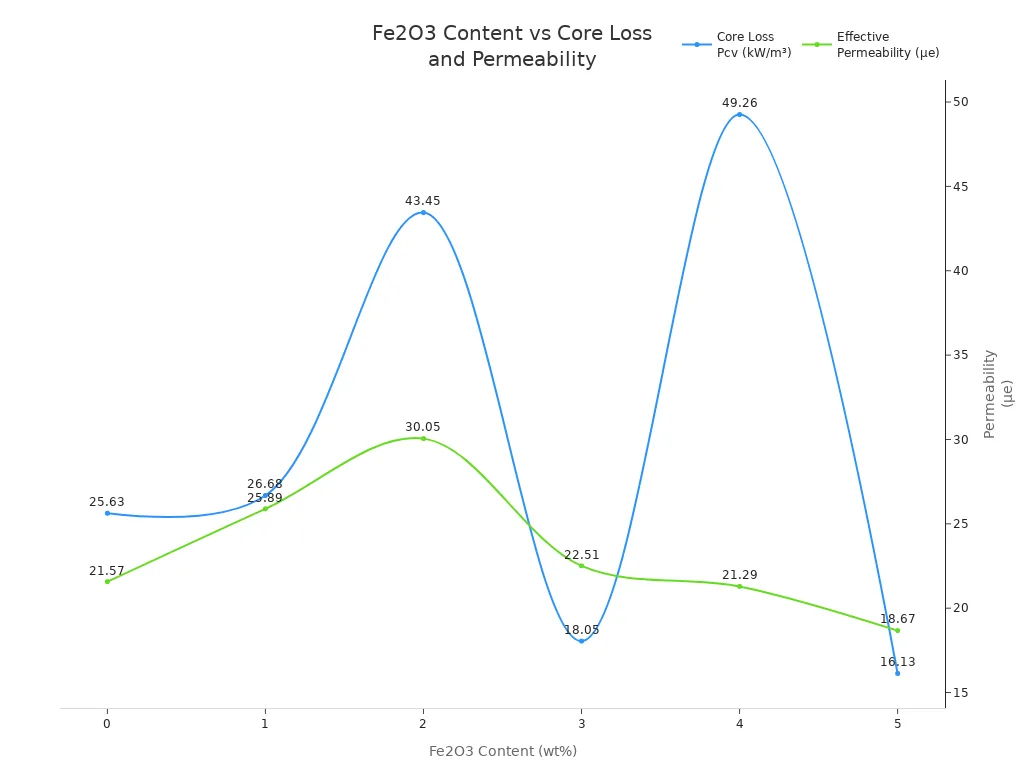
Fe-Si powder cores can achieve relative permeability values from about 50 to over 150. After annealing, coercivity can drop as low as 0.2 kA/m. Core losses vary with frequency and compaction, but advanced processing can reduce these losses, making powder metallurgy materials suitable for medium to high-frequency applications. Compared to conventionally manufactured magnets, powder metallurgy methods offer improved design freedom, more consistent microstructures, and the ability to produce complex shapes with high efficiency.
Note: Additive manufacturing in powder metallurgy enables engineers to create magnetic parts with up to 95% design freedom and properties that approach those of wrought materials. This flexibility supports innovative designs and weight reduction in electric machines.
Industrial Application Examples
Powder metallurgy parts play a vital role in many industries that require magnetic components. The electrical and electronics industry uses these parts for magnetic cores in motors and transformers. Both soft and hard magnetic materials produced by powder metallurgy serve as essential components in these applications.
- Electric motors and transformers: Soft magnetic composites made from iron, silicon iron, and cobalt iron provide high permeability and low coercive force. These properties improve efficiency and reduce energy losses.
- Sensors and actuators: Permanent magnets such as ferrites, NdFeB, and SmCo, produced by powder metallurgy, deliver strong, stable magnetic fields for precise control and measurement.
- Automotive and industrial machinery: Motors, actuators, and magnetic sensors in vehicles and equipment rely on powder metallurgy components for reliable performance.
- Appliances and HVAC: Motor brackets, fan components, and internal supports often use powder metallurgy magnetic parts for durability and efficiency.
- Aerospace and defense: Magnetic cores and specialized components benefit from the design flexibility and material consistency offered by powder metallurgy.
| Industry | Powder Metallurgy Components Relevant to Electric Motors/Transformers |
|---|---|
| Appliances & HVAC | Motor brackets, fan components, internal supports |
| Aerospace & Defense | Magnetic cores |
| General Electrical Use | Soft magnetic materials ideal for electric motors and transformers |
Powder metallurgy has advanced the production of small, net-shape parts for electric motors and gearboxes. While electrical steel laminations remain common for certain motor parts, powder metallurgy enables the creation of complex shapes and specialized magnetic materials that meet the evolving needs of modern industries.
Optimizing Electrical and Magnetic Properties in Powder Metallurgy Parts
Design and Material Strategies
Engineers can achieve optimal electrical and magnetic performance by carefully selecting materials and design approaches. Laser Powder Bed Fusion (LPBF) stands out as an advanced additive manufacturing method. This process uses a laser to selectively melt powder layers, guided by CAD data, which allows for precise control over geometry and microstructure. LPBF proves especially effective for Fe–Si soft magnetic alloys, enabling complex shapes and high density that enhance magnetic properties.
Material selection during the design phase directly impacts permeability, core losses, and frequency response. For example, Soft Magnetic Composites (SMCs) excel in AC applications due to their resistive coatings, which minimize eddy current losses. Sintered soft magnetic materials, on the other hand, offer higher strength and are better suited for DC applications. Engineers must also consider manufacturability constraints, such as minimum wall thickness and part complexity, to ensure robust and efficient Powder Metallurgy Parts.
Tip: Collaboration with experienced manufacturers during the design phase ensures the best material and geometry choices for superior performance.
Manufacturing and Post-Processing Approaches
Manufacturing techniques play a crucial role in optimizing properties. Sintering enhances particle bonding and ductility, while advanced heat treatments can further improve magnetic and electrical characteristics. Engineers often combine SMCs with traditional laminations to achieve reduced assembly size and improved efficiency. Powder metallurgy processes allow for fine-grain structures and minimized defects, which directly boost magnetic performance.
SMCs enable 3D shaping and improved heat efficiency, making them ideal for custom electric motor designs. However, secondary machining of SMCs should be minimized to preserve magnetic properties.
Balancing Trade-offs for Application Needs
Engineers must balance density, magnetic performance, mechanical strength, cost, and manufacturability. Increasing part density improves permeability and saturation induction but may increase brittleness and cost. SMCs offer high resistivity and design flexibility but generally have lower permeability than laminated steels.
| Factor | Powder Metallurgy Advantages | Impact on Balance of Cost, Performance, and Manufacturability |
|---|---|---|
| Material Utilization | High (95-98%) reduces waste | Lowers material cost and improves manufacturability |
| Energy Consumption | 25-50% less energy used | Reduces production cost |
| Dimensional Tolerance | Tighter (±0.05mm typical) | Enhances performance and reduces rework |
| Complex Geometries | Excellent capability | Enables optimized designs for performance and cost |
Engineers should leverage metallurgical expertise and collaborate with suppliers to select the right materials and processes, ensuring Powder Metallurgy Parts meet both performance and budget goals.
Engineers should focus on several key factors when optimizing electrical and magnetic properties in powder metallurgy parts:
- Particle size, shape, and composition directly affect compaction and final properties.
- Sintering increases density and reduces porosity, which improves conductivity and magnetic performance.
- Advanced materials like soft magnetic composites enhance efficiency in electromagnetic components.
Post-processing heat treatments further refine magnetic properties, making precise thermal control essential. Collaboration with manufacturers who offer strong R&D, simulation tools, and engineering support ensures powder metallurgy parts meet demanding application needs.
FAQ
What factors most affect the electrical conductivity of powder metallurgy parts?
Engineers find that density, porosity, and material composition have the greatest impact. Higher density and lower porosity increase conductivity. Alloying elements and processing methods also play important roles.
Can powder metallurgy parts achieve the same magnetic performance as conventionally manufactured parts?
Powder metallurgy parts can match or even exceed the magnetic performance of traditional parts. Advanced processing and material selection allow engineers to tailor properties for specific applications.
Which industries use powder metallurgy parts for electrical and magnetic applications?
Automotive, aerospace, electronics, and industrial machinery industries use these parts. Common applications include electric motors, sensors, transformers, and circuit protection devices.
How does sintering improve the properties of powder metallurgy parts?
Sintering bonds powder particles, increases density, and reduces porosity. This process improves both electrical conductivity and magnetic performance.
Are powder metallurgy parts suitable for high-frequency electromagnetic applications?
Yes. Soft magnetic composites and specialized alloys produced by powder metallurgy perform well at high frequencies. These materials minimize core losses and support efficient operation in advanced electrical systems.