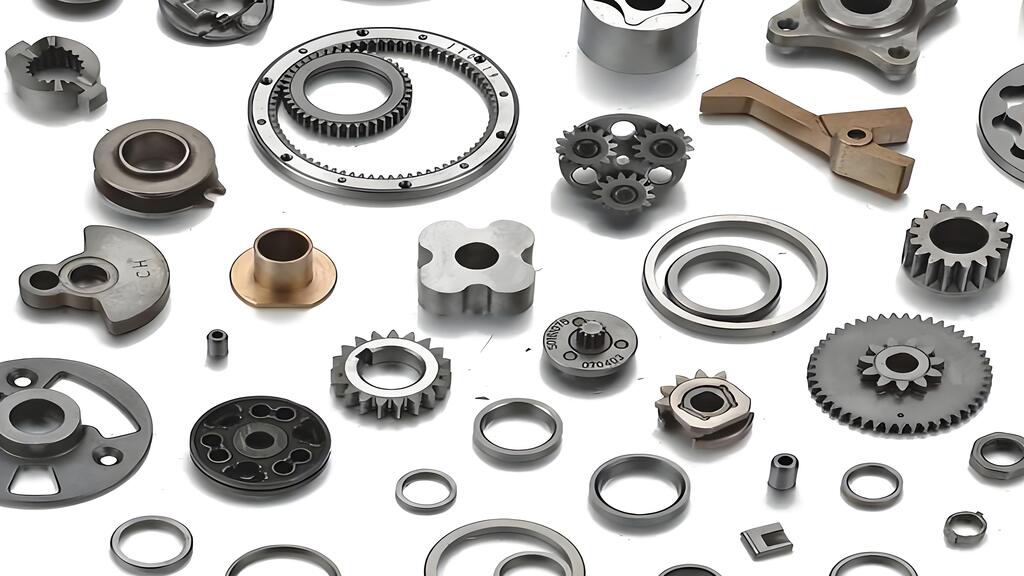


Sintered Density and Mechanical Properties in Powder Metallurgy

Sintered density directly determines the mechanical performance of components. This critical factor dictates how parts behave under stress and strain. Higher sintered density consistently produces superior mechanical properties. Engineers observe this direct relationship across various applications. Manufacturers prioritize achieving optimal density in Powder Metallurgy to ensure product reliability and durability. This foundational principle guides the selection and processing of materials.
Key Takeaways
- Sintered density directly affects the strength and durability of powder metallurgy parts.
- Higher sintered density means better strength, flexibility, and resistance to wear for components.
- Porosity, or tiny holes, weakens parts and can cause them to break easily.
- Sintering uses heat to bond powder particles, making parts denser and stronger.
- Advanced methods like Hot Isostatic Pressing (HIP) help make parts almost perfectly dense.
- Controlling powder type, compaction, and sintering temperature helps achieve the right density.
- Designers must balance the need for high density with the cost of making the parts.
Understanding Sintered Density in Powder Metallurgy
Defining Sintered Density
Sintered density represents the final density of a component after the sintering process. This metric directly influences the mechanical properties a part exhibits. Engineers often evaluate density in two primary ways: relative density and theoretical density.
Relative Density
Relative density expresses the ratio of a component's actual density to its theoretical density. This value indicates the amount of porosity remaining within the material. After sintering, powder metal parts typically exhibit a porosity ranging from 5% to 25%. Different applications require varying levels of relative sintered density:
| Application Type | Relative Sintered Density Range |
|---|---|
| Low-Density PM Parts | < 75% |
| Medium-Density PM Parts | 75% - 90% |
| High-Density PM Parts | > 90% |
| General Structural Parts | 80% - > 95% |
| Forgings | > 99% |
| Hot Isostatic Pressed Products | > 99% |
| Self-Lubricating Bearings | ~ 75% |
| Filters | (Specific range not provided) |
Theoretical Density
Theoretical density represents the maximum possible density for a given material, assuming a perfectly solid, pore-free structure. Manufacturers calculate this value based on the material's chemical composition and crystal structure. Achieving theoretical density is often the ultimate goal for high-performance applications, as it signifies minimal internal voids.
The Sintering Process for Powder Metallurgy
Sintering transforms a compacted powder into a solid, coherent mass. This thermal treatment occurs below the material's melting point. The process involves atomic diffusion, which causes particles to bond and pores to shrink.
Neck Formation
During the initial heating phase, particles begin to bond at their contact points. This forms "necks" between adjacent powder particles. Mass transport occurs from near-neck regions to these growing necks. Little to no shrinkage typically occurs at this stage.
Pore Elimination
As sintering progresses, these necks grow larger, and the material densifies. Pores within the structure shrink and become more spherical. The material reduces its overall volume as it eliminates these voids.
Driving Forces for Densification
Sintering is a densification process where diffusion of particle surfaces occurs, causing metal parts to bind and voids to close. The process involves three main stages:
- Presintering: Necks begin to form between powder particles. Mass transport occurs from near-neck to neck regions. Little to no shrinkage occurs.
- Intermediate Stage Sintering: Necks continue to grow. Pores shrink and become round. Densification occurs, reaching approximately 92% density.
- Final Stage Sintering: Pores continue to shrink. The part further densifies. Sintering temperatures and holds are monitored to optimize density and prevent excessive grain growth.
Sintered Density's Impact on Mechanical Strength in Powder Metallurgy
Sintered density profoundly influences the mechanical strength of components. Engineers consistently observe a direct correlation between higher density and superior performance under various mechanical loads. This section explores how sintered density dictates critical properties like tensile strength, yield strength, elongation, and ductility.
Tensile Strength and Yield Strength
Tensile strength and yield strength represent fundamental measures of a material's ability to withstand pulling forces before breaking or permanently deforming. Sintered density directly governs these properties.
Role of Porosity
Porosity significantly diminishes a material's load-bearing capacity. Pores reduce the effective cross-sectional area available to resist applied stress. Furthermore, these internal voids act as stress concentrators, initiating cracks and leading to premature failure. The presence of porosity in aluminum alloys, a common feature in Powder Metallurgy, leads to a decrease in mechanical properties, including a drop in overall strength. Materials with high porosity exhibit lower strength and are more prone to deformation and tearing. Therefore, minimizing porosity through effective sintering processes directly enhances both tensile and yield strength.
Interparticle Bonding
Strong interparticle bonding forms the backbone of a robust sintered component. During sintering, atomic diffusion creates metallurgical bonds between individual powder particles. A higher sintered density indicates more extensive and stronger bonds throughout the material. Weak or incomplete bonding results in areas of low cohesion, which act as internal flaws. These flaws reduce the material's ability to transfer stress efficiently, thereby lowering its overall tensile and yield strength. Optimal densification ensures comprehensive bonding, maximizing the material's inherent strength.
Elongation and Ductility
Elongation and ductility describe a material's ability to deform plastically before fracturing. These properties are crucial for applications requiring toughness and resistance to brittle failure. Sintered density plays a vital role in determining a component's capacity for plastic deformation.
Pore Morphology
The shape and distribution of residual pores critically influence a material's ductility. Irregularly shaped pores, particularly those with sharp corners or elongated geometries, create severe stress concentrations. These stress raisers can initiate microcracks under much lower loads, significantly reducing the material's ability to deform plastically. Loss of Fusion (LoF) pores have a detrimental impact on both ultimate tensile strength (UTS) and ductility due to high stress concentrations caused by their irregular shape. In contrast, LoF pores are significantly more harmful to mechanical properties, whereas small amounts (less than 1%) of Keyhole (KH) porosity have only a negligible impact. Residual porosity is an inherent defect in powder metallurgy components, and its morphology and structure have a significant impact on product quality. However, this issue has not been adequately addressed through quantitative analysis to date. Achieving a high sintered density often results in smaller, more spherical, and uniformly distributed pores, which are less detrimental to ductility.
Crack Propagation Resistance
A material's resistance to crack propagation directly relates to its ductility. In denser materials with well-formed interparticle bonds and favorable pore morphology, cracks encounter more resistance as they attempt to spread. The material can absorb more energy through plastic deformation at the crack tip, blunting the crack and preventing rapid fracture. Conversely, in materials with high porosity or poorly bonded regions, cracks can easily propagate through the voids or weak interfaces. This leads to brittle fracture with minimal plastic deformation. Therefore, higher sintered density enhances the material's ability to resist crack growth, contributing to improved elongation and overall ductility.
Enhancing Toughness and Fatigue Resistance in Powder Metallurgy
Sintered density significantly influences a component's toughness and fatigue resistance. These properties are crucial for parts operating under dynamic loads or impact conditions. Higher density generally leads to improved performance in these demanding environments.
Impact Strength and Fracture Toughness
Impact strength and fracture toughness measure a material's ability to absorb energy before fracturing. They indicate resistance to sudden, forceful impacts and crack propagation.
Energy Absorption Mechanisms
Denser materials possess a greater capacity for energy absorption. A solid, well-sintered structure allows for more extensive plastic deformation before fracture. This deformation dissipates impact energy effectively. In contrast, porous materials have less material to deform. Voids act as pathways for cracks, reducing the energy required for failure. High sintered density ensures the material can withstand and distribute impact forces more efficiently.
Microstructural Homogeneity
A uniform microstructure, achieved through high sintered density, enhances both impact strength and fracture toughness. Homogeneous materials lack localized weak points. These weak points could otherwise initiate cracks under stress. Consistent density throughout the component ensures predictable material behavior. It prevents premature failure from stress concentrations at microstructural irregularities. This uniformity allows the material to resist crack growth and absorb energy more effectively.
Fatigue Resistance
Fatigue resistance describes a material's ability to withstand repeated cycles of stress without failing. This property is vital for components in dynamic applications.
Stress Concentration at Pores
The degree of porosity in sintered metals significantly influences fatigue behavior. Individual pores act as stress concentrators and potential sites for crack initiation. Stress concentration on pore surfaces can lead to slip formation and crack initiation. These then coalesce into macrocracks, ultimately causing failure. Areas with increased porosity, often found near the surface, are privileged sites for microcrack nucleation. Beyond the degree of porosity, the fatigue life of sintered metals is also affected by the shape, size, and spacing of pores. Irregular pores generate stronger stress concentrations than oval pores. A reduction in the distance between pores decreases fatigue life.
Fatigue Crack Initiation
Even in near fully dense parts, remaining pores can still degrade mechanical properties, including fatigue performance. There is a recognized lack of experimental research concerning the fatigue performance of near fully dense parts produced by binder jetting followed by sintering. While extensive research exists on the fatigue behavior of fusion-based additively manufactured 316L SS, literature on the fatigue life of binder-jetted 316L SS is limited. This highlights the importance of achieving minimal porosity. In binder-jetted components, typical sintered relative density can reach up to 99%. Hot Isostatic Pressing (HIP) can further improve this. HIPed specimens demonstrated that a minimum relative density of 99.5% could be achieved in samples sintered at 1370 ℃ or higher temperatures. This high density minimizes the sites for fatigue crack initiation, thereby extending the component's fatigue life.
Factors Influencing Sintered Density in Powder Metallurgy
Achieving optimal sintered density in Powder Metallurgy components depends on several critical factors. These factors span the entire production process, from the initial powder characteristics to the final sintering parameters. Engineers carefully control each stage to ensure the desired density and mechanical properties.
Powder Characteristics
The inherent properties of the raw powder significantly influence the final sintered density.
Particle Size and Shape
Particle size and shape directly affect how powders pack together and densify. Adjusting part geometry can lead to more effective compaction, influencing density. Designing thicker sections can reduce voids, thereby increasing density. Strategic placement of powders with varying particle sizes or shapes can lead to denser packing. These features, potentially combined with differential compaction and localized sintering, can increase density in specific component locations. The selection of powder particle shape, size, and distributions is an empirical task; conclusions are difficult to transfer directly between different powders. For example, irregular hydride-dehydride titanium powder (D50 ≈ 45 μm), despite lower flowability and packing density, achieved a relative sintered density of 96.5%.
Particle Size Distribution
The distribution of particle sizes within a powder blend also impacts packing efficiency. Mixing fine spherical carbonyl iron powders (D50 = 4 μm) with coarse WA iron powders (D50 = 45 μm) in a 4:6 ratio impacts powder sinterability. An increase in the volume fraction of coarse particles in spherical stainless steel powders leads to a decrease in sintered density and hardness due to more irregular particles. Tailoring powder size distribution can reduce raw powder costs without compromising sintered properties. A bimodal feedstock of ~6 μm and ~20 μm GA stainless steel powders can reduce costs by 10% compared to unimodal powders, without compromising a sintered density of ~7.75 g/cm³.
Chemical Composition
The chemical composition of the powder influences its diffusion characteristics and melting behavior during sintering. Alloying elements can promote or inhibit densification by affecting atomic mobility and phase transformations.
Compaction Parameters
Compaction parameters determine the initial density of the green compact before sintering.
Compaction Pressure
Higher compaction pressure generally leads to a denser green compact. This reduces the amount of porosity that the sintering process must eliminate, making it easier to achieve high final densities.
Green Density
Green density refers to the density of the compacted powder before sintering. A higher green density provides a better starting point for sintering, as the particles are already in closer contact. This reduces the overall shrinkage required during sintering to reach the target final density.
Sintering Parameters
The conditions during the sintering process are paramount for achieving high density.
Sintering Temperature
Sintering temperature is a critical parameter. Increasing sintering temperature promotes atomic vibrations and facilitates diffusion, leading to the formation and growth of sintering necks. This in turn spheroidizes pores and increases density.
| Sintering Temperature (°C) | Sintered Density (g/cm³) | Relative Density (%) |
|---|---|---|
| 930 | 7.1 | 86.5 |
| 1030 | 8.14 | 99.2 |
| 1070 | 8.14 | 99.2 |
| 1090 | 8.13 | 99.1 |
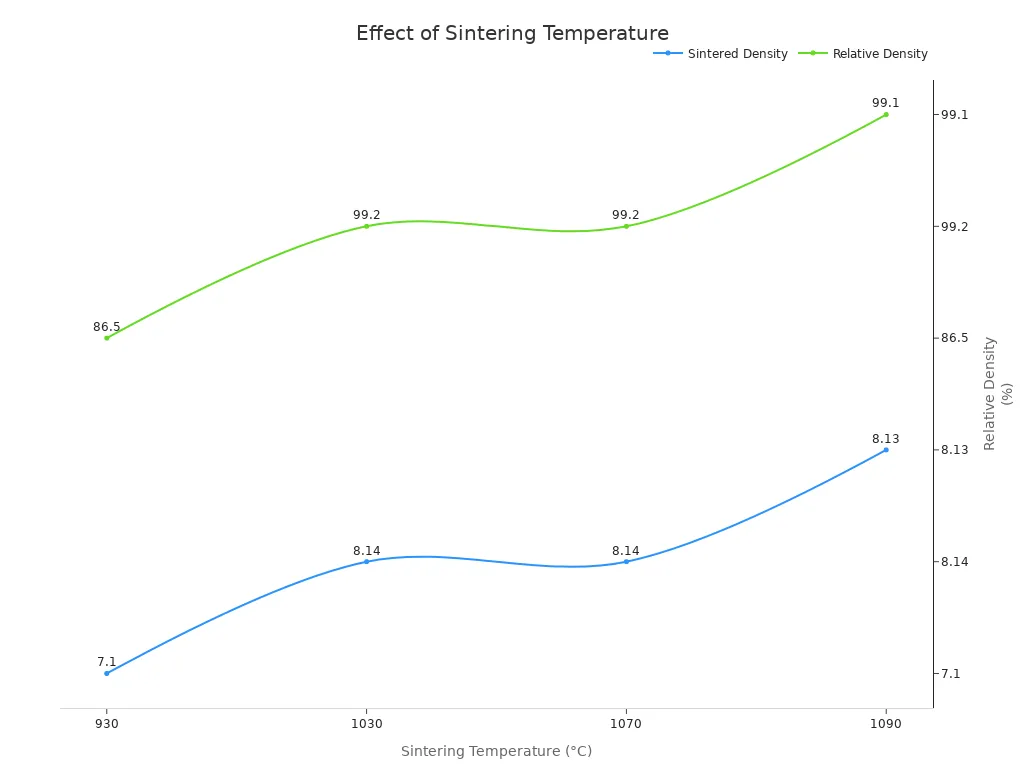
However, excessively high temperatures (e.g., 1090°C) can cause material melting and extrusion, potentially reducing the effectiveness of applied pressure and slightly decreasing density. Excessive grain growth due to high sintering temperatures can also lead to a decline in the mechanical properties of the material.
Sintering Time
Sintering time allows sufficient duration for atomic diffusion and pore elimination. Longer sintering times generally lead to higher densities, up to a point where further densification becomes negligible or grain growth becomes excessive.
Sintering Atmosphere
The atmosphere during sintering is crucial; it acts as an active chemical reagent rather than a passive element. A controlled atmosphere, such as high-purity hydrogen, creates reducing conditions that actively remove surface oxides and other impurities from material particles. This removal is essential for forming strong atomic bonds, which in turn enhance mechanical properties and achieve a superior surface finish and higher density. Without the removal of surface oxides, which act as physical barriers, metal atoms cannot diffuse and form strong metallic bonds, leading to weak, brittle parts with insufficient density. Vacuum sintering is particularly effective for materials sensitive to oxidation or those requiring high density, such as stainless steels and titanium alloys in conventional Powder Metallurgy parts. The oxygen-free atmosphere in vacuum sintering allows for higher sintering temperatures, resulting in parts with high density, low impurity levels, and superior quality.
| Method | Atmosphere | Properties of Final Part |
|---|---|---|
| Vacuum Sintering | Vacuum (no oxygen) | High purity, high density |
| Conventional Sintering | Atmospheric gas | Lower purity, oxidation risk |
| Hot Isostatic Pressing (HIP) | High pressure + inert gas | Extremely dense, defect-free |
| Spark Plasma Sintering (SPS) | Pulsed DC + pressure | Ultra-fast sintering, fine microstructure |
Controlled atmospheres prevent outside air from entering the sintering furnace and causing oxidation or decarburization of the workpiece. They help reduce the oxide layer on the surface of the compacted powder and burn off lubricants and adhesives in the workpiece.
Advanced Sintering Techniques for Optimized Density in Powder Metallurgy
Manufacturers constantly seek innovative methods to achieve higher densities and superior mechanical properties in sintered components. Advanced sintering techniques push the boundaries of conventional processes. These methods offer enhanced control over densification, microstructure, and overall material performance.
High-Temperature Sintering (HTS)
High-Temperature Sintering (HTS) represents a significant advancement over traditional sintering. This technique operates at elevated temperatures, promoting more aggressive densification.
Enhanced Diffusion
Higher sintering temperatures significantly intensify diffusion bonding. This leads to greater mass transport within the material. Particles form larger "necks" between grains. Pores between grains shrink and become more rounded, often resembling "tiny soccer balls." This pore shrinkage greatly enhances strength and densification. Compared to conventional sintering, high-temperature sintering enables optimum properties. Increased sintering temperature and duration lead to greater mass transport. This results in more rounded residual pores and stronger bonds between particles. Ultimately, this process achieves greater densification, improving mechanical, physical, and magnetic properties.
Grain Growth Control
Ultrafast High-Temperature Sintering (UHS), a specific form of HTS, operates within a temperature range of approximately 1000 °C to 3000 °C. This process uses Joule-heated carbon heaters to achieve uniform high temperatures. UHS offers rapid sintering, often occurring in just seconds, for example, 10-30 seconds. It accelerates diffusion and reaction processes due to these high sintering temperatures. The technique also avoids phase separation and abnormal grain growth through ultrafast cooling rates, typically 10^3–10^4 °C per minute. UHS can sinter a wide range of metals and alloys, including those with varying melting points like copper, steel, tungsten, intermetallics, and refractory metals. Its non-materials specific nature makes it suitable for materials discovery. It is compatible with 3D printing and other additive manufacturing processes because it does not apply pressure to samples. Furthermore, UHS enables real-time, direct observation of the sintering process for in-situ adjustments.
Ultra-High Temperature Sintering (UHTS)
Ultra-High Temperature Sintering (UHTS) takes the principles of HTS even further. It employs extremely high temperatures, often approaching the material's melting point, but without actually melting the entire component.
Near-Theoretical Density Achievement
UHTS aims to achieve near-theoretical density. The intense thermal energy drives maximum atomic diffusion and pore elimination. This results in components with minimal residual porosity. Such high densities significantly improve mechanical performance.
Specialized Applications
UHTS finds application in specialized fields. These include aerospace, defense, and medical implants. These industries demand materials with exceptional strength, hardness, and wear resistance. UHTS produces components capable of withstanding extreme operating conditions.
Pressure-Assisted Sintering for Powder Metallurgy
Pressure-assisted sintering combines heat with external pressure. This combination provides additional driving forces for densification. It effectively eliminates porosity and enhances material properties.
Hot Isostatic Pressing (HIP)
Hot Isostatic Pressing (HIP) is a transformative process. It consolidates materials by applying both high temperature and uniform, gas-based pressure from all directions simultaneously. HIP aims to produce materials as close to 100% theoretically dense as possible. It eliminates all internal voids, pores, and microscopic gaps. This process effectively collapses and welds shut internal porosity from casting, voids in 3D-printed parts, and delaminations in composites. It transforms potentially flawed components into solid, reliable ones. The combination of elevated temperatures and high-pressure inert gas applied uniformly from all directions is key to these advantages. Hot Isostatic Pressing (HIP) is utilized in Powder Metallurgy to densify sintered parts and eliminate their residual porosity. This contributes to full density and defect elimination. The simultaneous application of heat and pressure in HIP removes internal voids and microporosity. It achieves this through a combination of creep, plastic deformation, and diffusion bonding. This process allows for the consolidation of metal powders and the reduction of microshrinkage. It directly contributes to achieving full density and eliminating internal defects. The primary advantages of Hot Isostatic Pressing (HIP) are its unique ability to achieve nearly 100% material density, completely heal internal defects, and dramatically enhance mechanical properties such as strength and fatigue life.
Spark Plasma Sintering (SPS)
Spark Plasma Sintering (SPS) offers a rapid densification method. It operates at lower temperatures compared to conventional processes. SPS uses a high-intensity, low-voltage, pulsed current. This current flows through a graphite mold and potentially the sample. It induces very fast heating, up to 1000 °C per minute, via the Joule effect. The combination of high heating rates and uniaxial applied pressure results in fast consolidation. This occurs at temperatures 200 to 500 °C lower than conventional sintering. The applied pressure mechanically reduces inter-particle distances. It strengthens contacts and increases the driving force for densification. It modifies mass transport mechanisms like diffusion, viscous flow, plastic flow, and creep. This also helps limit grain growth. SPS achieves rapid densification at lower temperatures by utilizing pulsed direct current to generate internal heating. This leads to extremely high heating rates, often exceeding 300°C per minute. It also creates localized high-temperature states, several to ten thousand degrees centigrade momentarily, through spark discharge at particle contact points. This extreme heat causes surface evaporation and melting. It promotes neck formation between particles. This internal heating mechanism, combined with optimized processing parameters, allows for rapid consolidation. It maintains exceptional material properties, contrasting sharply with the external heating methods of conventional sintering.
Liquid Phase Sintering
Liquid phase sintering is a specialized technique. It involves the presence of a liquid phase during the sintering process. This liquid phase forms at the sintering temperature. It significantly enhances densification and microstructural control. This method is particularly effective for materials that are difficult to densify by solid-state sintering alone. The liquid phase acts as a medium. It facilitates faster atomic movement and particle rearrangement.
Enhanced Mass Transport
The presence of a liquid phase dramatically enhances mass transport. This leads to more efficient densification. The liquid acts as a fast diffusion path. It allows atoms to move more readily between solid particles. This accelerates the process of pore elimination.
Boron addition provides a clear example of this mechanism. Boron acts as an active sintering element in iron-based Powder Metallurgy (PM) parts. Unlike copper and phosphorus, boron has very low solubility in iron. This characteristic leads to the formation of the Fe-Fe2B eutectic at 1177 °C. The formation of this eutectic significantly promotes the rate of mass transport and densification in PM steels. The addition of boron also reduces the eutectic temperature of PM steels. This causes the liquid phase to form at a lower temperature. The earlier appearance of the liquid phase at lower temperatures, especially under conditions like vacuum sintering, accelerates the densification rate of PM steels.
Microstructural Refinement
Liquid phase sintering also plays a crucial role in microstructural refinement. It influences grain growth and pore morphology. This ultimately impacts the mechanical properties of the final component.
- Densification begins rapidly in the solid state during heating. This occurs even before the liquid phase sintering temperature is reached, especially with finer tungsten powders.
- During isothermal liquid phase sintering, substantial grain growth occurs.
- The liquid phase flows into and fills both open and closed pores sequentially. It starts with regions of small cross-sections.
- Grains subsequently grow into the liquid pockets formed at pore sites. Sequential pore filling by the liquid is the dominant densification process.
Liquid-phase sintering of WHA (tungsten heavy alloy) with rhenium (Re) and molybdenum (Mo) alloying leads to suitable refinement of tungsten grains. This occurs by controlling grain growth. It results in adequate strength and hardness. Molybdenum addition controls grain size by reducing tungsten dissolution in the matrix phase. Molybdenum forms a eutectic liquid with nickel. This restricts tungsten's dissolution in the binder phase. It inhibits grain growth and provides solid-solution strengthening. Cobalt alloying improves the strength of the tungsten-matrix interface. It also provides solid-solution strengthening. However, longer sintering times can lead to coarse grain microstructures. This can cause deterioration of mechanical properties. Therefore, optimized processing strategies are essential.
Practical Implications for Powder Metallurgy Component Design
Engineers consider sintered density a critical factor when designing components for Powder Metallurgy. This property directly influences a part's suitability for various applications. Designers must balance performance needs with manufacturing costs.
Component Performance Requirements
Component performance requirements dictate the necessary sintered density. Different applications demand different levels of material integrity.
High-Stress Applications
Components operating under high stress require maximum density. Parts like gears, connecting rods, and structural elements experience significant loads. Higher density ensures these parts possess superior tensile strength, yield strength, and fatigue resistance. This prevents premature failure and ensures reliability in demanding environments. Manufacturers prioritize achieving near full density for such critical components.
Wear Resistance
Wear resistance also benefits significantly from increased sintered density. Denser materials present fewer pores on their surface. These pores can act as initiation sites for wear particles or allow abrasive media to penetrate. A solid, homogeneous surface resists abrasion and erosion more effectively. This extends the lifespan of components exposed to friction or abrasive conditions.
Cost-Benefit Analysis of Densification
Achieving higher sintered density often involves more complex and costly processing steps. Engineers perform a careful cost-benefit analysis. They weigh the performance gains against the increased production expenses.
Processing Costs
Different processing methods yield varying densities at different costs. The table below illustrates typical cost implications for achieving higher densities.
| Processing Method | Achievable Density (g/cm³) | Relative Cost Implication |
|---|---|---|
| Standard Press-and-Sinter | Up to 7.1 | Baseline |
| Double-Press Double-Sinter | Up to 7.4 | Substantial increase |
| Advanced Compaction | Up to 7.4 | Minimal additional cost (compared to standard) |
| Advanced Compaction + High-Temperature Sintering | Beyond 7.4 | Moderate increase (more cost-efficient than double-press double-sinter) |
| Advanced Compaction + Ultra-High-Temperature Sintering | 7.6 | Significant improvement over double-press double-sinter, lower than powder forging |
| Powder Forging | 7.8 (Full Density) | Doubles the price (compared to standard) |
Achieving higher densities often requires more advanced techniques. These techniques increase processing costs. For example, powder forging can double the price compared to standard press-and-sinter methods.
Material Performance Trade-offs
Advanced sintering techniques offer significant performance advantages but introduce trade-offs. Resistance-Based Sintering (RBS) drastically reduces consolidation times, often to milliseconds. It also achieves a 97% reduction in energy consumption compared to traditional press-and-sinter techniques. Hot Isostatic Pressing (HIP) produces high-quality, near-net-shaped parts with excellent material properties. HIP minimizes material waste and creates unique microstructures. However, HIP presents challenges. These include complex capsule design and the need for specific heat treatments to achieve desired mechanical properties. Designers must evaluate if the enhanced material performance justifies these additional complexities and costs.
Sintered density forms the cornerstone for optimizing mechanical properties in Powder Metallurgy. Achieving high density is crucial for superior strength, ductility, toughness, and fatigue resistance in components. Continuous advancements in sintering techniques enable the production of high-performance parts. The critical link between density and properties guides material design and application.
FAQ
What is sintered density in Powder Metallurgy?
Sintered density measures a component's final density after the sintering process. It indicates the amount of material present versus the total volume. This metric directly influences the mechanical properties a part exhibits. Engineers often evaluate it as relative density or theoretical density.
Why is high sintered density crucial for mechanical properties?
High sintered density directly translates to superior mechanical properties. It enhances tensile strength, yield strength, ductility, toughness, and fatigue resistance. Fewer internal voids mean the material can better withstand stress and deformation. This ensures reliability in demanding applications.
How does porosity impact a component's strength?
Porosity significantly reduces a material's load-bearing capacity. Pores decrease the effective cross-sectional area resisting stress. They also act as stress concentrators, initiating cracks and leading to premature failure. Minimizing porosity through effective sintering directly enhances strength.
What is the role of sintering temperature in achieving high density?
Sintering temperature is a critical parameter. Higher temperatures promote atomic diffusion and facilitate the formation of strong bonds between particles. This causes pores to shrink and spheroidize, increasing the material's density. However, excessive temperatures can lead to unwanted grain growth.
How do advanced sintering techniques improve density?
Advanced techniques like High-Temperature Sintering (HTS) and Hot Isostatic Pressing (HIP) provide additional driving forces for densification. HTS enhances diffusion, while HIP applies uniform pressure and heat. These methods effectively eliminate porosity, achieving near-theoretical densities and superior mechanical properties.
Can Powder Metallurgy parts achieve full theoretical density?
Achieving full theoretical density, or 100% density, is challenging but possible with advanced techniques. Processes like Hot Isostatic Pressing (HIP) are specifically designed to eliminate all internal voids and microporosity. This results in parts with densities very close to the theoretical maximum.
What is the primary benefit of liquid phase sintering?
Liquid phase sintering significantly enhances densification by introducing a liquid phase during the process. This liquid acts as a fast diffusion path, accelerating mass transport between solid particles. It efficiently fills pores and promotes microstructural refinement, leading to higher densities and improved properties.