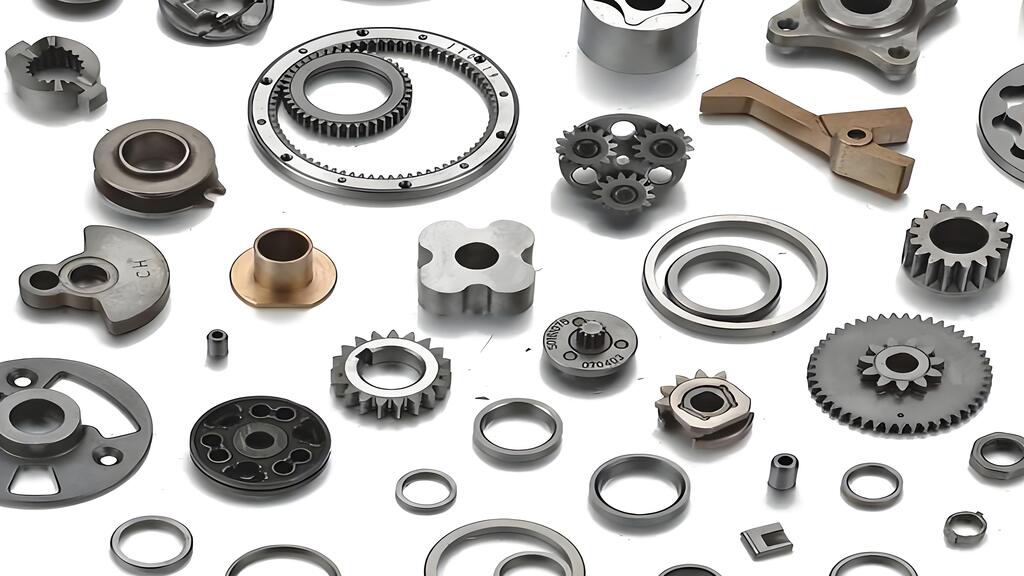


Steel Powder Manufacturing: Hidden Factors Affecting Part Quality

Steel powder has transformed the metallurgical industry through its remarkable performance. Powder Metallurgy steel reaches a hardness of 66-67 HRC and extends bearing fatigue life up to six times compared to conventional SAE 52100 steel. This advanced material works well in tough conditions and delivers superior toughness with wear resistance. The steel also keeps its edge sharp and remains easy to sharpen.
Powder metallurgy marks a major step forward in steel manufacturing technology. Scientists created this process to produce high-alloy tool steels, which involves three basic steps: powder blending, die compaction, and Sintering. Rapid solidification during powder manufacturing creates smaller dendrite structures that eliminate segregation and produce steel with fine carbide distributions. The very fine and regular grain size ranges from 0.1 to 1,000 μm, carefully selected based on the desired alloy. Several hidden factors during the powder metal manufacturing cycle can affect the final product's quality.
This piece explores the key variables in steel powder production that shape part quality, from the original powder characteristics to the final processing steps. Manufacturers can control the powdered metal process better and achieve optimal results by understanding these factors.
Powder Production Methods and Their Impact on Quality
Steel powder's characteristics and performance depend heavily on how it's made. The manufacturing process shapes particle features and purity levels that affect both processing steps and the final product's properties.
Gas Atomization vs Water Atomization: Particle Shape and Purity
Gas atomization and water atomization are the most accessible methods to produce steel powder, but they create very different results. Gas atomization creates round particles that flow well. The process breaks molten steel into droplets using high-pressure gas streams (2-4 MPa) like nitrogen, argon, or helium. The particles range from 10 to 300 μm, based on gas pressure, melt temperature, and nozzle setup.
Water atomization works differently. It uses high-pressure water jets (5-15 MPa) to break up molten steel. This creates rough, angular particles with uneven surfaces. The particles turn out this way because water hits the molten metal with more force. The metal solidifies quickly before surface tension can make it round.
Each method comes with its trade-offs:
| Feature | Gas Atomized Powder | Water Atomized Powder |
|---|---|---|
| Particle Shape | Spherical | Irregular |
| Oxygen Content | Low | High |
| Production Cost | Higher | Lower (10-80% less) |
| Applications | AM, MIM, HIP | PM, traditional press-sinter |
| Flowability | Excellent | Poor |
Water atomized powders contain more oxygen because of oxidation during production. Their irregular shape helps particles lock together better, which makes them stronger after pressing. These powders work great in traditional powder metallurgy despite their limits.
Gas atomized powders cost more but work better in additive manufacturing because they're round and have less oxygen. Research shows these powders can create denser parts using less energy. But water atomized powders can match this performance if you use more energy.
Electrolytic and Reduction Methods: Oxide Control
Electrolytic and chemical reduction methods provide different ways to make steel powder, especially when oxide control matters. Electrolysis creates pure powders by depositing iron on cathodes from solutions. This method produces clean material with minimal impurities, perfect for applications needing high purity.
Chemical reduction, particularly for sponge iron powders, reduces iron oxide with hydrogen or carbon monoxide at 700-900°C. These powders have compressible surfaces with unique structures. Water atomized powders can sometimes be cleaned through hydrogen reduction.
These methods serve specific applications where chemical purity matters more than particle shape. They produce less powder at higher costs, but remain crucial for some high-performance powder metallurgy uses.
Centrifugal Atomization for Narrow Particle Size Distribution
Centrifugal atomization stands out when you need precise control over particle size. The process drops molten metal onto a fast-spinning disk. The liquid metal spreads outward from centrifugal force before breaking into droplets that harden mid-air.
Faster disk rotation creates smaller particles, while slower melt flow rates help too, as the metal film gets thinner before breaking up. Cup atomizers with 67.5° wall angles make the finest powders by improving how the melt wets the atomizer.
This method creates powders with more consistent sizes than other techniques. The sizes follow a lognormal distribution with geometric standard deviations of 1.6 to 2.5. Better size consistency means higher yields, making this method cost-effective for special uses.
The particles come out very round with smoother surfaces than gas atomized powders. They also have fewer satellites - small particles stuck to bigger ones - which helps them flow better in additive manufacturing.
Powder Characteristics That Influence Final Properties

Steel component quality depends on powder characteristics that go beyond production methods. These properties shape everything from how the powder behaves during processing to the final performance of parts. Quality control of these properties is crucial for consistent results in the powder metallurgy process.
Particle Size Distribution and Flowability
The way steel powder particles are sized affects processing parameters and component properties. A newer study shows that particle size distribution has a big effect on part density when using powder bed fusion techniques. Powders with bigger mean particle sizes or tighter distributions show improved flowability. Better flow creates more even powder beds and improves surface quality in finished components.
Several powder characteristics combine to determine flowability. The Basic Flowability Energy (BFE) helps measure this property, with values between 4.46 mJ/g and 6.36 mJ/g for different stainless steel powders. More spherical powders show better flow characteristics, which matters a lot in additive manufacturing.
Particle size distribution also determines how well the powder packs together. Using multiple size distributions improves bulk packing density. Small particles fill the gaps between bigger ones. This optimization matters because:
| Particle Size Effect | Impact on Processing | Impact on Final Properties |
|---|---|---|
| Larger mean size | Improved flowability | Lower surface roughness |
| Narrower distribution | Enhanced rheology | More uniform density |
| Multimodal distribution | Higher packing density | Reduced porosity |
Oxygen Content and Surface Oxidation
Surface oxidation creates challenges in steel powder manufacturing, especially with alloys that readily absorb oxygen. Fresh atomized powders contain 0.024% to 0.044% oxygen by weight, depending on storage conditions. These variations affect processing behavior and final part properties.
Storage conditions and handling methods determine oxide layer thickness. Research shows inert-stored samples have similar CuO and Cu₂O thicknesses. Oxidized samples mostly contain CuO layers about 13.9 nm thick. These oxide layers slow down neck growth between neighboring particles by limiting element diffusion. This means higher sintering temperatures or longer processing times.
Materials like Ti-6Al-4V need careful control of residual oxygen in the processing atmosphere to maintain stability and reproducibility. Higher oxygen levels lead to more variation in relative density. Research shows that powder recycling and residual oxygen mostly affect surface roughness rather than porosity within certain ranges.
Internal Porosity in Powder Particles
Steel powder particles can hide internal pores that survive processing. These defects form when gas gets trapped in molten droplets during rapid solidification in gas atomization. Gas concentrations and porosities increase sharply with particle size, jumping around 75 μm.
Gas-atomized powders often contain trapped gas pores. Studies found that 28% of particles (183/653 μm) from one vendor and 21% (121/575 μm) from another had these defects. These internal pores can survive local melting and fusion zone turbulence during additive manufacturing, staying in the final component.
Smaller powder particles (≤45 μm) have fewer large internal pores. These powders usually contain only submicron pores (0.32-0.64 μm) in low concentrations. Despite this, even tiny pores can affect part density and mechanical properties, especially in high-performance applications.
Compaction Techniques and Density Uniformity

Powder metallurgy uses compaction to turn loose steel powder into shaped components that are strong enough to handle and process further. The way powder gets compacted plays a crucial role in determining the final part's accuracy, mechanical properties, and overall performance.
Single vs Double-Action Die Pressing
Die pressing methods differ in how they apply pressure to the powder. Single-action pressing applies force from just one side while keeping the lower punch and die still. This creates uneven density distribution - denser at the top near the punch and less dense at the bottom. These density differences can cause warping and size inconsistencies during sintering.
Double-action pressing squeezes the powder from both top and bottom at the same time. This creates more even density throughout the compact, which really matters for taller components. The more uniform density helps reduce uneven shrinkage during sintering, so parts stay more accurate and have better dimensional control.
The pressure needed usually ranges from 400-800 MPa, based on the steel powder mix and the green density you want. When pressure stays under 620 MPa, how well the powder can be compressed matters most. Above 690 MPa, additives like lubricants and graphite have a bigger effect.
Cold Isostatic Pressing for Complex Shapes
Regular uniaxial pressing just doesn't work for parts with high aspect ratios or complex shapes. Cold isostatic pressing (CIP) solves this by using uniform pressure (34.5-690 MPa) from all directions through fluid, which creates parts with consistent density throughout.
CIP works better than regular die pressing because it:
- Creates uniform density, whatever the part's shape or height-to-diameter ratio
- Can handle tough materials like tungsten and molybdenum
- Makes parts with three-dimensional features
- Results in stronger green components
During CIP, oil or water transfers pressure equally in all directions to a flexible mold holding the powder. Each part of the green compact gets similar pressure, which leads to uniform shrinkage during sintering. This method can even make large parts weighing up to 2000 kg with consistent density.
The biggest problem with CIP is precision - parts usually need extra machining to meet tight tolerances.
Effect of Lubricants on Green Density
Lubricants serve multiple purposes during compaction. While powder metallurgy has used EBS wax lubricants for years, newer lubricant systems work better with less material.
The way lubricant content affects green density isn't straightforward. Lower compaction pressures benefit from lubricants because they help particles move into place. But at higher pressures, too much lubricant gets in the way by filling the space in the remaining pores.
Temperature changes how well lubricants work during compaction. Raising the die temperature from 30°C to 80°C can boost green density by about 0.07 g/cm³. Warm die compaction works best with less lubricant (0.45-0.60% by weight) and die temperatures around 60°C (140°F), which gives good green density and makes parts easier to remove.
Pre-alloyed steel powders with more alloying elements need more lubricant to remove parts safely and protect tools. You need to balance lubrication, density, and removal force carefully based on your powder mix and part shape.
Sintering Parameters That Affect Microstructure
The sintering stage turns compacted powder into a solid metallic structure. Processing parameters play a crucial role in determining the final microstructure and mechanical properties of steel components. This vital phase needs careful monitoring of several variables to get the best results.
Solid-State vs Liquid-State Sintering
Solid-state sintering takes place below the material's melting point. It usually occurs at 0.6-0.8 of the melting temperature and relies on diffusion-driven mass transport. This approach creates uniform microstructures with controlled grain growth but needs higher temperatures to trigger diffusion mechanisms.
Liquid-phase sintering (LPS) works differently by adding a low-melting-point material that becomes liquid at sintering temperature. Boron works well as an element for inducing LPS in steel powders. It forms a eutectic liquid with iron at around 1175°C. This liquid helps speed up densification through capillary forces and particle rearrangement.
| Aspect | Solid-State Sintering | Liquid-Phase Sintering |
|---|---|---|
| Densification Rate | Slower | Faster due to liquid-assisted particle rearrangement |
| Temperature Requirement | Higher | Lower due to the presence of liquid |
| Microstructure | More uniform | May include complex secondary phases |
Sintering Atmosphere: Hydrogen vs Nitrogen
Sintering atmosphere does more than just protect from oxidation - it shapes part quality. Hydrogen removes surface oxides from powder particles effectively. Mixed with nitrogen, even small amounts of hydrogen (5-10%) remain effective.
Nitrogen atmospheres have become popular as furnace sealing technology has better. Many manufacturers now prefer nitrogen-hydrogen blends (95/5-50/50). These blends deliver balanced performance with dew points below -60°C. Such controlled atmospheres help maintain consistent physical properties and reduce surface decarburization.
Endothermic atmospheres still see use but come with drawbacks. They often show inconsistent gas composition and higher dew points that cause uneven carbon distribution. A nitrogen-hydrogen atmosphere produces the best results with minimal decarburization for carbon steel parts.
Shrinkage and Dimensional Control Challenges
Dimensional changes during sintering pose a major challenge. Stainless steels shrink more than carbon steels. Ferritic grades (400 series) show more dimensional change than austenitic grades (300 series).
Temperature stands out as the key factor affecting dimensional change and density. Research shows that maximum relative density (99.2%) happens at 1000°C under 50 MPa pressure with 8 minutes holding time. Small temperature changes (under 10°C) allow precise control of dimensional change without affecting other properties much.
Atmosphere composition also affects dimensional stability directly. Studies show that endothermic gas mixed with nitrogen helps reduce dimensional variations and improve microstructural uniformity. Complex components, especially in powder injection molding, face bigger dimensional control challenges due to substantial shrinkage (11-20%) during sintering.
Post-Sintering Treatments and Their Role in Quality

Post-sintering operations turn ordinary parts into high-performance components that have better properties. These vital treatments fix defects and make the microstructure better, which directly affects the final quality.
Hot Isostatic Pressing (HIP) for Full Densification
HIP exposes components to high temperature (800-1350°C) and isostatic gas pressure (100-200 MPa) inside a high-pressure containment vessel. This process gets rid of leftover porosity and makes mechanical properties better. Research on 316L stainless steel powder shows that higher temperatures from 1050°C to 1250°C (at constant 130 MPa) speed up densification. The time needed to reach 90% relative density drops from 90 minutes to under 60 minutes. The right HIP treatment can push relative density above 99.7%. Pressure moves from outside to inside, and densification usually happens faster in the specimen's center.
Coining and Repressing for Dimensional Accuracy
Coining puts extra pressure on sintered parts to create dimensional precision that other methods rarely achieve. The process copies surface details from dies with amazing accuracy. Parts become denser through repressing, which makes them stronger and harder. Tool manufacturing needs special processes sometimes. One study showed that new ideas in processing made tools last 148 times longer. These steps are crucial for parts that need exact dimensions.
Heat Treatment Effects on Carbide Distribution
Heat treatments change the sintered steel parts' microstructure completely. Carbides become smaller (less than 3 μm) and more round than as-sintered alloys after quenching and triple tempering. Alloying elements diffuse to control how carbides dissolve and form again. A study found that 825K steel alloy reached 64.2 HRC hardness and 2858 MPa bending strength when quenched at 1180°C and triple tempered at 540°C. This is a big deal as it means that cast alloy with a similar makeup. Fast heating during tempering can make carbides smaller, especially at high-angle grain boundaries. The time spent holding the temperature while quenching affects carbide shape. Studies showed that samples held for 160 seconds were harder than those quenched right away.
Common Defects in Powder Metallurgy Parts

Despite rigorous control throughout the powder metallurgy process, finished components can develop several common defects that reduce their performance and durability.
Residual Porosity and Its Effect on Fatigue Life
Residual porosity remains the biggest challenge in powder metallurgy parts after sintering. These pores significantly degrade mechanical properties. Components under cyclic loading develop cracks that start at these pores. The cracks usually begin at pores or pore clusters close to the surface. The amount, size, distribution, and shape of pores greatly affect mechanical behavior. PM steels show two distinct types of porosity - one from how powders pack together and another from liquid phases that form during sintering.
Segregation of Alloying Elements
Alloying elements sometimes concentrate unevenly across the microstructure. Nickel-based superalloys develop segregation at planar faults during creep. Elements like magnesium can change the balance between ballistic mixing and equilibration because of their high diffusivity. Powder particles distribute unevenly and don't diffuse completely during sintering. This creates uneven microstructures that change how damage spreads under stress.
Non-metallic Inclusions from Atomization
The powder production process creates non-metallic inclusions. These inclusions contain oxygen, silicon, chromium, manganese, and aluminum. Their composition varies from (8.46-21.20)Cr-(2.60-18.04)Mn-(3.26-17.00)Si-(0.38-6.30)Al-(0.34-3.61)Ti. Like pores, inclusions lower fatigue limits based on their size, shape, thermal properties, and interface strength. Hard and brittle oxide inclusions measuring tens of micrometers make materials less ductile. A single large inclusion can lead to complete failure.
Conclusion
Steel powder manufacturing covers many hidden factors that affect final part quality by a lot throughout the production pipeline. Gas atomization, water atomization, electrolytic reduction, and centrifugal atomization create distinct particle shapes and purity levels. These directly influence later processing steps. Gas atomization creates spherical particles that work best for additive manufacturing. Water atomization produces irregular particles better suited for traditional press-sinter applications.
The powder's characteristics play a key role in determining component quality. Particle size distribution affects how well the powder flows and packs. Larger mean sizes help with flow but might reduce final density. Higher oxygen content and surface oxidation slow down neck growth between particles. This means you need higher sintering temperatures. Many overlook internal porosity within powder particles. These tiny voids can remain through processing steps and weaken the finished parts' mechanical properties.
Different compaction techniques lead to varying quality levels. Double-action pressing creates a more even density distribution than single-action methods. This becomes especially important with taller components. Cold isostatic pressing works great with complex shapes, but loses some dimensional precision. The right lubricants improve green density. They help particles rearrange better at lower compaction pressures.
Sintering parameters reshape the steel components' microstructure completely. Solid-state sintering yields uniform structures with controlled grain growth. Liquid-phase sintering makes densification faster through capillary forces. The atmosphere you choose - hydrogen or nitrogen - affects oxide removal and carbon distribution. Temperature remains the most crucial factor that influences dimensional change during this phase.
Post-sintering treatments can lift ordinary parts into high-performance components. Hot isostatic pressing gets rid of leftover porosity and improves mechanical properties by a lot. Parts become more precise through coining and repressing. Heat treatments make carbide size and shape just right to optimize hardness and strength.
Even with careful control, defects show up in finished components. Leftover porosity creates stress concentration points that shorten fatigue life. When alloying elements separate, they create uneven microstructures. This affects how damage develops under stress. Non-metallic bits from atomization limit ductility severely and might cause complete failure.
Manufacturers should take an all-encompassing approach to these connected factors when designing powder metallurgy processes. The right powder choice, combined with optimized processing parameters, determines if a component meets tough performance requirements. Understanding these hidden factors helps producers make high-quality steel powder components consistently. These components serve sophisticated applications in a variety of industries.
Key Takeaways
Understanding the hidden factors in steel powder manufacturing is crucial for producing high-quality components that meet demanding performance requirements across industries.
• Powder production method determines part performance: Gas atomization creates spherical particles ideal for additive manufacturing, while water atomization produces irregular particles better for traditional press-sinter applications.
• Particle characteristics directly impact final quality: Oxygen content, internal porosity, and size distribution affect everything from flowability to mechanical properties—even small defects can persist through processing.
• Compaction uniformity prevents part distortion: Double-action pressing and cold isostatic pressing create a more uniform density distribution, reducing warping and dimensional inconsistencies during sintering.
• Sintering atmosphere controls microstructure: Hydrogen atmospheres effectively remove surface oxides, while temperature remains the most critical variable affecting dimensional change and final density.
• Post-sintering treatments unlock performance potential: Hot isostatic pressing can eliminate residual porosity and improve mechanical properties by over 99.7% relative density.
• Hidden defects compromise component reliability: Residual porosity, elemental segregation, and non-metallic inclusions act as stress concentrators that significantly reduce fatigue life and can cause catastrophic failure.
These interconnected factors must be managed holistically throughout the entire powder metallurgy process to achieve consistent, high-quality results in demanding applications.
FAQs
Q1. What are the key factors influencing part quality in steel powder manufacturing? The main factors include powder production method, particle characteristics (size, shape, oxygen content), compaction technique, sintering parameters, and post-sintering treatments. Each of these elements plays a crucial role in determining the final properties and performance of the component.
Q2. How does the choice of atomization method affect powder properties? Gas atomization produces spherical particles ideal for additive manufacturing, while water atomization creates irregular particles better suited for traditional press-sinter applications. The method chosen impacts particle shape, purity, flowability, and subsequent processing behavior.
Q3. What role does particle size distribution play in powder metallurgy? Particle size distribution affects flowability, packing efficiency, and final part density. Larger mean sizes generally improve flow but may reduce final density. A carefully controlled distribution is essential for achieving optimal processing and performance characteristics.
Q4. How does the sintering atmosphere impact the final product? The sintering atmosphere significantly influences oxide removal and carbon distribution in the final part. Hydrogen atmospheres are effective at removing surface oxides, while nitrogen-based atmospheres can help control carbon levels. The choice of atmosphere directly affects the microstructure and properties of the sintered component.
Q5. What are common defects in powder metallurgy parts, and how do they affect performance? Common defects include residual porosity, elemental segregation, and non-metallic inclusions. These defects act as stress concentrators, significantly reducing fatigue life and potentially causing catastrophic failure. Proper control of the entire manufacturing process is crucial to minimize these defects and ensuring reliable component performance.