

AZ91 vs AM60 vs AM50: Which Magnesium Alloy Is Best for Die Casting?
For most Die Casting applications, AZ91 is generally the best all-around magnesium alloy. It provides a good balance of strength, castability, and corrosion resistance. The 'best' alloy ultimately depends on specific application priorities. AM60 and AM50 offer distinct advantages. They provide enhanced ductility and impact strength. Selecting the correct Magnesium Alloy is crucial for optimal component performance.
Key Takeaways
- AZ91 is a balanced magnesium alloy. It offers good strength, castability, and corrosion resistance. It works well for many general uses.
- AM60 magnesium alloy is best for ductility. It absorbs impact well. Use it for car safety parts like steering wheels.
- AM50 magnesium alloy gives the most toughness. It can bend a lot without breaking. It is good for car seat frames and parts that need to deform.
- AZ91 has the best corrosion resistance. Its aluminum content helps protect it. AM60 and AM50 have less protection.
- Magnesium alloys are good for thin parts. They flow well into molds. This helps make light and complex designs.
- Magnesium alloys are recyclable. They help make cars lighter. This saves fuel and is good for the environment.
- Choose the right alloy for the job. Consider strength, how much it can bend, and cost. The best alloy depends on what you need it to do.
Understanding Key Differences in Magnesium Alloy Composition

AZ91 Magnesium Alloy: The Balanced Performer
Composition and General Characteristics
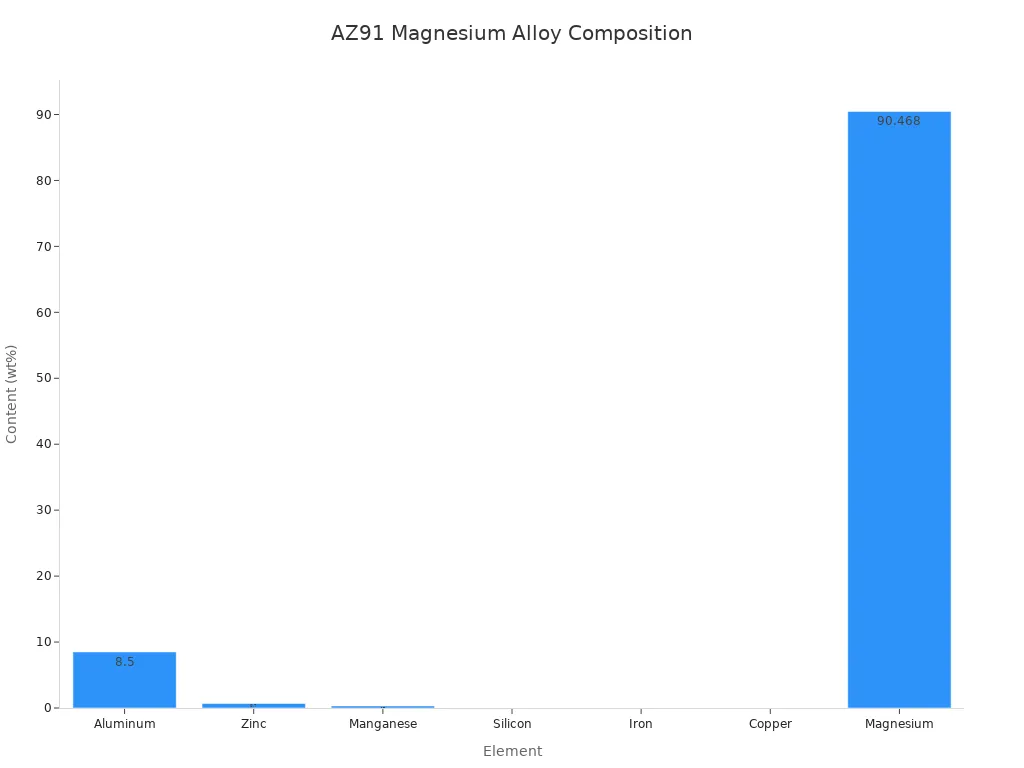
AZ91 magnesium alloy stands out for its balanced properties. Its composition includes approximately 8.5% aluminum and 0.7% zinc. Manganese is also present at about 0.32%. Other elements like silicon, iron, and copper exist in very small amounts. Magnesium forms the rest of the alloy.
| Element | Content (wt%) |
|---|---|
| Aluminum (Al) | 8.5 |
| Zinc (Zn) | 0.7 |
| Manganese (Mn) | 0.32 |
| Silicon (Si) | 0.01 |
| Iron (Fe) | 0.001 |
| Copper (Cu) | 0.001 |
| Magnesium (Mg) | rest |
Why AZ91 is a Workhorse Magnesium Alloy
AZ91 is a workhorse magnesium alloy due to its excellent strength-to-weight ratio. This makes it a preferred material in industries like automotive and aerospace. It offers high strength and good corrosion resistance, making it suitable for structural components. The higher aluminum content in AZ91, compared to AM60B, contributes to its increased strength. Zinc further enhances its strength and corrosion resistance.
AM60 Magnesium Alloy: Prioritizing Ductility
Composition for Enhanced Ductility
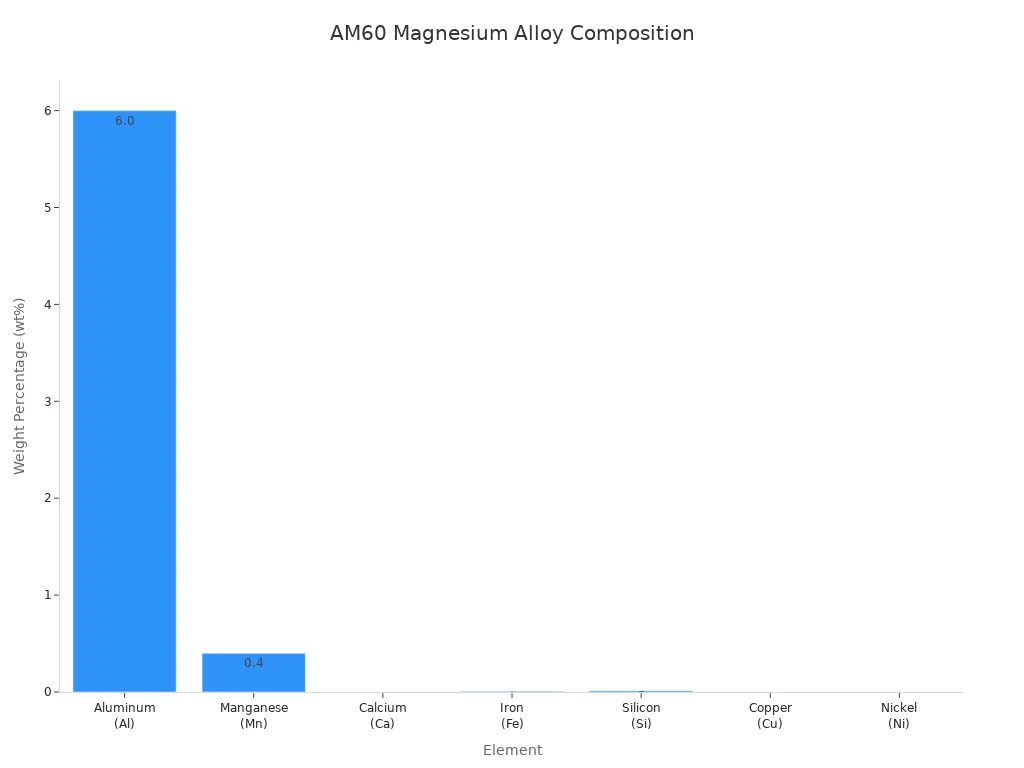
AM60 magnesium alloy prioritizes ductility. Its composition typically includes about 6.0% aluminum and 0.4% manganese. Manganese enhances resistance to cracking during casting and machining. Other elements like iron, silicon, copper, and nickel are present in very small quantities. Magnesium makes up the balance of the alloy.
| Element | Weight Percentage (wt%) |
|---|---|
| Magnesium (Mg) | Balance |
| Aluminum (Al) | 6.0 |
| Manganese (Mn) | 0.4 |
| Calcium (Ca) | 0.0 |
| Iron (Fe) | 71 pPm |
| Silicon (Si) | 136 ppm |
| Copper (Cu) | 10 ppm |
| Nickel (Ni) | 5 ppm |
Impact Strength Advantages of this Magnesium Alloy
AM60 is celebrated for its outstanding ductility and energy absorption qualities. This makes it suitable for impact resistance applications. While AZ91 is widely used in automotive powertrain applications, die-cast AM60 magnesium alloy is increasingly popular for components requiring better ductility. These include door inners and instrument panel beams. AM60 offers superior ductility compared to AZ91. This makes it preferred for applications where this property is critical.
AM50 Magnesium Alloy: Maximizing Toughness
Composition for Ultimate Ductility
AM50 magnesium alloy is designed for ultimate ductility. It contains approximately 5% aluminum and up to 0.5% manganese. This composition provides even greater ductility than AM60. The lower aluminum content compared to AZ91 contributes to its enhanced deformability.
Applications for this High-Toughness Magnesium Alloy
AM50 is ideal for components requiring maximum fracture toughness. It is particularly useful in applications where parts must deform significantly without breaking. Examples include seat frames and other highly deformable parts. Specific interior components with a high impact risk also benefit from AM50's properties.
Comparative Analysis of Magnesium Alloy Properties for Die Casting
Mechanical Properties: Strength, Ductility, and Impact Resistance
Tensile and Yield Strength Comparison of Magnesium Alloys
Tensile and yield strength are critical for structural integrity. AZ91 consistently demonstrates the highest tensile and yield strength among the three alloys. Its higher aluminum and zinc content contributes to this superior strength. AM60 offers moderate strength, lower than AZ91 but still robust for many applications. AM50, with its lowest aluminum content, exhibits the lowest tensile and yield strength. This characteristic prioritizes ductility over sheer strength.
Elongation and Ductility Performance Across Alloys
Ductility measures a material's ability to deform without fracturing. AM50 excels in elongation and ductility. Its reduced aluminum content allows for significant plastic deformation. AM60 also provides excellent ductility, making it suitable for energy absorption. AZ91, while strong, has the lowest ductility among the three. Its higher strength comes at the expense of deformability.
Impact Energy and Toughness Ratings for Each Magnesium Alloy
Impact energy and toughness are crucial for components subjected to sudden loads. AM50 offers maximum fracture toughness. It absorbs substantial energy before failure. AM60 also provides significant impact strength advantages. These properties make AM60 and AM50 ideal for safety-critical applications. AZ91, despite its strength, exhibits lower impact energy absorption compared to AM60 and AM50.
Corrosion Resistance of Magnesium Alloys
AZ91's Superior Corrosion Performance
AZ91 generally offers good corrosion resistance. Its higher aluminum content helps form a stable passive layer on the surface. This layer protects the material from environmental degradation. This inherent protection makes AZ91 a reliable choice for various environments.
AM60 and AM50 Corrosion Characteristics
AM60 and AM50 have lower aluminum content than AZ91. This typically results in slightly reduced corrosion resistance. However, their corrosion performance remains acceptable for many applications. Manufacturers often employ surface treatments to enhance their corrosion protection. While direct comparative data for all three alloys in salt spray tests is not always readily available in a single source, AZ91 demonstrates a corrosion rate lower than mild steel in such tests, indicating its relative resilience.
Factors Influencing Corrosion in Die Cast Magnesium Alloys
Several factors influence corrosion in die cast magnesium alloys. Microstructure plays a significant role. Impurities, especially iron, nickel, and copper, can accelerate corrosion. Surface treatments and coatings also greatly impact corrosion resistance. High-purity versions of these alloys generally exhibit improved corrosion performance.
Castability and Processing Considerations for Each Magnesium Alloy
Fluidity and Die Filling Capabilities
Fluidity is essential for filling complex die cavities and producing intricate parts. AZ91, with its higher aluminum content, generally exhibits superior fluidity. This allows for easier filling of intricate molds and the production of thin-walled components. AM60 and AM50 have slightly lower fluidity due to their reduced aluminum content. This may require higher casting temperatures or pressures for optimal die filling.
Hot Tearing Susceptibility and Mitigation
Hot tearing occurs during solidification when internal stresses exceed the material's strength. For Mg-Al based alloys, castability, which encompasses factors like hot tearing, decreases as the aluminum content is reduced. AZ91 is noted to be more castable than other alloys with lower aluminum content. This means AZ91 generally has lower hot tearing susceptibility. The hot tearing susceptibility (HTS) of Mg-Zn-Al-RE alloys generally increases with increasing Zn content up to 6 wt%, and then decreases with further increases in Al and/or Zn content. This further supports AZ91's better hot tearing resistance compared to AM60 and AM50, which have lower aluminum content. Proper die design and controlled cooling rates can mitigate hot tearing in all alloys.
Solidification Behavior and Microstructure
The solidification behavior significantly influences the final microstructure and mechanical properties. AZ91 forms a fine-grained structure with intermetallic phases. These phases contribute to its high strength. AM60 and AM50, with less aluminum, tend to have a more ductile matrix. This matrix allows for greater deformation before fracture. Controlling solidification rates is crucial for achieving desired microstructures and optimal performance in all three alloys.
Cost Implications of Different Magnesium Alloys
Raw Material Cost Differences
The initial cost of raw materials significantly influences the overall project budget. Current market trends indicate that the average price for magnesium alloys typically ranges from $3 to $6 per kilogram. This general range encompasses alloys like AM50 and AM60. However, specific pricing varies based on quantity and form. For bulk purchases, such as 25 tons or more, the price for ingots of AZ31, AZ61, AZ63, AZ91, AM50, and AM60 magnesium alloys falls between $1.50 and $2.00 per kilogram. Smaller quantities, like a single kilogram of AM50a ingot, command a higher price, ranging from $2.00 to $2.40.
| Alloy Type | Price per kg | Minimum Order |
|---|---|---|
| AZ31, AZ61, AZ63, AZ91, AM50, AM60 Mg Alloy Ingot | $1.50 - $2.00 | 25 tons |
| AM50a Ingot | $2.00 - $2.40 | 1 kilogram |
It is important to note that specialized forms also impact cost. For instance, AZ91 magnesium alloy sheets have a price between $12 and $20 per kilogram. This higher cost reflects the additional processing required to produce sheets. Therefore, while the base ingot prices for AZ91, AM60, and AM50 appear similar in bulk, the specific form and quantity needed for an application can lead to notable cost variations.
Impact on Tooling and Production Costs
The choice of magnesium alloy also affects tooling and production costs. Alloys with superior castability, like AZ91, often lead to more efficient production cycles. Their excellent fluidity allows for easier filling of complex die cavities. This reduces the likelihood of casting defects and minimizes scrap rates. Lower scrap rates directly translate to reduced material waste and reprocessing costs. Furthermore, good castability can extend tooling life by reducing stress on the dies during injection.
Conversely, AM60 and AM50, with their slightly lower fluidity, may require more precise process control. This could involve higher injection pressures or specific die designs to ensure complete filling and prevent defects. Such adjustments might increase production complexity. They could also potentially lead to slightly higher tooling wear over time. However, advancements in die casting technology and process optimization can mitigate these challenges. Manufacturers carefully balance these factors to achieve cost-effective production for each alloy.
Overall Economic Considerations for Magnesium Alloy Selection
Selecting a magnesium alloy involves more than just raw material price. Engineers must consider the total cost of ownership for the component. This includes material costs, processing costs, potential scrap rates, and any necessary post-processing or finishing. A seemingly cheaper raw material might incur higher production costs due to increased defects or slower cycle times.
For applications demanding high ductility and impact resistance, such as automotive safety components, AM60 or AM50 might be the optimal choice. Their superior performance in these areas justifies a potentially higher material or processing cost. The enhanced safety and durability they provide offer significant long-term value. Additionally, magnesium alloys contribute to lightweighting initiatives. This leads to benefits like improved fuel efficiency and reduced emissions in vehicles. These environmental and operational savings represent crucial economic considerations beyond the initial material purchase. Therefore, a comprehensive economic analysis considers both upfront expenses and long-term performance benefits.
Application-Specific Recommendations for Magnesium Alloy Selection
When to Choose AZ91 Magnesium Alloy
General-Purpose Structural Components
Engineers often select AZ91 magnesium alloy for general-purpose structural components. This alloy provides an excellent balance of strength, castability, and corrosion resistance. AZ91D is the most commonly used Magnesium Die Casting alloy. It offers superior corrosion resistance. For applications where maximum corrosion resistance is not a primary concern, engineers can consider AZ91A and AZ91B. These variants allow for the use of secondary metal, which helps reduce costs. AZ91E is another high-purity option. It is suitable for pressure-tight sand and permanent mold castings requiring high tensile strength and moderate yield strength. AZ91C also finds use in sand and permanent mold castings when corrosion resistance is not the main driver.
Automotive Housings and Brackets
AZ91 magnesium alloy is a preferred material for various automotive housings and brackets. It is particularly suitable for large-sized die cast components. These components often reside near engines, power trains, and motors. This alloy effectively addresses the limitations that conventional magnesium alloys previously faced in these demanding areas. Specific applications include engine parts, transmission housings, and other structural elements. Manufacturers also use AZ91 for engine covers and structural inner parts. Its high strength-to-weight ratio helps reduce overall vehicle mass, contributing to fuel efficiency.
Electronic Enclosures and Consumer Goods
The lightweight nature and good mechanical properties of AZ91 make it ideal for electronic enclosures. Manufacturers use it for laptop casings, mobile device frames, and other consumer goods. Its ability to form intricate shapes through die casting allows for complex designs. The alloy also provides adequate shielding against electromagnetic interference. This makes it a practical choice for protecting sensitive electronic components.
When to Choose AM60 Magnesium Alloy
Automotive Safety Components (e.g., Steering Wheel Armatures)
AM60 magnesium alloy is a prime choice for automotive safety components. Its superior ductility and energy absorption capabilities are critical in these applications. Manufacturers frequently use it for seat frames, steering wheels, and wheels. These parts must withstand significant forces during an impact. The alloy's ability to deform without fracturing helps protect occupants.
Instrument Panel Beams and Interior Structures
Instrument panel beams and other interior structures benefit greatly from AM60. These components often require a balance of strength and the ability to absorb energy during a collision. AM60 provides the necessary structural integrity while offering enhanced ductility. This combination helps manage crash energy effectively.
Applications Requiring Moderate Energy Absorption
AM60B magnesium alloy excels in applications requiring moderate energy absorption. It is particularly effective in automotive safety components like instrument panel structures and seat frames. This alloy offers excellent ductility. It efficiently absorbs energy, which is crucial for crash zones. In these areas, impact absorption directly impacts passenger safety. Its 10-15% elongation allows it to absorb impact in crush zones. This represents a significant advantage over traditional steel components, which would simply shear under similar conditions.
When to Choose AM50 Magnesium Alloy
Seat Frames and Highly Deformable Parts
AM50 magnesium alloy is specifically designed for ultimate ductility. This makes it an excellent material for seat frames. A notable application includes its use in Daimler Benz 500/600 models. Its high ductility strength also suggests suitability for other highly deformable parts. These components require flexibility and significant deformation without failure.
Components Requiring Maximum Fracture Toughness
For components demanding maximum fracture toughness, AM50 is the preferred choice. This alloy can absorb substantial energy before breaking. This property is vital in applications where parts must withstand extreme stress or sudden impacts. Its composition prioritizes deformability over sheer strength.
Specific Interior Components with High Impact Risk
AM50 finds its niche in specific interior components with a high impact risk. Its ability to deform significantly without fracturing makes it a reliable material for these critical parts. The alloy helps enhance passenger safety by absorbing impact energy effectively. This reduces the likelihood of brittle failure in high-stress situations.
Advanced Considerations for Magnesium Alloy Die Casting
Post-Processing and Finishing Options for Magnesium Alloys
Machinability of Each Magnesium Alloy
Magnesium alloys generally exhibit excellent machinability. They allow for high cutting speeds and long tool life. AZ91, with its higher hardness, machines well. However, AM60 and AM50, being softer and more ductile, can sometimes present challenges with chip formation. Proper tooling and cutting parameters ensure efficient machining for all three alloys. Manufacturers often use specific coolants to prevent ignition during high-speed operations.
Surface Treatment and Coating Compatibility
Magnesium alloys frequently require surface treatments. These treatments enhance corrosion resistance and improve aesthetic appeal. Common options include anodizing, conversion coatings, and various paint systems. Anodizing creates a hard, protective oxide layer. Conversion coatings offer a base for subsequent painting. All three alloys (AZ91, AM60, AM50) are compatible with these standard finishing processes. The choice of treatment depends on the application's environmental exposure and desired appearance.
Environmental Factors and Sustainability of Magnesium Alloys
Recyclability of Magnesium Alloys
Magnesium alloys are highly recyclable. This characteristic makes them a sustainable material choice. Recycling magnesium requires significantly less energy than primary production. This process reduces the environmental footprint. All three alloys, AZ91, AM60, and AM50, can be re-melted and reused. This contributes to a circular economy.
Lightweighting Benefits and Fuel Efficiency
The low density of magnesium alloys offers substantial lightweighting benefits. This is particularly crucial in the automotive and aerospace industries. Lighter components lead to improved fuel efficiency. They also reduce greenhouse gas emissions. Using these alloys directly supports environmental sustainability goals.
Design Flexibility and Part Complexity with Magnesium Alloys
Thin-Wall Casting Capabilities
Magnesium's excellent fluidity allows for the production of thin-walled castings. This capability enables designers to create complex, lightweight parts. Thin walls reduce material usage. They also contribute to overall weight savings. AZ91, with its superior fluidity, excels in this area.
Integration of Multiple Functions
Die casting with magnesium alloys facilitates the integration of multiple functions into a single component. Designers can combine several smaller parts into one complex casting. This reduces assembly steps. It also lowers production costs. Furthermore, it often improves the structural integrity of the final product.
Real-World Applications of Each Magnesium Alloy
Successful AZ91 Magnesium Alloy Applications
Automotive Powertrain Components
Manufacturers widely use AZ91 in automotive powertrain components. Its high strength-to-weight ratio makes it ideal for parts like engine blocks, transmission cases, and oil pans. These applications demand robust materials that can withstand high temperatures and mechanical stresses. AZ91 helps reduce the overall weight of vehicles. This contributes to improved fuel efficiency and lower emissions.
Laptop and Mobile Device Casings
AZ91 also finds extensive use in laptop and mobile device casings. Its lightweight nature is crucial for portable electronics. The alloy provides excellent rigidity and durability, protecting sensitive internal components. Furthermore, AZ91 allows for the creation of thin-walled, complex designs. This meets the aesthetic and functional requirements of modern consumer electronics.
Key AM60 Magnesium Alloy Implementations
Steering Column Components
AM60 is a preferred material for steering column components. Its superior ductility and energy absorption capabilities are vital for occupant safety. In a collision, the steering column must deform in a controlled manner. AM60 effectively absorbs impact energy. This reduces the risk of injury to the driver.
Automotive Door Inner Panels
Automotive door inner panels frequently incorporate AM60. These panels contribute significantly to a vehicle's crashworthiness. AM60's ability to deform without fracturing helps manage crash forces. This protects passengers during side impacts. Its lightweight properties also support overall vehicle weight reduction goals.
Noteworthy AM50 Magnesium Alloy Uses
Advanced Seat Structures
AM50 is instrumental in advanced seat structures. Its ultimate ductility allows seat frames to deform significantly under stress. This property is critical for occupant protection in various crash scenarios. The alloy ensures the seat absorbs impact energy effectively. This minimizes direct force on the occupant.
Specialized Impact-Absorbing Brackets
Engineers design specialized impact-absorbing brackets using AM50. These components are strategically placed within a vehicle's structure. They deform predictably during a collision. This controlled deformation dissipates kinetic energy. AM50's high fracture toughness makes it an excellent choice for these critical safety applications.
AZ91 often serves as the benchmark for magnesium die casting. It offers balanced properties. However, AM60 and AM50 provide crucial advantages. They excel in ductility and impact resistance for specific applications. The "best" magnesium alloy is not universal. It is the one that most effectively meets unique performance requirements. Cost constraints and processing considerations also play a role. Engineers must carefully evaluate application priorities. This ensures selection of the optimal magnesium alloy.
FAQ
🤔 What is the main difference between AZ91, AM60, and AM50 magnesium alloys?
AZ91 offers balanced strength and corrosion resistance. AM60 prioritizes ductility and impact strength. AM50 provides maximum ductility and fracture toughness. Each alloy serves different application needs.
🛡️ Which magnesium alloy provides the best corrosion resistance for die casting?
AZ91 generally offers superior corrosion resistance. Its higher aluminum content helps form a protective passive layer. AM60 and AM50 have slightly lower resistance but perform acceptably for many uses.
🚗 For which applications should one choose AM60 magnesium alloy?
Engineers select AM60 for automotive safety components. These include steering wheel armatures and instrument panel beams. It excels in applications requiring moderate energy absorption and good ductility.
💪 When is AM50 magnesium alloy the optimal choice?
AM50 is ideal for components needing maximum fracture toughness. It suits highly deformable parts like seat frames. This alloy absorbs significant energy before breaking.
📏 Do these magnesium alloys support thin-wall casting?
Yes, magnesium alloys support thin-wall casting. Their excellent fluidity allows for intricate, lightweight designs. AZ91 particularly excels in this capability due to its superior fluidity.
♻️ Are magnesium alloys considered sustainable materials?
Yes, magnesium alloys are highly recyclable. Recycling requires less energy than primary production. This contributes to a reduced environmental footprint and supports sustainability goals.
📊 How do the mechanical properties of AZ91 compare to AM60 and AM50?
AZ91 exhibits the highest tensile and yield strength. AM60 offers moderate strength with good ductility. AM50 provides the lowest strength but the highest ductility and impact toughness.