

Common Defects in Magnesium Die Casting and How to Prevent Them
The Magnesium Die Casting market shows significant growth, projected to reach USD 5,088 million by 2034. This expansion underscores the demand for high-quality components.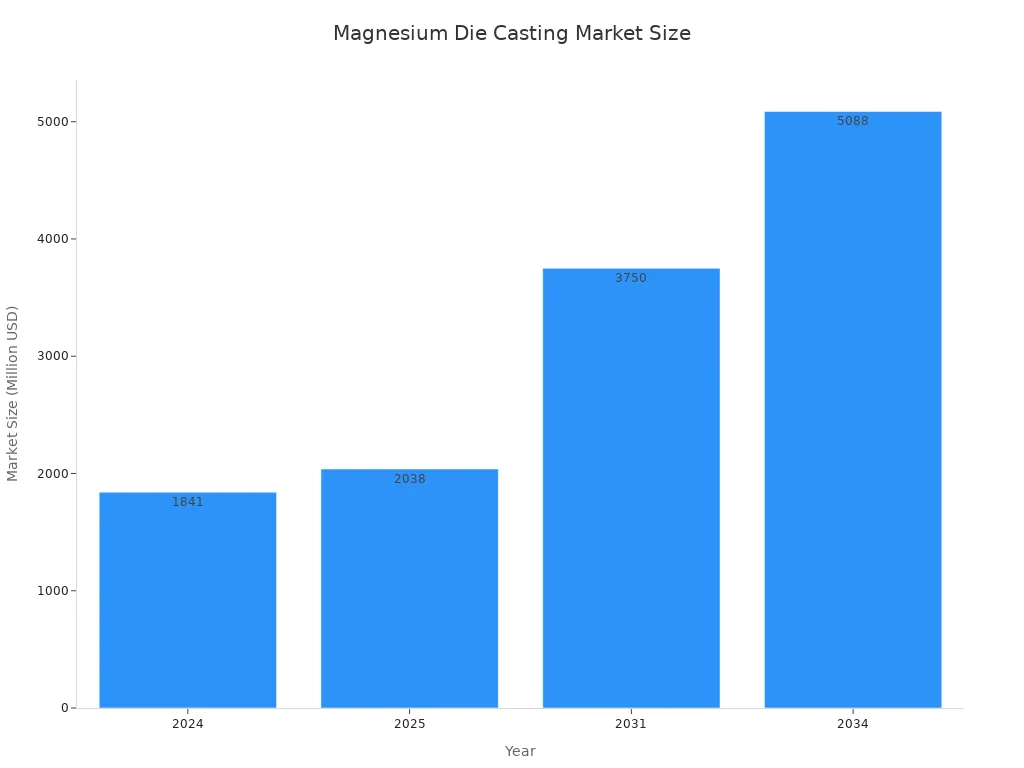 Identifying and preventing common defects in magnesium die casting is crucial for product quality and cost efficiency. Effective defect prevention ensures the integrity and performance of magnesium die-cast components.
Key Takeaways
- Magnesium die casting is growing. It offers light weight and strength. It also has challenges like high reactivity.
- Porosity is a common defect. It creates small holes in the metal. Gas, shrinkage, and trapped air cause it.
- Cold shuts happen when metal streams do not join. They look like lines. Low heat and slow injection cause them.
- Incomplete filling means the mold does not fill. This leaves parts unfinished. Low pressure and cold metal are causes.
- Hot tearing and cracking happen when metal cools. They create breaks. Restricted shrinking and uneven heat cause them.
- Surface defects are marks on the outside. These include flow marks and blisters. Uneven die heat and too much lubricant cause them.
- Good design helps prevent defects. Make parts simple. Use even wall thickness and proper angles.
- Control the process well. Use pure materials. Keep die temperature steady. Monitor the process in real-time.
Understanding Magnesium Die Casting Benefits and Challenges
Magnesium die casting offers distinct advantages and faces specific challenges. Understanding these aspects helps manufacturers leverage its strengths while mitigating potential issues.
Benefits of Magnesium Die Casting
Magnesium die casting provides numerous benefits, making it a preferred choice for various industries.
Lightweight Properties
Magnesium is one of the lightest structural metals. It has a density of approximately 1.8 g/cm³. This makes it significantly lighter than aluminum (2.7 g/cm³) and titanium (4.5 g/cm³). This property makes magnesium ideal for weight-critical applications, such as in the aerospace industry. Magnesium parts can be 35% lighter than aluminum, with potential reductions up to 50% when using thinner walls.
High Strength-to-Weight Ratio
Magnesium offers an excellent strength-to-weight ratio. This is crucial for applications demanding both strength and reduced weight, like automotive components or bicycle frames. Magnesium alloys typically exhibit yield strengths between 21-460 MPa. It achieves stiffness values comparable to aluminum or steel but with less material weight, enhancing resistance to elastic deformation.
Excellent Heat Dissipation
Magnesium possesses high thermal conductivity, around 150 W/mK. This characteristic makes it highly effective for dissipating heat. Manufacturers use magnesium in high-temperature applications, such as automotive engines or electronic devices operating between 150-200 °C.
Electromagnetic Shielding Capabilities
Magnesium die castings provide excellent electromagnetic interference (EMI) and radio-frequency interference (RFI) shielding properties. This makes it ideal for electronic components where protection against external interference is essential.
Challenges in Magnesium Die Casting
Despite its benefits, magnesium die casting presents several challenges that require careful management.
High Reactivity of Magnesium
High-strength magnesium alloys are highly reactive. This reactivity leads to rapid oxidation and can cause inclusions within the cast part. Magnesium's flammability also poses fire and explosion risks, necessitating strict safety protocols during processing.
Narrow Processing Window
Magnesium requires precise temperature control due to its relatively low melting point. Deviations in temperature can lead to vaporization or incomplete fills. Critical process variables include injection speed and pressure. An injection speed that is too slow can cause premature solidification, while one that is too fast can lead to turbulence and air entraPment. Excessive pressure can deform the die. Manufacturers must carefully control the cooling rate to achieve the desired microstructure and prevent internal stresses.
Susceptibility to Oxidation
Magnesium's high reactivity makes it susceptible to oxidation. This requires careful handling and processing to minimize exposure to oxygen. Proper melt treatment and protective atmospheres are crucial to prevent surface oxidation defects.
Specific Equipment Requirements
Magnesium alloys are abrasive, which can accelerate die wear. Rapid heating and cooling cycles create thermal stress, potentially leading to cracks in the die. The specific flow characteristics of magnesium necessitate careful die design to prevent air traps. While tooling for magnesium can last 2-3 times longer than for aluminum, the initial setup and ongoing maintenance require specialized equipment and expertise.
Porosity: A Common Defect in Magnesium Die Casting

Porosity represents a significant challenge in magnesium die casting, affecting both the mechanical properties and surface finish of components. It refers to the presence of small voids or holes within the cast metal. Manufacturers must understand its various forms and origins to effectively prevent this common defect.
Types of Porosity
Porosity manifests in several forms, each with distinct characteristics and causes.
Gas Porosity
Gas porosity occurs when gases become trapped within the molten metal during the casting process. These gases can originate from the melt itself, from lubricants, or from the air in the die cavity. As the metal solidifies, these trapped gas bubbles form spherical voids.
Shrinkage Porosity
Shrinkage porosity develops as the molten metal cools and solidifies. Metal contracts during solidification, and if insufficient molten metal is available to fill the resulting volume reduction, voids form. These voids often appear irregular in shape and can occur internally or on the surface.
Entrapped Air Porosity
Entrapped air porosity specifically refers to air from the die cavity that becomes trapped within the molten metal. This often happens due to turbulent flow or inadequate venting. These air pockets create voids that compromise the part's integrity. Gas porosities result from air entrapment during the melt filling process, while shrinkage porosities arise due to metal contraction during solidification.
Causes of Porosity
Several factors contribute to the formation of porosity in magnesium die castings. Identifying these root causes is crucial for effective prevention.
Inadequate Venting Systems
Poorly designed or insufficient venting systems prevent air and other gases from escaping the die cavity during injection. This leads to gas entrapment and subsequent porosity.
Insufficient Gate Size
A gate that is too small restricts the flow of molten metal into the die cavity. This can cause premature solidification, leading to shrinkage porosity as the metal cools without adequate feeding.
Improper Die Temperature Control
Uneven or incorrect die temperatures can lead to localized hot spots or premature solidification. Hot spots can cause localized shrinkage porosity, while cold spots can hinder proper filling and trap gases.
Excessive Lubricant Application
Applying too much die lubricant can introduce volatile components into the die cavity. These components vaporize under high temperatures, creating gases that become trapped in the solidifying metal, leading to gas porosity.
Material Contamination Issues
Contaminants in the magnesium alloy, such as oxides or impurities, can release gases during the casting process. These gases contribute to porosity within the final product.
Preventing Porosity Defects
Preventing porosity requires a multi-faceted approach, addressing design, material, and process parameters.
Optimizing Gating and Runner Design
Properly designed gating and runner systems ensure a smooth, laminar flow of molten metal into the die cavity. This minimizes turbulence, which reduces air entrapment. Optimizing gate size also ensures adequate feeding to prevent shrinkage porosity.
Improving Venting and Overflow Systems
Effective venting allows air and gases to escape the die cavity rapidly during injection. Manufacturers improve venting by strategically placing vents and overflow wells. Vacuum assistance also helps remove trapped air from the cavity, significantly reducing gas porosity. Optimizing vents ensures proper gas escape during the casting process.
Controlling Die Temperature Uniformity
Maintaining a consistent and appropriate die temperature across the entire die cavity is essential. This prevents premature solidification and ensures uniform cooling, which minimizes shrinkage porosity. Proper local cooling, such as using more die spray or localized cooling channels, prevents metallurgical defects caused by uneven cooling.
Managing Injection Parameters Precisely
Precise control over injection speed, pressure, and intensification is critical. Adjusting settings like injection speed and pressure can reduce porosity. A controlled injection profile minimizes turbulence and ensures complete filling, reducing both gas and shrinkage porosity.
Ensuring Proper Melt Treatment
Proper melt treatment significantly reduces gas porosity. This includes melting in vacuum or low-solubility gas atmospheres, such as argon, to prevent dissolved gases in the molten material. Degassing and filtering the molten magnesium before casting also removes dissolved gases and impurities, especially if oxide formation causes porosity.
Cold Shuts: Another Common Defect
Cold shuts represent another significant challenge in magnesium die casting. They occur when two streams of molten metal flow together but do not completely fuse, leaving a visible line or seam on the casting surface. This defect compromises both the aesthetic appeal and the structural integrity of the final product.
Characteristics of Cold Shuts
Cold shuts manifest with distinct visual and structural properties.
Unfused Flow Lines
Cold shuts appear as distinct, irregular lines or seams on the surface of the casting. These lines indicate where two fronts of molten metal met but failed to merge completely. The metal along these lines often shows a lack of fusion, appearing as a crack or a discontinuity.
Weakened Structural Integrity
Beyond their visual impact, cold shuts create areas of weakness within the casting. The unfused metal reduces the effective cross-section of the part, making it more susceptible to fracture under stress. This significantly compromises the component's overall strength and durability.
Causes of Cold Shuts
Several factors contribute to the formation of cold shuts. Understanding these causes helps manufacturers implement effective preventive measures.
Low Melt Temperature
Molten metal that is too cool loses fluidity rapidly. When the melt temperature is low, the metal solidifies prematurely before filling the die cavity or fusing with other flow fronts. Inadequate heating temperature of the molten metal is a primary contributor to cold shuts.
Slow Injection Speed
A slow injection speed allows the molten metal to cool excessively as it travels through the die cavity. This premature cooling prevents proper fusion when flow fronts meet.
Insufficient Gate Area
An undersized gate restricts the flow of molten metal, leading to a slower fill rate and increased heat loss. This can cause the metal to cool before it fully merges, resulting in cold shuts. Poor design of the gating system often contributes to this issue.
Complex Part Geometry
Intricate part designs with thin sections, sharp corners, or long flow paths increase the likelihood of cold shuts. The molten metal must travel further and navigate more obstacles, increasing its cooling time and reducing its ability to fuse.
Inadequate Venting
Poor venting can trap air or gases within the die cavity. These trapped gases impede the flow of molten metal, causing it to cool and solidify before complete fusion. Inadequate fluidity of the molten metal, often exacerbated by trapped gases, also plays a role.
Preventing Cold Shut Defects
Preventing cold shuts requires a comprehensive approach, focusing on process parameters, die design, and material handling.
Increasing Melt and Die Temperatures
Elevating both the melt and die temperatures helps maintain the molten metal's fluidity for longer. Manufacturers should maintain die temperatures between 200-300 °C for magnesium alloys and melt temperatures between 620-680 °C. This ensures the metal remains hot enough to fuse completely upon meeting.
Optimizing Injection Speed and Pressure
Adjusting injection speed and pressure ensures rapid and complete filling of the die cavity. Maintaining gate velocity between 25 and 45 m/s is crucial; velocities below 20 m/s increase heat loss, while those above 50 m/s cause turbulence. A consumer electronics foundry successfully addressed cold shuts on 1.2 mm thick keyboard deck ribs by increasing the cover-die temperature by 25 °C and implementing a porous gate insert to diffuse flow. This improved the yield from 82% to 98%.
Redesigning Gating System for Flow
An optimized gating system promotes smooth, laminar flow and minimizes heat loss. Using submarine (tangential) gates keeps the metal stream submerged, reducing oxide formation and heat loss to air. Fan gates spread flow across a wide front, reducing the distance metal travels inside the cavity.
Simplifying Part Design
Simplifying complex part geometries can significantly reduce the occurrence of cold shuts. Designers should aim for uniform wall thicknesses and avoid sharp corners or abrupt changes in section, which can impede metal flow.
Enhancing Venting Efficiency
Effective venting allows trapped air and gases to escape the die cavity quickly. Placing overflow wells at the last-to-fill locations acts as heat reservoirs, back-filling chilled fronts and preventing cold shuts. Adequate venting, with a vent area 5-10% of the projected part area, facilitates rapid filling and prevents air entrapment.
Incomplete Filling: A Related Common Defect
Incomplete filling, also known as a "misrun," occurs when molten metal fails to completely fill the die cavity. This defect leaves portions of the casting unfinished. It significantly impacts both the appearance and performance of the final product. Manufacturers must address incomplete filling to ensure component quality.
Characteristics of Incomplete Filling
Incomplete filling presents clear visual and functional indicators.
Unfilled Sections
The most obvious characteristic of incomplete filling is the presence of missing material in certain areas of the casting. These sections appear as voids or gaps where the molten metal did not reach. The edges of these unfilled areas often look rounded or smooth, indicating the metal solidified before completing its flow.
Compromised Part Functionality
Unfilled sections directly compromise the part's intended functionality. A component with incomplete filling lacks structural integrity. It cannot perform its designed role effectively. This defect can lead to premature failure, poor fit with other parts, or inability to meet performance specifications.
Causes of Incomplete Filling
Several factors contribute to incomplete filling, often stemming from issues with metal flow, temperature, or pressure.
Insufficient Shot Volume
An insufficient amount of molten metal in the shot chamber means the die cavity cannot fill completely. Not enough molten metal is available to completely fill the die cavity. This directly results in unfilled sections.
Low Injection Pressure
Inadequate pressure applied during injection prevents the molten metal from reaching all parts of the die cavity. The pressure applied is insufficient to force the metal to spread throughout the entire mold. This is particularly true for thin sections or areas far from the gate.
Premature Solidification
Molten metal can solidify before completely filling the die cavity. A die that is too cold causes the molten metal to solidify prematurely. High gas content or severe oxidation in the metal liquid reduces fluidity, contributing to this issue. The casting temperature of the alloy or the mold temperature may also be too low.
Restricted Flow Paths
Obstructions or a poorly designed gating system impede the smooth movement of molten metal. Poor metal flow can result from an overly full pressure chamber or a casting wall design that is too thin or inconsistently thick. Improper placement, method, or number of gates, or a gate's cross-sectional area that is too small, also restricts flow. Inefficient gas venting or excessive paint that has not burned off can also hinder metal flow.
Preventing Incomplete Filling
Preventing incomplete filling requires careful control over process parameters and optimized die design.
Adjusting Shot Volume and Pressure
Manufacturers must ensure the shot volume provides enough molten metal to fill the cavity completely. Optimizing injection pressure and speed settings achieves consistent and complete mold filling. Correctly setting injection pressure and speed optimizes cavity filling.
Increasing Melt and Die Temperatures
Elevating the pouring temperature ensures the metal reaches the correct temperature for complete mold filling. Maintaining proper working temperatures of dies prevents premature cooling. This allows the molten metal to maintain fluidity longer and reach all sections of the die.
Optimizing Runner and Gate Design
An improved gating and runner design ensures smooth and even metal distribution throughout the die cavity. This minimizes flow restrictions and promotes complete filling. Utilizing simulation software to model metal flow can predict misrun potential before starting production.
Improving Venting and Overflow
Adequate mold venting allows gases to escape, which prevents premature solidification of the metal. Efficient gas venting is crucial. High mold temperature can increase gas pressure in the cavity, hindering gas discharge, so proper venting helps manage this.
Hot Tearing and Cracking: Critical Common Defects
Hot tearing and cracking represent critical challenges in magnesium die casting. These defects severely compromise the structural integrity and reliability of cast components. Manufacturers must understand their nature and causes to implement effective prevention strategies.
Nature of Hot Tearing
Hot tearing occurs during the solidification process, creating internal or external fractures in the casting.
Intergranular Fractures
Hot tears appear as intergranular fractures. These fractures form along the grain boundaries of the metal. They typically occur when the metal is in a semi-solid state, meaning it has both liquid and solid phases present. The metal lacks sufficient strength to withstand tensile stresses at this stage.
Occurs During Solidification
Hot tearing specifically occurs during the solidification phase of the casting process. As the molten metal cools and solidifies, it contracts. If external forces or internal stresses restrict this contraction, the semi-solid metal can tear. This timing makes detection and prevention particularly challenging.
Causes of Hot Tearing
Several factors contribute to the formation of hot tears and cracks in magnesium die castings. Understanding these causes helps manufacturers implement effective prevention measures.
Restricted Shrinkage During Cooling
Molten metal contracts significantly during solidification. For example, aluminum contracts by about 6.5%. Uneven contraction, caused by temperature gradients or rigid die walls, generates tensile stress in the semi-solid metal. Key factors include a wide solidification range, high restraint from features like ribs or sharp corners, and low ductility at semi-solid temperatures. Inadequate feeding of liquid metal into the semi-solid region also contributes to this issue.
High Die Temperature Gradients
Large temperature differences across the die cavity create uneven cooling. This uneven cooling leads to localized stress concentrations. These stresses can exceed the strength of the semi-solid metal, causing hot tears. Preventing large temperature and stress gradients, such as by preheating permanent molds, significantly reduces hot tearing. Experiments with magnesium alloy AZ 91 showed a critical preheat temperature of 635°F (335°C) above which hot tearing does not occur.
Improper Ejection Timing
Ejecting the casting too early, while the metal is still hot and weak, can induce significant stress. This stress can cause the casting to tear or crack, especially in areas with complex geometries or thin sections. Early ejection, when the metal is still hot, is a common cause.
Unsuitable Alloy Composition
Certain alloy compositions increase susceptibility to hot tearing. Alloys with a wide solidification range are more prone to this defect. Excess magnesium, copper, or zinc, or low silicon content, can also increase the risk. Coarse grains from overheating or the inclusion of low-melting impurities also contribute to hot tearing. Magnesium alloy AZ 91 exhibits the lowest susceptibility to hot tearing among tested magnesium alloys.
Preventing Hot Tearing and Cracking
Preventing hot tearing and cracking requires a multi-faceted approach, focusing on die design, process control, and material selection.
Optimizing Die Design for Ejection
Designers must optimize the die to allow for unrestricted shrinkage during cooling. This includes incorporating proper draft angles and avoiding rigid cores or pins that restrain contraction. Proper die design minimizes mechanical stress during ejection.
Controlling Die Temperature Uniformity
Maintaining a uniform die temperature across the entire cavity is crucial. This prevents localized hot spots and uneven cooling. Preheating permanent molds to a critical temperature, such as 635°F (335°C) for AZ 91, effectively reduces hot tearing.
Adjusting Ejection Pin Placement
Correct placement and number of ejection pins ensure even ejection force. This prevents localized stress during the removal of the casting from the die. Proper ejection pin placement minimizes the risk of tearing.
Selecting Appropriate Alloy
Choosing magnesium alloys with lower susceptibility to hot tearing, such as AZ 91, can significantly reduce this defect. Manufacturers should consider the alloy's solidification range and ductility at semi-solid temperatures.
Modifying Cooling Rates
Using chills and exothermic materials helps manage cooling rates. Chills are metallic inserts that increase the cooling rate in thick sections, reducing temperature gradients. Exothermic materials slow down cooling in thin sections, ensuring uniform solidification. These techniques help prevent the formation of tensile stresses.
Surface Defects: Visual Common Defects

Surface defects are visual imperfections appearing on the exterior of magnesium die castings. These flaws can compromise the aesthetic appeal and, in some cases, the functional performance of the component. Manufacturers must identify and address these issues to ensure high-quality products.
Common Surface Imperfections
Several types of surface imperfections frequently occur in magnesium die casting. Each type has distinct characteristics.
Flow Marks
Flow marks appear as wavy lines or patterns on the casting surface. They indicate the path of the molten metal as it filled the die cavity. These marks often result from variations in metal flow or temperature.
Blisters
Blisters are raised, bubble-like formations on the casting surface. Trapped gases beneath the surface expand during solidification or subsequent heat treatment, causing these defects.
Surface Oxidation
Surface oxidation manifests as discoloration or a dull, non-metallic layer on the casting. Magnesium's high reactivity with oxygen causes this defect, especially when exposed to air during processing.
Solder Marks
Solder marks are areas where molten metal adheres to the die surface. These marks often appear as rough, discolored patches. They indicate a localized reaction between the molten magnesium and the die material.
Causes of Surface Defects
Various factors contribute to the formation of surface defects. Understanding these causes is essential for effective prevention.
Inconsistent Die Temperature
Uneven heating or cooling of the die causes inconsistent metal flow and solidification. This leads to flow marks and can exacerbate other surface issues. Banded defects, for example, are observed in high-pressure die castings of magnesium alloys. Shear deformation of the semi-solid mush entering the die cavity causes these bands. They can consist of aluminum-rich segregation, porosity, or a combination. Thermal gradients and pouring temperatures play a role in their formation.
Excessive Lubricant Application
Applying too much die lubricant can introduce volatile substances into the die cavity. These substances vaporize under high temperatures, creating gases that become trapped and form blisters.
Air Entrapment
Poor venting or turbulent metal flow can trap air within the die cavity. This trapped air can manifest as blisters or contribute to flow marks on the surface.
Die Erosion
Repeated exposure to hot, flowing metal causes wear and tear on the die surface. This erosion creates rough spots or pits on the die, which then transfer to the casting surface as imperfections.
Melt Contamination
Impurities in the molten magnesium significantly affect surface quality. Non-metallic impurities, such as slag or dross, can become trapped in the solidifying metal, forming inclusions. Slag originates from oxidation of elements in the furnace, refractory erosion, or sand in the charge. Dross, a similar layer of oxides/impurities, forms on aluminum or magnesium alloys. If not removed, these inclusions flow into the mold cavity, solidifying as internal flaws and causing surface blemishes. Turbulent metal flow during pouring can also dislodge particles from mold or furnace linings, leading to inclusions. These contaminants appear as blemishes or rough spots on the casting surface.
Preventing Surface Defects
Preventing surface defects requires careful control over material, process, and tooling.
Maintaining Consistent Die Temperature
Manufacturers must ensure uniform temperature distribution across the die cavity. This promotes consistent metal flow and solidification, reducing flow marks and other temperature-related defects.
Optimizing Lubricant Application
Applying the correct amount of die lubricant prevents gas formation and ensures proper release of the casting. This minimizes blisters and solder marks.
Improving Vacuum System Efficiency
An efficient vacuum system removes air and gases from the die cavity before metal injection. This significantly reduces air entrapment and the formation of blisters.
Using High-Quality Die Steel
High-quality die steel resists erosion and wear. This maintains a smooth die surface, preventing the transfer of imperfections to the casting. Regular maintenance and polishing of the die also contribute to surface quality.
Ensuring Clean Melt Practices
Strict control over melt purity prevents contamination. This includes proper degassing, filtering, and protective atmospheres during melting. Clean melt practices minimize inclusions and improve overall surface finish, reducing many common defects.
General Best Practices for Preventing Common Defects
Preventing defects in magnesium die casting requires a holistic approach. Manufacturers must integrate best practices across design, material selection, process control, and tooling. This comprehensive strategy ensures the production of high-quality, reliable components.
Design for Manufacturability (DFM)
Design for Manufacturability (DFM) forms the foundation for defect prevention. It involves designing parts specifically for efficient and reliable production through die casting. This proactive approach addresses potential issues before they arise on the production floor.
Simplifying Part Geometry
Complex part geometries often introduce challenges during the casting process. Simplifying these designs reduces the likelihood of defects. Simpler shapes allow for more predictable metal flow and solidification, minimizing areas prone to issues like incomplete filling or cold shuts.
Ensuring Uniform Wall Thickness
Maintaining uniform wall thickness throughout a part is critical. Designing components with uniform cross-sections prevents turbulence in molten metal flow. This turbulence can lead to porosity. Uniform thickness also ensures more even shrinkage, avoiding irregular contraction that causes defects such as warping or cracking during cooling. Manufacturers typically aim for wall thicknesses between 2mm and 5mm.
Incorporating Proper Draft Angles
Proper draft angles are essential for successful part ejection. Applying a small taper, or draft, to cavity sides facilitates the removal of the die-cast component from the mold. This prevents issues during ejection that could damage the part or the mold. Metal shrinkage can lock the casting onto tooling, making adequate draft even more important.
Designing Effective Gating and Runner Systems
An effective gating and runner system guides molten metal smoothly into the die cavity. Incorporating radii on outside corners and fillets on inside corners helps avoid sharp corners and rapid changes in cross-sections. This improves metal filling and adds strength, reducing potential defect points. For magnesium alloys, the gating system design is crucial due to the metal's susceptibility to oxidation and hydrogen absorption. It must minimize oxide ingress from the molten metal surface, prevent turbulence, and avoid free-falling or rapid changes in flow direction. This design reduces porosity and oxide inclusions. Manufacturers also utilize specialized software, such as MAGMASoft, for casting simulations. These simulations optimize gating system design, understand filling and solidification sequences, and analyze the influence of process parameters. This significantly reduces production costs and development time by identifying critical spots and optimizing pouring temperature and supply.
Material Selection and Handling
The quality of the raw material and its handling directly impact the final product. Careful material selection and meticulous handling practices are indispensable for defect-free magnesium die castings.
Using High-Purity Magnesium Alloys
Selecting high-purity magnesium alloys is a fundamental step in defect prevention. Alloy selection should consider several factors: required mechanical strength, corrosion resistance needs, weight limitations, surface finish requirements, and cost considerations. High-purity alloys inherently possess fewer impurities that could lead to gas porosity or inclusions.
Controlling Melt Chemistry
Precise control over melt chemistry is vital. Manufacturers must monitor and adjust the composition of the molten magnesium to ensure it meets specifications. Deviations in melt chemistry can affect fluidity, solidification behavior, and ultimately, the mechanical properties and defect susceptibility of the casting.
Implementing Proper Storage Practices
Magnesium alloys require specific storage conditions to prevent degradation. Proper storage practices protect the material from moisture and contamination. This minimizes the introduction of impurities or gases into the melt, which could otherwise cause defects.
Minimizing Oxidation During Melting
Magnesium's high reactivity makes it prone to oxidation during melting. Manufacturers must implement strategies to minimize this. This includes using protective atmospheres and coatings to prevent oxidation. Proper metal preparation, such as removing oxide films and moisture, along with adequate overflow areas, helps prevent porosity.
Process Control and Optimization
Rigorous process control and continuous optimization are essential for consistently producing high-quality magnesium die castings. These practices involve precise management of various operational parameters.
Monitoring and Controlling Die Temperature
Maintaining precise temperature control for both the molten metal and the mold is paramount. Manufacturers must utilize advanced monitoring systems to ensure consistent die temperatures. If the metal is too hot, it causes die erosion and poor surface finish. Conversely, if it is too cold, it leads to incomplete fills and cold shuts. Proper cooling channels help maintain consistent temperatures.
Optimizing Injection Parameters
Optimizing injection parameters ensures proper mold filling and minimizes defects. Manufacturers control injection velocity to prevent premature solidification. Fast injection prevents early cooling, while slow injection allows for better gas evacuation. Adjusting applied pressure ensures complete cavity filling. Higher pressure improves density but can increase die stress.
Implementing Vacuum Die Casting
Implementing vacuum die casting significantly reduces defects, especially those related to gas entrapment. This technology removes air and gases from the die cavity before metal injection. This process minimizes porosity and improves the overall surface finish and mechanical properties of the casting.
Utilizing Real-time Process Monitoring
Real-time process monitoring provides immediate feedback on casting parameters. Manufacturers can monitor and analyze casting parameters to identify trends, make informed adjustments, and apply predictive maintenance. This data-driven approach allows for quick corrections, preventing the production of defective parts and ensuring consistent quality.
Die Maintenance and Tooling
Effective die maintenance and proper tooling are indispensable for producing high-quality magnesium die castings. These practices directly influence part integrity, surface finish, and overall production efficiency. A proactive approach to die care minimizes defects, extends tool life, and ensures consistent product quality.
Regular Die Cleaning Procedures
Regular cleaning of die casting tools prevents the accumulation of residue and contaminants. Manufacturers must clean tools after each use. This practice prevents buildup and contamination, which can lead to defects such as soldering, where molten metal adheres to the die surface, or inclusions, where foreign particles become trapped in the casting. Consistent cleaning also helps maintain the die's intended surface finish, preventing issues like surface roughness. Maintaining a maintenance log helps identify recurring issues and ensures adherence to cleaning protocols.
Inspect for Die Wear and Damage
Frequent inspections for degradation, wear, and failures are crucial. Early recognition of wear, such as scratches, dents, and worn ejector pins, is important. These imperfections on the die surface can transfer directly to the casting, causing defects like drag marks or ejector pin marks. Monitoring cycle times can also indicate wear, aiding in maintenance scheduling. Calipers and CNC machines provide precision measurements, and all findings must be recorded to estimate repair costs and prevent unexpected breakdowns. For instance, worn-out dies contribute to flash, an excess material at parting lines. Identifying and repairing damaged areas, such as welding cracks and smoothing welded surfaces, helps restore die integrity. Cleaning cooling channels with compressed air and performing tests after repairs ensure compliance.
Ensuring Proper Die Alignment
Exact molds are critical; even small deviations, such as 0.1 mm, can cause defects like gaps or mismatched holes. Precision engineering, aided by CAD and CNC machines, is key to maintaining tight tolerances. Manufacturers must implement rigorous guidelines, including verifying parallelism with a dial indicator and ensuring all bolts and screws are properly tightened. Proper die alignment prevents mismatches, where die halves do not align correctly, and burrs, which are excess material at parting lines. Accurate molds and tight tolerances, often ±0.05 mm, ensure consistent part quality. This precision engineering, from design to machining, is fundamental for high-performing die-cast tooling, enhancing durability and preventing inaccuracies, fatigue, misalignment, or premature failure.
Applying Appropriate Die Coatings
Selecting the correct die material, such as hardened tool steels like H13 and DIN 1.2367, is crucial for resisting the high pressures and extreme temperatures involved in magnesium casting. Applying appropriate die coatings further enhances die performance and longevity. These coatings reduce friction and thermal stress, minimizing defects like soldering and surface pitting caused by corrosion or erosion of the die surface. Proper cooling, lubrication, and heating cycles minimize thermal stress and prevent heat check cracking. Precision-engineered cooling systems regulate temperature changes during casting, significantly reducing thermal fatigue and heat-related damage. This comprehensive approach to die material selection and coating application ensures optimal die performance and contributes significantly to defect prevention.
Proactive prevention of common defects is paramount for high-quality magnesium die castings. A comprehensive approach integrates design, material, process, and maintenance. This holistic strategy is essential for consistent success. Effective defect management leads to significant cost savings and enhanced product performance. Manufacturers achieve superior product integrity and reliability through these practices.
FAQ
What is the most common defect in magnesium die casting?
Porosity is a very common defect. It involves small voids or holes within the cast metal. Porosity can significantly affect both the mechanical properties and surface finish of components.
How does porosity impact the performance of magnesium castings?
Porosity weakens the structural integrity of castings. It reduces the part's strength and fatigue resistance. Porosity also compromises surface finish, making components unsuitable for certain applications.
What are the primary causes of cold shuts?
Low melt temperature, slow injection speed, and insufficient gate area primarily cause cold shuts. Complex part geometry and inadequate venting also contribute to this defect.
How can manufacturers prevent incomplete filling in die casting?
Manufacturers prevent incomplete filling by adjusting shot volume and pressure. They also increase melt and die temperatures. Optimizing runner and gate design and improving venting systems are crucial steps.
Why is die temperature control crucial for defect prevention?
Consistent die temperature prevents premature solidification and uneven cooling. This minimizes defects like porosity, cold shuts, and hot tearing. It ensures uniform metal flow and proper part formation.
What is Design for Manufacturability (DFM) in this context?
DFM involves designing parts for efficient and reliable production. It simplifies geometry, ensures uniform wall thickness, and incorporates proper draft angles. DFM addresses potential issues before production begins.
How does material purity affect defect formation?
High-purity magnesium alloys contain fewer impurities. These impurities can lead to gas porosity or inclusions. Using high-purity materials reduces the risk of various defects, improving overall casting quality.