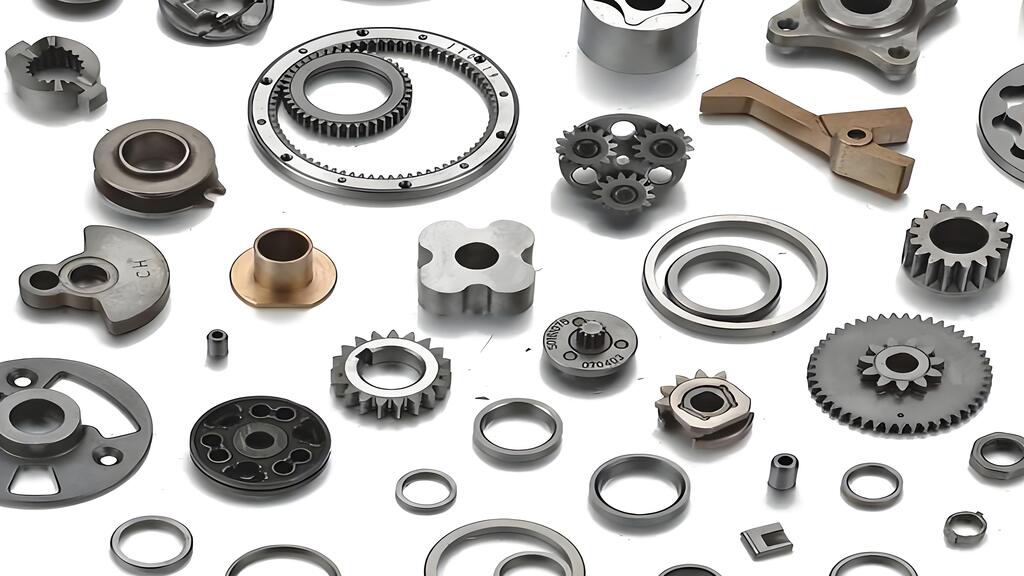


How Powder Metallurgy Improves Aerospace Component Performance
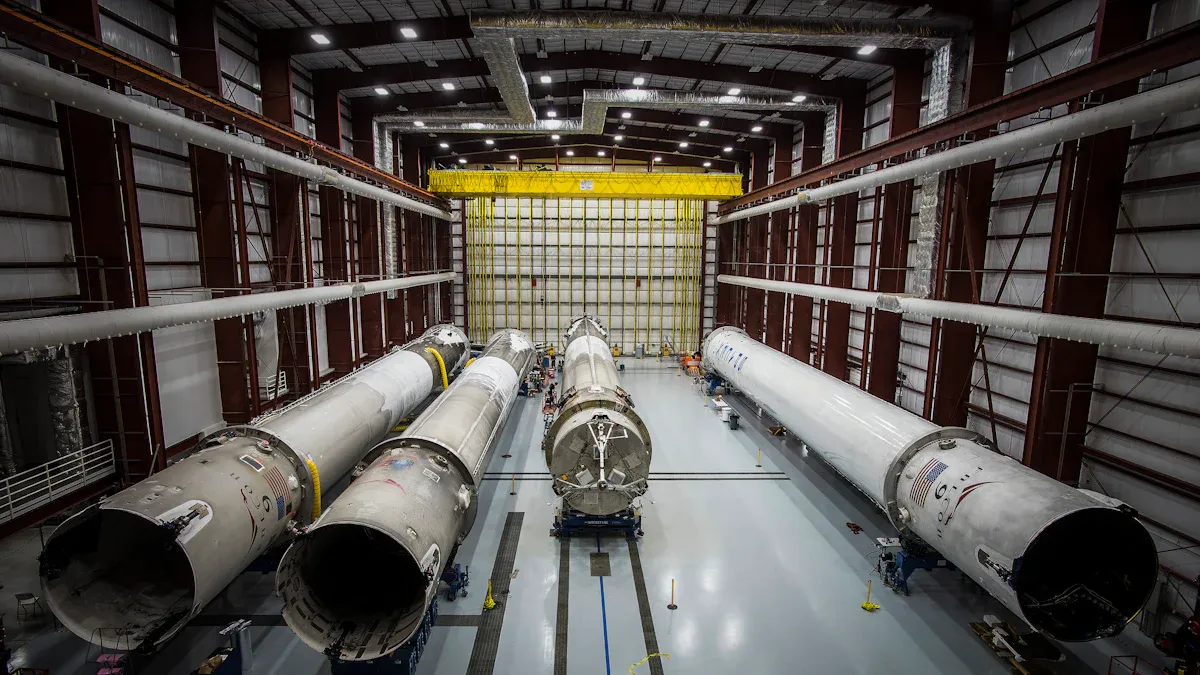
Powder Metallurgy significantly enhances aerospace component performance, reliability, and cost-effectiveness. This advanced manufacturing process offers distinct advantages over traditional methods. It minimizes material waste, achieving utilization rates over 95% by reusing unused powder. Powder Metallurgy also creates complex shapes with internal features and thin walls in a single operation. This capability allows for tailored components with superior properties like high strength-to-weight ratios and excellent fatigue resistance, crucial for demanding aerospace applications.
Key Takeaways
- Powder Metallurgy makes aerospace parts stronger and lighter. This helps planes and spacecraft fly better.
- This method creates parts that last longer. They can handle many flights without breaking.
- Powder Metallurgy parts work well in very hot places. This is important for airplane engines.
- Engineers can make complex shapes with this method. This allows for better designs and fewer parts.
- The process wastes less material. This saves money and is better for the environment.
- Powder Metallurgy is used for many parts. These include engine parts, landing gear, and satellite pieces.
- This method is better than old ways of making parts. It makes parts stronger and saves costs.
Superior Material Properties from Powder Metallurgy
Powder Metallurgy significantly enhances the material properties of aerospace components. This process creates parts with superior characteristics crucial for demanding aviation and space applications.
Enhanced Strength-to-Weight Ratios
Aerospace components require materials that are both strong and lightweight. This manufacturing method excels in producing materials with exceptional strength-to-weight ratios. This capability directly translates into more efficient and higher-performing aircraft and spacecraft.
Reducing Component Mass
This manufacturing technique enables the creation of lighter components without compromising structural integrity. For instance, specific alloys produced through this method offer superior strength-to-weight ratios compared to conventionally manufactured aerospace materials.
- Aluminum-Based Alloys (Al, Al-Si, Al-Cu): These alloys feature low density and high strength-to-weight ratios, along with good corrosion resistance. They find application in aerospace and automotive lightweight components, reducing overall component weight while maintaining strength. This makes them ideal for energy-efficient designs.
- Titanium-Based Alloys (Ti, Ti-Al, Ti-Ni): These alloys provide high strength-to-weight ratios and excellent corrosion and oxidation resistance. Aerospace structural components utilize these materials, which offer exceptional strength with reduced weight, suitable for specialized, high-value applications. Scientists at Sandia National Laboratories developed a new metal superalloy, composed of 42% aluminum, 25% titanium, 13% niobium, 8% zirconium, 8% molybdenum, and 4% tantalum. This alloy demonstrates a high strength-to-weight ratio and superior strength compared to conventional aerospace materials. It exhibited a maximum hardness more than 300% greater than Inconel 718, a nickel-based superalloy common in aviation. Its unique hardness-based high strength-to-weight ratio, showing only minor softening even at 800 °C, presents significant opportunities for weight and energy savings in critical engineering applications like turbomachinery.
Increasing Payload Capacity
Reducing component mass directly increases an aircraft's or spacecraft's payload capacity. Lighter structures allow for more fuel, cargo, or specialized equiPment, enhancing mission capabilities and operational efficiency.
Improved Fatigue Resistance
Aerospace components endure repeated stress cycles during flight, making fatigue resistance a critical material property. Materials with high fatigue resistance prevent crack initiation and propagation, ensuring long-term reliability.
Extending Component Lifespan
Processing via powder metallurgy significantly enhances the fatigue resistance of aerospace components, thereby extending their operational lifespan. This process, combined with hot extrusion and T39 heat treatment, achieves grain refinement in Al-Cu-Mg alloys, resulting in average grain sizes of approximately 3.5 µm in both extrusion and transverse directions. The process also leads to the formation of nanoscale Al2Cu and Al2CuMg precipitates (around 5 nm) within and between grains, along with MgAl2O4 and Al2O3 particles at sub-grain boundaries. These microstructural features, including grain refinement, precipitation, and dispersion strengthening, collectively improve mechanical performance and fatigue resistance by suppressing crack propagation. The T39 heat treatment, a crucial step in this processing method, synergistically enhances the strength and fatigue resistance of PM Al-Cu-Mg alloys through multiple mechanisms. These include precipitation strengthening, solution strengthening, and deformation strengthening. High-density dislocation regions, observed in TEM micrographs, contribute to work hardening during cold rolling, further improving the material's resistance to fatigue.
Boosting Operational Safety
Extended component lifespans directly contribute to boosting operational safety. Components that resist fatigue failures reduce the risk of catastrophic structural failures, ensuring safer flights and missions.
High-Temperature Performance of Powder Metallurgy Components
Aerospace engines and other critical systems operate under extreme temperatures. Materials must maintain their structural integrity and mechanical properties in these harsh environments.
Stability in Extreme Environments
Components produced through powder metallurgy exhibit remarkable stability in extremely high-temperature environments. This makes them indispensable for parts exposed to intense heat. Ultra-high-temperature sintering in this manufacturing technique is an advanced processing technique for structural applications demanding exceptionally high performance from material systems. This advancement improves properties like tensile strength, bending fatigue strength, and impact energy, indicating the potential for components to withstand more extreme conditions. Advanced high-temperature titanium alloys, such as Ti-1100 and IMI-834, are developed for service up to 595°C in aerospace engine applications. Titanium alloys can replace aluminum when operating temperatures exceed approximately 130°C, the typical maximum for conventional aluminum.
Suitability for Engine Parts
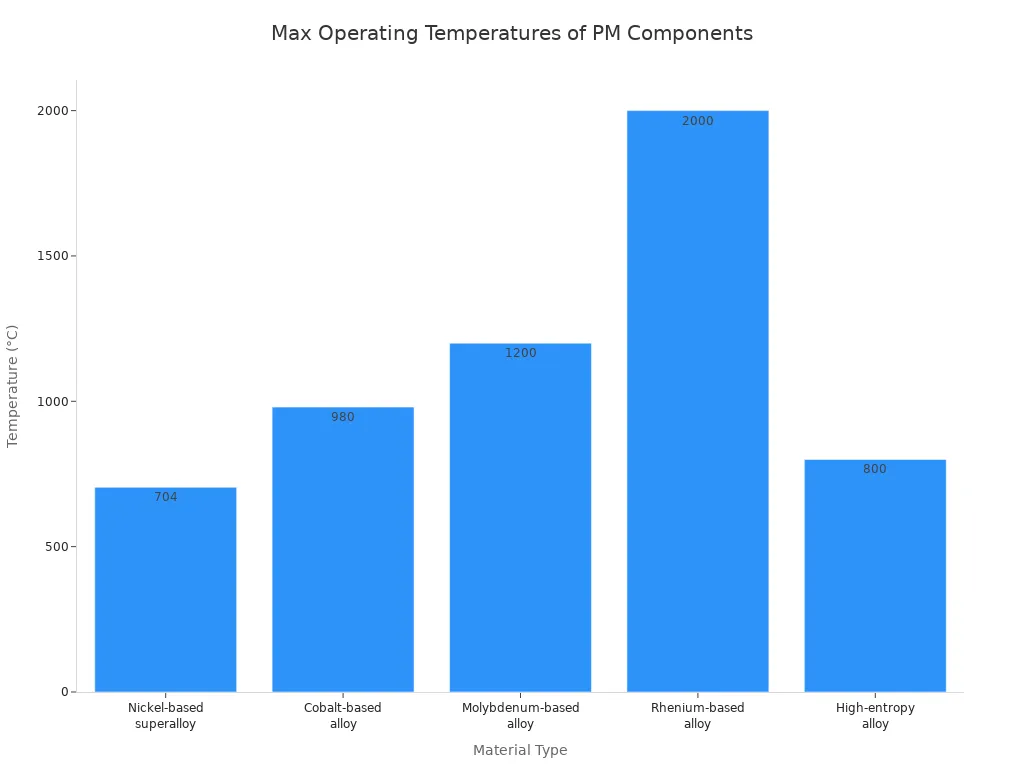
The high-temperature capabilities of materials produced by this method make them highly suitable for aerospace engine parts, including turbine blades, discs, and nozzles. Here is a look at the maximum operating temperatures for various powder metallurgy material types in aerospace engine applications:
| Material Type | Maximum Usage Temperature (°C) | Application Fields |
|---|---|---|
| Nickel-based superalloy (e.g., Inconel 718) | 704 | Aerospace engine turbine disks |
| Cobalt-based alloy (e.g., HA-31) | 980 | Gas turbine blades |
| Molybdenum-based alloy (e.g., TZM alloy) | 1,200 | High-temperature structural parts |
| Rhenium-based alloy (e.g., Ir-10Re) | 2,000 | Aerospace propulsion system nozzles |
| High-entropy alloy (e.g., AlCoCrFeNi system) | 800 | Advanced structural applications |
Specific high-temperature alloys are commonly used in this manufacturing process for aerospace components:
- GH3625 (Inconel 625)
- GH4169 (Inconel 718)
- GH3536
- GH3230
- GH5188
GH3230 powder is an age-hardenable nickel-iron base alloy, reinforced with W-Mo, containing 30% chromium, molybdenum, and aluminum. It is designed for environments between 700-1000°C, offering high strength, hardness, corrosion resistance, oxidation resistance, and good fatigue properties, making it suitable for aerospace components. GH3536 alloy powder is a nickel-based superalloy for additive manufacturing, providing high strength and corrosion resistance at elevated temperatures. Its advanced nature allows for complex geometries in aerospace applications using laser or electron beam-based metal 3D printing. GH3625 powder, also known as Inconel 625, is a Mo-Nb reinforced nickel-based high-temperature alloy, commonly used in this manufacturing method for aerospace components due to its robust properties. GH4169 powder (Inconel 718) is a precipitation hardening stainless steel powder, reinforced with Nb-Mo, designed for high strength, hardness, and corrosion resistance after heat treatment. It contains chromium, nickel, aluminum, titanium, and niobium, suitable for aerospace applications with a normal working environment of 253-650°C, and short-term use up to 800°C. GH5188 is a W-strengthened diamond-based high-temperature alloy, exhibiting good mechanical properties and excellent high-temperature oxidation resistance. It is ideal for aviation parts requiring tensile strength below 980°C and oxidation resistance below 1100°C.
Design Flexibility with Powder Metallurgy
Powder Metallurgy offers significant design flexibility. This manufacturing method allows engineers to create complex components that traditional processes find difficult or impossible to produce. This capability opens new possibilities for aerospace part design and functionality.
Creating Complex Geometries
Powder Metallurgy excels at forming intricate shapes. Modern technologies like Metal Injection Molding (MIM) and precision sintering produce complex geometries with tight tolerances. These advancements allow for the consolidation of multiple components into a single part. This reduces assembly time, improves part performance, and lowers costs. MIM specifically combines plastic injection molding techniques with Powder Metallurgy. It produces high-volume parts with unique, complex geometries, narrow tolerances, strong consistency, and high precision. This process offers considerable freedom in material choice and enables a high degree of design customization.
Enabling Integrated Functionality
Creating complex geometries enables integrated functionality. Manufacturers can design single components that perform multiple roles. For example, they can produce gears with complex tooth profiles or bearings with precise oil channels directly. This integration simplifies designs and often leads to more robust parts.
Reducing Assembly Steps
Integrated functionality directly reduces assembly steps. When one part replaces several, manufacturers need fewer individual components to join together. This streamlines the production process, saving time and labor costs. It also minimizes potential points of failure associated with multiple connections.
Near-Net-Shape Manufacturing via Powder Metallurgy
Near-net-shape manufacturing is a core benefit of Powder Metallurgy. This technique produces components very close to their final dimensions. It significantly reduces the need for extensive post-processing. The aerospace and defense industries leverage this capability to minimize material waste.
Minimizing Machining Needs
Near-net-shape manufacturing greatly minimizes machining needs. This process creates complex geometries and allows for greater variation in wall thickness. This is particularly beneficial for aerospace parts. For critical jet engine compressor cases, near-net-shaped centrifugals can reduce machining by as much as 80% compared to traditional forgings. This method casts much of the required shaping directly into the part. It significantly decreases the amount of material that needs to be machined away. This saves machining time and avoids the cost of adding and then removing expensive exotic alloy materials.
Optimizing Material Usage
Near-net-shape manufacturing optimizes material usage. It produces parts that closely resemble the final product. This reduces the need for extensive material removal. This technique minimizes material waste by producing components that are already close to their final shape.
| Manufacturing Method | Material Utilization Rate |
|---|---|
| Advanced Powder Bed Fusion Systems | 95-98% |
| Traditional Subtractive Manufacturing | 60-70% |
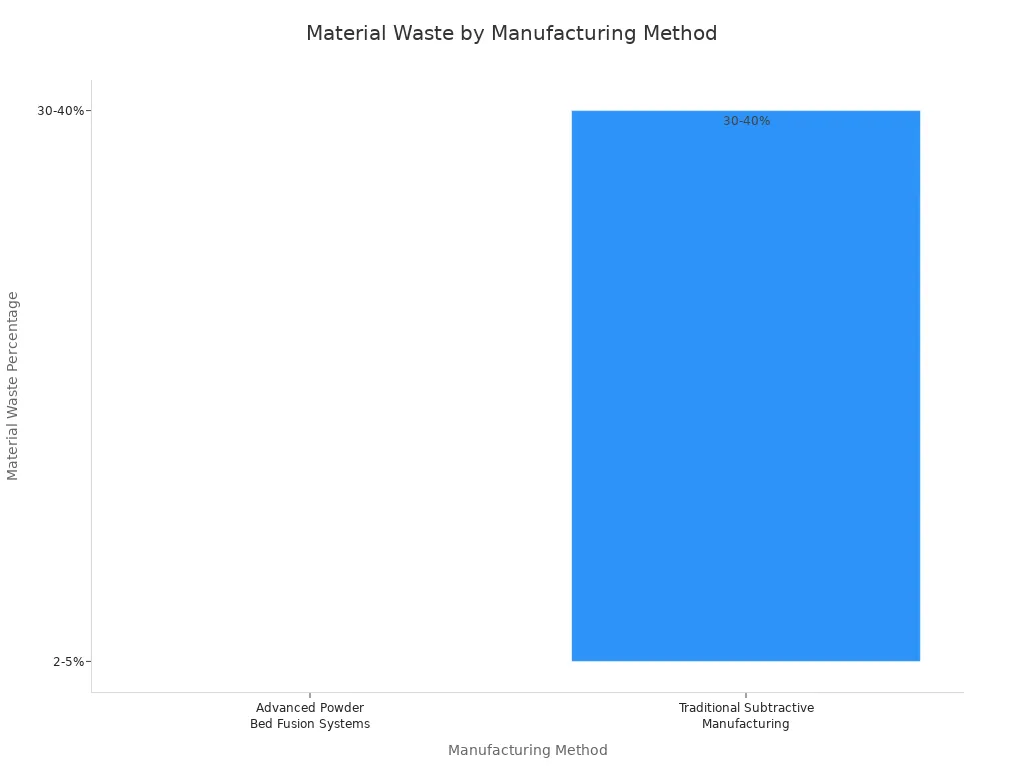
Advanced Powder Bed Fusion Systems, a form of Powder Metallurgy, achieve material utilization rates of 95-98%. In contrast, traditional subtractive manufacturing methods typically utilize only 60-70% of the material. This efficiency leads to significant cost savings and environmental benefits.
Cost-Effectiveness and Sustainability of Powder Metallurgy
Powder Metallurgy offers significant cost-effectiveness and sustainability benefits for aerospace manufacturing. This process optimizes material use and streamlines production, leading to economic and environmental advantages.
Reduced Material Waste
This manufacturing method inherently reduces material waste. It achieves high material utilization rates, which directly translates into cost savings and a smaller environmental footprint.
Efficient Powder Utilization
Manufacturers efficiently utilize powder in Powder Metallurgy processes. The method forms parts close to their final shape, minimizing the need for extensive material removal. Any unused powder from the process often undergoes recycling, further enhancing material efficiency. This closed-loop system ensures that very little raw material goes to waste.
Lower Scrap Rates
Powder Metallurgy significantly reduces scrap rates compared to conventional methods. The process forms parts close to their final shape, minimizing the need for extensive machining or finishing. This approach uses nearly all the raw material. Any unused powder or scrap can be recycled, further enhancing material efficiency and lowering environmental impact. Traditional machining, in contrast, often generates substantial material waste.
| Benefit | Powder Metallurgy | Traditional Machining |
|---|---|---|
| Material Utilization | Up to 97% | 60–70% |
| Scrap Generation | Minimal | High |
This table clearly illustrates the superior material utilization of Powder Metallurgy. It directly contributes to lower production costs and a more sustainable manufacturing process.
Streamlined Production Processes
Powder Metallurgy streamlines production processes. It reduces the number of manufacturing steps and lowers energy consumption, making it an efficient and environmentally friendly choice.
Fewer Manufacturing Steps
This method often consolidates multiple manufacturing steps into one. For example, it can produce complex components with integrated features in a single pressing and sintering operation. This eliminates the need for separate machining, welding, or assembly steps. Fewer steps simplify the production chain, reduce lead times, and lower labor costs.
Lower Energy Consumption
Streamlined production processes directly lead to lower energy consumption. Fewer manufacturing steps mean less energy expended on machinery operation, heating, and cooling. Near-net-shape manufacturing also reduces the energy required for extensive machining. This makes Powder Metallurgy a more energy-efficient alternative to traditional manufacturing techniques, contributing to overall sustainability goals in the aerospace industry.
Key Aerospace Applications of Powder Metallurgy
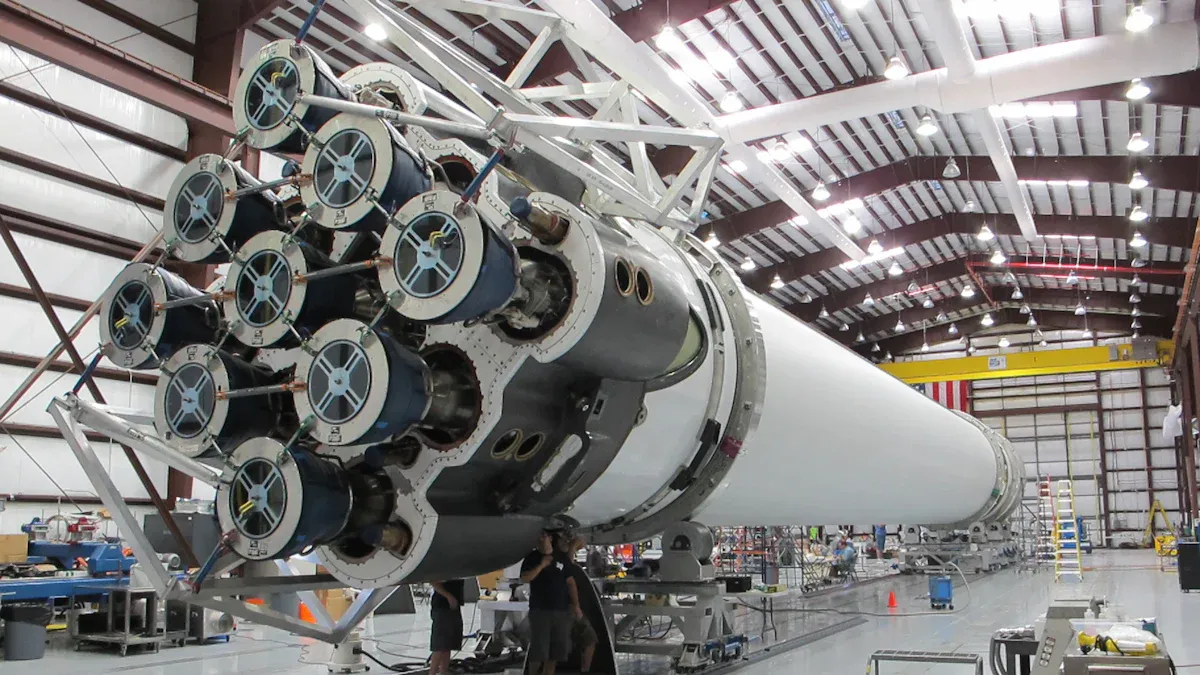
Aerospace manufacturers widely apply advanced manufacturing techniques to produce critical components. This method offers unique advantages for various parts across aircraft and spacecraft.
Engine Components
This manufacturing process plays a vital role in creating high-performance engine components. These parts operate under extreme conditions, demanding superior material properties.
Turbine Blades and Discs
Manufacturers use this process for aircraft engine components. This includes critical parts like turbine blades and rocket engine components. The process ensures these parts withstand high temperatures and immense stress.
Nozzles and Vanes
Engine nozzles and vanes also benefit from this advanced manufacturing. The method allows for complex internal geometries and precise material composition. This optimizes airflow and combustion efficiency within the engine.
Structural Parts
This manufacturing method also contributes significantly to aerospace structural parts. It provides lightweight yet robust solutions for various airframe elements.
Landing Gear Components
Landing gear components require exceptional strength and toughness. Manufacturers use materials like maraging steel and titanium alloys for these parts.
| Material | Key Properties | Application |
|---|---|---|
| Maraging Steel | High strength, good toughness | Landing gear |
| Titanium Alloys | High strength, good toughness, lightweight | Landing gear |
This manufacturing method offers enhanced design flexibility, allowing intricate and complex designs. These designs optimize components for performance and weight. Components exhibit improved mechanical strength, thermal resistance, and corrosion resistance, crucial for demanding aerospace environments. This process provides lightweight yet strong components, addressing the industry's need to reduce weight without compromising strength.
Tip: Powder metal gears are crucial for creating lightweight, high-strength components in aircraft engines and landing gear systems. The precise manufacturing results in excellent wear resistance, vital for extreme conditions. Reducing aircraft weight through these components directly improves fuel efficiency. Customizable material properties ensure performance under high stress, making them a top choice for aerospace applications.
Airframe Brackets
Airframe brackets benefit from the ability to create complex shapes with optimized material distribution. This reduces overall aircraft weight while maintaining structural integrity.
Specialized Systems
This manufacturing method extends its utility to highly specialized aerospace systems. It provides solutions for intricate and precise components.
Hydraulic System Parts
Metal Injection Molding (MIM) is a technique used for fittings and hydraulic system parts. It creates complex shapes with high precision. Spherical aluminum alloy powders are also utilized for conformal fluid channels in hydraulic systems. These channels improve fluid flow and system efficiency.
Satellite Components
MIM is applied to complex satellite components. It also finds use in missile guidance systems and electric propulsion systems. Spherical aluminum alloy powders are utilized in additive manufacturing for satellite components. These applications demand high precision, lightweight construction, and reliable performance in harsh space environments.
Powder Metallurgy Versus Traditional Manufacturing Methods
Aerospace manufacturing constantly seeks methods to improve component quality and efficiency. Powder Metallurgy offers distinct advantages over traditional manufacturing techniques like forging, casting, and machining. These benefits lead to superior parts and more cost-effective production.
Advantages Over Forging and Casting
Forging and casting are long-standing methods for creating metal parts. However, Powder Metallurgy often surpasses them in critical areas, especially for aerospace applications.
Finer Grain Structure
Powder Metallurgy processes typically produce components with a much finer and more uniform grain structure than forged or cast parts. The rapid solidification of individual powder particles during processing prevents large grain growth. This fine grain structure enhances mechanical properties such as strength, toughness, and fatigue resistance. These improvements are crucial for aerospace components that endure extreme stresses and temperatures. Forged parts can have directional grain flow, which may lead to anisotropic properties, while cast parts often exhibit larger, less uniform grains.
Superior Porosity Control
Controlling porosity is vital for aerospace components. Powder Metallurgy offers superior control over the density and porosity of the final product. Manufacturers can achieve near-full density through techniques like hot isostatic pressing (HIP), eliminating internal voids that could compromise structural integrity. Conversely, they can intentionally create controlled porosity for specific applications, such as filters or self-lubricating bearings. Casting, by nature, often introduces various forms of porosity, like gas pores or shrinkage cavities, which can be difficult to eliminate entirely and can weaken the part.
Benefits Over Machining
Machining involves removing material from a larger block to achieve the desired shape. While precise, this method can be wasteful and time-consuming, especially for complex aerospace parts. Powder Metallurgy provides significant benefits in these areas.
Less Material Removal
Powder Metallurgy inherently involves less material removal compared to traditional machining. The process forms parts very close to their final dimensions, a concept known as near-net-shape manufacturing. This significantly reduces the need for extensive post-processing machining, saving both time and cost. Manufacturers fabricate parts close to final dimensions, which minimizes the amount of material they must remove. This contrasts sharply with machining, where a substantial portion of the raw material often becomes scrap.
Cost Savings for Complex Parts
Powder Metallurgy offers substantial cost savings, particularly for complex aerospace parts. It enables the creation of intricate designs and complex geometries that are difficult or impossible to achieve with traditional machining. This method minimizes material waste because excess powder can be reused. Complex parts can be formed without extensive machining, directly leading to cost reductions.
Furthermore, Powder Metallurgy allows for the creation of unique alloys through powder blending. These alloys cannot be duplicated in a molten state, especially beneficial for materials with different melting points. This capability extends to special alloys, such as nickel or cobalt superalloys for airplane engines, which are difficult or impossible to replicate with other manufacturing methods. The precision of Powder Metallurgy also enables manufacturers to control the microstructure of each part, ensuring optimal performance within specific temperature ranges. This process facilitates the repeatable production of intricate, lightweight components with precise mass production, reducing material waste and machining. It produces net-shape components with strict tolerances, further reducing the need for additional machining. The sintering process in Powder Metallurgy enhances the strength and durability of components, making them ideal for high-stress aerospace applications. This method is crucial for producing lightweight yet durable parts, which are essential for performance and safety in aerospace.
Future Trends in Aerospace Powder Metallurgy
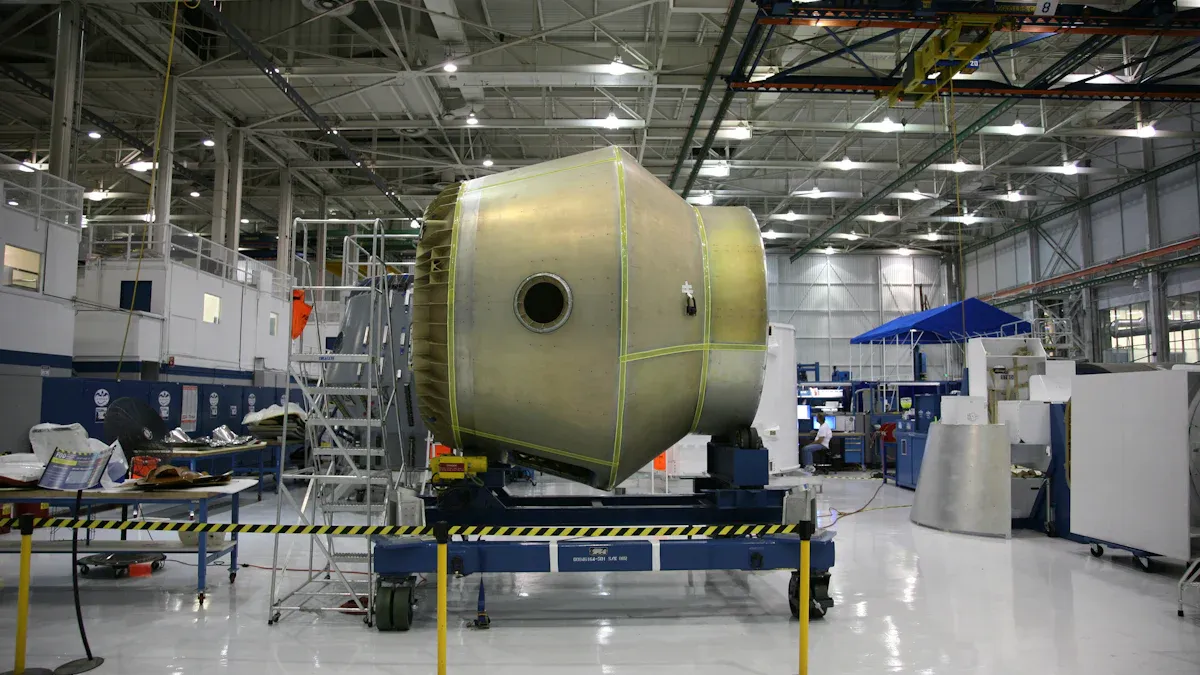
The aerospace industry constantly seeks innovation. It aims to push boundaries in performance, efficiency, and sustainability. Future trends in this manufacturing sector focus on advanced materials and integrated production methods. These advancements promise to revolutionize component design and manufacturing.
Advanced Powder Alloys
The development of new alloys is crucial for next-generation aerospace components. These materials offer superior properties for demanding applications.
Development of New Superalloys
Researchers are developing new superalloys for extreme operational requirements. Titanium aluminide (TiAl) is a standard for jet engine blades, offering reduced weight and high-temperature resistance. Additive manufacturing enhances nickel-based superalloys, improving engine manufacturing efficiency. Scientists also test magnesium-lithium alloys for aerospace. These alloys are among the lightest metallic materials, further reducing component weight. Techniques like directed energy deposition (DED) and powder bed fusion (PBF) are used for high-precision fabrication.
Enhanced Ceramic Matrix Composites
Ceramic matrix composites (CMCs) also see significant enhancements. These materials offer exceptional high-temperature stability and lightweight characteristics. They are ideal for hot sections of engines. Advances in powder processing improve their strength and durability, making them suitable for even more extreme environments.
Additive Manufacturing Integration with Powder Metallurgy
The integration of additive manufacturing (AM) with traditional powder-based processes creates powerful new capabilities. This combination offers unprecedented design freedom and efficiency.
Hybrid Manufacturing Approaches
Hybrid manufacturing approaches combine different techniques' strengths. AM can be used for rapid prototyping before mass production, allowing quick design iterations. AM also produces complex tooling for traditional processes. Techniques like Hot Isostatic Pressing (HIP) densify AM parts, improving mechanical properties. Binder Jetting, a type of AM, uses powder-based sintering for densification. These hybrid methods optimize production workflows and material performance.
Customized Component Production
Customized component production is a major benefit of AM integration. DED allows for complex geometries, including lattice structures or internal channels. These designs create lightweight, intricate parts, optimizing fuel efficiency in aerospace. DED also enables multi-material parts. Different metals are deposited in various regions. This optimizes performance against extreme conditions like high temperatures, stress, and corrosion. Metal AM allows for complex geometries, reducing aircraft component weight. It improves fuel efficiency and overall performance. This method offers design flexibility and customization. It allows for intricate designs and the consolidation of multiple parts into a single component. This reduces material waste and labor costs.
Powder Metallurgy stands as a critical technology for advancing aerospace component performance. It offers unique advantages in material properties, design flexibility, and cost-effectiveness. This process creates materials with high strength-to-weight ratios and excellent fatigue resistance, crucial for aerospace components. It also enables complex geometries and tailored properties for wear, corrosion, and high temperatures. Continued innovation in Powder Metallurgy, including advanced alloys and additive manufacturing integration, will drive the future of aerospace engineering. These advancements will lead to lighter, stronger, and more efficient aircraft and spacecraft.
FAQ
What is Powder Metallurgy?
Powder Metallurgy is a manufacturing process. It forms components from metal powders. Manufacturers compact these powders into a desired shape. Then, they heat the shape below its melting point. This process creates strong, precise parts.
How does Powder Metallurgy improve aerospace components?
Powder Metallurgy enhances aerospace components significantly. It creates parts with superior strength-to-weight ratios. It also improves fatigue resistance and high-temperature performance. This leads to lighter, more durable, and safer aircraft parts.
What are the main benefits of Powder Metallurgy for aerospace?
The main benefits include superior material properties, design flexibility, and cost-effectiveness. It allows for complex geometries and near-net-shape manufacturing. This reduces material waste and streamlines production processes.
Which aerospace parts commonly use Powder Metallurgy?
Aerospace engine components, such as turbine blades and nozzles, frequently use Powder Metallurgy. Structural parts like landing gear components and airframe brackets also benefit. Specialized systems, including hydraulic parts and satellite components, also utilize this method.
How does Powder Metallurgy reduce material waste?
Powder Metallurgy minimizes material waste through efficient powder utilization. The process forms parts close to their final dimensions. This significantly reduces the need for extensive machining. Unused powder can often be recycled, further lowering scrap rates.
Is Powder Metallurgy more cost-effective than traditional methods?
Yes, Powder Metallurgy often proves more cost-effective. It reduces material waste and streamlines production. Fewer manufacturing steps and lower energy consumption contribute to overall savings. It is especially beneficial for complex parts.
What future trends are emerging in aerospace Powder Metallurgy?
Future trends include developing advanced powder alloys like new superalloys and enhanced ceramic matrix composites. Integration with additive manufacturing is also growing. This leads to hybrid manufacturing approaches and customized component production. 🚀