

How Sintering Pressure and Temperature Influence Part Density
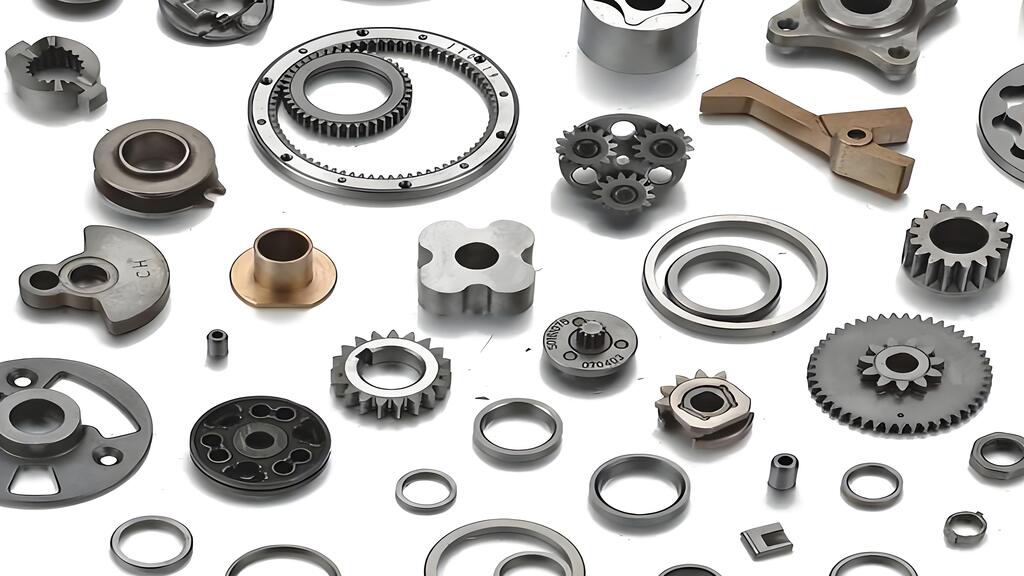
Manufacturers precisely control Sintering pressure and temperature during the production process. These critical parameters directly determine a manufactured part's final density. They significantly influence particle bonding and void reduction within the material. Effective management of these elements ensures the material achieves its optimal properties and structural integrity for diverse applications. Sintering Pressure, alongside temperature, is therefore fundamental to successful material densification.
Key Takeaways
- Sintering changes powder into a solid part. It uses heat and pressure to make parts strong.
- Part density is important. High density makes parts stronger and lasts longer.
- High heat helps atoms move. This makes particles stick together and fills empty spaces.
- Too much heat can harm parts. It can make them bend or break.
- Pressure pushes particles close. This helps fill gaps and makes parts denser.
- Special methods like HIP use pressure. They make very strong parts for planes and medical tools.
- Heat and pressure work together. They help make parts dense and strong.
- Manufacturers must control heat and pressure carefully. This makes sure parts are good and work well.
Understanding Sintering for Optimal Part Density
What is Sintering?
Consolidating Powdered Materials
Sintering is a fundamental processin Powder Metallurgy. It transforms loose powdered materials into a solid, coherent mass. Manufacturers heat the compacted powder to a temperature below its melting point. This heat promotes atomic diffusion between particles. The process effectively consolidates the material without fully liquefying it.
Achieving Material Cohesion
Sintering achieves material cohesion through various mechanisms. Atomic migration, also known as Ostwald ripening, is a primary mechanism. Atoms or molecules migrate over the catalyst surface. This leads to particle growth through collision and coalescence. Van der Waals forces often drive this phenomenon. Direct atom transfers between approaching particles also occur. Another mechanism is the crystallite migration model. Metal crystallites migrate across the catalyst surface. This results in particle growth or new compound formation. Particle mobility and diffusion influence this process. Sintering is highly temperature-dependent. The sintering rate increases exponentially with higher temperatures. The specific nature of the sintering process varies. It depends on the type of heterogeneous catalyst and the temperature applied. For bulk catalysts, sintering is typically a physical phenomenon. Supported metal catalysts involve complex physical and chemical phenomena. Key factors influencing sintering include temperature, metal loading, doping, metal-support interaction, nature of support, precursors, time, type of atmosphere, particle distribution, and particle size.
Why Part Density is Crucial
Impact on Mechanical Properties
Part density directly impacts a material's mechanical properties. Higher density generally correlates with improved strength, hardness, and wear resistance. A dense part has fewer internal voids or pores. These voids can act as stress concentrators. They reduce the material's ability to withstand external forces. Optimal density ensures the part performs reliably under stress.
Influence on Performance and Applications
Part density significantly influences performance across various applications. In the aerospace industry, components demand maximum thermal performance per unit weight and volume. Specialized metals like titanium, tungsten, and Inconel are chosen for their exceptional density. Advanced engineering plastics and composites also offer high density, surface hardness, and heat resistance. These properties are crucial for mission success. Hot Isostatic Pressing (HIP) services are widely used in both aerospace and medical industries. HIP produces defect-free, high-strength components for aerospace. For defense manufacturing, HIP technology creates complex, high-density, and low-porosity parts. In the medical industry, HIP eliminates defects in critical components. This ensures stringent quality standards. HIP also increases the density of Metal Injection Mold (MIM) components after sintering. It removes voids and improves material strength. It transforms metal powders into fully dense, high-performance components. This occurs by consolidating powders through heat and uniform pressure.
The Direct Impact of Sintering Temperature on Part Density
Sintering temperature is a primary factor controlling the densification process. It directly influences the atomic-level activities that transform loose powder into a solid, dense component. Manufacturers carefully select and control this temperature to achieve specific material properties and part densities.
Temperature's Role in Atomic Diffusion
Enhancing Atomic Mobility
Elevated temperatures significantly enhance atomic mobility within powdered materials. Atoms gain more kinetic energy, allowing them to move more freely. This increased movement is crucial for the densification process. The rate of crystal solid-state diffusion increases with temperature because the prevalence of point vacancies in the crystal lattice rises. This occurs in accordance with the Arrhenius equation. In substitutional lattice diffusion, atoms move by exchanging places with other atoms. This process depends on the availability of point vacancies. Diffusing particles migrate by rapidly and randomly jumping from one point vacancy to another. This atomic movement facilitates the rearrangement of particles and the filling of voids.
Promoting Neck Growth Between Particles
Atomic diffusion directly promotes neck growth between adjacent particles. As atoms move, they migrate to the contact points between particles, forming "necks." These necks are the initial bonds that connect individual powder grains. The thermodynamic driving force for sintering, which involves atomic diffusion, is the reduction of interfacial energy. Powder particles possess high surface area and corresponding high surface energy. At elevated temperatures, the system minimizes this energy by reducing surface area through particle bonding and pore elimination. Higher temperatures accelerate this neck growth, leading to stronger bonds and a more continuous material structure. This process effectively reduces the overall porosity of the part.
Temperature and Material Viscosity
Reducing Viscosity for Particle Rearrangement
Temperature also influences the viscosity of the material, particularly in amorphous or semi-crystalline powders. Higher temperatures reduce the material's viscosity. This allows particles to rearrange more easily under the influence of surface tension and external forces. A lower viscosity enables the powder compact to flow slightly, filling in gaps and reducing inter-particle spaces. This fluidity is essential for achieving a tightly packed structure.
Aiding Void Elimination
The reduction in material viscosity, coupled with enhanced atomic diffusion, significantly aids in void elimination. As particles rearrange and necks grow, the pores within the compact shrink. The material flows into these shrinking voids, effectively removing them. This process is critical for achieving high part density. Without sufficient temperature to reduce viscosity and promote flow, many voids would remain, resulting in a less dense and weaker part.
Optimal Temperature Ranges for Densification
Identifying the Ideal Temperature Window
Identifying the ideal temperature window for sintering is crucial for successful densification. This window is typically below the material's melting point but high enough to promote significant atomic diffusion and particle rearrangement. Too low a temperature results in insufficient densification, while excessively high temperatures can lead to undesirable grain growth, melting, or even part distortion. Manufacturers aim for a temperature that maximizes density without compromising the material's integrity or desired microstructure.
Material-Specific Temperature Considerations
Optimal sintering temperatures vary significantly depending on the material category. Different materials possess unique properties that dictate their ideal processing conditions.
| Material Category | Optimal Sintering Temperature Range |
|---|---|
| High-Temperature Ceramics (e.g., Zirconia) | 1,400°C to 1,600°C |
| Powdered Metals (e.g., Steel, Bronze) | 900°C to 1,250°C |
| Low-Temperature Polymers (e.g., SLS 3D Printing) | Below 200°C |
Advanced ceramics can be sintered at extreme temperatures, sometimes reaching up to 3000°C. Conversely, polymers can be sintered at much lower temperatures, typically below 300°C.
Several specific material properties dictate the ideal sintering temperature window:
- Melting Point: Sintering temperature is typically set between 60% and 80% of the material’s melting point. This ensures efficient diffusion without excessive melting. For example, silicon carbide (SiC) has a melting point of around 2700°C, so its sintering occurs between 1600°C and 2200°C.
- Particle Size: Smaller particles have a larger surface area. This promotes quicker diffusion and bonding, allowing for lower sintering temperatures. Larger particles, conversely, require higher temperatures for effective densification due to fewer contact points.
- Material Composition: The chemical composition, including impurities and sintering aids, significantly influences sintering behavior. Sintering aids, such as aluminum oxide or yttria for SiC, can lower the overall sintering temperature by enhancing bond formation. Impurities can also affect temperature requirements.
- Desired Final Properties: The application dictates the required properties, which in turn influence the sintering temperature.
- For wear-resistant components, manufacturers adjust sintering temperatures to balance hardness and toughness. Excessively high temperatures can cause brittleness, while low temperatures lead to insufficient densification.
- For electronic and semiconductor applications, lower sintering temperatures (e.g., 1600°C-1800°C for electronic-grade SiC) maintain electronic properties and prevent thermal degradation.
- For high-temperature applications, higher sintering temperatures (e.g., 2100°C-2200°C for SiC) achieve the necessary strength and density for furnace linings, heat exchangers, or aerospace components.
The sintering atmosphere also plays a crucial role in temperature selection. For example, silicon carbide is often sintered in an inert atmosphere (like nitrogen or argon) or in vacuum conditions. This prevents oxidation and preserves desired material properties, thereby optimizing the sintering temperature and product quality.
Consequences of Suboptimal Sintering Temperature
Manufacturers must carefully control sintering temperature. Deviations from the optimal range lead to significant negative consequences for part density and integrity. Suboptimal temperatures compromise the final product's performance and reliability.
Effects of Insufficient Temperature on Density
Insufficient sintering temperature prevents proper densification. When the temperature remains too low, atoms lack the necessary kinetic energy for effective diffusion. This limits atomic mobility, hindering the formation and growth of necks between particles. Particles cannot rearrange efficiently, leaving significant voids and pores within the compact. The material's viscosity remains too high, further impeding particle flow and void elimination. Consequently, the final part exhibits high porosity and low density. Such parts possess inferior mechanical properties, including reduced strength, hardness, and wear resistance. They also show increased susceptibility to fracture and premature failure in application.
Risks of Excessive Temperature on Part Integrity
Excessive sintering temperatures pose severe risks to part integrity. While higher temperatures initially accelerate particle bonding, exceeding the optimal window initiates destructive processes. These processes compromise structural integrity and lead to irreversible damage. The material's microstructure, mechanical strength, and aesthetic properties degrade fundamentally. Instead of strengthening, over-sintering breaks down the part.
Excessive energy input triggers harmful mechanisms that damage the material. Specific failures vary by material type. However, they generally include softening, which leads to warping or sagging and a loss of dimensional accuracy. Uncontrolled grain growth also occurs, resulting in a weaker, coarse-grain structure.
Consider the various consequences of excessive sintering temperatures:
| Consequence | Effect on the Part | Common in Materials |
|---|---|---|
| Warping & Sagging | Loss of dimensional accuracy and shape | Metals, Ceramics |
| Uncontrolled Grain Growth | Weaker, coarse microstructure; reduced strength | Metals, Technical Ceramics |
| Phase Transformations | Loss of chemical/structural stability | Zirconia |
| Reduced Translucency | Opaque, chalky appearance | Dental Zirconia |
| Molecular Decomposition | Drastic loss of strength & chemical resistance | Polymers (PTFE, PEEK) |
For materials like zirconia, high temperatures can trigger unwanted phase transformations. These transformations reduce chemical and structural stability, often leading to cracking. The formation of large grains and the elimination of specific pore structures can also reduce translucency, giving parts an opaque, chalky appearance. In polymers such as PTFE, excessive heat causes chain scission. This breaks molecular chains, leading to a drastic loss of strength, toughness, and chemical resistance due to fundamental decomposition.
Higher sintering temperatures facilitate easier diffusion of charged carriers. This leads to larger grain sizes and promotes abnormal grain growth. This acceleration of carrier migration and grain growth initially helps acquire a dense microstructure and increases breakdown field strength. However, when the sintering temperature becomes excessively high, abnormal grain growth intensifies. This accompanies excessive sublimation of elements like Bi, Sb, and Li. The result includes overly large grain sizes and a reduction in grain boundary density. Ultimately, this diminishes the mechanical performance and breakdown field strength of ceramics.
The Direct Impact of Sintering Pressure on Part Density
Sintering pressure plays a crucial role in achieving high part density. It directly influences how powder particles pack together and bond. Manufacturers apply external pressure to enhance densification, complementing the effects of temperature. This mechanical force helps overcome inherent material resistances, leading to a more compact and robust final product.
Sintering Pressure's Role in Particle Packing
Forcing Particles Closer Together
Applied external mechanical pressure significantly enhances densification. It promotes particle rearrangement and pushes particles closer together. This closer packing leads to better contact between particles. Better contact, in turn, promotes mass transport at lower temperatures during the early stages of sintering. External pressure also increases the chemical potential at particle contact surfaces, such as necks or grain boundaries. It supplements the natural sintering stress that arises from decreasing surface energy.
Reducing Porosity and Voids
Sintering pressure actively reduces porosity and voids within the powder compact. The densification process occurs in distinct stages under pressure:
- Initial Stage (Particle Rearrangement): Density increases as individual powder particles rearrange. This action eliminates spaces, bridges, and gaps, leading to more efficient packing. This stage offers lower resistance. Density rapidly increases with applied pressure, establishing contact points between particles.
- Second Stage (Plastic Deformation): Compression continues, increasing forces at contact points. This causes stress, leading to plastic deformation of particles. This deformation increases contact areas, promotes interlocking and plastic flow, decreases volume, and further raises density.
Sintering Pressure-Assisted Techniques
Manufacturers employ specialized techniques that leverage sintering pressure to achieve superior part densities. These methods are particularly effective for demanding applications.
Hot Isostatic Pressing (HIP) for High Density
Hot Isostatic Pressing (HIP) is a powerful technique that applies high isostatic pressure and elevated temperatures simultaneously. This process produces non-porous components with enhanced mechanical properties and reliability. HIP typically operates within a pressure range of 70–400 MPa. It is particularly effective for products demanding high reliability, such as ceramic hip implants, ball bearings, and demanding ceramic wear parts. HIP also eliminates internal defects like shrink holes in metallic alloys. These include Ti-alloys for aircraft components and medical devices, Al-alloys, Ni-base superalloys for jet engine turbine blades, and 17–4PH stainless steel. Furthermore, HIP technology is increasingly vital for post-compacting additively manufactured metallic components. It reduces porosity and achieves desired properties and reliability, especially for titanium and other superalloys.
HIP is effectively used for densification in various applications:
- Casting Densification (e.g., nickel-based superalloy and titanium castings for aircraft engines, cobalt chrome, titanium, and stainless steel implants, industrial casings, machine tools, pump impellers, turbine blades in power generation).
- Metal Powder Densification.
- MIM Part Densification.
- 3D Printed (AM) Part Densification.
- Densification of MMCs & Ceramics.
Common materials processed with HIP and their typical pressures include:
| Material | Pressure/MPa |
|---|---|
| Aluminum alloy | 100 |
| Copper alloy | 100 |
| Stainless steel | 100 |
| Nickel 718 | 100 |
| Ti-6Al-4V | 100 |
| WC-Co | 100 |
| Tungsten | 100 |
| Beryllium | 100 |
| Molybdenum | 100 |
| Pure Iron | 100 |
| Pure Nickel | 100–140 |
Spark Plasma Sintering (SPS) for Rapid Densification
Spark Plasma Sintering (SPS) is another advanced technique that utilizes sintering pressure for rapid densification. SPS offers significant advantages over conventional sintering methods. It allows for a reduction in sintering temperature by 100-300°C. This lower temperature benefits materials prone to decomposition at higher temperatures.
SPS achieves rapid densification through several key features:
- Lower Sintering Temperature: SPS operates 400–500°C lower than traditional solid-phase sintering and 100–200°C lower than hot pressing.
- Fast Heating Rate: It achieves tens to hundreds of degrees Celsius per minute, significantly reducing thermal cycles.
- Short Sintering Time: SPS completes sintering in just 5–10 minutes, compared to several hours for conventional methods.
- High Sintering Pressure: It applies pressure from tens of MPa up to 1 GPa, facilitating densification of hard-to-sinter materials.
- Internal Heating Mechanism: SPS generates heat internally by passing pulsed DC current through the material and/or surroundings. This leads to faster heating, quicker densification, and lower sintering temperatures.
The speed of SPS is evident when comparing it to conventional methods:
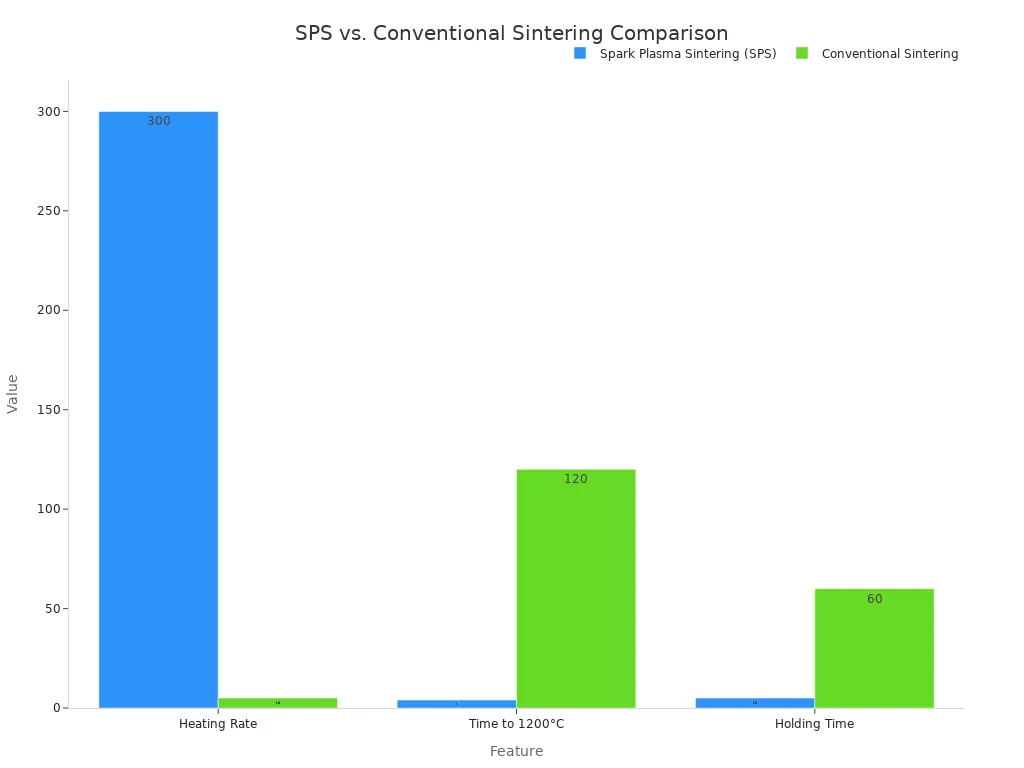
| Feature | Spark Plasma Sintering (SPS) | Conventional Sintering |
|---|---|---|
| Heating Rate | >300°C/min | 5-10°C/min |
| Time to 1200°C | 4 minutes | 2-4 hours or more |
| Holding Time | 5-10 minutes | Hours |
Overcoming Inter-Particle Friction with Sintering Pressure
Facilitating Efficient Particle Rearrangement
Sintering pressure plays a vital role in overcoming inter-particle friction. This friction can hinder efficient particle rearrangement. In hot pressing, the simultaneous application of heat and pressure reduces friction resistance between particles. This promotes denser packing. The uniaxial pressure provides an additional driving force. It accelerates particle rearrangement in the initial sintering stage. This pressure also generates radial stresses. These stresses accelerate interparticle shear, leading to particle rearrangement and the collapse of large pores. This acceleration in the initial stage is attributed to the creation of more particle contacts.
Enhancing Densification Efficiency
External pressure enhances densification efficiency by facilitating particle movement and bonding. During heating, radial compressional stress occurs due to differing thermal expansion coefficients. This leads to particle rearrangement to accommodate the effective pressure. This additional pressure enhances sintering activity and diffusion rates. It results in greater rolling and rotation angles of particles. This effect reflects in an increased average coordination number, indicating more new contacts between particles. External pressure further accelerates this process. It overcomes resistance between contacting particles and facilitates grain boundary sliding.
Optimal Sintering Pressure Levels
Manufacturers must carefully select and apply sintering pressure to achieve the desired part density and mechanical properties. Finding the optimal pressure range ensures maximum densification without compromising the part's integrity. This balance is crucial for producing high-quality components.
Balancing Pressure for Maximum Density
Achieving maximum density requires a precise balance of applied pressure. Too little pressure results in insufficient particle packing and residual porosity. Conversely, excessive pressure can lead to other detrimental effects. Engineers determine optimal pressure levels through extensive research and empirical testing, considering the specific material properties and desired final application. For instance, various powder types require specific pressure ranges to achieve their highest density:
| Powder | Sintering pressure (MPa) |
|---|---|
| AISI 316L | 55–60 |
| AISI 16Mo3 | 55–60 |
| TiO2 | 55–60 |
These examples illustrate that different materials respond best to distinct pressure environments. Manufacturers fine-tune the pressure to compact particles effectively, minimize voids, and promote strong inter-particle bonding. This careful calibration ensures the final product meets stringent density requirements.
Avoiding Cracking or Deformation
While higher pressures generally aid in achieving densification and a uniform microstructure, a critical point exists where pressure becomes detrimental. Excessive pressure during sintering can lead to deformation or cracking, particularly in materials with complex geometries. This occurs because the material cannot withstand the compressive forces, causing structural failure. Engineers must identify this threshold to prevent irreversible damage to the part.
For example, applying too much pressure to a delicate ceramic component can cause it to fracture before full densification occurs. Similarly, metal parts with intricate designs might deform or warp under excessive force, losing their intended shape and dimensional accuracy. Therefore, manufacturers meticulously control the applied pressure. They balance the need for high density with the imperative to maintain the part's structural integrity and geometric precision. This careful approach prevents costly defects and ensures the production of reliable components.
The Synergistic Relationship Between Sintering Pressure and Temperature
Combined Effects on Densification
Achieving Higher Densities Through Synergy
Manufacturers achieve superior part densities by combining sintering pressure and temperature. These two parameters work together, creating a synergistic effect that enhances densification beyond what either can accomplish alone. Applying external pressure during the heating cycle significantly accelerates densification. Pressure aids in particle rearrangement and more effectively collapses pores, often leading to near-full density. This principle is fundamental to processes like Hot Pressing (HP) and Hot Isostatic Pressing (HIP), which leverage pressure to achieve desired material properties. The combined approach ensures a more compact and robust final product.
Pressure-Lowering Required Sintering Temperature
The application of pressure can significantly reduce the temperature required for effective sintering. This allows manufacturers to achieve high densities at lower thermal loads. For instance, in nanometric zirconia, high pressure reduced the required temperature by several hundred degrees compared to traditional low-pressure sintering methods (1300–1500 °C). This capability is particularly beneficial for materials sensitive to high temperatures or when energy efficiency is a concern. It broadens the range of materials suitable for densification.
Trade-offs and Optimization Strategies
Adjusting Parameters for Target Density
Achieving target density in sintering involves a balancing act between temperature and pressure. Higher temperatures promote densification but risk unwanted grain growth. Grain growth can negatively impact mechanical properties like hardness and wear resistance. Conversely, applying external pressure, as in hot pressing, allows for densification at lower temperatures. This effectively mitigates grain growth and enables the processing of heat-sensitive materials. Manufacturers must carefully adjust these parameters to meet specific density requirements without compromising other critical material properties.
Material-Specific Parameter Combinations
The optimal combination of sintering pressure and temperature varies significantly depending on the material. Each material possesses unique characteristics that dictate its ideal processing conditions. The optimal choice depends on the primary focus: maximizing density may require high temperatures, while preserving fine-grain structure for hardness or accommodating heat-sensitive substrates necessitates lower temperatures and potentially pressure-assisted methods. Manufacturers conduct extensive testing to determine the best parameter combinations for each specific material and its intended application. This ensures the final product exhibits the desired performance and structural integrity.
Achieving Desired Part Density: Practical Considerations
Process Control and Monitoring
Precision in Temperature Profiles
Manufacturers must precisely control temperature profiles during sintering. This ensures optimal densification and prevents defects. Industry best practices guide this process.
- Begin with 70% of the material's melting point as a starting temperature.
- Increase the temperature in increments of 25°C.
- Monitor the material's density after each temperature adjustment.
- Track grain size to detect the onset of grain growth.
- Document shrinkage for precise dimensional control.
- Once the optimal temperature is determined, optimize the hold time.
Different industries have specific temperature requirements.
| Industry/Component | Temperature Requirement | Uniformity/Atmosphere |
|---|---|---|
| Medical Implants (CoCrMo) | 1350°C ±10°C | Meets ISO 5832-4 for 700 MPa tensile strength |
| Aerospace Components (Refractory Metals) | Exceeding 1760°C (e.g., tungsten) | ±5°C across furnace zone, vacuum or pure hydrogen atmosphere |
A typical temperature profile involves several stages:
- De-binding stage: Maintain temperatures between 400-600°C to remove organic binders.
- Pre-sintering: Heat to approximately 70% of the final sintering temperature for initial bonding.
- Peak sintering: Reach the optimal temperature for maximum densification.
- Controlled cooling: Implement programmed cooling rates to manage phase transformations.
To prevent cracking, implement a slower heating rate (5-10°C/min) through critical temperature zones. This is especially important during binder removal (400-600°C) and the initial sintering phase. This avoids thermal gradients. To prevent abnormal grain growth, minimize the duration at peak temperature by using rapid heating in non-critical zones. Incorporate grain growth inhibitors such as TiC or VC at concentrations of 0.5-1%. Utilize finer starting powders to increase the number of nucleation sites. Employ a two-stage sintering process with a lower final temperature.
Accurate Sintering Pressure Application
Accurate application of pressure is equally vital. It ensures uniform compaction and consistent part density. Manufacturers use specialized equipment to deliver precise and controlled pressure throughout the sintering cycle. This prevents deformation and achieves the desired final shape.
Influence of Material Properties
Particle Size and Shape Effects
Particle size and shape significantly influence densification. The formation of white, small, round, or irregular bright spots often hinders densification. These spots result from incomplete pore filling, oxide formation, or impurity enrichment. This leads to increased internal porosity and negatively impacts dimensional shrinkage. For instance, in 17-4PH with small and uniformly distributed particles, an increase in these white spots correlated with decreased sintering densification and increased porosity. Similarly, in medium-sized 316L and large-sized 304, the presence of these white spots also led to increased porosity. This impeded effective particle diffusion and exacerbated insufficient pore filling.
Material Composition and Its Response
Material composition, including alloying elements, dictates sintering response. Multicomponent alloys can be designed based on materials science principles. This achieves rapid sintering and controlled microstructure evolution. It leads to improved processability and final properties.
| Alloying Element (0.5 wt%) | Effect on Cu Sintering | Relative Density Increase (vs. pure Cu) |
|---|---|---|
| Cr | Promotes (most significant) | ~5% (to 95%) |
| Ti | Promotes | N/A |
| Al | Promotes | N/A |
| Mo | Impedes | N/A |
| Nb | Impedes | N/A |
| W | Impedes | N/A |
Sintering enhancement by Cr, Ti, and Al is attributed to their higher affinity for oxygen. This leads to the reduction of the oxide layer on Cu powder surfaces, thereby facilitating sintering.
Experimental Optimization for Specific Applications
Empirical Testing for Best Parameters
Manufacturers use empirical testing to optimize sintering parameters for new materials or applications. This involves systematic experimentation.
- They identify laser power, scan spacing, bed temperature, hatch length, and scan count as experimental parameters.
- They utilize Face-centered Central Composite Design as a statistical DoE technique for optimizing laser sintering parameters.
- They develop mathematical models to establish relationships between the identified parameters.
- They confirm model adequacy using Analysis of Variance (ANOVA).
Another approach involves:
- Application of the Design of Experiments (DoE) methodology to evaluate variable influence with minimal tests.
- Implementation of a fractional factorial DoE to systematically assess the impact of precursor concentration, current density, sintering time, and temperature on electrodeposition yield (R) and sintering yield (S).
- A combination of statistical modeling, experimental testing, and optical microscopy is used to derive predictive equations and evaluate coating structural quality.
Customizing for Performance Requirements
Sintering parameters are customized to meet specific performance requirements. These include fatigue resistance or thermal conductivity.
- Sintering parameters like time, temperature, and atmosphere are fine-tuned to meet specific material designations and performance requirements.
- Longer soaking times at peak sintering temperatures enhance particle bonding. This affects strength and dimensional accuracy.
- Uniform temperature during sintering is crucial for developing the proper microstructure. It allows necessary material transformations.
- The furnace atmosphere influences final product quality. It envelops the part, removes mold lubricant and oxides, and prevents oxidation. This ensures clean parts and proper bonding.
- High-temperature sintering (2100-2300ºF or higher) can lead to a 30% increase in tensile strength, 15% increase in bend fatigue strength, and 50% increase in impact toughness. This occurs by accelerating atomic diffusion and homogenizing alloying elements.
Optimizing sintering pressure and temperature is fundamental for achieving desired part density. This directly impacts mechanical performance and application suitability. A balanced approach, considering material specifics and precise process control, is key to successful densification. Manufacturers strategically adjust these parameters. This allows them to tailor parts for specific functional requirements. Jiehuang Chiyang provides comprehensive metal parts solutions, leveraging expertise in powder metallurgy, metal injection molding, and die casting to meet diverse industry needs.
FAQ
What is the primary goal of sintering?
Sintering aims to transform powdered materials into a solid, dense mass. It achieves material cohesion and reduces porosity. This process enhances the final part's mechanical properties and structural integrity.
Why does part density matter for manufactured components?
Part density directly impacts mechanical properties like strength, hardness, and wear resistance. Higher density means fewer internal voids. This allows the part to perform reliably under stress and ensures optimal function in its application.
How does sintering temperature influence atomic movement?
Elevated sintering temperatures increase atomic kinetic energy. This enhances atomic mobility and diffusion. Atoms move more freely, promoting neck growth between particles and facilitating particle rearrangement.
What role does sintering pressure play in particle packing?
Sintering pressure forces particles closer together. This reduces porosity and voids. It also overcomes inter-particle friction, facilitating efficient particle rearrangement and enhancing densification efficiency.
How do temperature and pressure work together in sintering?
Temperature and pressure work synergistically. Pressure can lower the required sintering temperature to achieve high density. This combined approach leads to superior densification and allows for processing temperature-sensitive materials.
What are the risks of using too much sintering temperature?
Excessive sintering temperature can cause several issues. These include warping, sagging, and uncontrolled grain growth. It can also lead to phase transformations, reduced translucency, and molecular decomposition, compromising part integrity.
How do material properties affect optimal sintering parameters?
Material properties like melting point, particle size, and composition significantly influence optimal sintering parameters. Manufacturers adjust temperature and pressure based on these characteristics to achieve desired density and performance for specific applications.