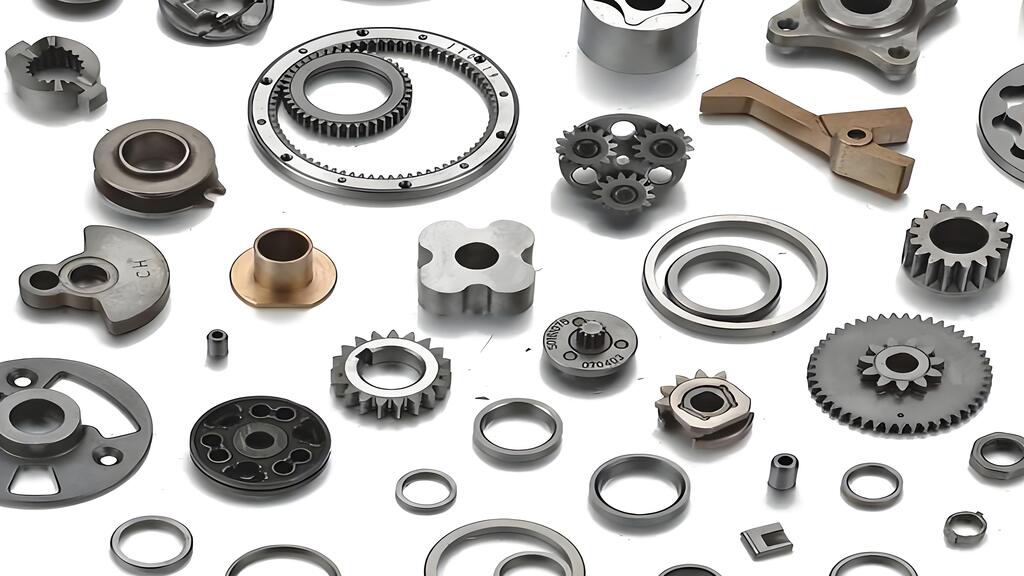


How to Perfect Hardening Compound Applications in Powder Metallurgy Parts

Powder metallurgy (PM) parts need specialized hardening compounds because their porous structure changes heat distribution and material properties. Pm Parts with a density above 90 percent act like wrought products, but their lower thermal diffusivity makes heating time substantially longer. Parts need heat treatment to control their hardness and strength properties.
Material porosity creates unique challenges in selecting and applying surface hardening compounds for Pm Components. These parts absorb about 2-3 percent oil by weight, which affects the case hardening compound instructions. Cherry red and kasenit case hardening compounds provide different advantages. Steam treatments make iron-based components stronger, more wear-resistant, and better looking. Sinter-hardened parts at 6.8 g/cm³ density show an apparent hardness of HRC 25, while their particle hardness reaches HRC 55. Case hardening creates an outer "skin" that measures 0.010-0.015 inch (0.25-0.38 millimeter) deep.
Understanding the Role of Hardening Compounds in PM

Surface hardening compounds are crucial in powder metallurgy (PM). They boost the mechanical properties of sintered parts. These special formulations help solve unique challenges that come with the porous nature of PM components.
Why PM Parts Require Surface Hardening
Heat treatment makes PM parts better by boosting their hardness, tensile strength, and wear resistance. It does this by refining grain structure and changing phase transformations. Most sintered components need harder surfaces to handle abrasive environments. The right heat treatment can push surface hardness to HRC 58-65. This creates parts that are tough and resist wear. On top of that, it makes parts much stronger. Research shows that certain heat treatments can boost tensile strength by 10% and notched fatigue strength by 25%. Parts with a hardened surface and more flexible core can handle heavy loads without breaking.
Difference Between Case and Through Hardening in PM
Case hardening creates a tough outer layer while keeping the core softer and more flexible. This works best with steels that have low carbon content (up to 0.7%). The case depth usually ranges from 0.2 to 2 mm, based on how long you treat it. Through hardening works differently - it makes the entire component equally hard. This makes it perfect when you need consistent mechanical performance throughout the part.
Here's what sets these methods apart:
- Case hardened parts combine a hard surface with a tough core, perfect for parts that face wear and shock
- Through-hardened parts have the same hardness everywhere, great for structural parts that need uniform properties
- Case hardening works with low-carbon steels, while through hardening needs medium to high-carbon steels
Impact of Porosity on Hardening Effectiveness
Porosity changes how well hardening works in PM parts. Parts with low porosity show less material removal and thinner transformed layers. They also have more plastic deformation and dislocation density. Parts with high porosity show more material removal and thicker transformed layers. Pores act as stress points where cracks can start and spread.
Pores reduce thermal conductivity and cooling rates during quenching. PM steels with more than 12% porosity cool faster than wrought steel because water gets through the connected pores. This affects how easily materials can be hardened, which directly changes how well hardening compounds work.
Application Techniques for Hardening Compounds

Powder metallurgy parts need the right application techniques to achieve the best results when using hardening compounds. PM components have a porous nature that demands special attention during hardening to prevent distortion and ensure even hardening throughout.
Pre-Application Cleaning and Surface Prep
The success of surface preparation depends on clean surfaces without contaminants that could disrupt hardening. Secondary operations often leave residual fluids trapped in the pores of PM parts. These fluids can reduce part strength and affect surface quality during heat treatment. You should start with an alkaline cleaning solution and follow up with a rinse that contains strong corrosion inhibitors. Heavily contaminated surfaces might need an extra pickling step to remove carbon smut.
Surface roughening is a vital part of the process. It boosts the surface area and allows hardening elements to diffuse better. All welds need continuous surfaces without flux. They should have smooth, rounded radii and no sharp edges to let compounds penetrate evenly.
Temperature Control During Compound Activation
The hardened layer's depth and diffusion rate depend on the case hardening temperature. While higher temperatures speed up diffusion, they also raise the risk of distortion and grain growth. PM parts need more heating time than their wrought counterparts because their lower thermal diffusivity slows down heat-up.
Careful monitoring of soaking time leads to better results. Longer soaks allow hardening elements to penetrate deeper and create thicker hardened layers. Yet too much soaking time can cause grain coarsening and surface decarburization that hurt final quality.
Post-Application Cooling and Handling
The choice of cooling method becomes vital after proper compound activation. Available options include slow furnace cooling, quenching in various media (water, oil, gases, or polymers), and inert gas cooling. Each method brings specific advantages based on material type and desired results.
PM parts usually soak up 2-3% of their weight in quenchant through surface pores. This absorption means parts need thorough cleaning after cooling. Without proper cleaning, leftover quenchant can release fumes during tempering. Most parts go through tempering after quenching to relieve internal stress and improve toughness.
High-precision components benefit from high-velocity atmosphere quenching - a method similar to vacuum heat treatment. This approach gives better dimensional control than oil quenching. Parts don't need reheating with this method, which saves energy while maintaining quality.
Comparing Common Case Hardening Compounds
Case hardening compounds create hard surfaces on mild steel components and keep their cores ductile. These products come with different performance features that matter in powder metallurgy applications.
Cherry Red Case Hardening Compound: Use and Limitations
Cherry Red is a quick-acting hardening powder that builds case-hardening surfaces on steel components. This compound boosts mild steel's hardness from 17 HRC to 39 HRC. The process needs parts heated to cherry red color, coated with the compound, reheated, and quenched in water or oil. Cherry Red works well on knives, punches, drills, and cutting edges. Today's Cherry Red formulas don't have toxic cyanide compounds, unlike older versions. The compound only creates a shallow case depth, so you'll need multiple applications to get deeper hardening.
Kasenit Case Hardening Compound: Depth and Durability
Kasenit brings a different approach with its performance features. This gray, grainy powder hardens surfaces without changing the part's dimensions. The hardening happens inside the metal instead of on top, which makes it perfect for precision components. Users heat the part to cherry red color, apply Kasenit, then quench it based on the steel type. You can get deeper case depths by soaking parts in Kasenit at 1,650 degrees Fahrenheit for 50-60 minutes before quenching.
Choosing Between Surface and Case Hardening Compounds
Your application needs will guide your choice between hardening compounds. Case hardening gives you parts with wear-resistant surfaces and impact-resistant cores - great for high-friction uses. Parts that need extra-hard surfaces do better with nitriding, which creates surfaces up to HRC 75 - similar to tungsten carbide. The surface look matters too. Case hardening leaves rougher surfaces that might need steel wool treatment or buffing to look better. Multiple applications of compounds like Cherry Red can build deeper cases for tough applications.
Optimizing Performance and Avoiding Failures

Powder metallurgy parts need careful attention to technical details for hardening compounds to work well. Getting consistent results depends on proper technique and safety awareness.
Case Hardening Compound Instructions for Uniform Depth
Several variables need precise control to achieve uniform case depth. The soaking time will affect how deep the penetration goes—carbon or nitrogen diffuses deeper into the metal when you soak longer. The temperature must stay between 850°C and 950°C (1562°F-1742°F) for optimal absorption of hardening elements. PM parts need faster quenchants than their wrought equivalents because their reduced thermal diffusivity lowers hardenability.
Avoiding Soft Spots Due to Uneven Application
Contaminated surfaces often create soft spots by blocking proper compound penetration. This becomes especially difficult when you have oily areas, causing adhesion problems. Sometimes, mechanical working before hardening helps break up carbide networks and improves diffusion uniformity. Case crushing can happen if you don't manage transitional hardness profiles carefully—excessive contact stress leads to subsurface deformation.
Managing Smoke and Fumes During Tempering
PM parts absorb about 2-3% oil by weight during quenching, which creates smoke during tempering. These fumes can irritate your respiratory system and make you cough. Oil buildup might ignite and cause dangerous fires in tempering furnaces if not managed properly.
Safety Considerations for Quenching Porous PM Parts
Quench tanks face extreme hazards from water contamination—water can expand 1,600 times when turning to steam. You can curb this risk by keeping water content below 1,000 ppm. PM components need different quench tank sizing—they typically need 3-4 gallons of oil per pound of parts instead of the standard 1:1 ratio.
Conclusion
Making powder metallurgy parts harder through compound applications needs a full picture of material properties and process variables. PM components' porous nature affects how heat spreads, absorption speeds, and the way hardening works. Companies must adapt their standard hardening methods to work with these unique properties.
Cherry Red and Kasenit hardening compounds each shine in different applications. Cherry Red makes surfaces harder quickly but doesn't go as deep. Kasenit penetrates deeper to boost durability. The choice between these compounds comes down to finding the right balance of surface hardness and core toughness that each part needs.
Without doubt, good preparation makes hardening work better. Clean surfaces free from contamination let compounds penetrate evenly. The right temperature control during activation determines how deep the hardening goes and stops parts from warping. The cooling method must match what the material needs to work properly without changing the part's size.
Safety remains crucial when using these compounds. PM parts' porous structure creates special challenges during quenching and tempering. Teams must control smoke, fumes, and fire risks through good ventilation and by watching oil levels.
The quickest way to harden powder metallurgy parts needs careful attention to detail. Every step from the first cleaning to the final cooling builds on what came before. This creates parts with the best mechanical properties. Done right, these techniques change standard PM parts into high-performance components that work well in many industries.