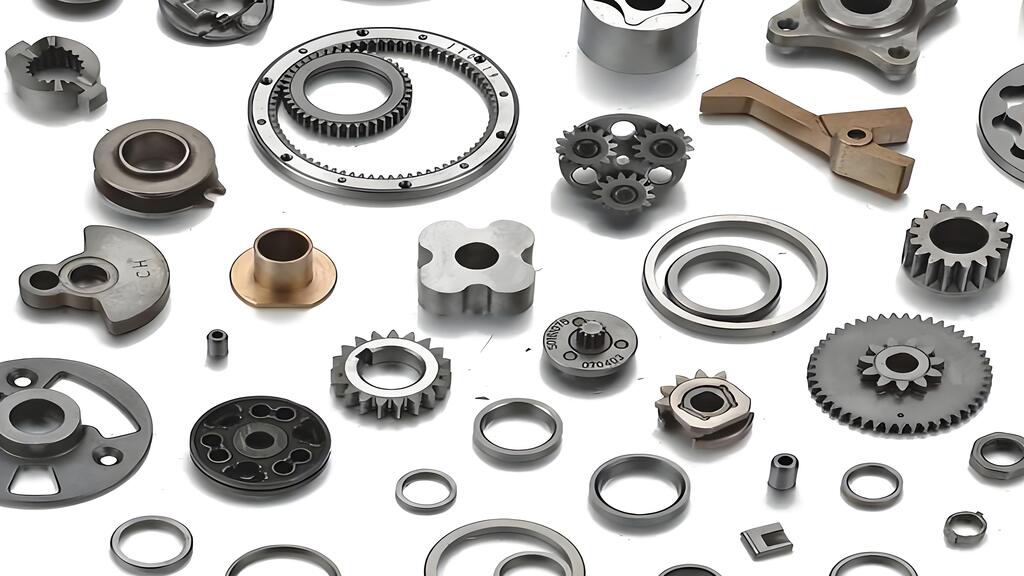


Porosity Control in Powder Metallurgy Products
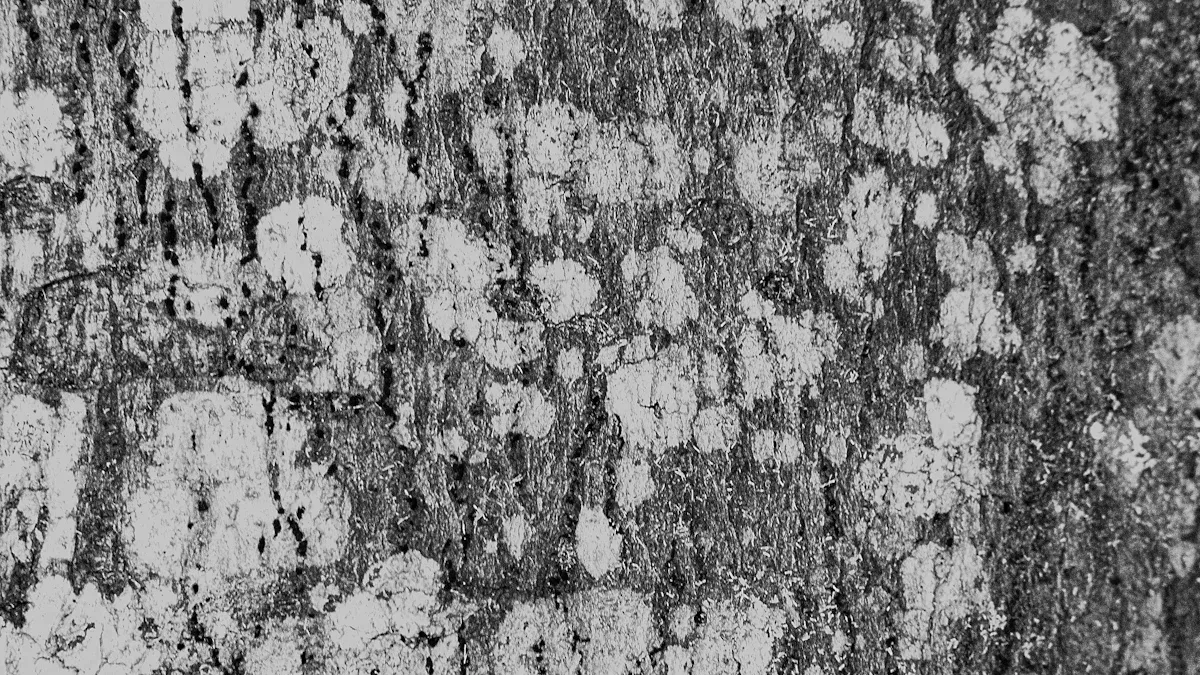
Porosity plays a crucial role in the quality of Powder Metallurgy products. Researchers note that increased porosity reduces mechanical strength and strain to failure, while the size and distribution of pores also influence product reliability. Manufacturers achieve targeted porosity by adjusting compaction pressure, sintering conditions, powder features, and material selection. By controlling these factors, they improve strength, density, and overall performance in powder metallurgy products.
Key Takeaways
- Increasing compaction pressure reduces porosity and improves the strength and density of powder metallurgy products.
- Optimizing sintering temperature, time, and atmosphere helps close pores and enhances particle bonding for better product performance.
- Choosing the right particle size and distribution improves powder packing, lowers porosity, and balances mechanical properties with processability.
- Selecting appropriate powder production methods affects particle shape and purity, which influence porosity and final product quality.
- Material composition and the use of additives or lubricants control porosity by improving powder flow, reducing friction, and tailoring pore structure to application needs.
Compaction Pressure in Powder Metallurgy Products
Impact on Porosity
Compaction pressure stands as a primary factor in controlling porosity within powder metallurgy products. As pressure increases, porosity decreases, resulting in denser green compacts. This inverse relationship has been recognized since the foundational studies of Balshin in the early 20th century. The compaction process unfolds in three distinct stages:
- Stage I: Granule rearrangement reduces large pores between particles.
- Stage II: Granule deformation eliminates larger pores, leading to significant densification.
- Stage III: Particle fracture and further deformation shrink smaller pores, pushing density closer to its theoretical maximum.
Statistical analyses show that compaction pressure contributes up to 61% of the relative density and up to 90% of the fracture toughness in iron powder compacts. For example, applying a compaction pressure of around 422 MPa can yield a relative density of 84%. Small angle neutron scattering studies reveal that higher compaction pressures reduce the number of pores, although some remaining pores may increase in size. In bimodal powders, increased pressure shrinks both intra-agglomerate and inter-agglomerate pores, enhancing green density and improving the uniformity of the pore structure.
Tip: Higher compaction pressures improve the mechanical properties and reliability of powder metallurgy products by minimizing porosity and increasing density.
Mechanism of Densification
Densification during compaction involves several key mechanisms:
- Particle Rearrangement: At the onset, particles slide and rotate, filling voids and increasing contact points.
- Elastic and Plastic Deformation: As pressure rises, particles first deform elastically, then plastically, which permanently changes their shape and enhances bonding.
- Pore Closure: Open pores gradually convert into closed pores, reducing overall porosity.
- Thermal-Mechanical Effects: Friction and deformation generate localized heat, which softens particles and promotes local welding.
- Spring Back: After pressure release, some elastic recovery occurs, slightly reducing the achieved density.
The uniformity of porosity depends on several factors, including friction between powder and die walls, granule properties, and compaction velocity. For instance, high-velocity compaction and proper lubrication can reduce density gradients, resulting in more uniform powder metallurgy products.
| Factor Category | Specific Factor | Effect on Porosity Uniformity and Density Distribution |
|---|---|---|
| Compaction Mechanism | High Velocity Compaction | Dynamic, high-speed impact forces improve densification and reduce density gradients compared to static compaction. |
| Friction | Internal and Mold Wall | Causes exponential decay of pressure with depth, leading to non-uniform density distribution. Lubrication and temperature reduce friction and improve uniformity. |
| Granule Properties | Strength and Deformability | Granules must be hard enough to rearrange and pack uniformly but soft enough to deform and eliminate porosity during compaction. |
| Mold Geometry | Height-Diameter Ratio | Lower height-diameter ratio improves uniformity by better transfer of compaction force. |
| Process Parameters | Compaction Velocity | Higher velocity increases impact energy, enhancing uniformity and density. |
| Environmental Conditions | Temperature | Increased temperature improves plastic deformation and lubrication, reducing friction and improving uniformity. |
Practical Considerations for Pressure Selection
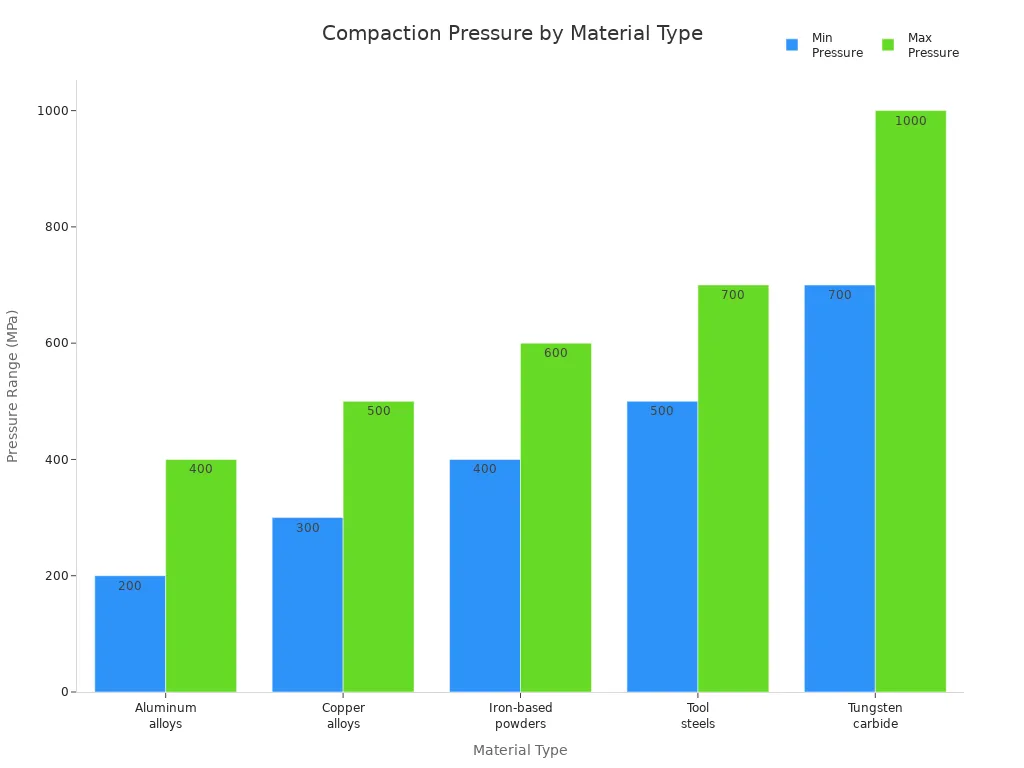
Selecting the right compaction pressure requires careful consideration of material type, equiPment capabilities, and powder characteristics. The following table summarizes typical pressure ranges for various materials:
| Material Type | Typical Pressure Range (MPa) | Notes |
|---|---|---|
| Aluminum alloys | 200-400 | Softer materials, require lower pressures |
| Copper alloys | 300-500 | Medium hardness, moderate pressures |
| Iron-based powders | 400-600 | Standard for many industrial applications |
| Tool steels | 500-700 | Higher hardness requires increased pressure |
| Tungsten carbide | 700-1000+ | Extremely hard, demands highest pressures |
Other practical factors include:
- Uniform pressure distribution ensures consistent density throughout the compact.
- Proper dwell time at maximum pressure improves compaction quality.
- Lubricant distribution reduces ejection forces and enhances green strength.
- Tool alignment and condition prevent defects and ensure even pressure application.
- Powder flowability, influenced by particle size and shape, affects die filling and compaction uniformity.
- Equipment limitations, such as die design and press capacity, set the upper limit for compaction pressure.
Manufacturers often start at the lower end of the recommended pressure range and adjust as needed to balance density, porosity, and the risk of defects. By optimizing these parameters, they produce powder metallurgy products with superior mechanical properties and reliability.
Sintering Parameters for Porosity Control
Sintering Temperature
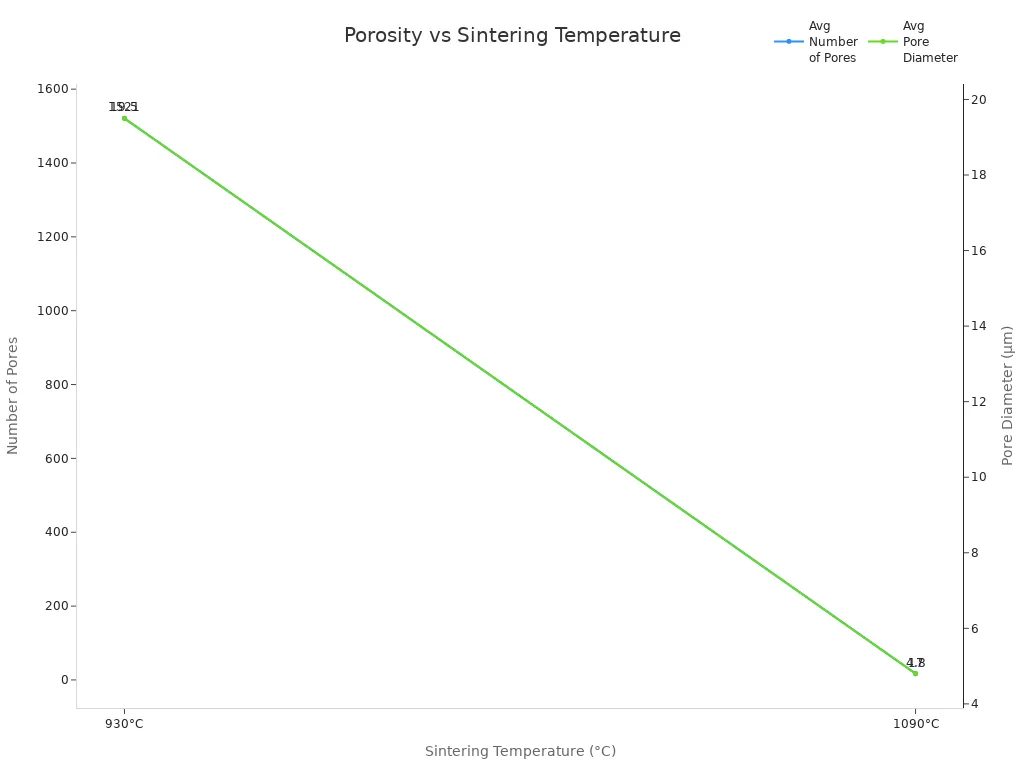
Sintering temperature directly influences the evolution of porosity in powder metallurgy products. As temperature rises, atomic diffusion accelerates, promoting neck growth between particles and reducing both the number and size of pores. The following table demonstrates how increasing sintering temperature affects density and pore characteristics:
| Sintering Temperature (°C) | Density (g/cm³) | Relative Density (%) | Average Number of Pores per Field | Average Pore Diameter (μm) | Porosity Evolution Description |
|---|---|---|---|---|---|
| 930 | 7.1 | 86.5 | 1521 | 19.5 | Large pores occupy considerable space; many pores present |
| 1030 | - | - | Decreasing | Decreasing | Pores progressively diminish and spheroidize |
| 1070 | 8.14 | 99.2 | - | - | Maximum density reached; pores significantly reduced |
| 1090 | 8.13 | 99.1 | 17 | 4.8 | Tiny number of pores remain; complete elimination impossible |
Manufacturers select optimal sintering temperatures based on alloy type. For example, steel typically requires 2050–2400°F, while bronze sinters best at 1470–1560°F. Ultra-high temperature sintering can further enhance densification and pore elimination, but atmosphere control remains critical to prevent unwanted reactions.
Sintering Time
Sintering time determines how long particles remain at elevated temperatures, which impacts pore closure and grain growth. During the initial stage, necks form between particles with minimal shrinkage. As time increases, necks grow, densification improves, and porosity decreases. In the final stage, pores become isolated, and trapped gases can limit further densification. Prolonged sintering time enhances mechanical properties by reducing porosity. For instance, extending sintering from 2 to 7 hours in 17-4 PH stainless steel increases relative density by 5%, Vickers hardness by 40%, and compressive yield strength by 10%. However, excessive time may cause rapid grain growth, which can affect mechanical performance.
Sintering Atmosphere
The choice of sintering atmosphere plays a vital role in porosity control. Reducing atmospheres, such as hydrogen, actively remove surface oxides, enabling better particle bonding and densification. Nitrogen atmospheres can promote pore filling through nitride formation, especially in aluminum-containing alloys. In contrast, inert atmospheres like argon or vacuum protect against oxidation but do not facilitate oxide removal, resulting in less effective pore closure. The table below summarizes the effects of different atmospheres:
| Sintering Atmosphere | Effect on Porosity and Densification | Mechanism |
|---|---|---|
| Nitrogen | Reduces porosity, enhances densification | Nitride formation and pore filling |
| Hydrogen | Maximizes densification, reduces porosity | Oxide reduction and improved sintering kinetics |
| Vacuum | Moderate densification, less effective pore reduction | No active oxide removal |
| Argon (Inert gas) | Minimal densification, limited pore closure | Inert, no chemical reactions |
Tip: Selecting the right combination of temperature, time, and atmosphere allows manufacturers to tailor porosity and achieve optimal performance in powder metallurgy products.
Particle Size and Distribution in Powder Metallurgy Products

Effect of Particle Size on Pore Structure
Particle size plays a critical role in shaping the pore structure of sintered components. Smaller particles increase the surface contact area, which raises interparticle friction and influences the moldability of the feedstock. Fine powders, typically less than 10 μm, create more homogeneous microstructures and lower oxygen impurity levels. This results in higher sintered relative density, often reaching about 90%, and improved mechanical properties such as tensile strength and elongation. Finer powders also produce smaller and more complex pore structures. For example, reducing powder size can decrease pore size from over 1000 nm to approximately 350 nm, while significantly boosting compressive strength. However, ultrafine powders may agglomerate, which can lower the critical solid loading and reduce moldability during processing. Particle size directly affects both the initial packing density and the final porosity by controlling microstructure uniformity and pore morphology.
Role of Particle Size Distribution
The distribution of particle sizes within a powder batch determines how efficiently particles pack together and fill voids. Mixing powders with a bimodal distribution—such as 10% small and 90% large particles—maximizes packing density by allowing smaller particles to occupy spaces between larger ones. This efficient packing reduces overall porosity and enhances the density of the compact. Mathematical models support this concept, showing how the number of smaller particles surrounding a larger one depends on their size ratio. Experimental data reveal that broader particle size distributions increase densification rates and grain growth during sintering. However, increased packing density also raises inter-particle friction, which can reduce powder flowability.
- Bimodal distributions fill voids more effectively.
- Broader distributions improve densification and final compact density.
- Increased packing density may reduce flowability due to higher friction.
Practical Guidelines for Powder Selection
Selecting the appropriate powder size and distribution depends on the desired balance between density, mechanical properties, and processability. The table below summarizes typical particle size ranges for 17-4 PH stainless steel powders:
| Powder Type | d10 (µm) | d50 (µm) | d90 (µm) | Sphericity | Aspect Ratio |
|---|---|---|---|---|---|
| Fine | ~7.0 | ~13.3 | ~19.1 | 0.92 | 0.86 |
| Medium | ~21.5 | ~29.8 | ~39.8 | 0.89 | 0.83 |
| Coarse | ~25.1 | ~36.1 | ~50.8 | 0.91 | 0.87 |
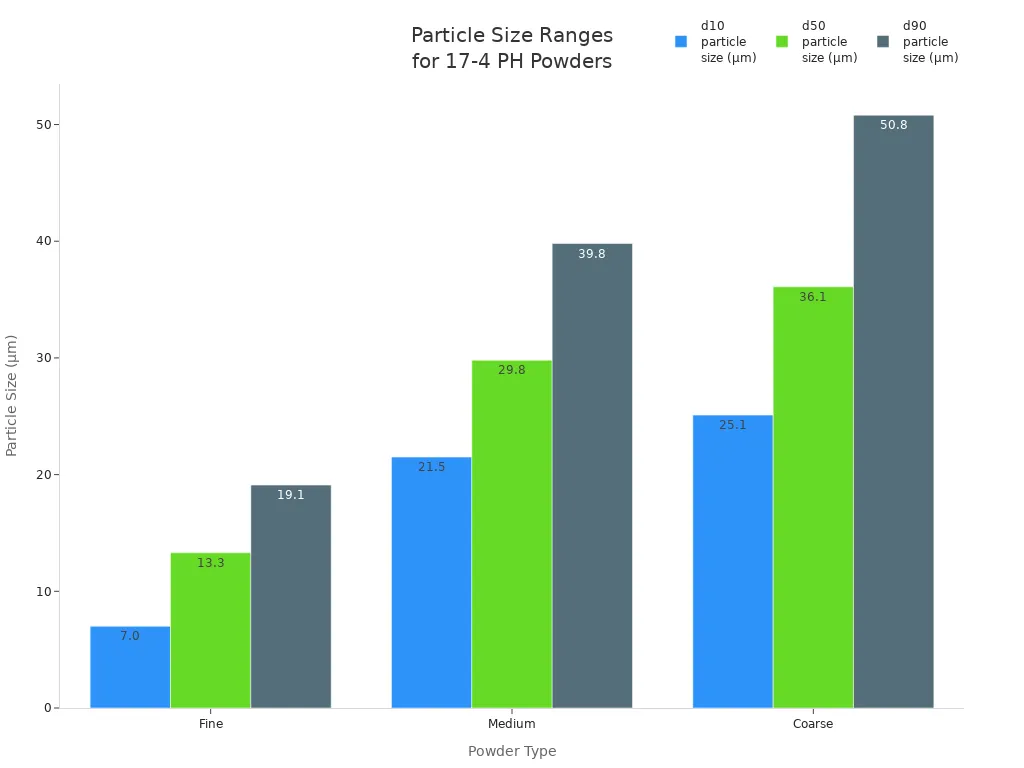
Despite clear differences in particle size, studies show that internal porosity remains similar across fine, medium, and coarse powders, with values around 2% to 3%. Most pores are spherical and small, indicating that within typical industrial ranges, particle size has a limited effect on overall porosity. Manufacturers should consider both the desired microstructure and the flowability requirements when selecting powders for optimal performance.
Powder Production Methods and Porosity
Atomization Techniques
Manufacturers often use atomization techniques to produce metal powders for powder metallurgy. Water atomization and gas atomization represent the two most common methods. Water atomization employs high-pressure water jets to break up molten metal. This process causes rapid cooling, which produces powders with irregular or dendritic shapes. The fast solidification leads to a broad particle size distribution and fine microstructures. However, water atomized powders typically show higher porosity. The irregular particle morphology and the dynamics of rapid solidification contribute to this effect. During water atomization, hydrogen gas forms inside droplets due to the reaction between water and molten metal. These gas bubbles become trapped, creating pores within the particles. The process also increases oxygen content, which can further impact porosity.
Gas atomization, in contrast, uses inert gases such as nitrogen or argon to disperse molten metal. The slower cooling rate results in more spherical particles with smoother surfaces. Gas atomized powders generally have higher purity, lower oxygen content, and higher bulk density. These powders exhibit lower porosity because the process minimizes gas entrapment and reduces the formation of internal pores.
Note: Water atomized powders often contain more internal pores than gas atomized powders due to hydrogen gas formation and rapid cooling.
Mechanical Alloying
Mechanical alloying involves repeated fracturing and welding of powder particles in a high-energy ball mill. This method creates fine, homogeneous powders with unique microstructures. The intense mechanical action can introduce defects and increase surface area, which may lead to higher initial porosity. However, the process also enables the production of alloys that are difficult to achieve by conventional melting. Mechanical alloying allows precise control over composition and particle size, which helps tailor porosity in the final product.
Other Powder Production Methods
Other methods, such as electrolytic deposition, chemical reduction, and carbonyl processes, also influence powder characteristics. Electrolytic powders often have high purity and irregular shapes, which can increase porosity. Chemical reduction produces spongy powders with interconnected pores. The carbonyl process yields very fine, spherical powders with low porosity. Each method offers distinct advantages for controlling porosity, depending on the application and desired properties.
| Method | Typical Particle Shape | Porosity Tendency | Key Features |
|---|---|---|---|
| Water Atomization | Irregular/Dendritic | High | Rapid cooling, higher oxygen |
| Gas Atomization | Spherical | Low | High purity, low oxygen |
| Mechanical Alloying | Irregular | Moderate-High | Fine, homogeneous powders |
| Electrolytic | Irregular | Moderate | High purity |
| Chemical Reduction | Spongy | High | Interconnected pores |
| Carbonyl | Spherical | Low | Very fine, high purity |
Selecting the right powder production method enables manufacturers to achieve targeted porosity and optimize performance in powder metallurgy products.
Material Selection for Powder Metallurgy Products
Influence of Alloy Composition
Alloy composition plays a decisive role in determining the achievable porosity in powder metallurgy products. Different elements influence microstructure and pore formation during both compaction and sintering. For example:
- Increasing silver content in Fe–Mn–Ag alloys leads to silver segregation and agglomerate formation, which correlates with higher porosity.
- Pressed samples consistently show much lower porosity than non-pressed samples of the same composition.
- Silver-bearing alloys display greater porosity than those without silver, even after pressing and sintering.
- Porosity often varies within a single part, with the top face of pressed and sintered samples showing higher porosity than the bottom.
- Non-pressed samples can have porosity levels five to nine times greater than pressed samples with identical alloy compositions.
Alloying elements such as chromium and molybdenum also affect phase transformations and microstructural evolution. Chromium can induce solution hardening and carbide precipitation, which enhances mechanical properties and modifies porosity by influencing particle bonding and phase formation.
Additives and Lubricants
Additives and lubricants serve as essential tools for controlling porosity during powder compaction and sintering. Lubricants reduce friction between powder particles and die walls, which lowers tool wear and allows for more effective pressing. This results in higher density and improved mechanical properties. Different lubricants offer unique benefits: zinc stearate yields high green density, Acrawax strengthens green compacts, and Kenolube lowers ejection force. Additives such as binders, including POLYOX™ polymers, improve green strength and prevent powder segregation, leading to a more uniform porosity distribution. POLYOX™ polymers also provide lubricity, reduce die wear, and enable clean binder removal during sintering, which helps maintain a controlled pore structure.
Compatibility with Desired Porosity Levels
Selecting materials compatible with the targeted porosity ensures that powder metallurgy products meet application-specific requirements. Porosity is primarily driven by the intended use rather than the material itself, allowing precise control over pore characteristics. For instance:
- Porous stainless steel is ideal for filters that require corrosion resistance.
- Porous iron works well in self-lubricating bearings, where pores retain lubricants.
- Porous copper offers inertness and ease of processing.
However, some materials may not suit certain porosity levels due to risks such as corrosion or flammability. The compatibility between material and desired porosity directly influences mechanical strength, corrosion resistance, and safety. Processing parameters like compaction pressure and sintering temperature further refine porosity, ensuring the final product meets performance expectations.
Manufacturers achieve optimal porosity control in powder metallurgy products by applying several proven strategies. The table below highlights the most effective methods:
| Strategy | Impact on Porosity | Practical Consideration |
|---|---|---|
| Increasing Compaction Pressure | Lowers porosity | Avoid die damage, ensure uniform density |
| Optimizing Sintering Parameters | Enhances particle bonding | Prevent grain growth or distortion |
| Controlling Particle Size | Improves packing and bonding | Manage agglomeration risks |
| Powder Production Methods | Shapes particle characteristics | Select method for desired porosity |
| Material Selection | Influences densification | Match material to application needs |
Precise porosity management leads to measurable improvements in mechanical properties, durability, and product consistency. For example, reducing porosity in mechanical seals and fiber-reinforced composites results in stronger, more reliable components.
- Planetary gearsets for lighting controls and powdered metal bevel gears for medical instruments demonstrate how advanced porosity control enables tight tolerances and high performance in powder metallurgy products.
FAQ
What is the main reason for controlling porosity in powder metallurgy products?
Manufacturers control porosity to improve strength, density, and reliability. Lower porosity increases mechanical performance and extends product life. Controlled porosity also allows for specific functions, such as filtration or self-lubrication.
How does powder particle size affect porosity?
Smaller powder particles pack more closely, reducing pore size and increasing density. Fine powders create more uniform microstructures. However, very fine powders may agglomerate, which can lower moldability.
Which sintering atmosphere best reduces porosity?
Hydrogen atmosphere works best for reducing porosity. It removes surface oxides and promotes strong particle bonding. Nitrogen and vacuum atmospheres also help, but hydrogen achieves the highest densification.
Can manufacturers adjust porosity for different applications?
Yes. Manufacturers select compaction pressure, sintering parameters, powder type, and material to achieve the desired porosity. For example, filters need higher porosity, while structural parts require low porosity for strength.
What role do additives and lubricants play in porosity control?
Additives and lubricants improve powder flow and reduce friction during compaction. They help achieve uniform density and minimize defects. Proper use of lubricants also lowers ejection force and enhances green strength.