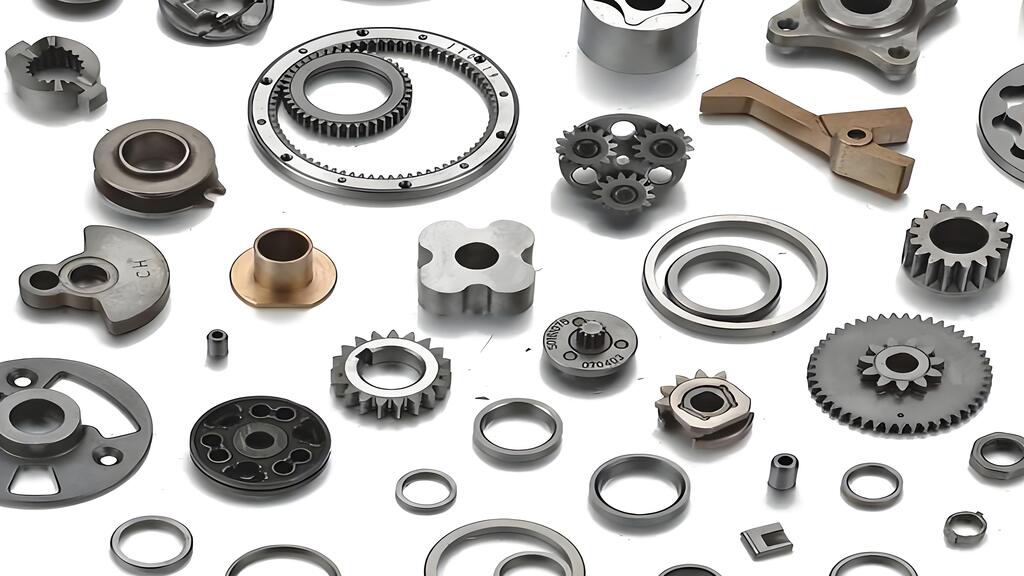


How Real Companies Solved Manufacturing Challenges Using Powder Metallurgy Examples

Powder Metallurgy Examples showcase a remarkably efficient manufacturing technique. The process turns over 97% of raw materials into finished products. Metal powders create parts with minimal waste, making this method accessible to more people as a green manufacturing approach. Material utilization rates above 95% help cut costs and boost production efficiency.
The powder metallurgy process has four key stages: powder preparation, blending and mixing, compacting, and Sintering. Manufacturers have embraced powder metal manufacturing because it minimizes post-processing and reduces production costs. The technology serves industries of all sizes - from automotive and aerospace to electronics, medical devices, and energy production. Powder metallurgy parts outperform other production technologies through lower energy use, better material utilization, and fewer process steps. Manufacturers value powder metallurgy's capability to form complex geometrical shapes directly while meeting tight dimensional tolerances, which eliminates machining operations. This piece examines ground powder metal components and powder metallurgy applications that tackle specific manufacturing challenges.
Oil Pump Rotor: Solving Tight Tolerance Challenges

Oil pump rotors face tough manufacturing challenges. These parts need very tight tolerances. Proper engine lubrication and performance depend on precise clearances between inner and outer rotors. Powder metallurgy gives manufacturers the perfect solution through controlled material properties and near-net shape capabilities.
Radial Clearance Requirements: 0.08–0.13 mm
A gerotor oil pump's success relies on specific internal clearances between its parts. The radial clearance between inner and outer rotors stands out as a crucial tolerance requirement. The clearance must stay within 0.08–0.13 mm to work well and remain reliable. Oil pressure drops and internal leakage rises sharply when clearances go beyond this range.
Quality small block engine oil pumps need about 0.003 inches (0.076 mm) of clearance between gears and housing, according to industry specs. The backlash between gears should stay under 0.007 to 0.008 inches. Powder metallurgy shines as the best manufacturing choice here. Regular machining methods can't reliably hit these tight tolerances in high-volume production.
Green Compact Formation and Sizing for Precision
The process starts with carefully picked metal powders - usually high-quality alloy steels chosen for specific traits. Heavy pressure compacts these powders in custom-designed dies. This creates "green" rotor blanks with the right shape. Getting the dimensions right begins with this crucial compaction stage.
Green compacts then go through sintering - heat treatment below the melting point in a controlled environment. Atoms move and bond during sintering. This joins particles together and removes gaps in the rotor material. The result is a denser, stronger part ready for oil pump use.
Powder Metal Manufacturing for Inner-Outer Rotor Fit
Two synchronized rotors power the pump. The inner and outer rotors spin opposite ways to pull oil into the system. Getting these parts to fit perfectly takes amazing precision. The rotors need extra shaping and finishing after sintering. Special machining techniques ensure the exact shape and surface finish.
The right radial clearance needs more than just perfect measurements. Materials matter, too, because metals change size with temperature. Expert manufacturers know that oil pumps built with perfect clearances when hot might stick when cold. Powder metallurgy tackles this issue through smart material choices and controlled porosity.
Jiehuang leads China's powder metallurgy suppliers. They join other global manufacturers in making oil pump rotors that stay dimensionally stable at different temperatures. These parts deliver steady performance throughout their service life.
Sintered Bushing: Enabling Self-Lubrication in Motors

Sintered bushings are remarkable powder metal components that solve a big challenge in motors - the constant need for lubrication. These components work maintenance-free in many applications thanks to careful powder metallurgy processes. The unique features of sintered bushings show why manufacturers of all sizes keep choosing powder metallurgy.
Porous Structure from Sintering Process
The real magic of sintered bushings lies in their controlled porosity, which typically makes up 20-25% of their volume. Metal particles, usually iron or bronze, are compacted into shape and then sintered at temperatures below their melting point. During sintering, the particles bond at their contact points and create a solid structure with connected pores.
Sintered bushings work better than regular bearing materials because of their engineered porosity. They keep their precise dimensions (up to IT 5 in diameter) while still having the porous channels they need. The sintering process uses heat to bond particles, which lets manufacturers control the density and spread of pores. This creates a matrix filled with small, evenly spread pores ready for the next step.
Vacuum Oil Impregnation for Continuous Lubrication
The next step is vacuum oil impregnation - the key to making these bushings self-lubricating. The bushings get a deep clean first to keep anything from getting in the way of the oil. They go into a vacuum chamber that pulls all the air out of the pores.
When the vacuum hits about 29" Hg, lubricating oil flows into the chamber. The difference in pressure pushes oil into all the connected channels. The process brings back normal air pressure, which forces even more oil into the pores. A final curing step locks the oil inside the porous structure.
Applications in HVAC and Office Equipment
You'll find these self-lubricating sintered bushings in equipment of all types, especially where you don't want to worry about maintenance. HVAC systems use them in fans, AC units, and extraction systems. They also work great in office equipment like paper handlers, printers, and chairs.
These powder metallurgy parts deliver on performance. They handle loads up to 10 MPa and speeds up to 8 m/s, making them perfect for tough jobs. You don't need external lubrication systems, which means less maintenance work. Equipment can run for thousands of hours without wearing down.
Jiehuang leads the pack of powder metallurgy suppliers in China that make these components. Companies choose sintered bushings when they need reliable, maintenance-free operation. This shows how powder metallurgy tackles engineering challenges with smart material design.
Powder Metallurgy Gears: Reducing Machining in Transmission Parts

Powder metallurgy has revolutionized gear production by minimizing machining needs. Companies can now create complex gear shapes at lower costs compared to traditional methods.
Near-Net Shape Tooth Formation
Powder metallurgy creates true involute tooth profiles with full fillet radius, which removes the need for undercut relief found in cut gears. The process begins when specialized metal powders are compacted into the desired tooth shape under high pressure. The tooth profile takes shape during compaction, so almost no metal needs to be removed for the final geometry. The powder metal process creates net-shape or near-net-shape parts that need minimal finishing. Precision tooling ensures tooth form accuracy and delivers consistent results in high-volume production.
Material Utilization >95% in Gear Production
Powder metallurgy gears stand out for their remarkable material efficiency. While traditional machining wastes material through cutting, powder metallurgy uses more than 95% of the material. This happens because the material directly forms the final shape instead of being cut from larger pieces. Standard PM processes use about 97% of the material, which makes them economical for large production runs. The forming process, rather than cutting, leads to better raw material yield and improved output.
Use in Automotive and Power Tools
Powder metallurgy gears serve many industries. These components work in automotive transmissions, oil pumps, balance shaft adjustors, window lifts, and headlight activators. The automotive sector represents the biggest market for powdered metal gears, where transmission components benefit from reliable quality. Jiehuang, a leading powder metallurgy supplier in China, makes these precision parts for various uses.
Power tools rely heavily on powder metal gears. You'll find them in drills, angle grinders, and electric chainsaws. These gears' compact design maximizes power density while keeping weight low. This makes them perfect for handheld devices where size and efficiency count.
ABS Sensor Ring: High-Volume Precision for Safety Systems

Safety-critical components in modern vehicles must be exceptionally precise, particularly in anti-lock braking systems. ABS sensor rings show how powder metallurgy creates high-volume precision parts that affect vehicle safety performance.
F-0000 Material for Consistent Magnetic Properties
ABS sensor rings made through machining or sintering employ F-0000 unalloyed powdered metal iron materials. This material choice is crucial for safety applications where magnetic consistency determines how well they work. F-0000 materials work best in lightly loaded structural applications. Their magnetic properties make them perfect for sensor rings that must generate consistent magnetic fields.
Some manufacturers mix plastic resin with ferrite powder as an alternative approach. These materials contain 30-80% ferrite by weight. The result is lighter, more elastic, and less brittle components. Once magnetized, these rings maintain magnetic strength between 300-3000 gauss. In spite of that, powder metallurgy F-0000 rings remain the top choice when dimensional precision matters most.
Near-Net Shape Forming for Tooth Profile Accuracy
Making precision ABS rings requires exact dimensional control, especially for tooth profile accuracy and pitch consistency. The powder metallurgy process helps produce these components with minimal size variations. Half-shearing type and piercing type formed from metal plates are two other manufacturing methods. Both need precise tooth pitch, parallel alignment between tooth and mounting surfaces, and accurate bearing part inner diameters.
Powder metallurgy's near-net shape forming capabilities eliminate many post-processing steps and improve production efficiency. Some manufacturers can produce more than 1.5 million pieces. This is a big deal as it means that the approach is highly scalable. These facilities use ISO9001:2000 quality systems to maintain consistent quality in high-volume production.
Integration in Anti-Lock Braking Systems
In anti-lock braking systems, the sensor ring (or tone wheel) works with speed sensors to stop wheel lockup during emergency braking. The ring connects to brake disks or drums and rotates with the wheel. Each tooth in the profile changes the magnetic field as it moves past the sensor.
The ABS sensor combines a toothed ring and magnet inside a coil. These elements interact to create an electric field and generate signals that become digital data for the ABS controller. The system uses this information to calculate individual wheel speeds. The ABS won't work properly with missing or damaged rings, but normal braking still functions.
Jiehuang, a leading powder metallurgy supplier in China, makes these critical safety components with the precision that reliable ABS operation needs in automotive applications of all sizes.
Shock Absorber Components: Meeting Flatness and Wear Resistance

Shock absorber components made through powder metallurgy must handle tough operating conditions on asphalt roads and dirt tracks. These parts face temperature extremes and constant load changes. Powder metal manufacturing works best for pistons, guides, and valves because they need high dimensional accuracy.
Three Annular Mating Surfaces in Pistons
Shock absorber pistons in cars feature three annular mating surfaces that interact with corresponding components. These surfaces need exact flatness since even tiny changes within acceptable ranges can dramatically affect the shock absorber's performance. The piston's up and down movement in the shock absorber body creates damping when oil pressure passes through small orifices or valves. Powder metallurgy helps create pistons with complex internal structures that boost damping performance without much machining.
Dimensional Control via Sintering and Sizing
Metal powder selection starts the powder metallurgy process for shock absorber parts. Manufacturers form these powders into green compacts. The compacts then undergo sintering at 70-90% of the metal's melting point. Temperature, time, and atmosphere need precise control during this process. The sintered parts might need re-pressing, machining, or heat treatment to meet final specifications. This manufacturing method will give consistent precision and dimensional stability between batches.
Material Selection for High Wear Resistance
Iron-based materials with 6.5g/cm³ density and 70-90HRB hardness are the foundations for shock absorber pistons. Many companies choose 4140 steel because it offers excellent strength, toughness, and wear resistance. These components can withstand continuous cyclic loading without failing. Jiehuang, a leading powder metallurgy supplier in China, produces these critical components with tight tolerances and superior wear characteristics.
Timing Pulley and Lock Parts: Cost-Effective Mass Production

Powder metallurgy excels at producing timing pulleys and lock parts in high volumes with minimal waste. These components showcase the technique's versatility in different industrial applications while meeting strict quality standards.
Single-Step Compaction for Tooth and Mounting Features
Single-step compaction creates powder metallurgy timing pulleys by forming tooth profiles and mounting features simultaneously. Metal powders (typically FC-0205 or Sint C11) are mixed with binders and spread evenly. Specialized presses use punches and a core rod to shape the powder in the mold cavity. This method creates a green compact with near-final geometry that includes precise tooth profiles to prevent belt slippage. The process eliminates the need for extensive secondary machining because both teeth and mounting features take shape in one operation.
Steam Treatment for Corrosion Resistance in Lock Pins
Lock pins gain protection through steam treatment, a controlled oxidation process that creates a thin protective oxide layer. The components heat above 700°F in air before steam exposure. The water vapor reacts with iron at 1000°F to form Fe3O4, which creates a blue-colored oxide and boosts corrosion resistance. Parts stay at this temperature for 30-60 minutes based on application needs. Natural cooling follows while the protective coating remains intact.
Use of FC-0205 and FC-0208 Materials
Iron-copper materials FC-0205 and FC-0208 deliver optimal properties for timing pulleys and lock components. FC-0205 contains 1.5-3.9% copper and 0.3-0.6% carbon, while FC-0208 has a higher carbon content at 0.6-0.9%. Studies show that lower copper content combined with higher carbon content improves dimensional stability from 200 microns to 35 microns on a 50mm component. This change moves tolerance capability from IT 12 to IT 8, which ensures consistent performance in high-volume production runs.
Conclusion
Powder metallurgy stands out as an exceptional manufacturing technique in industries of all types. This piece shows how different components prove the process's effectiveness in solving engineering challenges while optimizing material use. Oil pump rotors hit the exact tolerances needed for engines to work properly. Sintered bushings provide maintenance-free lubrication everywhere you look. The process also lets manufacturers make gears that don't need expensive machining because they come out nearly perfect.
ABS sensor rings showcase powder metallurgy's precision capabilities in safety-critical parts. These components keep their magnetic properties consistent - a must-have for reliable brake systems. The same goes for shock absorber parts that handle extreme conditions thanks to precise sintering and materials that resist wear perfectly.
The money-saving benefits of powder metallurgy really shine in high-volume parts like timing pulleys and locks. Manufacturers can shape complex geometries in one step while keeping tight tolerances. Steam treatment and special material formulas improve how these parts perform.
The process's material utilization rate is a big deal as it means more than 95% efficiency in most cases. You'll save money, use less energy, and leave a smaller environmental footprint. Complex shapes need minimal extra work, which cuts production time and costs.
Jiehuang, China's powder metallurgy leader, shows how manufacturers can deliver precise parts for automotive, industrial, and consumer products. Engineering needs keep changing, but powder metallurgy remains the go-to choice for parts that need to be precise, stable, and economical. The examples in this piece show why more global industries choose this process to solve their complex engineering challenges.
Key Takeaways
These real-world powder metallurgy applications demonstrate how manufacturers solve complex engineering challenges while achieving exceptional material efficiency and cost savings.
• Powder metallurgy achieves 95%+ material utilization compared to traditional machining, dramatically reducing waste and production costs across all applications.
• Near-net shape forming eliminates extensive machining by creating complex geometries like gear teeth and rotor profiles directly during compaction.
• Controlled porosity enables self-lubricating components through vacuum oil impregnation, providing maintenance-free operation in motors and equipment.
• Tight tolerance control (0.08-0.13mm) is consistently achievable through sintering and sizing processes, critical for precision parts like oil pump rotors.
• Single-step compaction forms multiple features simultaneously, reducing production steps and costs while maintaining dimensional accuracy for high-volume parts.
The success of these components across automotive, industrial, and safety applications proves that powder metallurgy offers manufacturers a competitive advantage through reduced processing steps, superior material efficiency, and the ability to create complex geometries that would be difficult or impossible to achieve through conventional manufacturing methods.
FAQs
Q1. What are the main advantages of powder metallurgy in manufacturing? Powder metallurgy offers several key advantages, including over 95% material utilization, near-net shape forming that reduces machining, ability to create complex geometries, tight tolerance control, and cost-effective high-volume production. These benefits make it ideal for producing components like gears, bushings, and precision automotive parts.
Q2. How does powder metallurgy enable self-lubricating components? Powder metallurgy creates components with controlled porosity, typically 20-25% by volume. This porous structure is then impregnated with oil through a vacuum process, allowing the part to continuously self-lubricate during operation. This is particularly useful in applications like sintered bushings used in motors and office equipment.
Q3. What industries benefit most from powder metallurgy techniques? Powder metallurgy finds extensive applications in automotive, aerospace, electronics, medical device manufacturing, and energy production industries. It's particularly valuable for producing components like transmission gears, oil pump rotors, ABS sensor rings, and various motor parts where precision and cost-effectiveness are crucial.
Q4. How does powder metallurgy achieve tight tolerances in manufacturing? Powder metallurgy achieves tight tolerances through precise control of the sintering process, careful material selection, and post-sintering operations like sizing. For example, oil pump rotors can maintain radial clearances of 0.08–0.13 mm, which is critical for proper engine lubrication and performance.
Q5. What materials are commonly used in powder metallurgy? Common materials in powder metallurgy include iron-based alloys like FC-0205 and FC-0208, which are used for components such as timing pulleys and lock parts. Other materials include bronze for self-lubricating bearings and specialized alloys for high-wear applications like shock absorber components. The choice of material depends on the specific requirements of the part being produced.