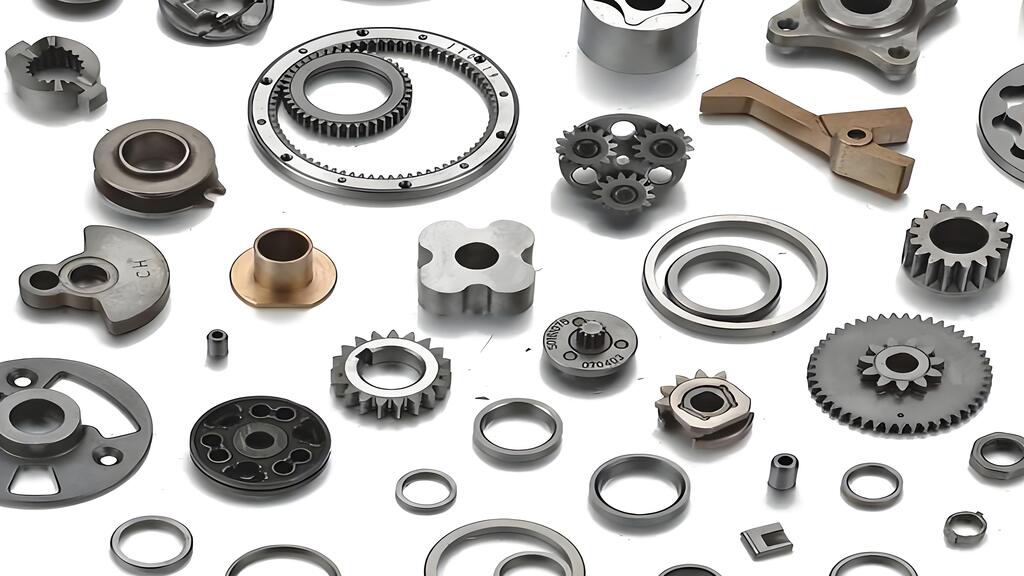


Powder Pressing Tools Design

The design of powder pressing tools plays a huge role in making the powder metallurgy production process work smoothly. These essential metallurgy tools usually take several days to weeks to manufacture. Some specialized companies can finish mold design in just 3 days and complete the whole production process within 15 days. Time spent on proper tooling design early on helps avoid production failures that can get pricey later.
Raw materials, press capabilities, and component shape are the foundations of powder compaction tooling design . The tools need to handle hundreds of thousands of powder compacting cycles . This makes durability crucial to their development. Powder Metallurgy gives manufacturers a cheaper option compared to other forming methods . Suppliers can mass-produce components with a single set of compaction tools and still keep product quality intact .
This piece covers everything in powder pressing tool design that helps prevent common production failures. Readers will find practical ways to improve their powder pressing process and maximize tool life. The guide shows you how to optimize net-shape forming and pick the right tool materials based on application stress.
1. Optimize for Net-Shape Forming to Reduce Secondary Operations

Near net shape manufacturing is the lifeblood principle in powder metallurgy. This approach creates components that closely match final dimensions and minimizes secondary operations. Tool designers who prioritize this concept during powder pressing gain multiple advantages.
Avoiding Undercuts and Reverse Tapers
Powder pressing tool design follows one basic rule - eliminate features that prevent part ejection from the die. On top of that, it's impossible to directly form re-entrant features like grooves, reverse tapers, and lateral holes during the powder compaction process. These limitations exist because powder compaction and ejection happen along a vertical axis.
Experienced tool designers modify designs rather than attempting impossible geometries to achieve the same functionality without problematic features. Secondary machining operations after Sintering must handle any essential undercuts.
Designing for One-Step Compaction
Successful one-step compaction depends on several crucial details:
- A straight land of at least 0.25 mm should exist between tapers and die walls/core rods
- Small drafts on flange steps ensure smooth part ejection
- Radii work better than sharp corners to avoid stress concentrations
One-step compaction makes powder metallurgy tools more affordable by eliminating multiple pressing operations or extensive secondary machining. This approach ended up reducing production time, material waste, and manufacturing expenses.
2. Respect Compaction Ratios to Prevent Cracking
Powder pressing tool design relies heavily on proper compaction ratios. These ratios optimize part integrity and help avoid cracking and density variations.
2:1 Fill-to-Final Ratio Rule
The basic principle of powder compaction uses a 2:1 ratio between the original powder fill height and the final compact length. A column of powder in the die compresses by about 50%. Spray-dried PZT needs roughly 10,000 PSI pressure to achieve the desired green density at this 2:1 compaction ratio. Consistent fill depths play a crucial role because they directly impact the component's weight, density, and volume.
Level-Specific Tool Member Requirements
Multi-level parts add exponential complexity to the process. Each component level needs its own powder fill amount because of the 2:1 compression ratio. The press must individually drive unique tool members that form specific sections. Basic presses can only handle two levels, while advanced machines can work with more complex designs.
Parts with uneven density distribution emerge when these level-specific requirements aren't met. Internal stresses develop and demonstrate themselves as micro-cracks during ejection or handling. Long hubs with large, thin sections are especially prone to cracking when removed from multiple-level dies.
3. Choose Tool Materials Based on Application Stress
The performance of powder pressing tools depends heavily on the materials used to make them. These materials need to line up with the specific stresses that occur during thousands of compaction cycles.
Tool Steel Selection: Hardness vs. Toughness
Material hardness shows how well it resists plastic deformation. The material's toughness shows how much energy it can absorb without breaking. Finding the right balance between these properties is vital to getting the best tool performance. The core team looks at these characteristics to select tool steels:
- Wear resistance for abrasive powders
- Compressive strength for high-pressure applications
- Fatigue resistance for high-cycle operations
- Dimensional stability during heat treatment
D2 tool steels (62-64 HRC) provide excellent wear resistance but don't offer much toughness. S7 shock-resistant steel focuses more on toughness. Powder metallurgy tool steels usually give you better combinations of both properties. These steels have fine, uniform structures without segregation. This creates the perfect mix of hardness and toughness to make tools last longer.
Heat Treatment and Coating Combinations
The right heat treatment boosts tool performance without doubt. Vacuum heat treatment keeps the surface safe from oxidation or decarburization. The tempering process then balances thermal stresses and gets the surface ready for coating.
Surface improvements help tools last even longer. GPA-PVD coatings that are 2-3 microns thick protect against wear and keep edges sharp. Tools can last more than 100,000 pieces with these coatings. Nitriding offers another option. It improves compressive strength without changing dimensions, which works great for tools that need very precise tolerances.
Heat treatment and coatings cost more at first. But they ended up saving money over time because tools last longer and work better.
4. Avoid Thin Walls That Compromise Tool Strength

Wall thickness plays a vital role in powder pressing tool design and affects both tool life and part quality. Poor attention to this aspect will lead to early failures and inefficient production.
Minimum Wall Thickness Guidelines
Wall thickness in powder metallurgy parts should stay above 1.52 mm (0.060 inches). This baseline measurement will give a strong tool foundation throughout the pressing cycle. Parts that need high density should have walls between 0.125 to 0.200 inches. The extra thickness helps control tool deflection, which matters a lot when higher forces are needed to achieve greater density. Multi-action tools need walls at least 0.100 inches thick.
Tool Breakage Risks in Thin-Walled Parts
Long, thin walls create several problems in powder pressing operations. These features result in delicate tooling that wears out faster. Parts with thin walls show uneven density patterns. The length-to-wall thickness ratio is a big deal, as it means that ratios above 8:1 need extra care to get even fill. Despite these precautions, density variations can't be avoided at such extreme ratios.
Risk of tool breakage rises sharply because pressing tools must handle several hundred thousand powder compacting cycles. Manufacturers must assess:
- Compaction forces needed for specific materials
- Stress distribution throughout the tool during operation
- Wear patterns in critical features
5. Design for Long Tool Life and High Cycle Durability

Powder pressing tools need to last through hundreds of thousands of production cycles to make economic sense. The right design choices affect both durability and production efficiency throughout a tool's life.
Stress Distribution in Tool Geometry
The way stress spreads through tools plays a key role in preventing early failures. Studies show that tools only get uniform pressure at their base when the compressed powder column is tall enough. Shorter samples create uneven, concentrated pressure that leads to dangerous wear patterns. The sidewalls near the piston face very high radial stresses. This stress pattern affects how long tools last because it creates focused wear zones that need special design attention.
Wear-Prone Feature Identification
We can spot parts likely to wear out by looking at the main ways tools fail:
- Mild abrasive wear (most common in powder metallurgy dies)
- Severe adhesive wear/galling (shows up early in tool life)
- Cracking from too much stress in one spot
Tool lineup matters a lot - even tiny misalignments (0.01-0.02mm) make tools wear out 30-50% faster. When everything works right, dies sets usually last 300,000-500,000 parts, punches make it to 200,000-300,000 cycles, and core rods typically handle 100,000-200,000 operations. Premium tool steels with PVD coatings can add 30-50% more life.
Well-planned maintenance programs cut downtime by 40-60% and add 5-8 years to press life. Companies should create detailed tool management plans that include documentation, maintenance schedules, and ways to track performance for the best durability.
6. Use a Holistic Tooling Strategy Across Manufacturing Stages
A detailed approach to powder pressing tools goes beyond single tool design and welcomes the complete manufacturing workflow. Smart manufacturers know that their tooling choices shape every production stage, from the original compaction to the final assembly.
Tooling Impact on Assembly and Sintering
Powder metallurgy tools shape every downstream process. Manufacturers can create fully dense parts that weigh less and need minimal machining when they combine hot isostatic processing with the right tools. The way tool materials interact becomes especially important during sintering. To name just one example, graphite tooling can push carbon into parts and create chromium carbides that change mechanical properties. Teams should predict these material interactions before they choose tooling materials.
Vendor Collaboration for Cost Efficiency
Mutually beneficial alliances between powder metallurgy manufacturers and their tooling suppliers create significant advantages. Companies that cooperate with suppliers grow faster, spend less, and earn more than their competitors. Joint business planning helps teams line up their short-term goals with long-term objectives.
Manufacturing simulation software gives product development teams the data they need to negotiate effectively. Teams can spot parts that cost too much. Better transparency across the supply chain leads to quicker responses when demand changes, which cuts operating costs. AI technology improves forecasting accuracy by up to 20% compared to older methods.
7. Consider Alternatives for Edging and Finishing
Powder pressing tools design alone doesn't deal very well with many challenges. Secondary processing becomes necessary for certain edge features, even though powder metallurgy offers net-shape capabilities.
Tumbling and Brushing as Secondary Operations
Tumbling is a budget-friendly way to finish powder metallurgy components. Parts and grinding media vibrate together in donut-shaped drums to remove burrs and make surfaces smoother. This process works best with simple geometry components and creates surface finishes between 0.8-3.2μm Ra. The process also helps improve sintered stainless steel parts' corrosion resistance by sealing surface pores.
Other ways to remove burrs include:
- Rotary brush deburring (powder metallurgy's most common choice)
- Thermal deburring (works well for complex internal features)
- Vibratory deburring (perfect for batch processing)
Avoiding Sharp Radii in Tool Design
Sharp radii create some of the most important challenges in tooling design. These radii often create razor-sharp edges that don't mold well. The quickest way around this is to design angled edges that can be tumble-finished later to get the right radius. For critical edges like bushings, a 30-degree angle with a 0.005 to 0.015 inch (0.13 to 0.38mm) flat helps eliminate problematic feather edges.
Chamfers might look better than radii, but manufacturers need to be careful. Large-angle chamfers can slow down production by creating die-fill problems or making powder wedges between tools.
8. Embrace New Powder Materials for Better Performance

Modern powder metallurgy depends on choosing advanced materials that make components perform better and tools last longer. New powder compositions create better parts and speed up manufacturing.
Material Compatibility with Pressing Tools
New powder materials have changed how designers look at tooling needs. Chromium-coated powders resist oxidation better and flow more easily because they reduce tribo-electrical charging. Ready-to-press powders made under strict quality control help avoid cross-contamination. These advances mean tool steel choices must match specific material properties.
Balancing Cost and Density Requirements
Choosing the right powder materials needs careful analysis of costs and performance. Copper-alloyed steels reach densities up to 90% (7.1 g/cm3) through standard press-and-sinter processing. Iron-nickel, diffusion-alloyed, and pre-alloyed materials achieve 90-93% density (7.0-7.3 g/cm3).
Manufacturers should think over:
- Special sintering processes like high-temperature sintering and infiltration that boost density
- Cost impacts, since sintering is the most expensive part of powder metallurgy
The choice between different powder materials comes down to matching performance needs with manufacturing limits. New chromium-alloyed products like Astaloy® CrA are versatile enough for the automotive industry's needs. They offer economical strength and wear resistance compared to nickel and molybdenum options.
Conclusion
Powder pressing tool design is the lifeblood of successful powder metallurgy operations. This piece highlights key principles that help prevent production failures and maximize efficiency. We focused on net-shape forming to cut down on expensive secondary operations and improve production costs. The right compaction ratios are crucial to avoid dangerous cracks that can ruin part integrity.
Your choice of materials will affect how tools perform under stress. Finding the sweet spot between hardness and toughness helps tools last through hundreds of thousands of cycles. Manufacturers need to assess specific application needs before they lock in their material specs.
Wall thickness plays a big role in how long tools last and how good the parts turn out. Thin walls can lead to problems - from uneven density to tools breaking completely. Following minimum thickness rules helps avoid these risks.
Tools last longer when stress spreads evenly across their geometry. Smart manufacturers spot wear-prone areas early. They can then build in design features that make tools last much longer. A detailed approach that connects tooling decisions through all manufacturing stages brings benefits beyond just better tools.
Different finishing methods can help with edge features that are hard to press. These extra steps work with the original tool design instead of replacing good engineering basics.
New powder materials open doors to better performance and simpler tool needs. Getting the right mix of material properties, processing techniques, and tool design determines part quality and production efficiency.
Without doubt, powder pressing tool design needs deep knowledge of metallurgy, mechanical engineering, and real-life production. Companies that get these design basics right deal with fewer production problems, spend less on operations, and make better products. Good tooling design is worth the investment because it prevents costly issues throughout production.
Key Takeaways
Master these essential powder pressing tool design principles to prevent costly production failures and maximize manufacturing efficiency:
• Follow the 2:1 compaction ratio rule - Powder fill height should be twice the final compact length to prevent cracking and ensure uniform density distribution.
• Maintain minimum wall thickness of 1.52mm (0.060") - Thinner walls create fragile tooling with shorter service life and density variations that compromise part integrity.
• Design for net-shape forming by avoiding undercuts and reverse tapers - These features prevent proper part ejection and require costly secondary machining operations.
• Select tool materials balancing hardness and toughness - Premium tool steels with PVD coatings can extend tool life by 30-50% beyond standard materials.
• Plan for 300,000-500,000 part cycles from quality die sets - Proper stress distribution and wear-prone feature identification are critical for achieving maximum tool durability.
• Embrace modern powder materials like chromium-coated powders - These advanced materials offer improved oxidation resistance and flowability while potentially simplifying tool requirements.
Successful powder pressing tool design requires understanding that every design decision impacts the entire manufacturing workflow, from initial compaction through final assembly and sintering processes.
FAQs
Q1. What are the main challenges in powder metallurgy? The primary challenges include achieving uniform powder distribution, ensuring proper density, controlling porosity, and preventing issues like cracking and warping during the compaction and sintering processes. Overcoming particle agglomeration and poor interfacial bonding are also significant hurdles.
Q2. What are crucial design considerations for powder pressing tools? Key considerations include optimizing for net-shape forming, respecting compaction ratios, choosing appropriate tool materials, avoiding thin walls, and designing for long tool life. It's also important to consider the flow behavior of metal powders and the pressing action during compaction.
Q3. How can manufacturers extend the lifespan of powder pressing tools? To extend tool life, manufacturers should select premium tool steels with appropriate coatings, maintain proper stress distribution, identify wear-prone features early, and implement regular maintenance programs. Adhering to minimum wall thickness guidelines and respecting compaction ratios also contributes to longer tool life.
Q4. What role do new powder materials play in improving powder metallurgy processes? Advanced powder materials, such as chromium-coated powders, offer improved oxidation resistance and flowability. These materials can enhance part performance, simplify tool requirements, and potentially reduce manufacturing costs. However, their selection must be balanced with specific application needs and tooling compatibility.
Q5. How does wall thickness affect powder pressing tool performance? Wall thickness is critical for tool strength and part quality. Insufficient thickness can lead to premature tool failure, density variations in parts, and increased risk of cracking. Generally, a minimum wall thickness of 1.52mm (0.060") is recommended, with thicker walls required for high-density applications or multi-action tools.