

Tungsten Alloy Counterweights Made by Powder Metallurgy
Tungsten Alloy Counterweights are high-density components. They play a crucial role in balancing diverse mechanical systems. Tungsten possesses unique material properties. These characteristics make conventional manufacturing methods impractical. Consequently, Powder Metallurgy emerges as the indispensable manufacturing method for producing these specialized counterweights. This process effectively leverages tungsten's attributes.
Key Takeaways
- Tungsten alloy counterweights are very dense. They help balance machines.
- Powder metallurgy is key to making these counterweights. Tungsten is hard to melt.
- These counterweights are strong and resist rust. They last a long time.
- Tungsten counterweights are safer than lead. They do not harm the environment.
- They help make aircraft stable. They also improve car engine performance.
- Powder metallurgy makes parts very precise. This helps machines work better.
- New ways of making tungsten alloys are always being found. This makes them even better.
Understanding Tungsten Alloy Counterweights: Properties and Advantages
Tungsten alloy counterweights offer exceptional properties. These characteristics make them ideal for demanding applications. Understanding their unique attributes reveals why industries widely adopt them.
The Unique Characteristics of Tungsten
Exceptional Density and High Melting Point
Tungsten stands out for its remarkable density. This metal possesses the highest melting point of all metals. Its density is a critical factor for counterweight applications.
| Material Type | Density (g/cm³) |
|---|---|
| W-Ni-Fe, W-Ni-Cu, W-Ni-Co | 15.8-18.75 |
| Tungsten Nickel Copper (W-Ni-Cu) powder (W-3.5Ni-1.5Cu, W-4.5Ni-3Cu, W-6Ni-4Cu) | 16.85-18.35 |
| General Tungsten Heavy Alloys | 17-18.5 |
Tungsten alloy counterweights typically exhibit a very high density, ranging from 16.5 to 19 g/cm³. This density more than doubles that of ordinary steel. This property highlights their suitability for applications requiring high specific gravity.
Superior Strength and Corrosion Resistance
Pure tungsten is one of the strongest metals at room temperature. It offers remarkable tensile strength, especially in high-temperature environments. Tungsten has an impressive tensile strength of around 500,000 psi. This makes it significantly stronger than aluminum (approximately 45,000 psi) and steel (around 100,000 psi).
Tungsten also exhibits strong acid resistance, corrosion resistance, and chemical inertness at normal temperatures. Tungsten-Nickel-Copper (W-Ni-Cu) alloys offer high corrosion resistance. This makes them ideal for harsh environments. Tungsten-Tantalum (W-Ta) alloys provide superior corrosion resistance, suitable for chemical and marine environments.
Why Tungsten Alloys are Preferred for Counterweights
Enhanced Machinability and Ductility through Alloying
Pure tungsten is inherently brittle. Alloying elements significantly enhance its machinability and ductility. These additions make tungsten practical for manufacturing complex counterweight shapes.
- Nickel (Ni), Iron (Fe), and Copper (Cu) serve as a binder matrix. They hold brittle tungsten grains together. This makes the alloys ductile and easy to machine. Nickel-iron is a popular additive, often in a 7Ni:3Fe or 8Ni:2Fe weight ratio.
- Cobalt (Co) is added to W-Ni-Fe alloys. It slightly enhances both strength and ductility. Cobalt contributes to solid-solution strengthening of the binder. It also improves tungsten-matrix interfacial strength.
Common Tungsten Alloy Grades: W-Ni-Fe and W-Ni-Cu
Manufacturers commonly use W-Ni-Fe and W-Ni-Cu alloys for counterweights. These grades balance density, strength, and workability.
- Tungsten content has the most significant effect on tensile properties. Increasing tungsten improves strength but reduces ductility. High-tungsten alloys show high tensile strength but low elongation at break.
- Nickel content significantly improves ductility and toughness. It increases elongation at break. Nickel forms a ductile solid solution phase. This phase absorbs deformation energy and slows crack propagation. Increased nickel generally enhances tensile properties.
- Other metals (e.g., Iron, Copper):
- Iron can increase tensile strength. However, excessive amounts may reduce plasticity.
- Copper helps improve electrical conductivity and ductility. It enhances deformation capability during tensile stress.
Comparison of Tungsten Alloy Counterweights with Alternative Materials
Density and Performance Against Lead and Steel
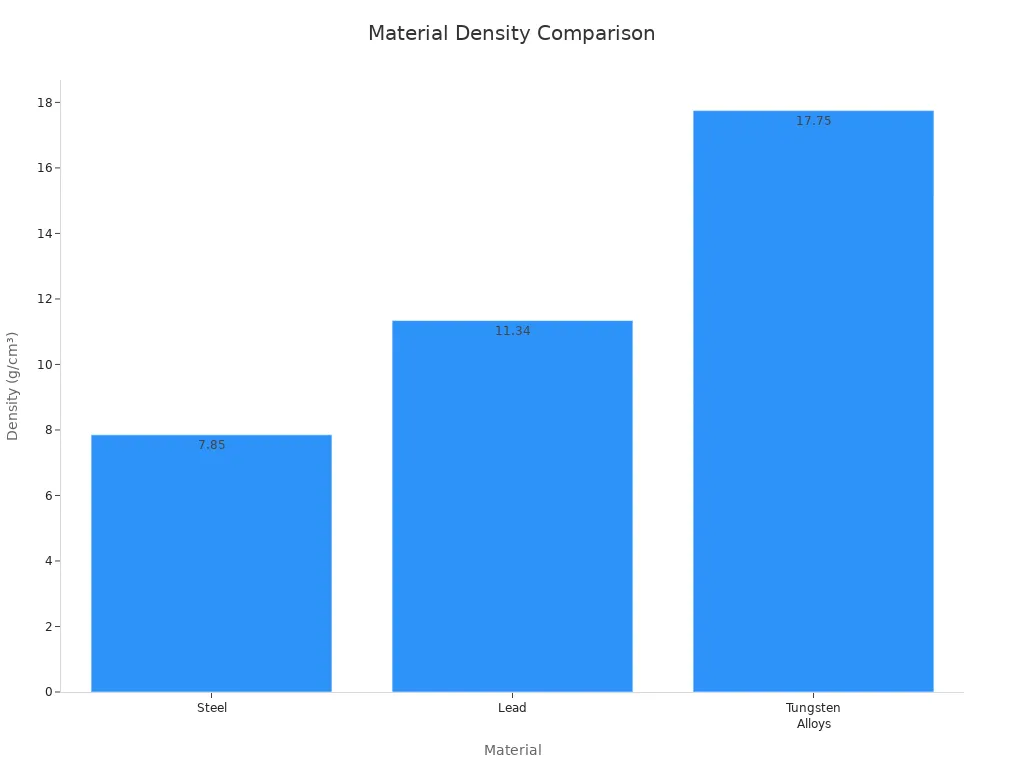
Tungsten alloy counterweights offer superior density compared to traditional materials like lead and steel. This allows for smaller, more efficient designs.
| Material | Density (g/cm³) | Performance Characteristics (Summary) |
|---|---|---|
| Steel | 7.85 | Cost-effective, readily available, good strength, machinability, corrosion resistance (can be alloyed or coated). |
| Lead | 11.34 | High density, low melting point, excellent machinability, good sound dampening, and corrosion resistance. Toxic and environmentally hazardous. |
| Tungsten Alloys | 17.0 - 18.5 | Very high density, non-toxic, excellent strength, good corrosion resistance, high melting point, good machinability (though harder than lead/steel). More expensive. |
Advantages Over Depleted Uranium in Specific Applications
Tungsten alloys present a safer, non-toxic alternative to depleted uranium. This is particularly important in aerospace and medical fields.
- Tungsten heavy alloy provides high density in a much safer form. Depleted uranium is radiotoxic and chemically toxic.
- Depleted uranium exhibits high chemical reactivity. This makes it susceptible to pyrophoric behavior and a high corrosion rate. These issues are not present with WHA.
- WHA offers low surface reactivity compared to DU. It is not subject to the high corrosion rate or stress corrosion cracking susceptibility of DU.
- Few aircraft counterweights today are fabricated from depleted uranium. Serious problems can occur from contamination by uranium-containing smoke or dust.
The Essential Role of Powder Metallurgy in Tungsten Alloy Counterweight Production

Powder metallurgy is essential for creating tungsten alloy counterweights. This manufacturing method addresses the unique challenges tungsten presents. It allows for the production of high-performance components.
Why Powder Metallurgy is Critical for Tungsten
Overcoming Tungsten's High Melting Point and Brittleness
Tungsten is a refractory metal. It has an inherently high melting point and is brittle. These properties make traditional manufacturing difficult. Powder metallurgy techniques, such as hot isostatic pressing and spark plasma Sintering, overcome these issues. These methods consolidate powder feedstock. They produce high-density tungsten parts. This happens at potentially lower temperatures and shorter times than conventional processes.
Impracticality of Conventional Melting and Casting Methods
Conventional melting and casting methods are impractical for tungsten. Tungsten's extremely high melting point makes it difficult to melt. Its brittleness also causes problems during casting. The material would crack or become porous. Powder metallurgy avoids these issues. It processes tungsten in its powder form. This bypasses the need for high-temperature melting and casting.
Key Stages of the Powder Metallurgy Process for Tungsten Alloy Counterweights
The powder metallurgy process involves several critical stages. Each stage contributes to the final quality of the tungsten alloy counterweights.
Precise Powder Preparation and Blending
The process begins with precise powder preparation. Manufacturers select high-purity tungsten powder. They blend it with other alloying elements. This ensures a homogeneous mixture.
| Application | Typical Purity |
|---|---|
| Counterweights | 99.95% (3N5) |
Manufacturers also control the particle size. This affects the final density and mechanical properties.
| Application Area | Recommended Particle Size |
|---|---|
| High-density counterweight | 20-25 microns |
Some specifications require larger particles.
| Property | Specification |
|---|---|
| Particle Size | Minimum 85% > 70 Microns |
| Particle Size Distribution | Minimum 90% between 100 and 200 Mesh |
Compaction and Shaping of Green Parts
After blending, the powder undergoes compaction. This shapes it into a "green" part. This part has a specific geometry.
| Compaction Method | Description | Advantages | Disadvantages |
|---|---|---|---|
| Uniaxial Pressing (Die Pressing) | Powder is pressed in rigid dies using mechanical or hydraulic presses, with pressure applied from the top or top and bottom. | High dimensional precision for small parts, suitable for process automation, high production rates for small parts. | Density non-uniformity (especially for large parts), potential for crack formation/distortion during sintering, limited by press capacity and part geometry, less precise dimensional control compared to isostatic pressing. |
| Cold Isostatic Pressing (CIP) | Powder is filled into flexible molds (rubber/elastomers) and subjected to uniform hydrostatic pressure. | Achieves much higher density uniformity, requires lower pressure for a given green density, results in stronger compacts, offers more freedom in dimensions, allows pressing of parts with undercuts/reentrant angles, enables production of thin-walled tubes and very large parts. | Less precise dimensional control, much lower production rate. |
Tungsten powder is primarily consolidated into green parts using two main compaction methods: uniaxial pressing and isostatic pressing. Uniaxial pressing involves pressing the powder in rigid dies. Pressure is applied from one or both directions. This method works well for smaller parts and high production rates. However, it can cause density variations. Isostatic pressing fills powder into flexible molds. These molds then receive uniform hydrostatic pressure. This technique results in much higher density uniformity. It offers greater flexibility in part size and shape.
Sintering for Densification and Material Fusion
Sintering is a crucial high-temperature process. It bonds the powder particles. This reduces porosity and increases density. Atomic diffusion forms strong bonds. This transforms the material into a solid, cohesive mass.
Tungsten Heavy Alloys (WHA) contain matrix alloy elements. These include nickel, iron, cobalt, and copper. During heating, these elements form a eutectic with tungsten. This creates a liquid phase at 1400-1550 °C. This temperature range is significantly lower than for pure tungsten (1800-2700 °C). It allows for full densification of WHA. This results in a material with high density and improved mechanical properties.
| Tungsten Alloy Type | Optimal Sintering Temperature | Sintering Time | Key Outcomes/Considerations |
|---|---|---|---|
| Tungsten Heavy Alloy (WHA) | 1525 °C | 30 min | Achieves desired structure, good mechanical properties (UTS > 1000 MPa, plasticity > 20%). Sintering below 1525 °C leads to insufficient homogenization, voids, and gaps. Higher temperatures (e.g., 1550 °C) can cause gravity sedimentation and slightly lower UTS due to restoration phenomena. |
| Tungsten Heavy Alloy (WHA) | 1500 °C | Extended time | An alternative to 1525 °C to mitigate gravity sedimentation issues at higher temperatures. |
The sintering atmosphere is crucial. Controlled environments, such as hydrogen or vacuum, prevent oxidation. They also facilitate the densification process. This precise control ensures the final component has high density, excellent mechanical strength, and accurate dimensional tolerances. Achieving densification typically requires stringent sintering conditions. These include high temperatures or extended durations. However, a novel inorganic metal salt binder can generate nanoparticles in situ. These nanoparticles occupy interparticle voids. They enhance green and pretreated density. This allows for densification at a lower sintering temperature of 1500 °C. It improves surface quality and compressive strength.
Post-Sintering Treatments and Finishing
After sintering, parts often undergo post-sintering treatments. These treatments refine their properties and dimensions.
- Heat Treatments:
- Stress Relieving: Reduces internal stresses from manufacturing.
- Annealing: Improves ductility and reduces hardness, making the material more workable.
- Solution Treatment: Heats the alloy to dissolve alloying elements, creating a uniform solid solution.
- Aging: A controlled heating process that precipitates fine particles to enhance strength and hardness.
- Machining Techniques:
- Abrasive Machining: Uses abrasive wheels or belts, effective for hard and brittle materials.
- Electrical Discharge Machining (EDM): A non-contact method using electrical sparks for intricate shapes and fine features.
- Laser Beam Machining (LBM): Uses a high-power laser for precision cutting, drilling, and engraving.
- Waterjet Cutting: Employs a high-pressure stream of water (often with abrasives) for cold cutting, preventing thermal distortion.
Advantages of Powder Metallurgy for Manufacturing Tungsten Alloy Counterweights
Powder metallurgy offers significant advantages for producing tungsten alloy counterweights. These benefits contribute to superior product quality and manufacturing efficiency.
Near-Net Shape Manufacturing and Material Efficiency
Powder metallurgy enables near-net shape manufacturing. This means the final product requires minimal machining. It reduces material waste. This process is highly efficient. It saves both material and production costs.
Uniform Microstructure and Controlled Density
Powder metallurgy ensures a uniform microstructure. It also allows for controlled density. Manufacturers precisely control composition by mixing fine powders. This ensures even dispersion of alloying elements. It prevents segregation, unlike casting. Powder metallurgy maintains elements in their mixed powder state. This prevents separation during lower-temperature sintering. It ensures consistent alloy composition. Manufacturers can also tailor the microstructure. They control grain size through powder particle size and sintering conditions. This optimizes mechanical properties. Powder metallurgy enables precise control over the final density. This is critical for applications like radiation shielding. Thorough mixing of tungsten powder with other alloying elements prevents localized variations. This ensures consistent material properties. Compaction techniques like Cold Isostatic Pressing (CIP) contribute to higher density uniformity. Sintering then bonds particles, reducing porosity and increasing density.
Production of Complex Geometries and Superior Mechanical Properties
Powder metallurgy allows for the production of complex geometries. This includes features like undercuts and internal channels. It offers design flexibility. This method also results in superior mechanical properties. The controlled process creates strong, durable parts.
Performance Benefits of Powder Metallurgy Tungsten Alloy Counterweights
Powder metallurgy tungsten alloy counterweights offer unparalleled performance. Their unique properties provide significant advantages across various demanding applications. These benefits stem from their exceptional density, precision, and durability.
Maximizing Density and Space Efficiency in Counterweight Designs
Engineers often face challenges with limited space in mechanical systems. Tungsten alloy counterweights provide an ideal solution. They deliver maximum mass within minimal volume.
Achieving High Weight in Minimal Volume
Tungsten heavy alloys, such as those conforming to ASTM B777 classes, typically achieve densities ranging from 17.0 to 18.5 g/cc. Depending on the exact alloy, densities can range from approximately 10 g/cc to 18 g/cc. Specifically, W-Ni-Fe alloys boast high density, typically between 17 and 18.5 g/cm³. W-Ni-Cu alloys also offer impressive densities, ranging from 16 to 18 g/cm³. These heavy alloys generally pack an impressive 15.8-18.7 g/cm³ density. This allows engineers to create compact, weight-efficient parts that fit in tight spaces. Tungsten alloys, with densities as high as 16.5 to 18.75 g/cm³, allow for the use of smaller components. This is crucial in aerospace where counterweights are often placed in limited spaces. It enables more weight distribution control per unit volume and increases the sensitivity of control mechanisms.
Enabling Compact and Optimized System Designs
Tungsten's impressive density, ranging from 16.5 to 18.75 g/cm³, allows manufacturers to create compact, high-mass components. This significantly improves flight stability in aerospace applications. In modern aircraft, tungsten alloy counterweights deliver maximum mass in minimal space. This is crucial for streamlined fuselages and thinner wings, where internal volume for counterweights is shrinking. For flight surface balancing in ailerons, elevators, and rudders, dense tungsten materials fit perfectly. They prevent dangerous aerodynamic flutter at high speeds, allowing designers to maintain maximum surface area for control. The high strength of tungsten enables optimal positioning for efficient weight effect, minimizing material usage. In helicopter rotor blades, tungsten alloys are ideal for compensating imbalances. They enable both static and dynamic balancing to prevent excessive vibration and ensure stable flight dynamics.
| Feature | Tungsten Alloys (17-18.5 g/cm³) | Lead (11.3 g/cm³) | Steel (7.8 g/cm³) |
|---|---|---|---|
| Density Advantage | ~41% more dense than lead, >2x denser than steel | - | - |
| Mechanical Performance | Stable in mechanically stressed positions | Exhibits creep at ambient temperatures | - |
| Space Efficiency | Higher density allows smaller components, reducing overall system weight | - | - |
| Structural Integrity | Tensile strength 700-1000 MPa, excellent fatigue resistance | - | - |
Tungsten heavy alloys (17.1-18.5 g/cm³) are nearly twice as dense as steel and significantly denser than lead. They provide a unique mass-to-volume ratio. This density enables compact design freedom in applications with limited space, such as fitting balance weights into narrow wing edges or robotic arms. It leads to optimized weight distribution for improved performance and efficiency. This results in reduced overall size and system complexity compared to bulkier alternatives. It also contributes to a lower moment of inertia, allowing faster response times in moving systems. It enhances structural efficiency due to smaller counterweights, reducing the need for reinforcement around them.
Precision and Balance in Tungsten Alloy Counterweights
Precision is paramount in balancing applications. Powder metallurgy ensures that tungsten alloy counterweights meet stringent requirements for consistency and accuracy.
Consistent Density for Optimal Weight Distribution
The powder metallurgy process ensures a highly uniform microstructure and consistent density throughout the counterweight. This uniformity is critical for optimal weight distribution. It guarantees that the counterweight performs as designed, providing precise balance.
Dimensional Accuracy for Superior Balancing Performance
Powder metallurgy allows for exceptional dimensional accuracy. Manufacturers can achieve a dimensional tolerance of ±0.05 mm. Precision CNC machining technology further refines this. Metal Injection Molding (MIM) can achieve an even tighter dimensional tolerance of ±0.02 mm. This high level of precision ensures superior balancing performance. It minimizes vibrations and enhances the overall stability of mechanical systems.
Durability and Longevity of Tungsten Alloy Counterweights
Tungsten alloy counterweights are built to last. They exhibit remarkable durability, even in harsh operating conditions.
Resistance to Wear, Impact, and Corrosion
Tungsten alloy counterweights exhibit high strength and hardness. This allows them to withstand significant impact and wear. Their tensile strength ranges from 800-1000MPa in the sintered state. This increases to 1300-1500MPa after heat treatment and deformation. They also possess strong corrosion resistance, being resistant to chemicals and water. They have good wear resistance due to their high hardness, which extends their lifespan.
| Property | Tungsten (W) |
|---|---|
| Tensile Strength (MPa) | 550–1,000+ |
| Hardness (Vickers) | 350–500+ |
| Fracture Toughness (MPa·√m) | ~15–20 |
| Corrosion Resistance | Moderate (oxidizes at high temps) |
| Oxidation Behavior | Oxidizes above 400–500°C |
| Reaction with Acids | Resistant to most acids, except nitric + HF |
| Resistance to Chlorides | Poor – attacked by chlorides at high temp |
Stable Performance in High-Temperature Environments
Tungsten's inherently high melting point translates to excellent thermal stability for its alloys. Tungsten alloy counterweights maintain their structural integrity and performance even in high-temperature environments. This makes them suitable for applications where heat is a significant factor, ensuring reliable operation over extended periods.
Environmental and Safety Aspects of Tungsten Alloy Counterweights
The choice of materials for industrial components increasingly considers environmental impact and safety. Tungsten alloys offer significant advantages in these areas. They provide a responsible solution for counterweight applications.
Non-Toxic Alternative to Lead Counterweights
Historically, lead served as a common material for counterweights due to its high density. However, lead poses severe environmental and health risks. It is a toxic heavy metal. Lead can leach into the environment. It contaminates soil and water. Exposure to lead can cause serious health problems in humans and animals. These problems include neurological damage and developmental issues.
Tungsten alloys present a safe and non-toxic alternative. They do not contain lead or other hazardous substances. This makes them inherently safer for manufacturing, handling, and disposal. When industries choose tungsten alloys, they eliminate the risks associated with lead. This protects workers, consumers, and the environment. The inert nature of tungsten alloys means they do not release harmful chemicals. This ensures long-term safety in various applications.
Compliance with Modern Environmental Regulations
Global environmental regulations have become stricter. These regulations aim to reduce hazardous substances in products. Tungsten alloys help industries meet these stringent requirements. They ensure compliance with global lead regulations. These include important directives like RoHS (Restriction of Hazardous Substances) and REACH (Registration, Evaluation, Authorisation and Restriction of Chemicals).
Compliance with RoHS and REACH is crucial for market access. It helps companies avoid fines and market access barriers. Many industries, especially aerospace, prioritize sustainable practices. Tungsten alloys support these efforts. They offer an environmentally compliant material choice. This commitment to non-toxic materials aligns with modern sustainability goals. It allows manufacturers to produce components that are both high-performing and environmentally responsible.
Diverse Applications of Tungsten Alloy Counterweights Across Industries
Tungsten alloy counterweights find extensive use across numerous industries. Their unique properties make them indispensable for critical applications requiring high density, precision, and durability.
Aerospace and Aviation Applications for Tungsten Alloy Counterweights
The aerospace industry heavily relies on these specialized components for safety and performance.
Balancing Aircraft Control Surfaces
Aircraft control surfaces demand precise balancing for stable flight. Manufacturers use tungsten alloys to balance components like ailerons, flaps, rudders, and elevators. This balancing prevents dangerous aerodynamic flutter, ensuring aircraft stability and control, especially at high speeds.
Helicopter Rotor Blade Stabilization
Helicopters require exceptional balance for smooth operation. Tungsten alloys stabilize helicopter rotor blades. They compensate for imbalances, preventing excessive vibration. This ensures stable flight dynamics and enhances overall safety.
Precision in Missile Guidance Systems
Missile guidance systems need extreme precision. Tungsten alloys provide the necessary mass in small volumes for these systems. This allows for accurate weight distribution, which is crucial for maintaining trajectory and achieving target accuracy.
Automotive and Motorsports Uses for Tungsten Alloy Counterweights
The automotive sector, particularly high-performance vehicles, benefits significantly from tungsten alloy components.
Crankshaft Balancing and Engine Performance
Crankshaft balancing is vital for engine performance. Professionals in race cars, aircraft, and other high-performance engines depend on high-quality tungsten weights for precise balancing. Tungsten alloy is preferred over lead and steel for crankshaft counterweights due to its significantly higher density and environmental friendliness. These alloys offer small volume with high density, excellent hardness, superior wear resistance, good corrosion resistance, and wonderful shock resistance. They also feature a high melting point and high-temperature resistance. Tungsten alloy crankshaft weights are essential for fine-tuning engine dynamics. They ensure optimal balance and reduce vibration in high-performance crankshafts, leading to enhanced engine stability. Their compact design enables precise adjustments, resulting in improved horsepower, torque, and operational efficiency.
Vibration Dampening in High-Performance Vehicles
High-performance vehicles often experience significant vibrations. Tungsten alloys effectively dampen these vibrations. This improves the overall driving experience and extends the lifespan of critical components.
Medical and Scientific Applications of Tungsten Alloy Counterweights
The medical and scientific fields utilize tungsten alloys for their shielding and balancing capabilities.
Radiation Shielding in Medical Devices
Medical devices frequently require effective radiation shielding. High-density tungsten alloys are employed in CT scanners and other imaging equipment for this purpose. They also serve in radiotherapy equipment as collimators and shielding components. Other applications include isotope vials and containers, custom shielding components, and multi-leaf collimators for radiosurgery. Tungsten alloys are also found in nuclear testing equipment and large container inspection devices.
Balancing Components in Imaging Equipment
Imaging equipment, such as MRI machines, requires precise balance for accurate operation. Tungsten alloys provide the necessary weight for balancing components in these sensitive instruments. This ensures stable and reliable performance during diagnostic procedures.
Industrial and Sporting Goods Utilizing Tungsten Alloy Counterweights
Industries and recreational activities widely adopt tungsten alloy counterweights. Their unique properties make them ideal for various applications. These components provide essential balance and performance enhancement.
Counterbalances in Heavy Machinery
Heavy machinery requires precise counterbalancing for safe and efficient operation. Manufacturers use tungsten alloys in cranes, excavators, and robotic arms. These alloys provide maximum weight in minimal space. This allows engineers to design more compact and stable equipment. The high density of tungsten ensures optimal stability, preventing tipping and improving load-handling capabilities. It also enhances the precision of movement in robotic systems. This leads to increased operational safety and efficiency in industrial settings.
Weights for Golf Clubs and Fishing Tackle
The sporting goods industry also benefits from tungsten alloys. Golf club manufacturers integrate tungsten weights into club heads. This strategic placement optimizes the club's center of gravity. It improves swing dynamics, increases ball speed, and enhances accuracy. Golfers experience better control and longer drives.
Anglers use tungsten in fishing tackle, particularly for sinkers and jig heads. Tungsten's high density allows for smaller, heavier weights compared to lead. This provides several advantages. Smaller weights create less water resistance, allowing for faster sinking and better feel for bites. They also cast further and more accurately. Furthermore, tungsten is environmentally friendly, offering a non-toxic alternative to lead in waterways. This makes it a responsible choice for fishing enthusiasts.
Advancements and Future Outlook for Tungsten Alloy Counterweights
The field of tungsten alloy counterweights continues to evolve. Innovations in manufacturing processes and material science drive this progress. These advancements promise even greater performance and broader applications for these critical components.
Innovations in Powder Metallurgy Techniques for Tungsten Alloys
Powder metallurgy remains central to tungsten alloy production. Ongoing research and development enhance its capabilities.
Enhanced Powder Characteristics and Processing
Manufacturers now focus on improving powder quality. They develop finer, more uniform tungsten powders. This leads to better compaction and sintering. Advanced processing techniques also ensure precise blending of alloying elements. This creates a more homogeneous starting material. Such improvements result in stronger, more consistent final products.
Advanced Sintering Technologies
New sintering methods revolutionize tungsten alloy manufacturing. Spark Plasma Sintering (SPS) and Field-Assisted Sintering Technology (FAST) are prominent examples. These advanced techniques rapidly and efficiently consolidate materials. They often operate at lower temperatures and shorter times than traditional methods. This prevents excessive grain growth and phase segregation. These issues can compromise the properties of tungsten alloys. Researchers explore these methods for various tungsten-based materials. Examples include W-La2O3, W-ZrC, W-TaC, and W-HfC. They also investigate transition metal additions like nickel and iron to enhance sintering. These technologies create novel microstructures and improve mechanical properties.
Development of New Tungsten Alloy Counterweight Formulations
Material scientists actively develop new tungsten alloy compositions. They aim to meet specific industry demands.
Tailored Properties for Emerging Applications
New alloy formulations offer tailored properties. Researchers design these alloys for specific emerging applications. They focus on optimizing density, strength, and corrosion resistance. This allows for custom solutions in demanding environments. These specialized alloys expand the utility of tungsten in various sectors.
Cost-Effective and High-Performance Alloys
The development of new alloys also targets cost-effectiveness. Scientists seek to create high-performance materials at a lower production cost. This involves optimizing alloy compositions and processing parameters. Such efforts make tungsten alloys more accessible for a wider range of industries. They balance superior performance with economic viability.
Expanding Markets for Tungsten Alloy Counterweights
The market for tungsten alloys shows significant growth. New technologies and industries increasingly adopt these materials.
Integration into New Technologies and Industries
The tungsten alloy market experiences substantial growth. Increased demand from aerospace, defense, and medical applications drives this expansion. Tungsten alloys are essential for advanced technologies. These include radiation shielding and counterweights. Manufacturers seek materials with high density, durability, and resistance to extreme conditions. The global tungsten heavy alloys market projects an 8.1% CAGR from 2025 to 2035. This growth stems from rising demand in defense and aerospace. Medical applications, particularly radiation shielding and surgical instruments, also show increasing demand.
Meeting Demands for Miniaturization and High Performance
Modern applications demand smaller, more powerful components. Tungsten alloys meet these needs effectively. They offer exceptional density, strength, and corrosion resistance. These properties are ideal for weight reduction and high-temperature stability. Innovations in powder metallurgy and additive manufacturing enable complex geometries. They also allow for miniaturized components. These advancements lead to improved machinability, corrosion resistance, and thermal stability. This is crucial for high-performance aerospace, medical, and defense applications.
Powder metallurgy proves indispensable for producing high-performance Tungsten Alloy Counterweights. These components offer an unmatched combination of density, precision, and durability. Their versatility ensures continued critical roles across diverse and evolving applications. Future advancements in materials and processes will further enhance their capabilities, meeting the demands of new technologies.
FAQ
What are tungsten alloy counterweights?
Tungsten alloy counterweights are high-density components. They balance mechanical systems. Manufacturers create them from tungsten mixed with other metals like nickel and iron. These alloys offer superior density and strength. They provide precise weight in minimal space.
Why is powder metallurgy essential for tungsten counterweights?
Powder metallurgy is critical because tungsten has a very high melting point and is brittle. Traditional melting and casting methods are impractical. Powder metallurgy processes tungsten in powder form. This overcomes these challenges. It produces high-performance, dense parts.
What are the main advantages of tungsten alloy counterweights?
Tungsten alloy counterweights offer several advantages. They provide exceptional density, allowing compact designs. They also feature superior strength, wear resistance, and corrosion resistance. These properties ensure durability and stable performance in demanding environments.
Are tungsten alloy counterweights environmentally safe?
Yes, tungsten alloy counterweights are environmentally safe. They are a non-toxic alternative to lead counterweights. They comply with modern environmental regulations like RoHS and REACH. This makes them a responsible choice for various applications.
What industries commonly use tungsten alloy counterweights?
Many industries use tungsten alloy counterweights. Aerospace, automotive, and medical sectors are prominent users. They balance aircraft control surfaces, crankshafts, and medical imaging equipment. Industrial machinery and sporting goods also benefit from their properties.
How does powder metallurgy ensure precision in counterweights?
Powder metallurgy ensures precision through controlled processes. It creates a uniform microstructure and consistent density. This method also allows for exceptional dimensional accuracy. These factors contribute to optimal weight distribution and superior balancing performance.