

Can magnesium die casting be used outdoors?
Yes, Magnesium Die Casting can be used outdoors. Its suitability highly depends on specific environmental conditions and the implementation of appropriate protective measures. While raw magnesium exhibits high reactivity, significant advancements in surface treatments and alloy compositions have made outdoor applications viable for a wide range of products. These innovations allow for the successful deployment of magnesium die casting in various demanding outdoor environments.
Key Takeaways
- Magnesium die casting can be used outdoors. It needs special protection.
- Magnesium reacts easily with water and oxygen. This causes corrosion.
- Moisture, temperature changes, and salt speed up magnesium damage.
- Special magnesium alloys resist corrosion better. They contain fewer impurities or rare elements.
- Protective coatings like anodizing and paints keep magnesium safe. They form a strong barrier.
- Good design helps prevent corrosion. It avoids water traps and separates different metals.
- Magnesium die castings are used in cars, electronics, and industrial boxes. They are lightweight and strong.
- Regular checks and repairs help outdoor magnesium parts last longer. This ensures good performance.
Understanding the Challenges of Outdoor Magnesium Die Casting
Using magnesium die casting outdoors presents several challenges. Its inherent reactivity and various environmental factors contribute to degradation. Understanding these challenges is crucial for ensuring the longevity and performance of magnesium components in exposed conditions.
The Science Behind Magnesium's Reactivity
Electrochemical Nature and Corrosion Potential
Magnesium is an electrochemically active metal. This inherent property makes it susceptible to corrosion, especially in outdoor environments. The corrosion process involves specific electrochemical reactions.
- The overall corrosion of magnesium involves Mg reacting with water. This reaction forms magnesium hydroxide and hydrogen gas: Mg + 2H2O → Mg(OH)2 + H2↑.
- In magnesium alloys, the magnesium matrix acts as an anode. It undergoes oxidation to Mg2+. The second phase and impurities serve as cathodes. Here, H+ or H2O molecules are reduced. This spontaneous reaction occurs due to differences in equilibrium potentials.
- Pitting corrosion occurs in passive magnesium alloys. This is especially true in the presence of chloride ions (Cl-). It involves localized cells. The metal surface within the pit becomes anodic (more negative). The surrounding surface acts as a cathode (more positive). This leads to localized dissolution and acidification within the pit.
- Chloride ions accelerate corrosion. They react as follows: 2Cl- + Mg(OH)2 → MgCl2 + 2OH- and 2Cl- + Mg → MgCl2 + 2e-. These reactions lead to corrosion pit formation.
- In outdoor settings, carbon dioxide (CO2) from the air reacts with water. This forms carbonic acid (H2CO3). Carbonic acid then reacts with Mg(OH)2 to produce magnesium carbonate (MgCO3).
- Chloride ions adsorb at defects in the passivation film. This initiates pitting corrosion. Within the pit, Mg dissolves to form Mg2+. Mg2+ hydrolyzes to Mg(OH)2. This increases H+ concentration. It also attracts more Cl- to maintain electroneutrality. This process accelerates pitting.
Reactivity with Oxygen and Water
Magnesium reacts with both oxygen and water. This reactivity dictates its behavior when exposed to the elements. Without protection, magnesium forms an oxide layer.
| Condition | Observation |
|---|---|
| Pure Magnesium | Slow oxide growth, logarithmic kinetics, oxide film 1-15 nm |
| Impurities (Iron/Manganese) | Increased oxidation rate |
| High-purity Aluminum–Magnesium Alloys | Lower oxide growth rates |
| 10% Relative Humidity | No surface corrosion after 18 months |
| 30% Relative Humidity | Slight corrosion, visible surface oxide haze |
| 80% Relative Humidity | Considerable corrosion, amorphous phase over ~30% of the surface |
| ≥93% Relative Humidity | Crystalline magnesium hydroxide formation |
Pure magnesium develops a slow-growing oxide film. This film typically measures 1-15 nm. However, impurities like iron and manganese increase the oxidation rate. High-purity aluminum-magnesium alloys show lower oxide growth rates. Humidity also plays a significant role. At 10% relative humidity, no surface corrosion appears after 18 months. At 30% relative humidity, slight corrosion and a visible surface oxide haze develop. Eighty percent relative humidity leads to considerable corrosion. An amorphous phase covers about 30% of the surface. At 93% relative humidity or higher, crystalline magnesium hydroxide forms.
Environmental Factors Accelerating Degradation
Impact of Moisture, Humidity, and Rain
Moisture, humidity, and rain significantly accelerate magnesium degradation. High-humidity conditions, especially in marine atmospheric environments, make magnesium alloys prone to severe localized corrosion. This occurs in alternating humid and dry environments. The dynamic nature of the marine atmosphere, with high chloride deposition rates and persistent high relative humidity, contributes to enhanced corrosivity.
- Increasing relative humidity from 75% to 95% increases the corrosion rate of magnesium alloys.
- Marine atmospheric environments have high humidity and wet-dry cycles. Magnesium alloys are particularly susceptible to severe localized corrosion and crack formation in these conditions.
- The liquid film on the magnesium alloy surface thickens with higher relative humidity. This weakens the protective ability of the corrosion product layer.
Humidity plays a major role in the corrosion rate of magnesium alloys. The corrosion rate generally increases with atmospheric humidity.
Effects of Temperature Fluctuations and Freeze-Thaw Cycles
Temperature fluctuations and freeze-thaw cycles pose additional challenges. Extreme temperature changes cause materials to expand and contract. This creates stress on any protective coatings applied to the magnesium. Over time, this stress can lead to micro-cracks in the coating. Freeze-thaw cycles exacerbate this issue. Water can penetrate these micro-cracks. When the water freezes, it expands. This expansion further damages the coating and exposes the underlying magnesium to corrosive elements.
UV Exposure and Material Stability
Ultraviolet (UV) radiation from sunlight also affects the stability of magnesium components. UV light can degrade organic coatings, such as paints and polymers. This degradation makes the protective layer brittle or causes it to delaminate. Once the coating fails, the underlying magnesium becomes vulnerable to corrosion. UV exposure can also affect the chemical stability of some surface treatments, reducing their effectiveness over time.
Influence of Pollutants and Salt Spray Environments
Industrial pollutants and salt spray environments severely impact unprotected magnesium components. These elements introduce aggressive corrosive agents.
| Environment | AZ91A-T6 (Jönsson et al.) | AZ91A-T6 (Godard et al.) | AZ61X (Southwell et al.) |
|---|---|---|---|
| Rural | 2.18 | 4.3 | 12.6 |
| Industrial | N/A | 15.7 | N/A |
| Marine | 4.15 | 22 | 19.2 |
| Urban | 1.75 | N/A | N/A |
Note: Corrosion rates are in µm/year. N/A indicates data not provided in the source for that specific study and environment.
Industrial environments, for example, show significantly higher corrosion rates compared to rural settings. Marine environments, characterized by salt spray, exhibit even greater corrosivity.
In road environments, de-icing salts and road dirt significantly affect the corrosion rate of materials. This includes magnesium alloy AZ91D. A layer of dirt from the road can prolong the wetting period. It also contains various corrosive species. These include de-icing salt and copper particles from braking pads. These factors contribute to increased degradation.
The corrosion rates of magnesium alloy AZ91D vary significantly across different global locations, especially in environments influenced by sea spray.
| Location | AZ91D Corrosion Rate (µm/year) |
|---|---|
| France | 3.9 ± 0.3 |
| Dubai | 4.0 ± 0.3 |
| Thailand | 3.1 ± 0.1 |
| Canada | 8.5 ± 1.3 |
| Sweden | 14.7 ± 2.3 |
| England | 10.7 ± 2.1 |
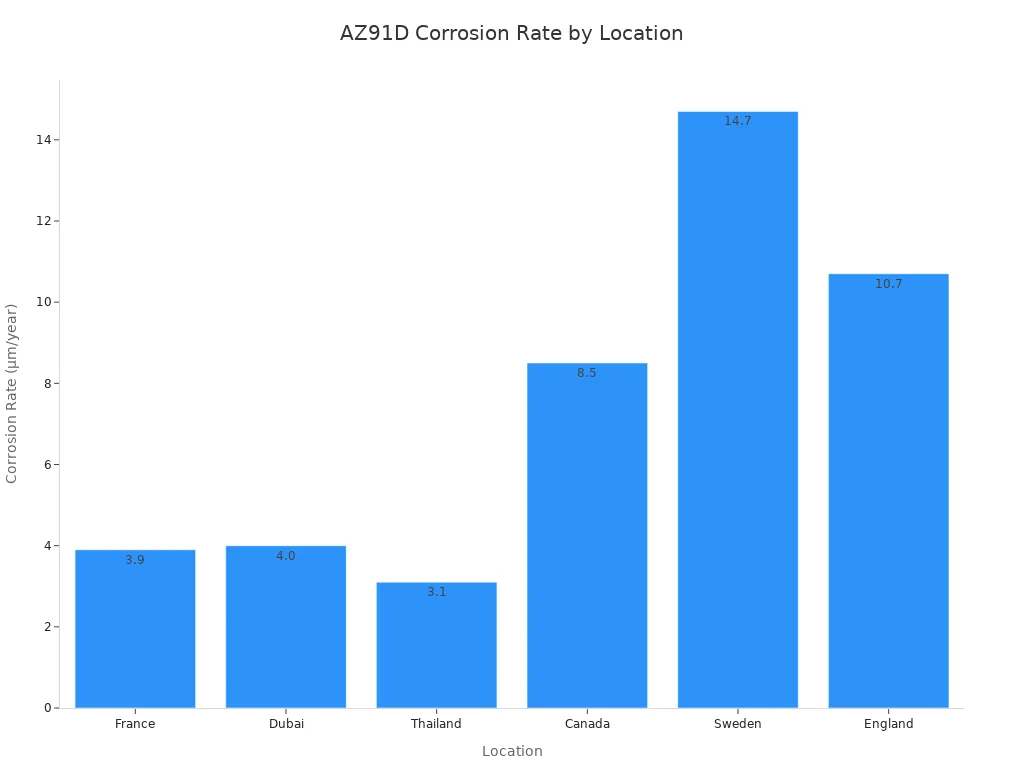
This chart visually represents the varying corrosion rates. It highlights the impact of specific environmental conditions on magnesium components. Understanding these challenges is crucial for developing effective protection strategies for magnesium die casting in outdoor applications.
Enhancing Outdoor Durability of Magnesium Die Casting Through Alloy Selection
Selecting the correct magnesium alloy significantly improves the outdoor durability of components. Engineers must consider the specific environmental challenges when choosing materials. Advanced alloy compositions offer enhanced resistance to degradation.
Importance of Specific Magnesium Alloys
Specific alloy compositions play a crucial role in determining a component's resilience in outdoor settings. These specialized alloys address magnesium's inherent reactivity.
Low-Impurity Alloys for Improved Resistance
Low-impurity alloys demonstrate superior corrosion resistance. Scientists in Germany have developed a new magnesium-calcium alloy. This alloy exhibits exceptionally low corrosion rates, even surpassing ultra-high-purity magnesium. It approaches 'stainless magnesium' due to its ability to resist corrosion. This resistance comes from reducing cathodic water reduction kinetics, forming a protective surface film, and stabilizing impurities like iron and silicon. Elektron 21® also stands out as an advanced magnesium alloy. It is specifically noted for its superior corrosion resistance. This allows it to maintain high performance over extended periods in harsh outdoor conditions.
Role of Rare Earth Elements in Alloy Performance
Rare earth elements (REEs) significantly enhance the performance of magnesium alloys. They improve both corrosion resistance and mechanical properties. Adding RE elements like Gd, Nd, Zr, and Y to Mg-based alloys increases strength at room temperature through solution strengthening. RE elements also form thermally stable intermetallic compounds, such as Mg₃RE and Mg₅RE. These compounds act as well-dispersed precipitates, impeding dislocation motion. This enhances strength and creep resistance through precipitation strengthening. Furthermore, RE elements hinder grain growth during fabrication. This leads to finer grain structures, which improve both strength and toughness through grain boundary strengthening. A comprehensive understanding of how individual REEs affect the corrosion mechanisms of pure magnesium and various magnesium alloy systems has been a significant research need. Recent findings on the influences of each REE on the corrosion properties of magnesium and its alloys have been summarized and discussed in a dedicated review. These elements also contribute to impressive mechanical properties, as seen in alloys like Mg–10Gd–2.5Er–0.5Zr, which exhibits high ultimate tensile strength and yield strength.
Comparing Magnesium Alloys for Outdoor Use
Different magnesium alloys offer varying levels of outdoor performance. Understanding these differences guides material selection.
Standard Alloys vs. High-Performance Alloys
Standard magnesium alloys, such as AZ91, provide good strength-to-weight ratios but may require more extensive surface treatments for outdoor use. High-performance alloys, often containing rare earth elements or specific impurity controls, inherently offer better corrosion resistance. These advanced alloys reduce the reliance on external coatings alone. They provide a more robust base material for demanding outdoor applications.
Tailoring Alloy Selection to Environmental Conditions
Engineers must tailor alloy selection to specific environmental conditions. For instance, marine environments demand alloys with exceptional salt spray resistance. Industrial areas with high pollution levels require alloys that withstand chemical degradation. The right alloy choice significantly extends the lifespan and reliability of magnesium die casting components in their intended outdoor settings.
Advanced Surface Treatments for Outdoor Magnesium Die Casting
Magnesium components require advanced surface treatments to withstand outdoor environments. These treatments create protective barriers. They enhance the material's inherent resistance to corrosion and degradation.
Barrier Protection with Conversion Coatings
Conversion coatings chemically alter the magnesium surface. This process forms a protective layer. These coatings serve as a crucial first line of defense against environmental elements.
Chromate and Phosphate Conversion Coatings
Chromate conversion coatings (CCCs) historically provided good corrosion protection. They also served as an excellent primer for paint adhesion. However, their use faces restrictions due to the toxicity of hexavalent chromium. Phosphate conversion coatings offer moderate corrosion resistance. They are often porous. These coatings typically require additional topcoats for optimal protection. They serve as a good base for subsequent painting or oiling.
The table below summarizes the protection levels of various coating types:
| Coating Type | Protection Level |
|---|---|
| Plasma Electrolytic Oxidation (PEO)/Micro-Arc Oxidation (MAO) | Excellent |
| Hard Anodizing | Excellent |
| Electroless Nickel Plating | Excellent |
| Certain PVD/CVD Coatings | Excellent |
| Chromate Conversion Coatings (restricted) | Good |
| Environmentally Friendly Anodizing | Good |
| Well-Applied Organic Coatings | Good |
| Phosphate Conversion Coatings | Moderate (often requires topcoats) |
| Conventional Anodizing | Moderate (often requires topcoats) |
Anodizing for Enhanced Corrosion Resistance
Anodizing processes create a thicker, more durable oxide layer on the magnesium surface. Plasma Electrolytic Oxidation (PEO), also known as Micro-Arc Oxidation (MAO), creates a hard, ceramic-like oxide coating. This significantly enhances corrosion resistance. It forms a dense, adherent ceramic layer. PEO overcomes magnesium's poor inherent corrosion resistance. Hard anodizing also offers superior corrosion resistance by forming robust barriers. Environmentally friendly anodizing options also provide good protection.
Advanced conversion coatings demonstrate significant improvements in corrosion resistance. For example:
- PEO-LDH-BTA coatings show a 30% lower corrosion rate in 3.5 wt% NaCl solution compared to standard PEO samples.
- A ZnAl-LA LDH film decreases corrosion current density by two orders of magnitude compared to a bare magnesium substrate.
- CM-LDH/MAO coatings achieve a corrosion current density of 8.38 × 10⁻¹⁰ A/cm². This is significantly lower than both MAO and LDH/MAO alone.
- CM-LDH/MAO coatings also show increased impedance values at 0.01 Hz after 120 hours of immersion. This indicates self-healing properties.
Organic Coatings for Comprehensive Protection
Organic coatings provide a comprehensive protective layer over the magnesium surface. These coatings include paints, powder coats, and e-coats. They offer excellent barrier properties against moisture, chemicals, and UV radiation.
Paints, Powder Coats, and E-Coats
E-coating is a highly effective organic coating. E-coated parts can endure 500 to 1,500 hours of salt spray testing. This makes them suitable for marine, aerospace, and heavy industrial applications. E-coatings exhibit excellent UV stability, humidity resistance, and chemical resistance. These properties qualify them for outdoor and harsh industrial environments. E-coating is utilized for magnesium components, particularly in the automotive and aerospace sectors. It provides a protective layer that enhances their durability and longevity. This addresses their susceptibility to corrosion. Powder coating is also effectively used on magnesium engine parts. It demonstrates both an excellent appearance and superior protection.
Adhesion and Durability of Organic Layers
The adhesion and durability of organic coatings on magnesium substrates depend on several key factors. These factors range from surface preparation to environmental conditions.
| Factor | Effect on Adhesion/Durability |
|---|---|
| Surface Preparation | |
| Sandblasting | Increases surface roughness, improving mechanical interlocking and adhesion. |
| Acid etching | Creates micro-porosities, enhancing surface area and chemical bonding. |
| Plasma treatment | Modifies surface chemistry, increasing wettability and promoting chemical interactions. |
| Silane coupling agents | Form a chemical bridge between the inorganic substrate and the organic adhesive, improving bond strength and durability. |
| Adhesive Properties | |
| Viscosity | Affects flow and penetration into surface irregularities; optimal viscosity ensures good wetting and minimal voids. |
| Curing mechanism | Influences bond formation and final mechanical properties; proper curing ensures complete polymerization. |
| Modulus of elasticity | Mismatched moduli between adhesive and substrate can lead to stress concentrations and premature failure. |
| Thermal expansion coefficient | Differences can induce thermal stresses during temperature fluctuations, leading to delamination. |
| Environmental Factors | |
| Temperature | High temperatures can degrade adhesive, while low temperatures can cause embrittlement. Thermal cycling can induce fatigue. |
| Humidity/Moisture | Water can plasticize adhesives, hydrolyze bonds, and promote corrosion at the interface, leading to reduced adhesion. |
| UV radiation | Can degrade organic adhesives, leading to chain scission and loss of mechanical properties. |
| Chemical exposure | Solvents or aggressive chemicals can attack and dissolve the adhesive or weaken the interface. |
| Loading Conditions | |
| Type of stress (tensile, shear, peel) | Adhesives perform differently under various stress modes; peel and cleavage stresses are generally more detrimental. |
| Rate of loading | High strain rates can lead to brittle fracture, while slow rates can allow for creep and viscoelastic deformation. |
| Cyclic loading/Fatigue | Repeated stress cycles can lead to crack initiation and propagation, reducing bond life. |
| Substrate Properties | |
| Surface energy | High surface energy substrates are generally easier to wet, promoting better adhesion. |
| Porosity | Allows for mechanical interlocking and penetration of adhesive, but excessive porosity can lead to adhesive absorption and starved joints. |
| Chemical inertness | Reactive substrates can interfere with adhesive curing or degrade the adhesive over time. |
| Mechanical strength | Weak substrates can fail cohesively before the adhesive bond fails. |
| Application Techniques | |
| Bondline thickness | Optimal thickness is crucial; too thin can lead to starved joints, too thick can lead to increased stress concentrations. |
| Pressure during bonding | Ensures intimate contact between adhesive and substrate, minimizing voids. |
| Curing conditions (time, temperature) | Proper curing ensures full develoPment of adhesive properties and bond strength. |
| Cleanliness of surfaces | Contaminants (oils, dust, release agents) prevent intimate contact and bonding. |
| Design Factors | |
| Joint geometry | Overlap joints are generally stronger than butt joints. Stress concentrations should be minimized. |
| Edge effects | Stress concentrations at the edges of bonded areas can lead to premature failure. |
| Material selection | Compatibility between adhesive and substrate is critical for long-term performance. |
| Residual stresses | Can arise from curing shrinkage or differential thermal expansion, potentially weakening the bond. |
Metallic Coatings for Severe Environments
Metallic coatings provide robust protection for magnesium in severe outdoor environments. These coatings create a durable barrier. They also offer sacrificial protection in some cases.
Nickel and Zinc Plating Applications
Electroless nickel plating provides superior corrosion resistance. It forms robust barriers. This makes it an excellent choice for demanding applications. Zinc plating also offers protection. It often acts as a sacrificial layer. The zinc corrodes before the magnesium, thereby protecting the underlying component.
Creating a Multi-Layered Protective System
A multi-layered protective system often provides the most effective defense for magnesium die casting components. This approach combines different coating types. For example, a conversion coating can serve as a base layer. An organic coating, like an e-coat or powder coat, then applies over it. This synergistic combination enhances overall protection and longevity. It leverages the strengths of each coating type. This creates a highly resilient surface against diverse outdoor challenges.
Design Considerations for Outdoor Magnesium Die Casting Applications
Effective design plays a critical role in the successful deployment of magnesium die-casting components outdoors. Thoughtful engineering can significantly extend the lifespan and performance of these parts, even in challenging environments. Designers must consider how environmental factors interact with the material and its protective systems.
Mitigating Corrosion Through Smart Design
Designers can actively prevent corrosion by incorporating specific features into the component's structure. These design choices complement material selection and surface treatments.
Avoiding Moisture Traps and Ensuring Drainage
Water accumulation is a primary driver of corrosion. Designers must create geometries that prevent moisture from collecting on surfaces. This includes incorporating sloped surfaces, drain holes, and channels to direct water away from critical areas. Eliminating crevices and stagnant zones also reduces the risk of localized corrosion. Proper drainage ensures that water, especially rainwater or condensation, does not sit on the component for extended periods.
Strategic Isolation of Dissimilar Metals
Galvanic corrosion occurs when two dissimilar metals come into contact in the presence of an electrolyte (like moisture). Magnesium is highly anodic, meaning it will corrode preferentially when coupled with most other common metals. Designers must strategically isolate magnesium components from dissimilar metals. They can achieve this through insulating washers, gaskets, or non-conductive coatings at contact points. This prevents the formation of galvanic cells and protects the magnesium.
Designing for Longevity and Maintenance
Designing for the long term involves considering not only initial performance but also ongoing upkeep and potential repairs. This approach ensures sustained functionality in outdoor settings.
Accessibility for Inspection and Repair
Components exposed to outdoor conditions require periodic inspection and maintenance. Designers should ensure easy access to critical areas for visual checks, cleaning, and potential repairs. This proactive approach helps identify and address minor issues before they escalate into major problems.
The cabinets are also designed for easy maintenance, allowing for quick access to internal systems when necessary, thereby minimizing downtime.
This design philosophy applies to all outdoor magnesium die casting applications, from industrial enclosures to consumer electronics.
Structural Integrity in Outdoor Conditions
Outdoor components face various physical stresses, including wind loads, impacts, and temperature extremes. Designers must ensure the structural integrity of magnesium die casting parts under these conditions. This involves appropriate wall thicknesses, ribbing, and reinforcement in stress-prone areas. The design must account for thermal expansion and contraction to prevent stress cracks in both the material and its protective coatings. A robust design ensures the component remains functional and safe throughout its intended service life.
Successful Outdoor Applications of Magnesium Die Casting
Magnesium die casting finds successful application in various outdoor products. These applications demonstrate the effectiveness of advanced protective strategies. Engineers leverage magnesium's lightweight properties while ensuring durability in demanding environments.
Real-World Examples of Outdoor Use
Numerous industries utilize magnesium die casting for outdoor components. These examples highlight the material's versatility and performance when properly protected.
Automotive Components and Their Protective Measures
The automotive industry extensively uses magnesium die castings for weight reduction and performance enhancement. These components often operate in harsh outdoor conditions.
- The C-5 Corvette, since 1997, features an entire magnesium alloy die-cast roof frame.
- The Cadillac XLR Convertible uses magnesium for its retractable hardtop convertible roof and top frame.
- Ford F-150 Trucks and SUVs incorporate coated magnesium castings for radiator supports.
- Volkswagen and Mercedes-Benz utilize thin-walled magnesium alloy castings in body panels.
These applications rely on robust coatings and careful design to withstand road salts, moisture, and temperature fluctuations.
Housings for Portable Electronics and Sports Equipment
Magnesium die cast housings protect portable electronics and sports equipment. These products often face exposure to weather elements. Specific surface treatments enhance their corrosion resistance and durability. Plasma Electrolytic Oxidation (PEO) is a highly effective coating technology. A Ford study showed PEO's superior corrosion protection compared to conventional chrome-based conversion techniques. PEO involves an electrolyte bath-based process. It forms an oxide coating on the magnesium substrate. A plasma discharge further modifies this coating. This allows for additional surface properties by varying the electrolyte composition. For instance, Keronite’s G3Mag PEO coating, a ceramic-like duplex coating, showed no corrosion in a rigorous six-hour salt spray test using 4% sodium chloride at 80°C on a ZE41A alloy. Other protective measures include chromate conversion coating, used as undercoats for paint adhesion or as stand-alone films in mildly corrosive environments, and anodizing, which provides a hard, corrosion-resistant coating through a sparking process in alkaline solutions.
Industrial Enclosures in Varied Climates
Industrial enclosures often house sensitive electronics or machinery. They must withstand diverse climates, from arid deserts to humid coastal regions. Magnesium die-cast enclosures offer a lightweight yet sturdy solution. Manufacturers apply multi-layered protective systems, including conversion coatings and robust organic topcoats, to ensure long-term performance against moisture, UV radiation, and pollutants.
Factors Influencing Feasibility and Adoption
Several factors determine the feasibility and widespread adoption of magnesium die casting for outdoor use. These considerations guide material selection and protection strategies.
Environmental Severity vs. Component Lifespan
The severity of the outdoor environment directly impacts the required level of protection and the expected component lifespan. A component in a mild, dry climate needs less aggressive protection than one exposed to marine salt spray or industrial pollutants. Engineers must balance the desired lifespan with the environmental challenges. This ensures the chosen solution provides adequate durability without over-engineering.
Cost-Benefit Analysis of Protective Strategies
Implementing advanced protective strategies adds to the overall cost of magnesium die-cast components. A thorough cost-benefit analysis is crucial. This analysis weighs the initial investment in specialized alloys, surface treatments, and design against the long-term benefits. These benefits include extended product life, reduced maintenance, and enhanced performance. For high-value or critical components, the added cost of robust protection often justifies itself.
Quality Control and Manufacturing for Outdoor Magnesium Die Casting
Effective quality control and precise manufacturing processes are essential for magnesium die casting components used outdoors. These steps ensure the parts meet the rigorous demands of external environments. They also guarantee the protective coatings perform optimally.
Optimizing the Die Casting Process
Optimizing the die casting process lays the foundation for durable outdoor magnesium components. This involves careful control over material flow and solidification.
Minimizing Porosity and Internal Defects
Minimizing porosity and internal defects is crucial for outdoor magnesium components. These imperfections create weak points within the casting. They reduce the effective cross-section of the part. This makes the component more prone to fracture under stress. Porosity specifically diminishes the component's strength and fatigue resistance. These properties are critical for durability in outdoor conditions. Furthermore, porosity can compromise the surface finish. This affects both aesthetic and functional requirements in outdoor applications. Manufacturers must employ advanced casting techniques and rigorous inspection to prevent these flaws.
Achieving Consistent Surface Finish for Coatings
A consistent surface finish is vital for effective coating application. A smooth, uniform surface allows coatings to adhere evenly and completely. Irregularities or rough spots can lead to uneven coating thickness. This creates areas of weakness where corrosion can initiate. Achieving a high-quality surface finish directly contributes to the longevity and performance of the protective layers.
Post-Processing and Surface Preparation
Post-processing and surface preparation are critical steps. They prepare the magnesium substrate for its protective coatings. These stages directly influence the coating's adhesion and overall effectiveness.
Criticality of Surface Cleaning and Pre-Treatment
Thorough cleaning is paramount for optimal coating adhesion on metallic substrates. Surface-modifying chemical reactions and subsequent adhesion of organic coatings require an uncontaminated surface. Unremoved soils will inhibit or prevent these chemical reactions. This is especially true with modern pretreatments like silane polymers and zirconium nanocoatings. Additionally, manufacturers must avoid undesirable reactions during cleaning. These include hydrolysis and smutting. Both can hinder pretreatment and coating adhesion.
The critical steps in surface cleaning and pre-treatment for magnesium die castings include:
- Cleaning the Surface: Always apply coatings to clean substrates. Use standard industrial methods like chemical washes or solvent cleaning, and degreasing. Ensure all cleaning residues are completely removed. If necessary, physically remove dirt, rust, mill scale, or old paint. After cleaning, handle the metal with gloves to prevent contamination from fingerprints or residual oils.
- Preheating the Parts: Preheating metal substrates to the coating's baking temperature can help remove traces of oil and other contaminants. This is especially beneficial for porous cast metals.
- Conversion Coatings: These are chemically modified metal surfaces. Examples include zinc, manganese, iron phosphates, or chromates. They improve finish adhesion and maximize corrosion resistance. Their effectiveness relies on uniformity and integrity before and after the final coating application.
Ensuring Optimal Coating Adhesion and Performance
Optimal coating adhesion and performance depend heavily on proper surface preparation. Due to magnesium's negative electrode potential, porosity, and surface impurities in castings, it is generally necessary to first apply a chemical conversion film. This typically involves a dip in zinc or manganese. After this initial conversion film, copper plating is often applied. Following this, other electroplating or chemical plating treatments can be processed. These include Zn, Ni, Cu Ni Cr, or Ni-P. These steps enhance adhesion and provide further protection. For metals resistant to chemical pretreatment or those that are not passivated, physical abrasion is often necessary to enhance adhesion. This includes methods like blasting with grit, shot, or beads, or other forms of physical surface abrasion. These techniques increase the surface area for better paint bonding.
Long-Term Performance, Monitoring, and Maintenance of Outdoor Magnesium Die Casting

Ensuring the long-term performance of outdoor magnesium die casting components requires diligent monitoring and proactive maintenance. These practices extend the lifespan of parts. They also preserve their functionality in diverse external environments.
Strategies for Extended Lifespan
Manufacturers and users implement specific strategies to maximize the operational life of magnesium die-cast products. These strategies focus on early intervention and effective repair.
Regular Inspection and Early Detection of Degradation
Regular inspections are crucial for outdoor magnesium components. They allow for the early detection of degradation. Technicians should look for signs such as coating blistering, cracking, or discoloration. They also check for localized corrosion, pitting, or material loss. Early identification of these issues prevents minor problems from escalating. This proactive approach saves significant repair costs and extends the component's service life. 🔍
Repair and Refurbishment Options for Coatings
Damaged protective coatings require prompt attention. Various repair and refurbishment options exist. For minor coating damage, touch-up paints or localized re-coating can restore protection. More extensive damage may necessitate complete stripping and reapplication of the protective system. This process ensures the underlying magnesium remains shielded from environmental elements. Effective repair maintains the component's integrity and appearance.
Understanding Environmental Impact on Longevity
The specific outdoor environment significantly influences a magnesium component's longevity. Understanding these impacts helps predict performance and plan maintenance.
Predicting Performance in Specific Outdoor Settings
Predicting performance involves analyzing environmental data. Engineers consider factors like average humidity, rainfall, temperature extremes, and pollutant levels. They also use results from accelerated corrosion tests. These tests simulate harsh conditions. This data helps estimate a component's expected lifespan in a particular outdoor setting. Accurate predictions guide material selection and protection strategies.
Maintenance Schedules for Different Applications
Different applications require tailored maintenance schedules. For example, automotive components exposed to road salts need more frequent checks than industrial enclosures in a mild climate. Components in marine environments demand rigorous, regular maintenance due to high salt spray. Establishing appropriate schedules ensures consistent protection. It also optimizes the cost-effectiveness of maintenance efforts. 🗓️
Magnesium die casting proves viable for outdoor use. A holistic protection strategy is essential. Combining advanced alloy selection, state-of-the-art surface treatments, and intelligent design principles effectively overcomes magnesium's inherent reactivity. This approach allows for the successful deployment of lightweight, durable magnesium components in diverse, demanding outdoor environments. 🛠️
FAQ
What makes magnesium reactive outdoors?
Magnesium is electrochemically active. It readily reacts with oxygen and water. This forms magnesium hydroxide and hydrogen gas. Impurities and high humidity accelerate this natural corrosion process.
Which environmental factors accelerate magnesium degradation?
Moisture, humidity, and rain significantly accelerate degradation. Temperature fluctuations and freeze-thaw cycles also cause damage. UV exposure and pollutants, like salt spray, further increase corrosion rates.
How do specific alloys improve outdoor durability?
Low-impurity alloys offer better corrosion resistance. Rare earth elements enhance both corrosion resistance and mechanical properties. These specialized alloys provide a more robust base material for outdoor applications.
What advanced surface treatments protect outdoor magnesium die castings?
Conversion coatings, like anodizing and PEO, create protective barriers. Organic coatings, such as paints and e-coats, offer comprehensive protection. Metallic coatings, like nickel plating, provide robust defense in severe environments.
Why is smart design crucial for outdoor magnesium components?
Smart design mitigates corrosion. It avoids moisture traps and ensures proper drainage. Strategic isolation of dissimilar metals prevents galvanic corrosion. This approach extends the component's lifespan and performance.
Where do we see successful outdoor applications of magnesium die casting?
Automotive components, like roof frames and radiator supports, use magnesium. Housings for portable electronics and sports equipment also utilize it. Industrial enclosures in varied climates benefit from magnesium's lightweight durability.
How do we ensure long-term performance for outdoor magnesium die castings?
Regular inspection detects degradation early. Repair and refurbishment options address coating damage. Understanding environmental impact helps predict performance. Tailored maintenance schedules ensure consistent protection. 🛠️