

Sintering of Stainless Steel Powder: Key Parameters and Challenges

Sintering of Stainless Steel Powder involves compacting metal powder and heating it below its melting point. This process fuses the particles, forming a solid, coherent mass. Controlled sintering significantly enhances material performance. It increases density, hardness, and corrosion resistance, leading to stronger, longer-lasting stainless steel materials. This process also improves mechanical properties, increasing tensile strength by 30% and impact energy by 50%. Furthermore, controlled sintering maximizes material utilization, minimizes waste, and reduces the need for extensive machining. Understanding the critical parameters and associated challenges ensures optimal outcomes for diverse applications.
Key Takeaways
- Sintering heats stainless steel powder to make it a strong, solid part. This process makes the steel harder and more resistant to rust.
- The right temperature is very important. Too low, and the part is weak; too high, and the grains grow too big, which can make the part weaker.
- The air inside the furnace matters a lot. Using gases like hydrogen stops rust and helps the steel particles stick together well.
- How long you heat the steel affects its strength. Heating it for too long can make the grains too big, which is not good.
- Small, even powder particles make stronger, denser steel. Big or uneven particles can leave holes in the final product.
- Getting rid of all the tiny holes in the steel is hard. These holes can make the steel weaker and less resistant to rust.
- Controlling how the steel shrinks and changes shape during heating is a big challenge. This helps make sure the final part is the correct size.
- Special methods like Hot Isostatic Pressing (HIP) can make the steel even stronger and remove almost all the holes.
Key Parameters in the Sintering of Stainless Steel Powder
Sintering Temperature for Stainless Steel Powder
Impact on Densification and Microstructure
Sintering temperature stands as a primary factor influencing the final properties of stainless steel parts. It directly affects the degree of densification and the resulting microstructure. As the sintering temperature increases, the relative density of the Sintered Part generally rises. For instance, parts can reach 95.83% relative density at 1390 °C. At lower temperatures, such as 1300 °C, sintered parts often exhibit a high number of large pores and lower density. Increasing the temperature to 1375 °C significantly reduces the number of pores, making the remaining pores smaller and mostly spherical. Further increasing the temperature from 1375 °C to 1390 °C continues to decrease both the number and size of pores. However, this higher temperature also leads to an increase in grain size, which can impact mechanical properties.
For common stainless steel grades, specific temperature ranges are crucial. Sintering of 316L and 17-4PH stainless steel powders often occurs at temperatures ranging from 1100 to 1340 °C. For AISI 316L and 17-4PH steels, appropriate sintering compatibility was observed at 1200 °C for 60 to 120 minutes, and at 1250 °C for shorter durations. Notably, 17-4 PH steel sintered at 1200 °C showed lower density than AISI 316L, while at 1250 °C and 1300 °C, the density relationship inverted. Researchers have also sintered 316L stainless steel powders at 1250 °C for 1 hour using both conventional and microwave sintering methods.
Temperature Uniformity and Gradients
Achieving uniform temperature distribution within the sintering furnace is critical. Temperature gradients can lead to uneven densification, differential shrinkage, and internal stresses within the component. These inconsistencies result in parts with varying properties and potential defects. Modern furnace designs incorporate advanced heating elements and insulation to minimize temperature variations, ensuring consistent material quality across the entire batch. Precise temperature control systems actively monitor and adjust heat distribution, preventing localized overheating or under-sintering.
Sintering Atmosphere for Stainless Steel Powder
Role of Reducing Atmospheres
The sintering atmosphere plays a vital role in preventing oxidation and controlling the chemical composition of stainless steel parts. Reducing atmospheres, such as hydrogen or dissociated ammonia, are commonly employed. These atmospheres react with surface oxides on the powder particles, removing them and promoting better metallic bonding. This removal of oxides is essential for achieving high densification and strong inter-particle necks.
Inert and Vacuum Sintering Environments
Inert atmospheres, like argon, prevent oxidation by excluding reactive gases. Vacuum sintering also achieves this by removing all gases from the furnace chamber. Both methods are effective in maintaining the purity of the stainless steel. Vacuum sintering is particularly useful for materials sensitive to even trace amounts of oxygen or nitrogen. It also allows for higher sintering temperatures without the risk of atmospheric contamination.
Preventing Oxidation and Carburization
Selecting the correct atmosphere is crucial for preventing undesirable reactions. Oxidation can severely degrade the mechanical properties and corrosion resistance of stainless steel. Carburization, the absorption of carbon into the material, can also occur in certain atmospheres, altering the alloy's properties.
| Property | Sintering in Dissociated Ammonia | Sintering in Hydrogen |
|---|---|---|
| Nitrogen Content | Up to 0.5 wt% increase; material becomes fully austenitic (for 302-type) | Reduced to less than 0.01 wt%; material becomes largely ferritic (for 302-type) |
| Density | Lower | Higher |
| Tensile Strength | Generally lower | Higher |
| Ductility | Less | More |
| Hardness | Higher | Lower |
| Oxide Reduction | Affected by hydrogen partial pressure | Effective in reducing oxides |
As the table illustrates, hydrogen atmospheres generally lead to higher density, tensile strength, and ductility, while dissociated ammonia can increase nitrogen content and hardness. The choice depends on the desired final properties.
Sintering Time for Stainless Steel Powder
Relationship with Densification and Grain Growth
Sintering time directly influences both densification and grain growth. Longer sintering times generally allow for greater atomic diffusion, leading to increased densification and reduced porosity. However, extended times also promote grain growth, where smaller grains merge to form larger ones. While some grain growth is inevitable, excessive grain growth can negatively impact mechanical properties like strength and toughness.
Optimizing Time for Desired Properties
Optimizing sintering time involves finding a balance between achieving sufficient densification and controlling grain size. For water-atomized 316L stainless steel powder, sintering at 1350°C for 30 minutes yields similar density to 1250°C for 120 minutes. However, the higher temperature results in significantly larger grain size (ASTM 4 vs. ASTM 6). General guidelines for stainless steels suggest a hold time of 30-60 minutes. An optimization study for 316L found that 1300°C for 60 minutes in a 100% H2 atmosphere achieved 96% density with acceptable grain size (ASTM 5-6). Increasing the temperature to 1350°C provided only a marginal density improvement (97%) but led to excessive grain growth (ASTM 3-4). This highlights the critical interplay between temperature and time in achieving optimal material characteristics during the Sintering of Stainless Steel Powder.
Heating and Cooling Rates in Sintering Stainless Steel Powder
Influence on Microstructure Evolution
Heating and cooling rates significantly influence the final microstructure and mechanical properties of sintered stainless steel. Rapid heating can cause thermal shock, leading to cracks or defects in the green compact. Slow heating allows for more uniform temperature distribution and effective binder removal. The cooling rate after sintering is equally critical. It dictates the phase transformations and precipitation kinetics within the material.
The microstructure and mechanical behavior of sintered stainless steel are significantly influenced by the sinter-cooling rate. High cooling rates, such as water-cooling, generally lead to improved mechanical properties across various stainless steel compositions. While cooling rates drastically alter microstructure and mechanical performance, porosity remains largely unaffected by these rates, being primarily determined by compaction pressure.
| Aspect | Furnace-Cooling (Slow) | Water-Cooling (High) |
|---|---|---|
| Microstructure | Typical austenite and ferrite phases with some precipitates | Different phases and precipitates, potentially avoiding brittle precipitates |
| Mechanical Properties | Generally lower mechanical results | Promotes better mechanical results for all compositions |
| Porosity | Barely affected, similar to water-cooled samples | Barely affected, similar to furnace-cooled samples |
| Overall Impact | Leads to specific microstructures and mechanical behaviors | Leads to specific microstructures and enhanced mechanical behaviors |
This table shows how different cooling rates affect the material. High cooling rates, like water-cooling, often result in better mechanical properties. They can also prevent the formation of undesirable brittle precipitates. Slow cooling, such as furnace-cooling, allows for different phase formations and precipitation. However, porosity levels remain largely unchanged by cooling rates; compaction pressure primarily determines them.
Preventing Thermal Stresses and Cracking
Preventing thermal stresses and cracking is crucial. Rapid cooling can induce significant thermal stresses due to uneven contraction, especially in complex geometries. These stresses can cause warpage, cracking, or internal defects. Controlled cooling profiles, often involving multiple stages, minimize temperature gradients within the part. This approach allows the material to cool uniformly, reducing stress buildup and maintaining dimensional stability.
Powder Characteristics for Sintering Stainless Steel
The characteristics of the initial stainless steel powderprofoundly affect the Sintering Process and the final product's quality.
Particle Size and Distribution
Particle size and its distribution are fundamental. Smaller particles offer a larger surface area-to-volume ratio. This leads to a stronger sintering driving force at high temperatures. This stronger force facilitates more effective shortening and fusion of interfaces between particles. Consequently, pores reduce quicker, forming a denser structure with lower porosity. Conversely, larger particle sizes result in an insufficient sintering driving force. This leads to inadequate bonding between particles and higher porosity.
| Stainless Steel Type | Particle Size Characteristics | Sintering Driving Force | Densification | Porosity | Shrinkage | Hardness Distribution |
|---|---|---|---|---|---|---|
| 17-4PH | Small and uniform | Stronger (due to larger surface area) | Higher, forms denser structure | Low, pores quickly reduced | Highest, uniform in all directions | More consistent |
| 316L | Medium | Moderate | Moderate | Moderate | Moderate | Moderate, stable |
| 304 | Larger and uneven | Insufficient | Lower, poor densification | Highest | Lowest | Lower and less uniform, largest fluctuation range |
This table illustrates the impact of particle size on various stainless steel types. For example, 17-4PH, with small and uniform particles, achieves high densification and low porosity. In contrast, 304, with larger and uneven particles, shows lower densification and higher porosity. This also affects the total deformation of the material.
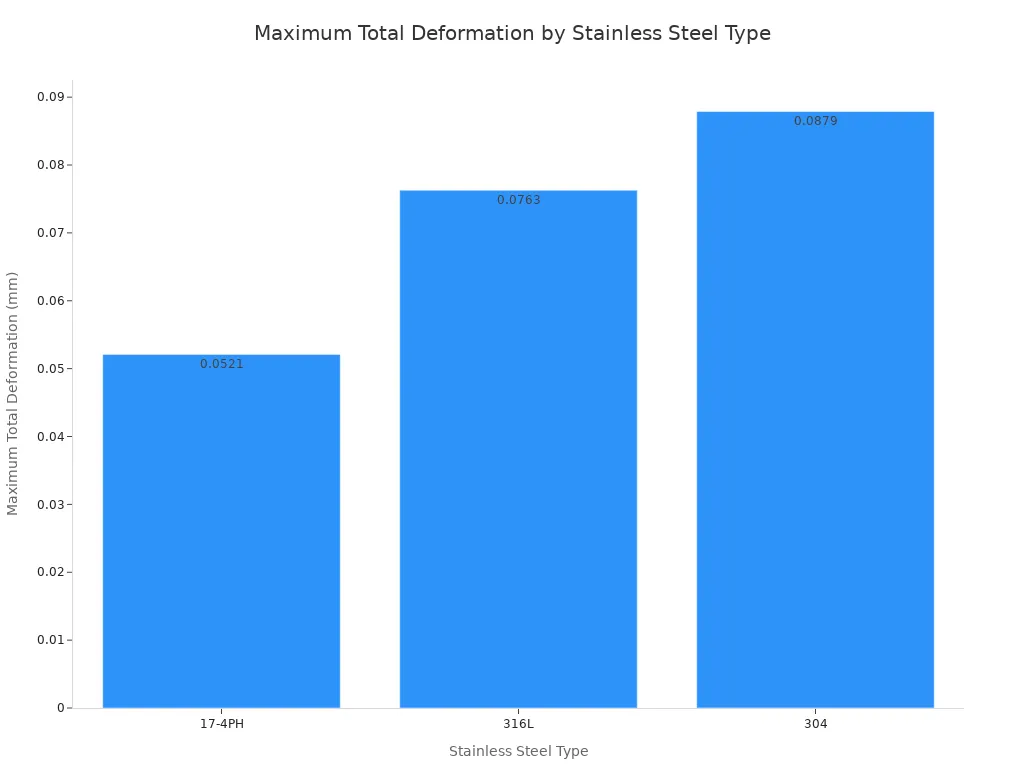
The chart above shows that 17-4PH stainless steel exhibits the lowest maximum total deformation, indicating better dimensional stability due to its optimal particle characteristics.
Particle Shape and Morphology
Particle shape and morphology also play a significant role. Irregularly shaped particles tend to interlock more effectively during compaction, leading to higher green density. However, spherical particles often sinter more efficiently due to their lower surface energy and more uniform contact points. The choice of particle shape depends on the desired balance between green strength and sinterability.
Chemical Composition and Alloying Elements
The chemical composition of the stainless steel powder dictates its inherent properties and sinterability. Alloying elements like chromium, nickel, and molybdenum provide corrosion resistance and mechanical strength. Other elements, even in small amounts, can significantly influence the sintering process.
The addition of graphite to AISI 316L stainless steel powder significantly impacts sinterability and final properties. Increasing the proportion and specific surface area of graphite leads to higher densities and lower porosity in both compacts and sinters. For instance, samples with 0.3% by weight of graphite nanopowder (400 m2/g BET specific surface area) achieved the highest densities and lowest total porosity (7.5%) after sintering at 1280 °C. This improvement is attributed to the carbothermal reduction of oxides like chromium and silicon. These oxides are crucial for initiating the sintering process and exposing clean metallic surfaces. This enhances densification and reduces porosity.
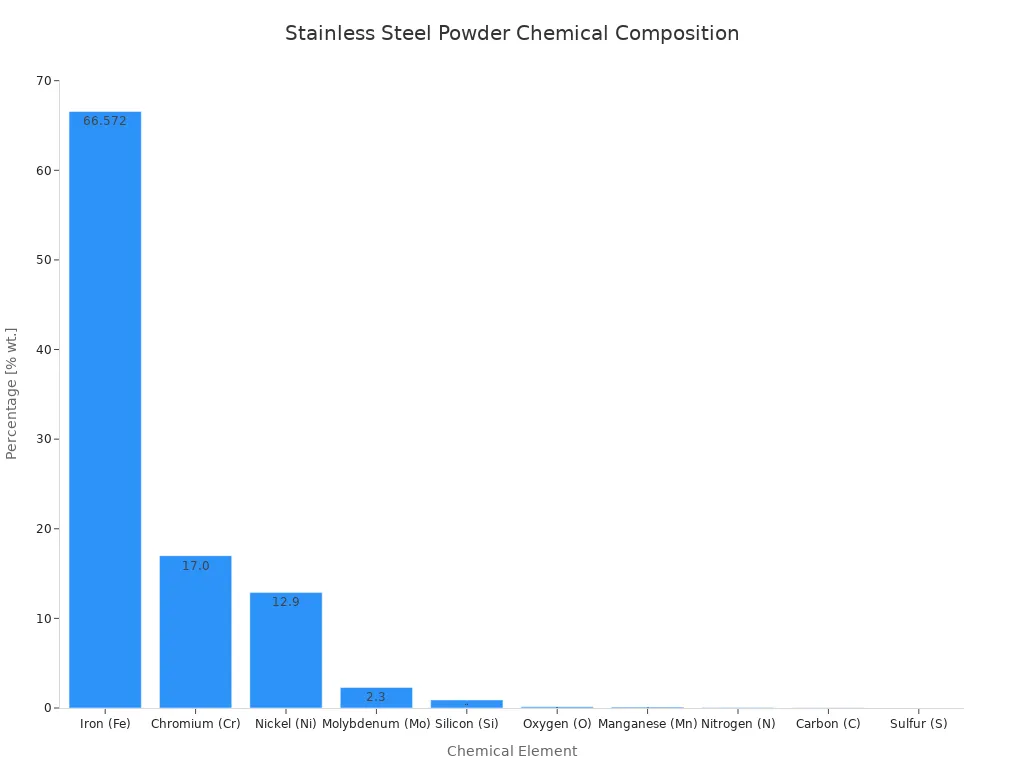
This chart shows a typical chemical composition of stainless steel powder, highlighting the balance of elements like iron, chromium, and nickel.
| Chemical Element | Percentage [% wt.] |
|---|---|
| Carbon (C) | 0.018 |
| Sulfur (S) | 0.01 |
| Molybdenum (Mo) | 2.3 |
| Nickel (Ni) | 12.9 |
| Manganese (Mn) | 0.1 |
| Chromium (Cr) | 17.0 |
| Silicon (Si) | 0.9 |
| Oxygen (O) | 0.14 |
| Nitrogen (N) | 0.06 |
| Iron (Fe) | Balance |
The presence of elements like silicon and molybdenum, as shown in the table, influences the material's response during sintering.
Green Compact Properties for Sintering Stainless Steel
The properties of the green compact, the unsintered pressed powder part, significantly influence the final sintered product.
Green Density and Porosity
Green density refers to the density of the compact before sintering. It directly correlates with the final sintered density and mechanical properties. A higher green density generally means less porosity to eliminate during sintering, leading to a denser final product.
Lower green density in 17-4 PH compacts consistently leads to a lower sintered density. This relationship is also influenced by the sintering environment, with a hydrogen atmosphere resulting in higher densification compared to a vacuum at the same sintering temperature (1240 °C).
A direct correlation exists where a lower green density in 17-4 PH compacts results in a lower final sintered density. The sintering environment also plays a crucial role. A hydrogen atmosphere promotes greater densification than a vacuum when compacts are sintered at 1240°C. This highlights the importance of achieving optimal green density and selecting the right sintering atmosphere for effective Sintering of Stainless Steel Powder.
Binder Content and Removal
Binders are organic additives mixed with the powder to provide sufficient green strength for handling before sintering. The amount and type of binder are critical. Too much binder can lead to excessive shrinkage and defects during removal. Too little binder results in a fragile green compact. Binder removal, or debinding, is a crucial step before high-temperature sintering. It involves heating the compact slowly to volatilize or decompose the binder without damaging the part. Incomplete binder removal can leave carbon residues, which can negatively affect the final material properties and corrosion resistance.
Challenges in the Sintering of Stainless Steel Powder
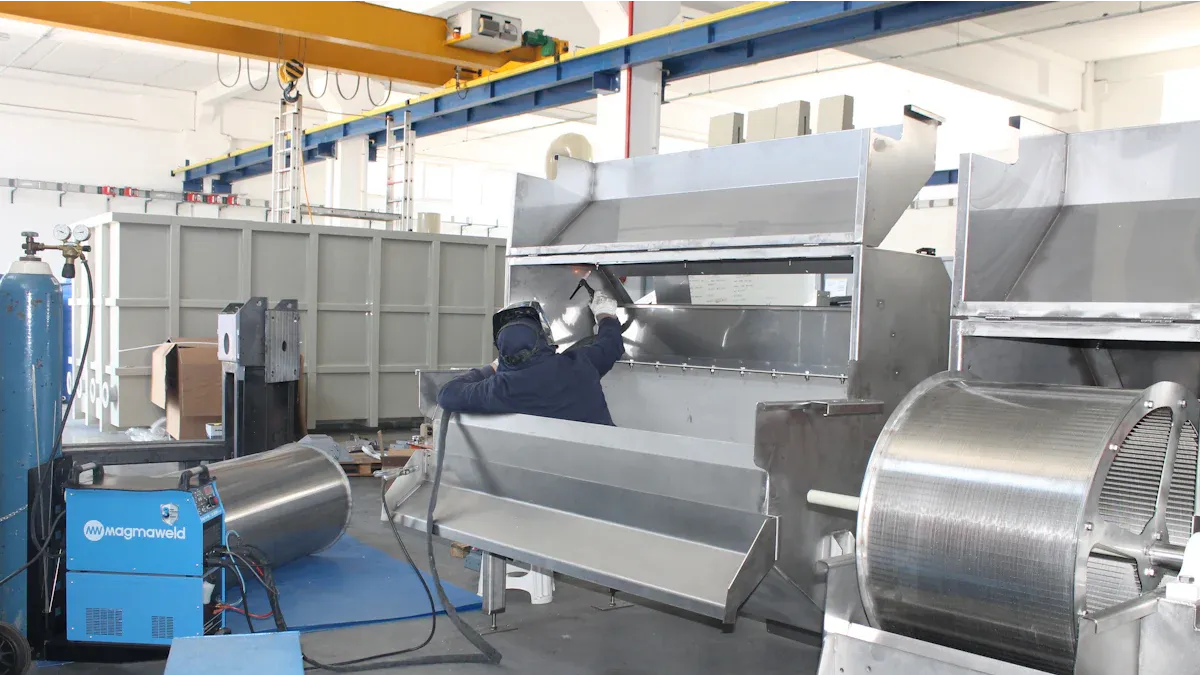
Sintering stainless steel powder presents several complex challenges. Manufacturers must overcome these obstacles to produce high-quality components with desired properties. These challenges range from achieving optimal density to controlling the final dimensions and microstructure of the parts.
Achieving Full Densification in Sintering Stainless Steel
Achieving full densification is a primary goal in sintering. However, several factors often prevent this ideal state.
Residual Porosity Issues
Residual porosity remains a significant issue in sintered stainless steel components. This porosity can compromise mechanical properties and corrosion resistance. Stainless steel powders, especially austenitic grades like 316L, inherently resist compaction. They possess high hardness and work-hardening rates. Ferritic and martensitic grades show only slight improvements in this regard. Chromium oxide layers on powder particles also hinder effective particle-to-particle bonding during sintering. This oxide layer acts as a barrier.
Controlling the sintering atmosphere presents another challenge. A narrow processing window exists. This window balances the need to reduce surface oxides with preventing chromium depletion. Hydrogen-based atmospheres effectively reduce oxides but can lead to chromium loss. Vacuum sintering effectively removes contaminants but faces economic and scaling limitations. Particle characteristics also play a role. Finer particles increase surface area for sintering but also increase interparticle friction and oxygen content. Irregular particle shapes help green strength but create non-uniform pore structures that are difficult to eliminate. Furthermore, advanced densification techniques like hot isostatic pressing (HIP) or high-temperature sintering add significant costs. These costs make such methods economically unfeasible for many applications. Achieving precise dimensions is also challenging due to differential shrinkage, which causes distortion and variability. This often requires costly secondary operations.
Factors Hindering Densification
Several specific factors hinder full densification during the sintering of stainless steel powder. Powder characteristics, including mean size and particle size distribution, directly influence green part density, densification, and shrinkage. Sintering below the solidus temperature typically does not achieve the final stage of sintering for most powders. Sintering above the solidus temperature with powders in the 16–63 μm range rapidly removes larger pore sections. This can achieve over 99% sintered densities. However, using particle ranges of 16–25 μm and 53–63 μm above the solidus temperature does not eliminate large pores. This results in lower sintered densities.
Narrow size distributions often lead to a higher population of pore defects. They also cause non-uniform, anisotropic shrinkage, making them less suitable for complex structures. Bimodal powder use, which combines different particle sizes, results in greater packing density. It also initiates densification at lower temperatures due to increased capillary forces from fine powder. Optimization of print speed and compaction mechanisms directly affects powder compaction and green density. Binder saturation is a critical variable. It influences green density, internal defects, contamination, and sintering behavior. Higher temperatures with shorter dwell times lead to faster densification. Conversely, lower temperatures require longer dwell times. Carbon contamination from binders, particularly in materials like 316L stainless steel, can influence the solidus temperature and affect sintering.
Microstructure Control During Sintering of Stainless Steel
Controlling the microstructure is crucial for achieving desired material properties. This involves managing grain growth, phase transformations, and the homogeneity of alloying elements.
Grain Growth and Its Effects
Grain growth during sintering significantly impacts the mechanical performance of stainless steel parts. Excessive grain growth can reduce strength, hardness, and toughness. Precise temperature control ensures uniform densification and prevents this excessive grain growth. Regular furnace calibration is vital for accurate temperature profiles. Managing sintering time is also crucial. Insufficient time leads to poor densification, while excessive time causes undesirable grain growth. Atmosphere control protects parts from oxidation and contamination. Nitrogen creates an inert environment, while vacuum sintering eliminates contamination and helps control grain growth. Adjusting heating and cooling rates also controls the microstructure and mechanical properties. This prevents defects and ensures consistent quality. The base powder mix design, including composition and particle size, is critical for achieving a fine grain size and minimal porosity. Selecting alloying elements that increase effective self-diffusivity can improve sinterability and densification rates. This leads to less grain growth during sintering and improved yield strength.
Phase Transformations and Management
Stainless steels undergo various phase transformations during heating and cooling cycles. These transformations can significantly alter the final properties of the material. For example, austenitic stainless steels can form ferrite or carbides, depending on temperature and cooling rates. Managing these transformations involves careful control of the sintering temperature, holding time, and cooling rate. This ensures the formation of desired phases and avoids detrimental ones. Proper phase management is essential for optimizing corrosion resistance and mechanical strength.
Homogeneity of Alloying Elements
Achieving a homogeneous distribution of alloying elements is another critical challenge. Stainless steels rely on elements like chromium, nickel, and molybdenum for their unique properties. During sintering, these elements must diffuse evenly throughout the material. Inhomogeneous distribution can lead to localized variations in properties. This includes differences in corrosion resistance or mechanical strength. Factors like powder mixing, particle size, and sintering time influence the homogeneity of alloying elements. Longer sintering times generally promote better diffusion and more uniform distribution.
Dimensional Stability in Sintering Stainless Steel Powder
Maintaining dimensional stability is a major concern in powder metallurgy. Parts often experience shrinkage, warpage, and distortion during sintering.
Shrinkage Prediction and Management
Shrinkage is an inherent part of the sintering process. Predicting and managing it, especially for complex geometries, is vital. Sintering simulations, particularly those based on the Finite Element Method (FEM) and multiscale models, are crucial tools. These simulations incorporate thermo-mechanical coupling, viscoplastic behavior, and grain growth kinetics. This helps resolve spatial variations in stress, strain, temperature, and porosity. Such detailed modeling is essential for capturing anisotropic shrinkage and localized deformation in complex geometries. Simplified models might overestimate shrinkage. Incorporating microstructural details like porosity distribution and density gradients can improve accuracy. Future work suggests hybrid models combining macro-level FEM with micro-scale kinetic models or data-driven surrogates for higher fidelity and speed. Material model calibration using experimental and in situ data is also critical to enhance prediction reliability. This focuses on parameters like sintering stress, friction coefficient, and grain growth dynamics. This also extends to microstructural representation, integrating details like layer resolution, void anisotropy, and infill path strategies to simulate true deposition and sintering behavior.
The ultimate goal is to transition towards process-aware predictive design. This moves away from trial-and-error scaling to simulation-based design for sintering. This approach enables predictive distortion compensation and mechanical performance forecasting before printing. It leads to cost, time, and defect reduction. Understanding and quantifying anisotropic shrinkage behavior is a significant strategy. This involves theoretical studies and experimental investigations, including three-directional dilatometry, scanning electron microscopy, and X-ray computed tomography. Anisotropic shrinkage can originate from anisotropic microstructure, such as preferential orientation of particles or uneven density distribution. External fields like stress, gravity, and thermal gradients also contribute. Analytical modeling, linking sintering stress and viscosity tensors to shrinkage, provides an in-depth understanding. Efforts to alleviate anisotropic shrinkage include tailoring internal microstructures, such as adding pore formers to improve pore interconnectivity. Appropriate modifications to the CAD file design also help. For processes like binder jetting, in-process monitoring systems visualize shrinkage and deformation on larger samples. This allows for correlating strain evolution with porosity based on feedstock and sintering temperatures. The influence of green density, powder characteristics, and the binder jet printing process on anisotropic shrinkage (e.g., Z > X > Y direction) is also highlighted.
Warpage and Distortion Control
Warpage and distortion are common issues that affect the final shape and functionality of sintered parts. Sintering conditions, including isothermal sintering temperature, holding time, and sintering atmosphere, directly influence densification and volumetric shrinkage. Anisotropic shrinkage, with higher shrinkage along the building direction (Z) compared to the building plane (X-Y), often occurs. This is attributed to the layer-by-layer manufacturing process and residual porosity between layers. Inhomogeneous green density, resulting from binder-powder interaction or sample geometry, causes shape distortion. Frictional forces between the part surface and the support plate during sintering lead to inhomogeneous deformation. Gravity-induced loads cause severe deformation, particularly in cantilever beams and overhanging structures. Printing-related factors like layer shifting and slight anisotropy in the X-Y plane, due to roller and printhead movement, also contribute to dimensional instability. Effective control requires careful process optimization and design considerations.
Preventing Corrosion and Contamination in Sintering Stainless Steel
Manufacturers face significant challenges in preventing corrosion and contamination during the sintering process. These issues directly impact the final product's performance and longevity.
Surface Oxidation During Sintering
Surface oxidation is an unavoidable process during stainless steel powder production, handling, and processing. Exposure to the environmental atmosphere causes this oxidation, especially for metals with a high affinity for oxygen. The chemistry of the formed oxides primarily depends on oxygen-gettering elements such as chromium, manganese, and silicon. These surface oxides significantly alter the powder's melting and solidification behavior. They increase the full melting temperature due to reduced permeability of liquid steel (a "cage effect") and poor wetting. Additionally, surface oxidation modifies the steel composition by consuming solute elements like chromium, manganese, and and silicon, which possess high oxygen affinity. The entrapped oxides can also lead to inclusion agglomeration, reducing the number density of heterogeneous nucleation sites and promoting undesired coarse columnar grain growth.
To prevent surface oxidation, manufacturers employ various strategies:
- Chemical Inhibitors: These interfere with the oxidation process. They form protective layers on the metal surface, adsorb onto the surface to alter its chemistry, or promote the formation of a stable passive oxide layer. Examples include organic inhibitors (amines, phosphonates, organic acids) and inorganic inhibitors (chromates, phosphates, silicates).
- Environmental Control Strategies: These involve manipulating the environment to make it less favorable for oxidation. Key strategies include:
- Oxygen Reduction: Achieved through inert gas purging (e.g., nitrogen) or vacuum packaging to create an oxygen-free environment.
- Moisture Control: Utilizing desiccants or dehumidification to maintain low humidity levels.
- Temperature Management: Lowering temperatures significantly slows down the oxidation process.
- Physical Barriers: These separate the reactive material from oxidative elements. Methods include:
- Coatings and Paints: Applying protective paints, powder coatings, or specialty coatings (e.g., zinc-rich paints, epoxy coatings).
- Plating: Electroplating with other metals (e.g., gold, chromium) or galvanization (applying a zinc coating).
- Anodizing: Thickening the natural oxide layer on aluminum to enhance resistance.
- Sealants and Varnishes: Applying clear sealants or marine varnishes to create a protective barrier.
- Corrosion-Resistant Materials: Using materials like stainless steel or specific alloys that naturally form a protective oxide layer.
Intergranular Corrosion Susceptibility
Intergranular corrosion in stainless steels occurs due to the formation of chromium carbides, mainly concentrated in the grain boundaries. This leads to chromium depletion, making the regions around the grain boundaries anodic and resulting in a deterioration of corrosion resistance. The susceptibility to intergranular corrosion, or sensitization, increases significantly when aging occurs at temperatures higher than 495 °C.
Intergranular corrosion in stainless steel arises from two primary factors: the presence of MnS inclusions and chromium depletion. MnS inclusions act as initiation sites for pitting corrosion. Subsequently, intergranular corrosion occurs when this pitting corrosion reaches chromium-depleted regions along the sensitized grain boundaries. Chromium depletion itself is caused by the formation of chromium carbides, primarily concentrated at grain boundaries, which makes these regions anodic and reduces corrosion resistance. The dissolution of MnS inclusions can also be the first step in depassivation, leading to intergranular corrosion due to the dissolution of these chromium-depleted regions.
Contamination from Furnace Environment
The furnace environment itself can introduce contaminants that degrade the quality of sintered stainless steel. Residual oxygen or moisture in the furnace atmosphere, even in trace amounts, can lead to oxidation. Carbon contamination from furnace elements, lubricants, or incomplete binder removal can also occur, affecting the material's mechanical properties and corrosion resistance. Proper furnace maintenance, including regular cleaning and leak checks, helps minimize these risks. Using high-purity process gases and ensuring efficient binder burnout cycles are also crucial steps in preventing contamination.
Optimizing Mechanical Properties After Sintering Stainless Steel
Optimizing the mechanical properties of sintered stainless steel is essential for its intended application. This involves carefully balancing various characteristics.
Balancing Strength and Ductility
Achieving an optimal balance between strength and ductility is a critical goal. High strength often comes at the expense of ductility, and vice versa. Sintering parameters, such as temperature, time, and atmosphere, directly influence this balance. For example, higher sintering temperatures can increase density and strength but may also lead to excessive grain growth, which reduces ductility. Alloying elements and post-sintering heat treatments also play a significant role in tailoring these properties. Engineers often use specific heat treatment cycles to refine the microstructure, enhancing both strength and toughness.
Hardness and Wear Resistance
Hardness and wear resistance are vital properties for applications requiring durability and resistance to abrasion. Sintered stainless steel parts often find use in demanding environments. The density of the sintered part directly correlates with its hardness; higher density generally means greater hardness. Alloying elements like carbon, chromium, and molybdenum contribute significantly to hardness. Post-sintering treatments, such as carburizing or nitriding, can further enhance surface hardness and wear resistance without compromising the core properties.
Fatigue Performance Considerations
Fatigue performance is a crucial consideration for components subjected to cyclic loading. Pores and inclusions within sintered parts can act as stress concentrators, initiating fatigue cracks. Therefore, minimizing porosity and achieving high densification are paramount for improving fatigue life. The Sintering of Stainless Steel Powder process aims to reduce these internal defects. Microstructural homogeneity and grain size also influence fatigue resistance. Finer, more uniform grain structures generally exhibit better fatigue properties. Surface finishing techniques, such as shot peening, can introduce compressive residual stresses on the surface, further enhancing fatigue strength.
Solutions and Best Practices for Sintering of Stainless Steel Powder
Manufacturers employ various solutions and best practices to overcome the challenges in sintering stainless steel powder. These strategies aim to optimize material properties and ensure high-quality components.
Advanced Sintering Techniques for Stainless Steel
Hot Isostatic Pressing (HIP)
Hot Isostatic Pressing (HIP) significantly enhances the density and mechanical properties of sintered stainless steel components. This process densifies any pore not connected to the outer surface, as such pores are susceptible to closure. HIP reduces dimensional variability across components by bringing all parts to near 100% density, even if initial sintering resulted in density variations. The increase in density directly correlates with improved mechanical properties, including hardness, yield strength (YS), and ultimate tensile strength (UTS). Dynamic properties like elongation, fatigue, and impact strength show the most significant improvements due to HIP's ability to mitigate microstructural defects.
- HIP treatment increased the relative density of binder jetted 316L stainless steel from 90.5% (as-sintered) to 97%, leading to enhanced tensile strength through pore elimination.
- For another set of binder jetted 316L SS specimens, HIP enhanced relative density from 95% to approximately 99%, resulting in:
- 15% increase in yield strength
- 5% increase in ultimate tensile strength (UTS)
- 30% increase in elongation
- HIPed specimens achieved a minimum relative density of 99.5% when sintered at 1370 ℃ or higher temperatures, compared to 87% to 99.5% for sintered-only parts.
Spark Plasma Sintering (SPS)
Spark Plasma Sintering (SPS) offers rapid densification at lower temperatures. This technique uses pulsed direct current and uniaxial pressure. SPS is particularly useful for materials requiring fine grain structures or specific phase compositions. One application of Spark Plasma Sintering (SPS) involves the creation of metal-carbon nanotubes. This process utilizes a complex powder formed by ball milling a metal powder with single-walled carbon nanotube powder. The metal powder, with an average particle size of 1 to 5 μm, can be selected from a group that includes stainless steel, alongside aluminum, aluminum alloys, copper, titanium, and titanium alloys.
Microwave Sintering Applications
Microwave sintering provides rapid and volumetric heating. This leads to faster densification and reduced energy consumption. It also offers the potential for finer microstructures and improved mechanical properties compared to conventional sintering methods.
Powder Pre-treatment and Blending for Sintering Stainless Steel
Surface Activation Techniques
Surface activation techniques prepare powder particles for optimal sintering. These methods remove surface oxides or contaminants, promoting better metallic bonding. Techniques include chemical etching or mechanical milling, which create fresh, reactive surfaces.
Homogeneous Powder Mixing Strategies
Homogeneous powder mixing is crucial for uniform material properties. Inconsistent blending leads to localized variations in composition and density. Advanced blending techniques, such as V-blenders or planetary mixers, ensure a uniform distribution of alloying elements and binders throughout the powder mixture.
Furnace Design and Control for Sintering Stainless Steel
Uniform Temperature Zones
Advanced furnace designs are essential for achieving uniform temperature zones. This prevents uneven densification and part distortion.
- Multi-zone designs feature multiple independent heating zones. Each zone has its own thermocouple and controller. This allows for active compensation of heat loss at the ends of the tube by setting end zones to slightly higher temperatures. This flattens the temperature profile and creates a larger, more uniform hot zone.
- High-quality thermal insulation prevents heat from escaping. It concentrates thermal energy within the heating chamber. This ensures efficient use of energy from heating elements to heat the sample, contributing to a stable and uniform internal temperature.
- The material of the process tube, such as quartz or alumina, plays a role in uniformity. Materials like quartz efficiently and evenly transmit heat radiation. This distributes thermal energy uniformly across the sample.
- Cylindrical heating elements provide 360-degree radiant heat. This ensures even exposure from all sides of the sample.
- A PID control system uses thermocouples to continuously adjust power to the heating elements. This maintains stable and precise temperatures throughout the process.
Precise Atmosphere Management Systems
Precise atmosphere management systems are vital for controlling the sintering environment.
- Advanced digital controllers with programmable PID control enable precise execution of complex thermal profiles. This is crucial for processes like sintering, ensuring consistent and uniform temperature application.
- The choice of materials for furnace tubes (e.g., alumina, quartz, molybdenum, tungsten) is critical. These materials are selected for their ability to withstand high temperatures, corrosive environments, and mechanical stress. This contributes to stable and uniform thermal performance. These systems prevent oxidation, control carburization, and maintain the desired chemical composition of the stainless steel.
Post-Sintering Treatments for Stainless Steel Powder
After the primary sintering process, stainless steel components often undergo additional treatments. These post-sintering steps further enhance material properties and refine surface characteristics. These treatments are crucial for meeting specific application requirements.
Heat Treatment for Property Enhancement
Heat treatment is a critical post-sintering step. It significantly improves the mechanical properties of sintered stainless steel. This process modifies the microstructure, enhancing strength, hardness, and ductility. For 15-5 PH stainless steel, common post-sintering heat treatments include solution annealing and precipitation hardening (aging). These treatments are vital in additive manufacturing. They influence the alloy's strength, hardness, and ductility.
Specific heat treatment protocols are often employed:
- Solution Annealing: This process occurs at 1038 °C for 1 hour. Air cooling follows this step. This treatment normalizes the crystal microstructure. It transforms it into a body-centered cubic (BCC) structure.
- Aging: This treatment is conducted at 482 °C for 1.5 hours. Air cooling follows. This process generates copper-rich precipitates. It refines the grain structure. It also increases hardness through precipitation hardening.
- Modified Solution Annealing: This involves extending the soaking time to 3 hours at 1038 °C. Air cooling follows.
- Forging (Annealing): This involves annealing at 1200 °C for 1.5 hours. Furnace cooling follows.
These precise thermal cycles optimize the material's internal structure. They ensure the final product exhibits superior performance.
Surface Finishing and Densification Methods
Surface finishing techniques are essential for improving the aesthetic and functional qualities of sintered stainless steel parts. Sintered components often have a rough surface finish and some residual porosity. Mechanical methods like machining, grinding, and polishing remove surface irregularities. They achieve tighter dimensional tolerances. These processes also enhance surface smoothness. This improves corrosion resistance and reduces friction.
Other densification methods can further reduce porosity. These methods include infiltration. Infiltration involves filling residual pores with a lower melting point metal or alloy. This increases density and improves mechanical properties. Surface densification techniques, such as shot peening or surface rolling, introduce compressive residual stresses. These stresses enhance fatigue life and wear resistance. These post-sintering treatments ensure the stainless steel components meet stringent performance standards.
Impact of Sintering on Final Stainless Steel Material Properties
Sintering profoundly influences the final properties of stainless steel materials. It dictates mechanical strength, corrosion resistance, and physical characteristics. Understanding these impacts helps engineers design components for specific applications.
Mechanical Properties of Sintered Stainless Steel
Sintering significantly shapes the mechanical performance of stainless steel. It directly affects how the material withstands forces and deformation.
Tensile Strength and Yield Strength
Sintering enhances both tensile strength and yield strength. These properties measure a material's resistance to breaking and permanent deformation. For instance, adding 0.2 wt% graphene to copper/stainless steel composites can dramatically improve these values.
| Property | Increase with Gr-Cu/SS (0.2 wt% graphene) |
|---|---|
| Tensile Strength | 74.0% |
| Yield Strength | 65.5% |
Heat treatment after sintering further optimizes these properties. Researchers have reported impressive results for as-sintered and heat-treated stainless steel.
| Property | Value (As-sintered) | Value (After Heat Treatment) |
|---|---|---|
| Tensile Strength | Best reported so far | 1.35 GPa |
| Yield Strength | Best reported so far | 1.11 GPa |
Elongation and Toughness
Elongation measures a material's ability to stretch before breaking. Toughness indicates its capacity to absorb energy before fracturing. Sintering parameters, especially those that reduce porosity and refine grain structure, improve these characteristics. The same heat treatment that boosts strength also enhances ductility.
| Property | Value (As-sintered) | Value (After Heat Treatment) |
|---|---|---|
| Elongation | Best reported so far | 7.8% |
Corrosion Resistance of Sintered Stainless Steel
Sintering plays a crucial role in establishing the corrosion resistance of stainless steel. This resistance relies heavily on the formation and stability of a protective layer.
Passivation Layer Formation
The passive layer acts as a corrosion barrier. Chromium oxide is a key component. It forms through a chemical reaction between oxygen in the air and chromium in the stainless steel. This layer can regenerate when oxygen is present, even after being scratched. However, high temperatures and chloride ions can diminish its protective capacity.
- Passivating the powder before sintering improves the passive layer's stability.
- Grain size reduction enhances the passivation properties of 316L stainless steel in neutral electrolytes.
- Molybdenum (Mo) addition thickens the Cr-based passivation film and restores its ability. This significantly improves resistance to chloride pitting.
- Factors like grain size, porosity, and pre-sintering passivation treatments influence the stability and formation of the passivation layer.
Resistance to Various Environments
Sintered stainless steel's ability to resist corrosion in various environments depends on the integrity of its passivation layer. A dense, homogeneous microstructure with minimal porosity supports a robust passive film. This protects the material from aggressive media, including acids, bases, and chloride solutions.
Physical Properties of Sintered Stainless Steel
Sintering also determines key physical properties. These include density, porosity, and conductivity.
Density and Porosity
Sintering increases the density of the material by reducing porosity. Higher sintering temperatures and longer times generally lead to greater densification. The remaining porosity directly impacts other physical and mechanical properties.
Thermal and Electrical Conductivity
As porosity increases in sintered materials, both thermal and electrical conductivity decrease. This happens because porosity reduces the cross-sectional area available for heat or electrical flow. It also increases the path length required to bypass the pores. This relationship is consistently observed across various models. Conductivity approaches that of a fully dense material as porosity approaches zero. It decreases towards zero as porosity increases.
- Numerous analytical expressions model the dependence of thermal and electrical conductivity on porosity. Both are transport phenomena influenced similarly by porosity.
- Pore morphology and connectivity significantly affect model accuracy. Many expressions include empirical parameters to account for microstructural influences like pore shape and size.
- Some models, such as those by Odelevskii, Grootenhuis et al., and Loeb, are well-validated for very low porosity ranges.
- Other models, including those by McLachlan, Gruzdev et al., Montes et al., Pabst et al., and Solonin et al., apply to higher porosity ranges. They satisfy upper boundary conditions relevant to powdered systems.
## Conclusion Sintering stainless steel powder demands precise control over several critical parameters. Sintering temperature, time, and atmosphere are paramount. These factors directly influence the microstructure, pore characteristics, and final density of components. Achieving optimal performance requires careful management of these interacting variables. The sintering process significantly affects final density and mechanical properties. The industry is moving towards advanced powder production techniques and increasing adoption of [additive manufacturing](https://www.jhpim.com/news/powder-metal-manufacturing-pmm/). This trend is driven by the demand for high-performance materials and sustainability. FAQ
What is sintering of stainless steel powder?
Sintering involves heating compacted stainless steel powder below its melting point. This process fuses the particles together. It forms a solid, dense component. This method enhances material properties like strength and hardness.
Why is sintering temperature important?
Sintering temperature directly affects densification and microstructure. Higher temperatures generally lead to denser parts. However, excessive heat can cause undesirable grain growth. Precise temperature control ensures optimal material properties.
What role does the sintering atmosphere play?
The sintering atmosphere prevents oxidation and controls chemical composition. Reducing atmospheres, like hydrogen, remove surface oxides. Inert gases or vacuum environments maintain material purity. This choice impacts the final part's quality.
What are common challenges in sintering stainless steel?
Challenges include achieving full densification, controlling microstructure, and maintaining dimensional stability. Preventing corrosion and contamination also presents difficulties. Manufacturers must carefully manage these factors for successful outcomes.
How does particle size affect sintering?
Smaller particles offer a larger surface area. This promotes stronger sintering forces and better densification. Larger or uneven particles can lead to higher porosity and less effective bonding. Particle size distribution is crucial.
What is Hot Isostatic Pressing (HIP)?
Hot Isostatic Pressing (HIP) is an advanced technique. It applies high pressure and temperature simultaneously. HIP significantly reduces internal porosity. This process enhances the density and mechanical properties of sintered stainless steel components.
How does sintering affect corrosion resistance?
Sintering influences the formation of a protective passivation layer. A dense, homogeneous microstructure with minimal porosity supports a robust passive film. This film is essential for the material's resistance to various corrosive environments.