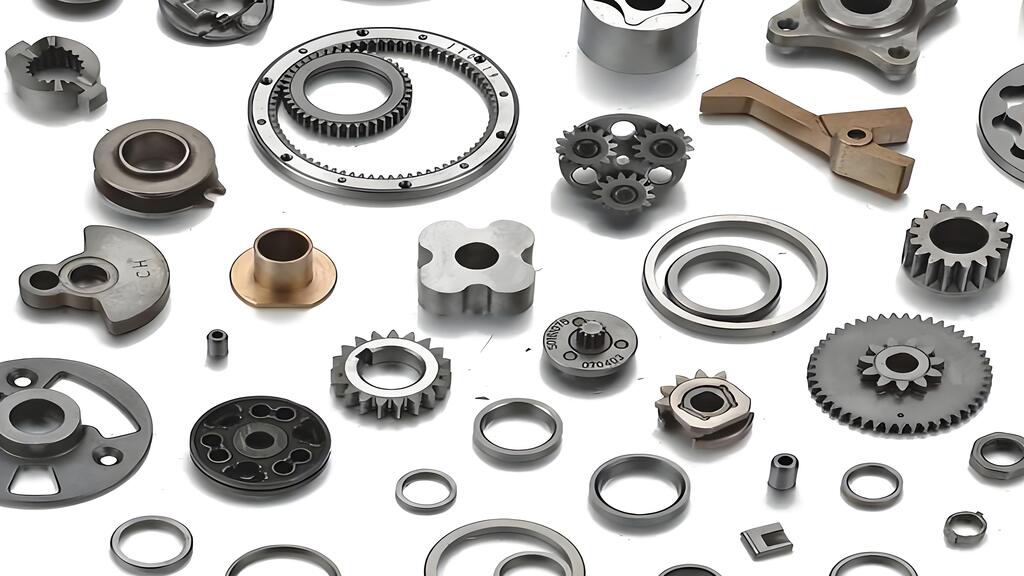


ISO and ASTM Standards for Powder Metallurgy Components
Industry leaders recognize ISO and ASTM standards as essential for Powder Metallurgy components. These standards define terminology, establish design guidelines, and set material specifications. They also outline testing methods and post-processing requirements.
- Standards help ensure consistent material properties and process repeatability.
- They support safety compliance, especially in regulated sectors like medical implants.
- ISO/ASTM 52900, ISO/ASTM 52910, ASTM F2924, and ASTM F3001 stand out as key examples.
- Standardized frameworks guide powder characterization and finished part evaluation, directly improving performance and reliability.
Key Takeaways
- ISO and ASTM standards provide clear rules for powder metallurgy materials, testing, and quality, helping manufacturers produce reliable and safe components.
- ISO focuses on global harmonization with detailed classifications, while ASTM offers flexible, consensus-based standards often used in North America.
- Material specifications in both systems define chemical and mechanical properties, ensuring parts meet strict performance and safety requirements.
- Standardized testing methods, like density and strength tests, help detect defects early and maintain consistent product quality.
- Using harmonized or dual ISO/ASTM standards simplifies compliance, supports global trade, and improves product reliability across industries.
Standards Organizations in Powder Metallurgy Components
ISO (International Organization for Standardization)
ISO plays a central role in setting global benchmarks for powder metallurgy components. The organization operates through Technical Committee ISO/TC 119, established in 1966 and managed by the Swedish Institute for Standards (SIS). This committee oversees the develoPment and maintenance of standards that cover terminology, powder characterization, sintered metal testing, hard metals, and material specifications. The table below summarizes ISO’s structure and contributions:
| Aspect | Details |
|---|---|
| Committee | ISO/TC 119 |
| Established | 1966 |
| Managing Body | Swedish Institute for Standards (SIS) |
| Scope | Standardization of powder metallurgical materials, terms, sampling, testing, specs |
| Subcommittees | Terminology, Powder characterization, Sintered metal characterization, Hardmetals, Material specs |
| Standards Developed | Vocabulary, powder properties, testing methods, material specs |
| Contribution to SDGs | Industry innovation (SDG 9), Responsible consumption and production (SDG 12) |
| Membership | 11 participating, 21 observing members |
| Meetings | Regular, next in September 2025, Glasgow |
| Role Summary | Ensures quality, consistency, and global harmonization in powder metallurgy components |
ISO standards provide a foundation for quality assurance and international trade in powder metallurgy.
ASTM International
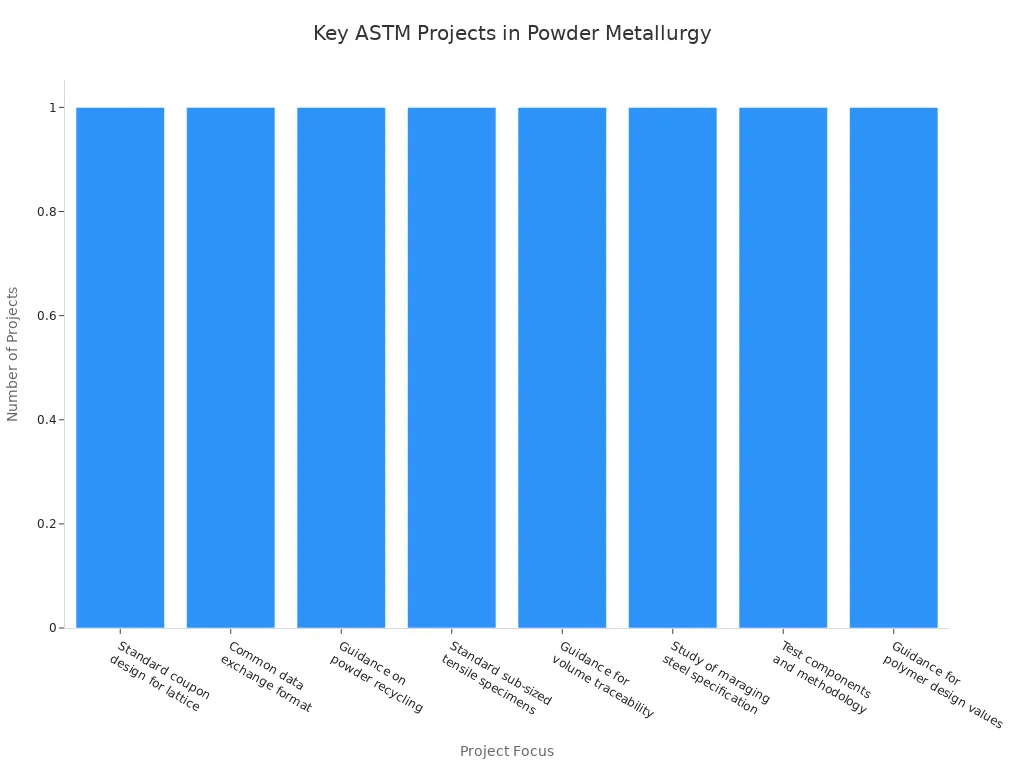
ASTM International advances the standardization of powder metallurgy components through a collaborative, consensus-driven process. Committee F42 on Additive Manufacturing Technologies leads efforts in this area, drawing expertise from industry, academia, and government. The committee develops standards for test methods, specifications, guides, and terminology. The process involves idea submission, task group formation, drafting, consensus voting, and final publication. The chart below illustrates the breadth of ASTM’s projects in powder metallurgy:
Key steps in ASTM’s standards development include:
- Committee F42 brings together experts from multiple sectors.
- Members develop consensus-based standards essential for quality and reliability.
- The process requires full agreement and typically takes about two years.
- ASTM supports research projects that generate data for new standards.
- Collaboration with ISO accelerates development and broadens expertise.
- Stakeholders participate actively, fostering technical exchange.
- The process includes multiple review and voting stages.
- Participation offers insight into industry trends and access to technical expertise.
ASTM’s approach ensures that powder metallurgy standards remain current and relevant to evolving technologies.
MPIF and Other Industry Bodies
The Metal Powder Industries Federation (MPIF) and similar organizations provide essential support for powder metallurgy standards. MPIF publishes widely used standards, such as MPIF Standard 35, which defines chemical compositions, mechanical properties, and physical properties for powder metallurgy materials and parts.
- MPIF Standard 35 includes materials standards for structural parts and metal injection molded components.
- The federation covers test methods, design manuals, and quality assurance guidelines.
- MPIF consists of six trade associations, each representing a sector of the powder metallurgy industry.
- Boards and committees oversee standards development, industry advancement, and recognition of achievements.
- MPIF maintains a digital library of technical papers and offers comprehensive publications on powder metallurgy science, technology, and business.
- Other referenced standards include Germany’s DIN 30910 and Japan’s JIS Z 2550, which complement MPIF’s guidelines.
These organizations ensure that designers, manufacturers, and users of powder metallurgy components have access to reliable, up-to-date standards.
ISO Standards for Powder Metallurgy Components

Powder Characterization Standards
ISO standards set the foundation for reliable powder metallurgy processes. These standards define the methods for measuring and reporting the properties of metal powders. ISO 4497 specifies the determination of apparent density, which helps manufacturers control the flow and packing of powders. ISO 3923-1 outlines the method for measuring the tap density of metallic powders. This measurement ensures consistency in powder compaction and sintering.
ISO 3271 addresses the determination of compressibility. This property affects how powders behave during the pressing process. Accurate powder characterization leads to better control over the final properties of powder metallurgy components. Manufacturers use these standards to select suitable powders and optimize production parameters.
Tip: Consistent powder characterization reduces variability in finished parts and improves process repeatability.
Sintered Part Testing Standards
After compaction and sintering, ISO standards guide the evaluation of finished parts. ISO 2740 describes the transverse rupture strength test for sintered metals. This test measures the ability of a part to resist breaking under bending forces. ISO 3928 covers the determination of tensile strength, which is critical for structural applications.
ISO 5754 provides methods for measuring the density of sintered parts. Accurate density measurement ensures that parts meet design requirements and perform as expected. ISO 2739 specifies the determination of dimensional change after sintering. This standard helps manufacturers control shrinkage and maintain tight tolerances.
Manufacturers rely on these standards to verify that powder metallurgy components meet mechanical and dimensional specifications. Consistent testing supports quality assurance and customer confidence.
Hardmetals and Cemented Carbides Standards
Hardmetals and cemented carbides require specialized testing due to their unique properties. ISO standards address these needs with precise methods for evaluating hardness, toughness, and strength. The table below summarizes key ISO standards relevant to hardmetals and cemented carbides, along with their impact on product performance and reliability:
| ISO Standard | Test Method | Applicability to Hardmetals and Cemented Carbides | Impact on Product Performance and Reliability |
|---|---|---|---|
| ISO 6507-1 | Vickers Hardness Test | Suitable for hard metals and cemented carbides | Provides consistent, comparable hardness measurements critical for assessing material performance and ensuring quality control. |
| ISO 148-1 | Charpy Pendulum Impact Test | Applicable to metallic materials, including hard metals | Assesses impact resistance and toughness, important for reliability under dynamic loads and varying temperatures. |
| ISO 6508-1 | Rockwell Hardness Test | Used for metallic materials, including cemented carbides | Quick and cost-effective hardness testing supporting quality assurance and repeatability. |
| ISO 6892-1 | Tensile Testing at Room Temperature | Applies to metallic materials, including hard metals | Measures tensile strength, yield strength, and elongation, ensuring mechanical properties meet performance and durability needs. |
These standards help manufacturers evaluate critical properties such as hardness and toughness. Consistent application of these tests ensures that hardmetals and cemented carbides deliver reliable performance in demanding environments. Quality control teams use these standards to detect defects early and maintain high product standards.
Note: Adhering to ISO standards for hardmetals and cemented carbides reduces the risk of failure in high-stress applications.
Material Specifications
ISO material specification standards set clear expectations for the properties and performance of powder metallurgy components. These standards outline the chemical composition, mechanical properties, and physical characteristics that each material must meet. Manufacturers rely on these specifications to ensure that their products deliver consistent quality and performance.
ISO standards define acceptable ranges for elements such as carbon, nickel, and copper. They also specify minimum requirements for mechanical properties like tensile strength, yield strength, and hardness. By following these guidelines, manufacturers can produce parts that meet strict industry demands.
Material designation codes in ISO standards align with other international systems, including MPIF, JIS, and DIN. This alignment supports global compatibility and makes it easier for companies to source materials or components from different regions. The table below highlights how ISO standards compare with other major systems:
| Property | ISO Standard | MPIF Standard | JIS Standard | DIN Standard |
|---|---|---|---|---|
| Chemical Composition | Defined ranges | Defined ranges | Defined ranges | Defined ranges |
| Mechanical Properties | Minimum values | Minimum values | Minimum values | Minimum values |
| Material Codes | Harmonized | Harmonized | Harmonized | Harmonized |
| Quality Verification | Required | Required | Required | Required |
Manufacturers benefit from these harmonized standards. They can produce interchangeable parts and maintain quality assurance across different production sites.
ISO material specifications also include guidelines for verifying quality and performance. These guidelines help manufacturers maintain consistency during production and ensure that finished parts meet customer expectations. Comparison tables and cross-references among ISO, MPIF, JIS, and DIN standards further support global compatibility and quality control.
By referencing ISO material specifications, manufacturers can confidently deliver powder metallurgy components that meet international benchmarks for quality and reliability.
ASTM Standards for Powder Metallurgy Components
Structural Parts Standards
ASTM standards for structural parts in powder metallurgy provide a framework for ensuring mechanical integrity and performance. These standards address the unique requirements of components produced from metal powders, which often serve in demanding applications. The most frequently referenced standards include ASTM E2652, which focuses on metal powders, and ASTM E8, which covers general metals. Each standard offers specific advantages and limitations, as shown in the table below:
| Standard | Material Type | Applications | Advantages | Limitations |
|---|---|---|---|---|
| ASTM E2652 | Metal Powders | Powder metallurgy, automotive | Tailored for metal powders, standardized method, high accuracy | Requires precise equipment |
| ISO 6892 | Metals | General metal testing | International recognition | May not address powder-specific needs |
| ASTM E8 | Metals | Structural steel/alloys | Comprehensive guidelines | Not tailored for powdered materials |
| JIS Z 2241 | Metals | Japanese industrial use | Specific to Japanese standards | Limited global applicability |
Engineers rely on these standards to produce high-strength components for the automotive industry, such as gears and bearings. The aerospace sector uses them to manufacture lightweight yet robust parts for aircraft and spacecraft. Medical device manufacturers depend on ASTM guidelines to create durable implants and surgical instruments. Electronics companies apply these standards to fabricate reliable connectors and conductive components.
The process for evaluating structural parts typically involves several key steps:
- Sample Preparation: Technicians compact metal powder samples into standardized shapes to ensure uniformity.
- Conditioning: Specimens undergo conditioning under controlled temperature and humidity to eliminate environmental variables.
- Testing: Technicians subject specimens to tensile testing until fracture.
- Data Recording: The maximum force before failure is recorded to calculate tensile strength.
These procedures help manufacturers achieve consistent quality and performance in powder metallurgy components.
Bearings and Porous Materials Standards
Bearings and porous materials present unique challenges in powder metallurgy due to their structure and function. ASTM B939-21 stands out as the primary standard for evaluating the radial crushing strength of powder metallurgy bearings and structural materials. This standard outlines a destructive test that determines the radial crushing strength, including test specimen geometry and limitations.
| Aspect | Details |
|---|---|
| ASTM Standard | ASTM B939-21 |
| Title | Standard Test Method for Radial Crushing Strength, K, of Powder Metallurgy (PM) Bearings and Structural Materials |
| Scope | Destructive test to determine radial crushing strength of PM bearings and porous materials; includes test specimen geometry and limitations |
| Applications | - Acceptance test for oil-impregnated sintered bearings (per Specs B438 and B439) - Lot acceptance test for metal powders and lubricated powder mixtures - Manufacturing control test in the PM industry |
| Documented Outcomes | - Provides quantitative, destructive evaluation data - Used to grade, classify, and evaluate PM materials - Radial crushing strength is about twice the ultimate tensile strength (experience-based) - Not a design value but a material property |
| Limitations | - Test assumes minimal ductility - Specimen deflection limits - Results for thick-walled specimens (>1/3 outside diameter) are comparative only |
| Units | Inch-pound units standard; SI units provided for information only |
| Safety and Standardization | Users are responsible for safety; developed per WTO TBT Committee principles |
Manufacturers use ASTM B939-21 as an acceptance test for oil-impregnated sintered bearings and as a lot acceptance test for metal powders and lubricated mixtures. The standard provides quantitative data that help grade, classify, and evaluate powder metallurgy materials. Although the radial crushing strength is not a design value, it serves as a critical material property for quality control. The test assumes minimal ductility and has specific specimen deflection limits, making it most effective for comparative analysis.
Note: Radial crushing strength values are typically about twice the ultimate tensile strength, based on industry experience.
Test Methods and Procedures
Consistent product quality in powder metallurgy depends on reliable test methods and procedures. ASTM B962 is widely recognized for measuring the density of compacted or sintered powder metallurgy products using Archimedes’ Principle. This method applies to green, sintered, and oil-impregnated parts, accounting for the surface-connected porosity common in these components.
| Aspect | Description |
|---|---|
| ASTM Test Method | ASTM B962 - Standard Test Methods for Density of Compacted or Sintered Powder Metallurgy Products Using Archimedes’ Principle |
| Purpose | Measures the density of PM products, including green, sintered, and oil-impregnated parts, accounting for surface-connected porosity common in PM components |
| Procedure Highlights | Uses Archimedes’ principle (water displacement) to determine volume and density; requires specimen preparation, including cleaning, sealing pores if needed, and temperature control |
| Types of Density Measured | Green density (compacted, unsintered), sintered density, impregnated density |
| Quality Control Contribution | Enables detection of defects such as porosity and insufficient densification; monitors pressing and sintering consistency; correlates density with mechanical properties like strength and hardness |
| Integration with Other Methods | Works alongside ASTM B311 (for impermeable materials) and ASTM B328 for comprehensive quality assurance |
| Industry Impact | Provides internationally recognized, standardized testing, facilitating global trade and compliance |
| Error Minimization | Emphasizes specimen selection, cleaning, temperature control, bubble removal, and equipment calibration to ensure accurate and repeatable results |
| Application Scope | Suitable for complex geometries and materials with surface-connected porosity, including iron-based alloys, copper, aluminum, tungsten, titanium, and coated components |
| Outcome | Supports consistent product quality by providing reliable density data that predicts material performance and manufacturing stability |
Technicians prepare specimens by cleaning and, if necessary, sealing pores. They then use water displacement to determine the volume and calculate density. This method enables the detection of defects such as porosity and insufficient densification. It also monitors pressing and sintering consistency, correlating density with mechanical properties like strength and hardness.
ASTM B962 works in conjunction with other standards, such as ASTM B311 for impermeable materials and ASTM B328, to provide comprehensive quality assurance. The method supports global trade and compliance by offering internationally recognized, standardized testing. Proper specimen selection, cleaning, temperature control, and equipment calibration minimize errors and ensure repeatable results.
Tip: Reliable density measurements help manufacturers predict material performance and maintain manufacturing stability for powder metallurgy components.
Material Specifications
ASTM material specifications provide a clear framework for manufacturers who produce powder metallurgy parts. These specifications define the chemical composition, mechanical properties, and physical characteristics required for each material grade. Engineers and quality managers use these documents to ensure that every part meets strict industry standards.
ASTM standards such as ASTM B783, ASTM B783M, and ASTM B783-93 outline the requirements for iron-based, copper-based, and other alloyed materials. Each standard includes detailed tables that list acceptable ranges for elements like carbon, nickel, copper, and molybdenum. These tables help manufacturers select the right powder blend for each application.
| ASTM Standard | Material Type | Key Elements Specified | Typical Applications |
|---|---|---|---|
| ASTM B783 | Iron-based alloys | Fe, C, Ni, Cu, Mo | Gears, bushings, structural |
| ASTM B783M | Copper-based | Cu, Sn, Zn, P | Bearings, electrical contacts |
| ASTM B783-93 | Alloyed materials | Varies by alloy | Specialty components |
Material specifications also set minimum requirements for mechanical properties. These include tensile strength, yield strength, hardness, and elongation. For example, ASTM B783 specifies that an iron-based part must achieve a minimum tensile strength of 415 MPa. This ensures that the finished product can withstand operational stresses.
Manufacturers must also verify physical properties such as density and porosity. ASTM B328 provides methods for measuring density, while ASTM B923 covers porosity testing. These tests confirm that the part has the correct structure and will perform reliably in service.
Note: Material specifications often reference additional standards for testing and inspection. This cross-referencing ensures that all aspects of quality are addressed.
ASTM material specifications support traceability and certification. Each batch of powder and every finished part receives documentation that links it to the relevant standard. This process helps companies demonstrate compliance during audits and customer inspections.
Engineers benefit from the clarity and consistency of ASTM material specifications. They can compare different materials, select the best option for each project, and predict how a part will behave in real-world conditions. This approach reduces the risk of failure and supports long-term reliability.
ISO vs. ASTM Standards for Powder Metallurgy Components
Similarities and Differences
ISO and ASTM standards both aim to ensure quality, safety, and performance in powder metallurgy components. Each system provides detailed requirements for material properties, testing methods, and calibration procedures. However, important differences exist in their approach and application. The table below highlights a direct comparison between ISO 7500-1 and ASTM E4, two widely used standards for mechanical testing:
| Aspect | ISO 7500-1 | ASTM E4 |
|---|---|---|
| Accuracy Classification | Defines specific classes (Class 0.5, 1, 2, 3) with precise permissible errors (e.g., Class 1 allows ±1.0%) | Specifies a general accuracy requirement of ±1% without classification |
| Calibration Procedure | Requires calibration at multiple points (at least five) across 20%-100% of capacity, including increasing and decreasing forces | Allows multiple calibration methods; less prescriptive on procedure |
| Environmental Conditions | Mandates a controlled environment with a stable temperature between 10°C and 35°C during calibration | Does not explicitly define environmental conditions |
| Traceability and Uncertainty | Requires detailed measurement uncertainty assessment | Emphasizes SI traceability but allows combined deviations |
| Regional and Industry Adoption | Preferred internationally; mandated for ISO/IEC 17025 compliance | Predominantly used in North America |
ISO’s classification system enables precise accuracy assessment, which is critical for international contracts. ASTM’s flexibility supports diverse testing environments, especially in North America. The choice of standard can affect traceability, measurement uncertainty, and regulatory acceptance.
Selection Criteria
Manufacturers select between ISO and ASTM standards based on several practical factors. The following table summarizes the main criteria:
| Criteria for Selecting Standards | Description |
|---|---|
| Minimum Strength Value | Agreement on minimum mechanical strength required for the PM part |
| Grade Selection | Choosing appropriate material grades based on application needs |
| Chemistry | Specifying chemical composition to meet performance requirements |
| Proof Testing | Defining testing protocols to verify part integrity |
| Typical Property Values | Establishing expected material and part properties |
| Process Effects | Considering manufacturing processes that impact part application |
| Cross-referencing Standards | Ensuring compatibility with MPIF, ASTM, and ISO standards |
Manufacturers also consider stakeholder input, industry sector, and regulatory requirements. Technical committees and industry groups, such as MPIF, help align standards and avoid misunderstandings.
Harmonization and Dual Standards
Harmonization between ISO and ASTM has become increasingly common. Many standards for powder metallurgy components now exist as joint ISO/ASTM documents. This dual approach allows manufacturers to meet both international and regional requirements. For example, ASTM’s additive manufacturing standards often align with ISO, supporting global compatibility. Collaborative development ensures that standards reflect the needs of startups, established businesses, academia, and government agencies.
Tip: Using harmonized or dual standards streamlines compliance, reduces duplication, and supports access to global markets.
Practical Implications for Powder Metallurgy Components
Material Selection Impact
Material selection shapes the performance and reliability of powder metallurgy components. Engineers use ISO and ASTM standards to compare material grades, chemical compositions, and mechanical properties. These standards help them choose powders that match the demands of each application, whether for automotive gears or medical implants. By following standardized material specifications, manufacturers reduce the risk of defects and ensure that each component meets strict industry requirements. Consistent material selection also supports global sourcing, as harmonized standards allow for interchangeable parts from different suppliers.
Selecting the right material at the start of a project saves time and cost during production and reduces the likelihood of product failure.
Testing and Inspection Requirements
Testing and inspection play a critical role in verifying the quality of powder metallurgy components. ISO and ASTM standards outline specific tests for chemical composition, particle properties, flow, density, and more. The table below summarizes typical requirements and relevant standards:
| Test Category | Typical Tests / Inspections | Methodologies / Equipment | Relevant ISO / ASTM Standards |
|---|---|---|---|
| Chemical Composition | Bulk elements, trace elements, gases | ICP-AES/OES, ICP-MS, LECO, SEM-EDX | Alloy dependent |
| Particulate Properties | Particle size, shape, surface area | Laser diffraction, SEM, adsorption | ASTM B822 / ISO 13320-1, etc. |
| Flow Analysis | Powder flowability, dynamic flow | Hall flowmeter, Carney flowmeter | ASTM B213 / ISO 4490, ASTM B964 |
| Density Analysis | Apparent, tap, skeletal density | Hall funnel, pycnometry, balance | ASTM B212 / ISO 3923-1, etc. |
| Moisture Content | Moisture analysis | Absorbent method, Karl Fischer | ASTM E203 |
| Cleanliness | Cross-contamination, cleanliness | EDS/EDX, microscopy | Informational only |
| Nondestructive Testing | Ultrasonic, liquid penetrant, radiography | Various NDT methods | N/A |
Standardized testing ensures that each batch meets safety and performance criteria. Reliable test results support international trade and build customer trust.
Quality Control and Certification
Quality control and certification processes rely on adherence to ISO, ASTM, and MPIF standards. These standards define powder characterization, sampling, and sample preparation protocols. Manufacturers use them to verify chemical and physical properties for every production lot. Certification programs, such as the AM Powder Metallurgy Proficiency Testing Program, provide training on test methods and statistical analysis. Laboratories that participate in these programs demonstrate their testing capabilities and meet accreditation requirements.
- ISO/ASTM 52907 and ASTM F3049 set general requirements for powder evaluation.
- Sampling methods from ASTM B215 and ISO 3954 ensure representative samples.
- Sample preparation follows ASTM E3 and ISO 14887 protocols.
- Certification uses MPIF Standard 35, ASTM B783, and ISO 5755 for verification.
Every batch undergoes rigorous quality checks, supporting repeatability and traceability. Training programs, including eLearning and workshops, help professionals stay current with evolving standards and best practices.
Understanding and applying the correct ISO and ASTM standards remains essential for anyone working with powder metallurgy components. These standards ensure quality, reliability, and access to global markets.
- ISO and ASTM standards evolve as technology advances, now emphasizing finished part chemistry, particle size distribution, and powder morphology.
- Manufacturers often set tighter internal specifications to address changes during additive manufacturing processes.
- Ongoing collaboration between standards organizations and research groups helps address new challenges in powder metallurgy components.
Staying informed about updates allows companies to maintain compliance and deliver high-performing products.
FAQ
What is the main difference between ISO and ASTM standards?
ISO standards focus on international harmonization, while ASTM standards often address regional or industry-specific needs. Both ensure quality and safety, but companies may choose one based on market requirements or customer preferences.
Why do manufacturers need to follow both ISO and ASTM standards?
Many global markets require compliance with both sets of standards. Following both helps manufacturers ensure product compatibility, meet customer expectations, and access more markets.
How often do ISO and ASTM standards for powder metallurgy change?
Standards organizations review and update documents every few years. Industry advancements or new technologies can prompt more frequent revisions. Manufacturers should monitor updates to stay compliant.
Can a company use ISO and ASTM standards together?
Yes. Many companies use both to meet diverse customer and regulatory needs. Harmonized or dual standards simplify this process and support global trade.