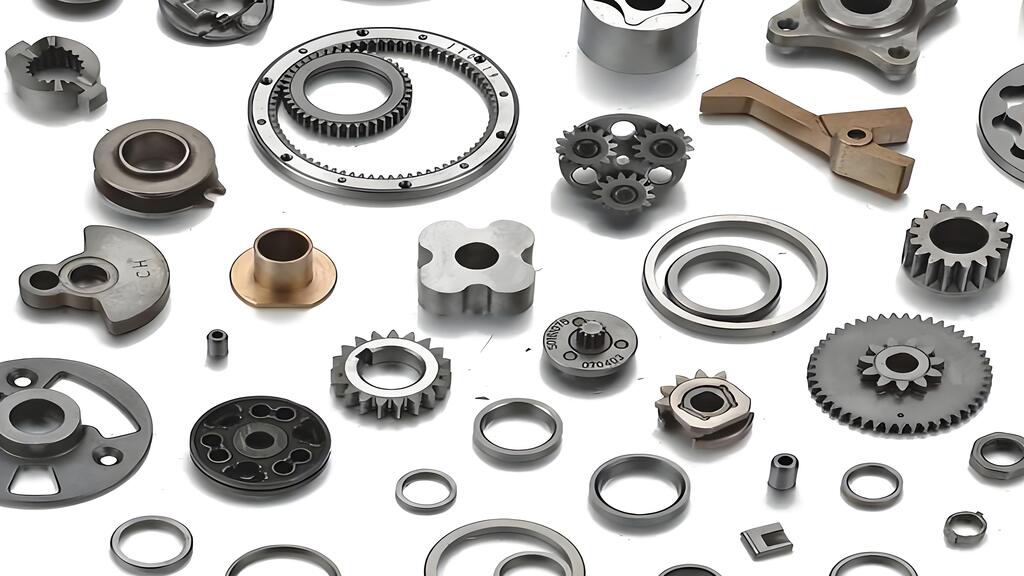


Why Powder Metallurgy is Ideal for Automotive Components
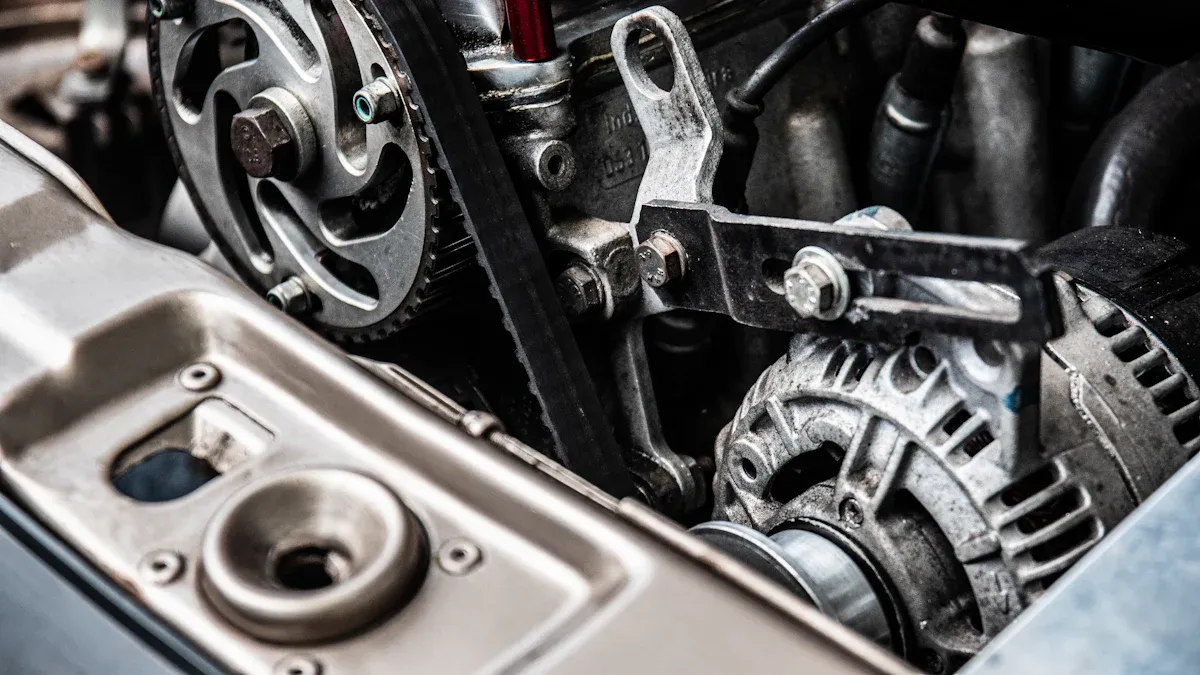
Powder Metallurgy offers automotive manufacturers a precise method for producing high-performance components. This process reduces material waste and energy use during manufacturing. Companies achieve cost savings while maintaining strict quality standards. Manufacturers also benefit from greater design flexibility, which supports innovation in automotive engineering. As a result, powder metallurgy helps the industry meet demanding efficiency and sustainability goals.
Key Takeaways
- Powder metallurgy reduces material waste by producing parts close to their final shape, saving costs and supporting green manufacturing.
- This process lowers production costs through efficient batch processing and fast cycles, making it ideal for high-volume automotive parts.
- It allows the creation of complex, precise components that improve performance and reduce assembly time.
- Powder metallurgy ensures consistent quality with tight dimensional control and stable mechanical properties for reliable automotive parts.
- The method supports sustainability by cutting energy use, recycling materials, and enabling lightweight designs that boost fuel efficiency.
Core Advantages of Powder Metallurgy
Material Efficiency and Minimal Waste
Powder metallurgy stands out for its exceptional material efficiency. Manufacturers press metal powders directly into the desired shape, which minimizes waste compared to traditional processes like casting or machining. In casting, excess material often requires removal through secondary machining or trimming, leading to lower material utilization. Powder metallurgy, by contrast, achieves a much higher material utilization rate. The process produces near-net-shape parts, which means components come out of the mold very close to their final dimensions. This reduces the need for additional machining and keeps scrap rates low—up to 97% of the raw material ends up in the finished part.
Powder metallurgy avoids many of the defects found in casting, such as shrinkage or internal voids, which often result in scrap or require extra finishing. The ability to combine multiple parts into a single, complex component further reduces assembly requirements and supply chain complexity. As a result, manufacturers experience lower costs and less waste, supporting both economic and environmental goals.
Key benefits include:
- Minimal material waste due to near-net-shape production
- Reduced need for secondary machining
- Lower scrap rates compared to machining and casting
- Efficient use of raw materials, supporting green manufacturing
Cost-Effectiveness in Manufacturing
Automotive manufacturers choose powder metallurgy for its cost advantages, especially in high-volume production. The process supports efficient batch processing and shortens production cycle times for complex parts. Once the initial tooling is set up, manufacturers can produce large quantities of components rapidly and consistently.
| Factor | Powder Metallurgy | CNC Machining |
|---|---|---|
| Scrap Rate / Material Waste | Low (~3%) | High (up to 50%) |
| Suitability for Production Volume | High-volume, efficient batch processing | Low-volume, longer per-part-time |
| Setup and Tooling | High initial investment, rapid cycles | Lower setup cost, slower for mass production |
| Design Complexity Impact | Minimal post-processing | More tooling, longer cycle for complex parts |
Powder metallurgy’s low scrap rate and ability to form parts close to their final shape reduce the need for rework and waste handling. This efficiency translates into faster throughput and lower per-part costs, making it ideal for the automotive industry’s demand for large-scale, repeatable production.
Design Flexibility and Complex Geometries
Powder metallurgy enables the creation of intricate and highly functional automotive components. The process excels at forming complex shapes and geometries that traditional methods struggle to achieve. Manufacturers can consolidate multiple sub-assemblies into a single component, which improves structural integrity and reduces assembly time.
- The process allows for intricate details, such as specialized edges or curves, that are essential for part performance.
- Powder metallurgy achieves exceptional dimensional accuracy and supports the production of undercuts and features that would otherwise require extensive machining.
- The technology enables the integration of multiple functions into a single part, such as combining structural, magnetic, and mechanical properties.
For example, sensor mounting bosses made from stainless steel can be produced with permanent welding features, reducing material waste and assembly time. Oil pump assemblies and damping pistons benefit from multi-level precision compaction, integrating several functions into one part. This approach not only enhances performance but also lowers manufacturing costs and lead times.
Powder metallurgy’s design flexibility empowers automotive engineers to innovate, optimize part performance, and meet stringent industry requirements—all while maintaining cost and material efficiency.
Consistent Quality and Performance
Automotive manufacturers demand reliable, repeatable quality in every component. Powder metallurgy delivers this consistency by using controlled processes and uniform raw materials. Each part begins with carefully measured metal powders, which ensures that every batch meets strict specifications. This approach reduces variation and supports high-volume production with predictable results.
Dimensional accuracy plays a critical role in automotive applications. Powder metallurgy achieves as-sintered dimensional tolerances in the range of ±0.3% to ±0.5% of the nominal dimension, or about ±0.003 inches (±0.076 mm). This level of precision surpasses Die Casting and rivals many traditional methods. For features that require even tighter tolerances, secondary operations such as sizing or coining can further refine the part. The following table compares typical dimensional tolerances across common manufacturing methods:
| Manufacturing Method | Typical Dimensional Tolerance |
|---|---|
| Powder Metallurgy | ±0.3% to ±0.5% (±0.003 in / ±0.076 mm) |
| Die Casting | ±0.5% to ±1.0% |
| Machining | ±0.001 in (±0.025 mm) or better |
| Stamping | ±0.001 in (±0.025 mm) or better |
Consistent dimensional control allows automotive engineers to design assemblies with confidence. Parts fit together as intended, reducing the risk of defects and costly rework.
Mechanical properties also influence the performance and reliability of automotive components. Powder metallurgy parts typically exhibit controlled porosity and uniform microstructure, which support stable mechanical behavior. However, compared to forged parts, powder metallurgy components may show slightly lower density and higher porosity. Forged parts achieve superior mechanical property consistency due to their dense, anisotropic grain structure, which enhances strength and fatigue resistance. Powder metallurgy, while versatile and capable of producing complex shapes, balances cost-effectiveness and reasonable mechanical performance for many automotive applications.
Automotive manufacturers value the repeatability of powder metallurgy. Each production run yields parts with similar strength, hardness, and wear resistance. This reliability simplifies quality control and supports the high standards required in the automotive industry.
Key factors contributing to consistent quality and performance:
- Uniform powder composition and controlled compaction
- Precise dimensional tolerances suitable for most automotive needs
- Stable mechanical properties for reliable part performance
- Repeatable results across large production volumes
Powder metallurgy enables automotive companies to maintain high standards while optimizing efficiency and cost. This combination of quality and performance makes it a preferred choice for many critical vehicle components.
Powder Metallurgy in Automotive Applications
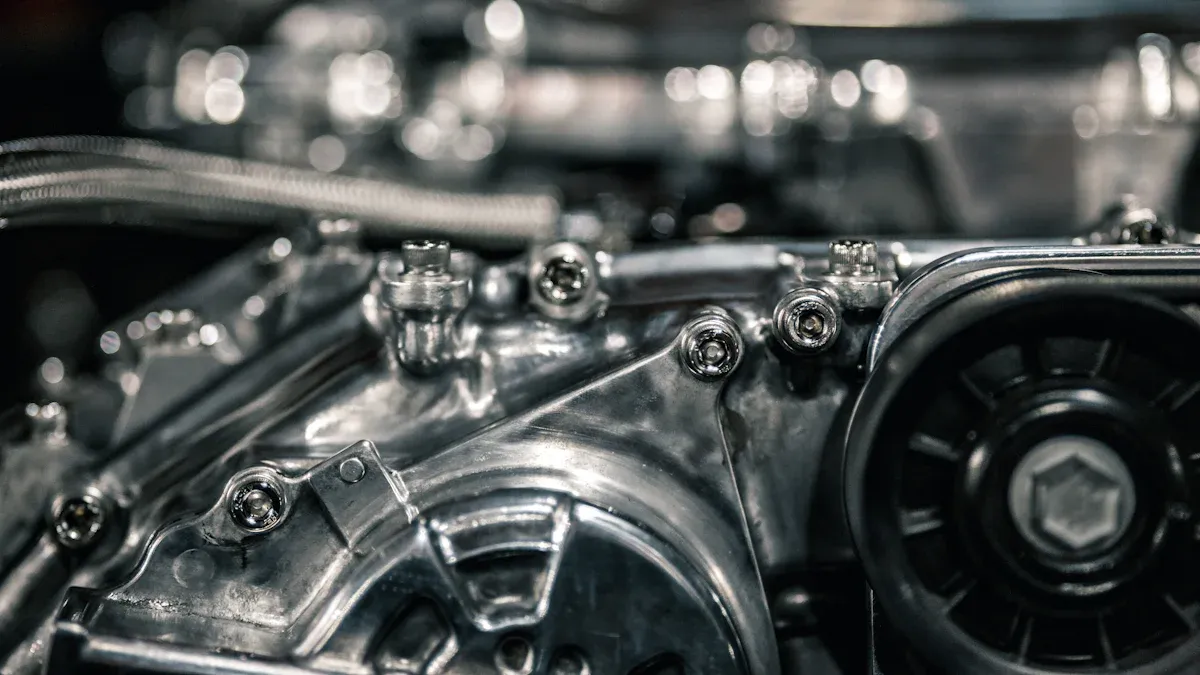
Common Automotive Components Produced
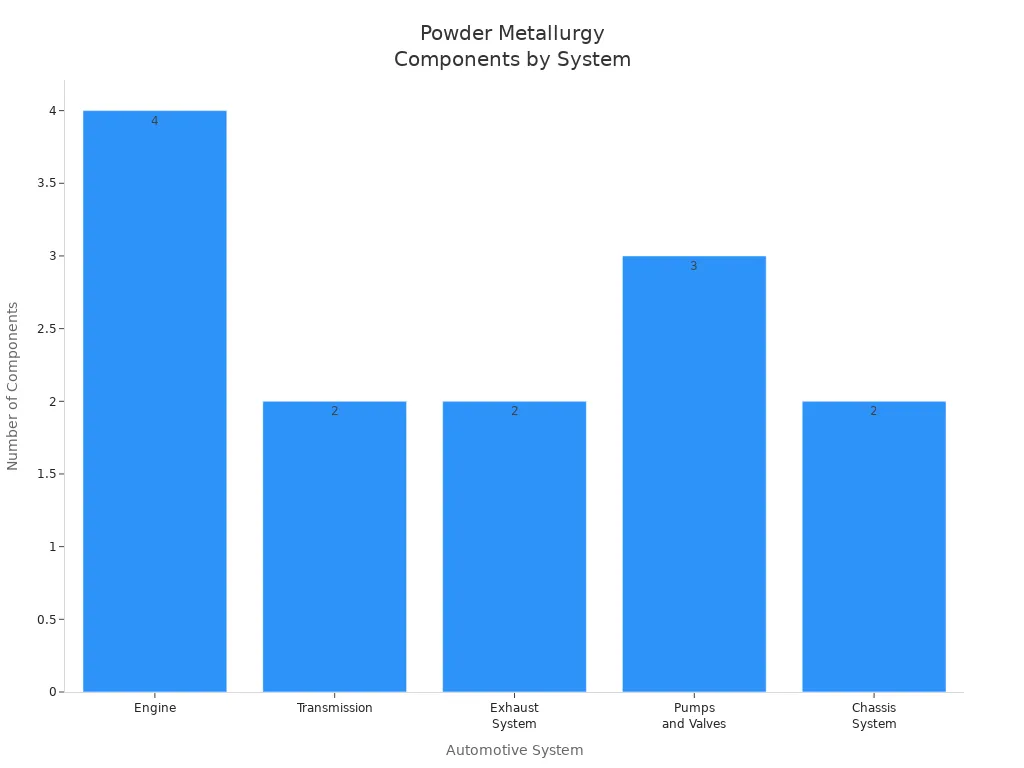
Automotive manufacturers rely on powder metallurgy to produce a wide range of critical components. This process supports the creation of parts for engines, transmissions, exhaust systems, pumps, and chassis systems. The following table highlights some of the most common components and the recommended metal powders for each application:
| Automotive System | Components | Recommended Metal Powders |
|---|---|---|
| Engine | Camshaft, piston, connecting rod, gear | Nickel-based alloy, iron-based alloy powder |
| Transmission | Gear, clutch plate | Molybdenum-based powder, titanium alloy powder |
| Exhaust System | Exhaust pipe, muffler | Stainless steel powder (316L) |
| Pumps and Valves | Fuel pump, oil pump, valve | Bronze powder, stainless steel powder |
| Chassis System | Suspension, axle | Aluminum alloy powder |
Manufacturers also use powder metallurgy for oil-impregnated bearings, synchronizer rings, clutch hubs, and ABS sensor rings. These components benefit from the process’s ability to deliver precise shapes and consistent quality.
Performance and Durability Enhancements
Powder metallurgy enhances the performance and durability of automotive parts. The process produces components with high strength and excellent wear resistance. Fine metal powders ensure uniform composition, which reduces weak points and extends the lifespan of each part. The porous structure formed during sintering allows for self-lubrication, especially in bearings, which reduces friction and wear. Manufacturers can also create complex shapes with tight tolerances, optimizing designs for better durability. Improved surface finish further minimizes friction, supporting longer service life for gears, bearings, and other moving parts.
Lightweighting and Fuel Efficiency Benefits
Reducing vehicle weight remains a top priority for automotive engineers. Powder metallurgy enables the production of lightweight components by using materials with lower density than traditional wrought metals. For example, parts made with this process typically achieve a 10% weight reduction. Advanced materials, such as aluminum metal matrix composites, replace heavier steel in powertrains and chassis. This weight reduction leads to significant improvements in fuel efficiency. A 10% decrease in vehicle weight can improve fuel economy by 6–8% and lower CO2 emissions. In electric vehicles, lighter motors and battery systems enhance energy efficiency and driving range. Powder metallurgy supports the industry’s shift toward sustainability and regulatory compliance by enabling these lightweight, high-strength solutions.
Sustainability and Environmental Benefits of Powder Metallurgy

Reduced Material Waste and Resource Use
Automotive manufacturers face increasing pressure to conserve resources and minimize waste. Powder metallurgy addresses these challenges by producing near-net shape parts that require little to no machining. This process stands in contrast to traditional metalworking, which often removes large amounts of raw material, resulting in significant waste. By forming components close to their final dimensions, manufacturers reduce scrap and optimize material usage. Studies in the Journal of Cleaner Production highlight that this approach enables substantial reductions in material waste, supporting sustainable manufacturing goals. The high efficiency of powder metallurgy also allows for the creation of complex geometries in a single step, further conserving resources.
| Resource Aspect | Powder Metallurgy (PM) | Conventional Processes (Casting, Forging, Machining) |
|---|---|---|
| Raw Material Utilization | Over 95% (very high efficiency) | Significantly lower due to machining waste |
| Energy Consumption | About 43% of energy used by forging and machining | 100% baseline energy consumption |
This table demonstrates the significant resource savings achieved through powder metallurgy, with over 95% raw material utilization and much lower energy requirements compared to conventional methods.
Lower Energy Consumption in Production
Energy efficiency remains a top priority in automotive manufacturing. Powder metallurgy processes can reduce energy consumption by up to 50% compared to casting and forging. The process includes powder production, compaction, and sintering, each step designed for minimal energy use. Manufacturers benefit from lower operational costs and reduced carbon emissions. The following chart compares energy consumption across different manufacturing methods:
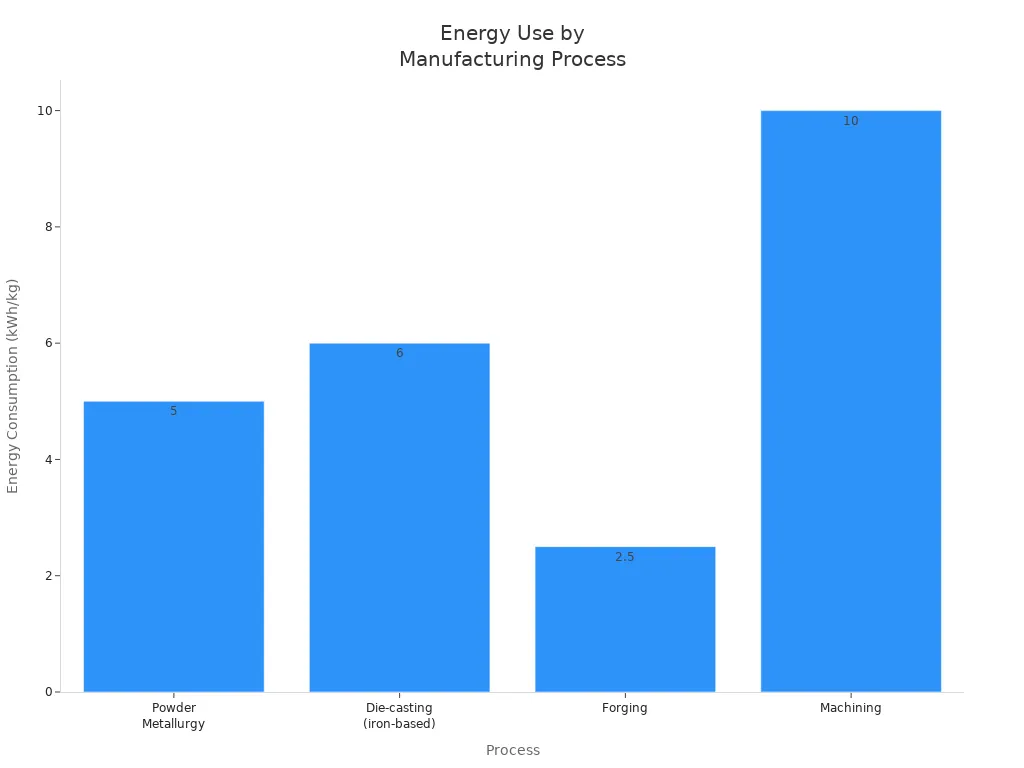
Powder metallurgy proves especially advantageous for smaller, intricate parts and high-volume production runs. The lower energy demand not only supports cost savings but also helps automotive companies meet strict environmental regulations.
Support for Green Manufacturing Initiatives
Sustainability certifications and green manufacturing standards have become essential in the automotive industry. Powder metallurgy supports these initiatives in several ways:
- The process operates at lower sintering temperatures, reducing carbon emissions.
- Manufacturers can recycle unused metal powders, minimizing waste and environmental pollution.
- The technology requires little to no cutting fluids or chemicals, which significantly reduces chemical waste and wastewater.
- High material utilization and recycling capabilities help conserve natural resources.
- Automotive companies use powder metallurgy to produce lightweight, high-strength components, improving fuel efficiency and lowering emissions.
Major automotive suppliers, such as GKN and Sumitomo Electric Industries, invest in powder metallurgy to meet stringent emission standards and sustainability goals. Electric and hybrid vehicle manufacturers also rely on this technology for lightweight battery housings and motor parts, further supporting decarbonization targets. The eco-friendly nature of powder metallurgy processes aligns with ISO9001 certification and ESG (Environmental, Social, Governance) objectives, making it a cornerstone of modern green manufacturing.
Limitations and Considerations of Powder Metallurgy
Design and Size Constraints
Powder metallurgy offers many advantages, but it does have design and size limitations. The process works best for small to medium-sized automotive parts. Most presses can handle parts up to 250 mm in diameter and 200 mm in height. The minimum wall thickness typically starts at 1.52 mm (0.060 inches), while the largest presses can form parts weighing up to 136 kg (300 pounds). However, practical part size often remains limited to about 40–50 square inches in area due to press tonnage restrictions.
| Parameter | Limitation |
|---|---|
| Maximum Diameter | Up to 250 mm |
| Maximum Height | Up to 200 mm |
| Minimum Wall Thickness | At least 1.52 mm (0.060 in) |
| Recommended Aspect Ratio | Within 8:1 |
Complex shapes with deep undercuts or intricate 3D contours present challenges for powder metallurgy. While the process excels at producing near-net-shape parts, highly detailed features may require secondary machining or alternative methods such as Metal Injection Molding (MIM).
Material Selection Limitations
Powder metallurgy supports a broad range of alloys, including those difficult to process by casting or forging. Manufacturers can select from iron, nickel, copper, and even refractory metals like tungsten. This flexibility allows for unique material combinations tailored to specific automotive needs. However, achieving uniform density and mechanical properties across complex shapes requires careful process control. Variations in density can affect strength and wear resistance, especially in parts with thick cross-sections or uneven geometry.
Note: While powder metallurgy offers a nearly limitless alloy selection, some applications may require additional post-processing to meet strict surface finish or tolerance requirements.
Application Suitability in Automotive Manufacturing
Not every automotive component suits powder metallurgy. The process excels in producing pistons, connecting rods, camshaft sprockets, and synchronizer rings. However, very large structural parts or components requiring ultra-high strength may not achieve optimal performance due to inherent porosity and density limits. Powder metallurgy parts may not provide the sealing required for hydraulic or airtight systems. Thin-walled parts below 0.5 mm and those with deep internal threads also present manufacturing challenges.
| Application Type | Suitability for PM | Reason |
|---|---|---|
| Large structural components | Not recommended | Equipment size limitations |
| Ultra-high strength applications | Use with caution | Porosity affects mechanical properties |
| Low-volume production | Not recommended | High tooling costs |
| Parts with deep undercuts | Poor capability | Shape complexity limitations |
| Hydraulic/airtight components | Limited | Porosity affects sealing |
Automotive engineers should consider these factors when selecting powder metallurgy for specific vehicle parts. The process delivers outstanding results for many applications, but understanding its boundaries ensures optimal performance and cost-effectiveness.
Automotive manufacturers continue to choose this advanced process for its efficiency, cost savings, and sustainability. Industry reports highlight several advantages:
- Up to 98% material utilization, reducing waste and supporting green manufacturing.
- Consistent production of complex, precise parts with excellent surface finishes.
- Lower carbon footprint and use of recycled materials. Manufacturers also benefit from improved fuel efficiency, lightweight designs, and the ability to meet strict regulatory standards. These strengths make it the leading solution for modern automotive applications.
FAQ
What automotive parts benefit most from powder metallurgy?
Powder metallurgy works best for gears, bearings, bushings, sprockets, and structural parts. These components require precise shapes and consistent quality. Manufacturers often select powder metallurgy for high-volume production of these critical automotive parts.
How does powder metallurgy improve sustainability in automotive manufacturing?
Powder metallurgy reduces material waste and energy use. Manufacturers recycle unused powders and minimize scrap. This process supports green manufacturing initiatives and helps companies meet strict environmental standards.
Can powder metallurgy produce complex shapes?
Yes. Powder metallurgy enables the creation of intricate geometries and multi-level parts. Engineers design components with features that traditional methods cannot easily achieve. This flexibility supports innovation in automotive design.
Is powder metallurgy suitable for electric vehicle components?
Powder metallurgy produces lightweight, high-strength parts for electric vehicles. Battery housings, motor components, and structural supports benefit from this process. Manufacturers use powder metallurgy to improve efficiency and extend driving range.
What quality standards apply to powder metallurgy parts?
Automotive powder metallurgy parts often meet ISO9001 and IATF 16949 standards. Manufacturers use strict process controls and quality checks. This ensures each part meets industry requirements for safety, durability, and performance.