

How to Reduce Energy Consumption During the Sintering Process
Sintering processes demand substantial energy. Implementing low-temperature sintering techniques significantly helps reduce energy consumption. Manufacturers actively optimize existing sintering process parameters, which provides immediate energy savings. They also adopt advanced furnace technologies to enhance overall energy efficiency. These strategies collectively improve sustainability and decrease operational costs for Metal Parts production.
Key Takeaways
- Low-temperature sintering methods save energy. These methods use less heat than the old ways.
- Optimizing how sintering works saves energy. This means making small changes to the process.
- New furnace designs help save energy. They use better insulation and heating parts.
- New materials like tiny powders help save energy. They let sintering happen at a lower heat.
- Saving energy in sintering helps businesses. It lowers costs and helps the environment.
- Challenges exist when trying to save energy. These include new equiPment costs and technical problems.
- Waste heat recovery systems capture heat. They reuse this heat to save more energy.
Primary Strategies to Reduce Energy Consumption in Sintering
Manufacturers actively pursue several primary strategies to reduce energy consumption during the sintering process. These strategies focus on both innovative techniques and optimizing existing operational parameters.
Low-Temperature Sintering Approaches
Low-temperature sintering techniques offer significant advantages for energy reduction. These methods allow materials to densify at much lower temperatures than conventional processes.
Additive-Assisted Sintering
Additive-assisted sintering involves incorporating small amounts of specific materials, known as sintering aids, into the powder compact. These additives promote densification at lower temperatures by enhancing atomic diffusion or forming transient liquid phases. This approach significantly reduces the thermal energy required.
- Energy savings range from 30% to 60% compared to conventional high-temperature sintering processes.
- Quantitative targets for these technologies include achieving energy savings of 30-50% compared to conventional sintering.
- Heraeus's mAgic® paste technology enables up to 80% less energy consumption compared to conventional soldering processes.
Novel sintering techniques, including those utilizing sintering aids, have been shown to decrease energy consumption by an order of magnitude. This method also offers substantial environmental benefits.
- Energy Savings: 30-50% reduction in energy consumption for sodium electrolyte fabrication.
- Carbon Footprint Reduction: Up to 40% decrease compared to conventional high-temperature ceramic processing.
- Temperature Reduction: Sintering temperatures are typically lowered from 900-1100°C to 400-700°C.
Field-Assisted Sintering Techniques
Field-assisted sintering techniques, such as Spark Plasma Sintering (SPS) and Flash Sintering, apply external electric fields or currents during the sintering process. These fields directly heat the material or enhance diffusion mechanisms, leading to rapid densification at lower temperatures and shorter times.
"You don’t use much energy, and you put it right at the atomic site where it is needed – rather than using more energy to create higher temperatures in a kiln, which is less efficient," Conrad says. "If you want to make a strong ceramic, you want to eliminate porosity and keep the grain size as small as possible. And you want to do it at the lowest cost – which means using the smallest amount of energy and doing it at the lowest temperature at the fastest rate possible. Using an electric field achieves all of these goals."
These techniques demonstrate superior energy efficiency compared to traditional methods.
| Technique | Energy Consumption (kW) | Heating Rate (°C/min) | Notes |
|---|---|---|---|
| Conventional (pressureless, HP) | 5–10 | 5–10 (pressureless), 50–100 (HP) | |
| Spark Plasma Sintering (SPS) | 5–10 | Up to 600 | More energy efficient than conventional due to shorter processing times, but much energy is consumed in heating the graphite die. |
| Flash Sintering | ~0.1 W/mm³ (during flash event) | N/A | More efficient than SPS during the flash event, but overall efficiency is compromised by the need for a conventional furnace to reach the transition temperature. |
| Novel SPS System | Up to 100 times lower than traditional SPS | >2000 | Achieves sintering in less than 1 minute by localizing the electric current. |
Pressure-Assisted Sintering
Pressure-assisted sintering combines heat with external pressure to aid densification. Hot Isostatic Pressing (HIP) and Hot Pressing (HP) are common examples. Applying pressure helps close pores and reduces the required sintering temperature or time, thereby saving energy.
Process Optimization for Reduced Energy Consumption
Optimizing existing sintering process parameters offers immediate and substantial energy savings without requiring entirely new equipment.
Enhanced Heating Rates and Shorter Sintering Times
Increasing heating rates and reducing overall sintering times directly translates to lower energy consumption. Faster processing minimizes the duration materials spend at high temperatures, reducing heat loss to the surroundings. This requires precise control over furnace temperature profiles and material response.
Optimized Feed Material Composition and Parameters
Adjusting the composition and physical parameters of the feed material significantly impacts energy efficiency. This includes particle size distribution, green density, and binder content. A well-optimized feed material requires less energy to densify.
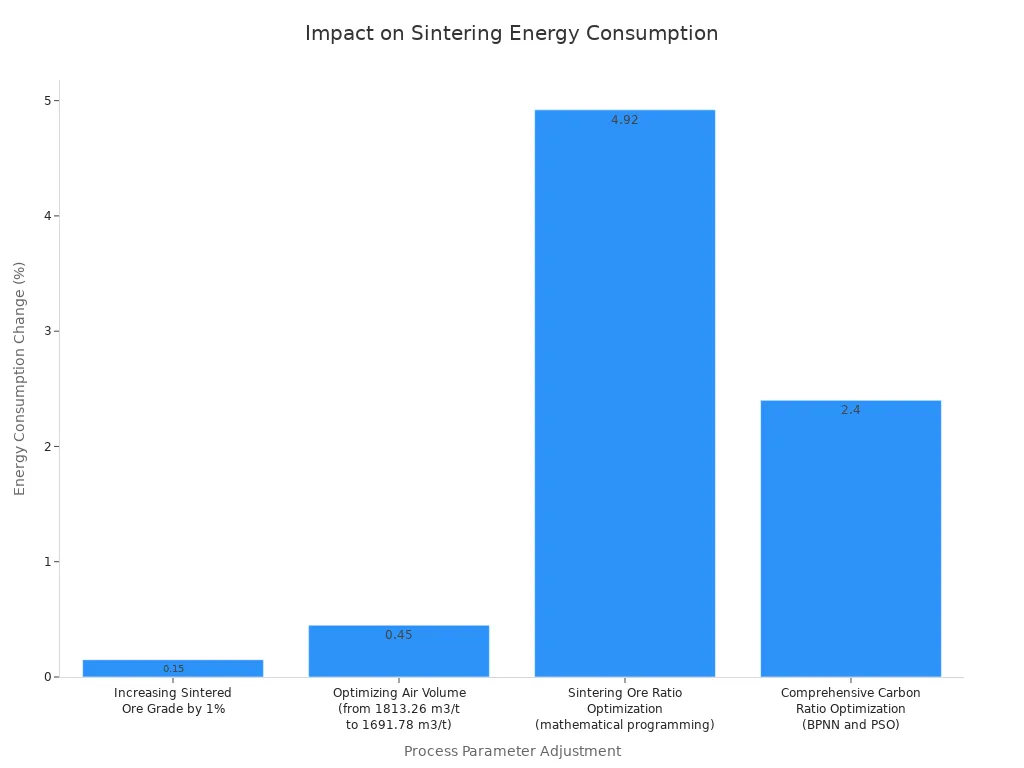
Several process parameter adjustments lead to significant energy savings in industrial sintering operations.
| Process Parameter Adjustment | Impact on Heat Utilization Efficiency | Impact on Production Cost | Impact on Sintering Energy Consumption | Other Impacts |
|---|---|---|---|---|
| Increasing Sintered Ore Grade by 1% | Decreases by 0.81% | Decreases by 0.19% | Increases by 0.15% | Reduced heat consumption due to fewer impurities, reduced CO2, SO2, and NOx emissions |
| Optimizing Air Volume (from 1813.26 m3/t to 1691.78 m3/t) | Improves | N/A | 0.45% reduction in coke powder consumption | Reduced flue gas volume, decreased heat loss carried away by flue gas (from 21.56% to 20.73%) |
| Adjusting Ore Type Ratios | Improves | N/A | N/A | Increased sensible heat conduction, moisture evaporation heat, and carbonate decomposition heat; 0.83% reduction in exhaust heat loss |
| Sintering Ore Ratio Optimization (mathematical programming) | N/A | N/A | 4.92% improvement in energy-saving and emission reduction effect | N/A |
| Overall Optimization of Steel Manufacturing Process | N/A | 8.46% cost reduction | N/A | N/A |
| Comprehensive Carbon Ratio Optimization (BPNN and PSO) | N/A | N/A | 2.40 kg/t reduction in comprehensive carbon ratio | N/A |
Other critical factors for optimization include:
- Fuel substitution (e.g., semi-coke, biomass, natural gas replacing coke powder and coal).
- Efficient combustion and material ratio optimization (rational combination of fuel components, low-carbon batching schemes, precise monitoring and control).
- Comprehensive treatment of air leakage and air volume control (reducing air leakage rate below 35%).
- Waste heat recovery (from flue gases and sensible heat from sintered ore).
- Flue gas purification and resource recycling (reducing SO2, NOx, and particulate matter emissions by nearly 80%, increasing recycling of iron-containing waste materials).
Fuel-Layered Distribution
Optimizing fuel distribution within the sintering bed significantly impacts energy consumption. Distributing fuel in multiple layers ensures more uniform heating and efficient combustion throughout the material. For instance, Zhang et al. (2020) demonstrated a reduction in fuel consumption by 2.66 t/h by distributing fuel in 13 layers. Additionally, applying surface fuel addition technology, with optimal parameters (60 mm addition thickness and 0.32 wt% addition ratio), leads to reduced sintering energy consumption and improved heat utilization efficiency.
While thick-bed sintering offers lower fuel consumption, it presents challenges with bed permeability. Increased bed height reduces permeability, which in turn negatively impacts sinter yield and quality, and exacerbates temperature differences within the bed, affecting surface sinter quality.
Advanced Technologies to Reduce Energy Consumption
Manufacturers continuously develop and implement advanced technologies to significantly reduce energy consumption in sintering processes. These innovations focus on improving furnace efficiency, optimizing atmospheric conditions, and recovering waste heat.
Innovative Furnace Designs and Insulation
Modern furnace designs prioritize energy efficiency. High-temperature vacuum furnaces minimize energy consumption while maximizing output. This approach leads to reduced operational costs and a smaller carbon footprint. Modern tube furnaces incorporate energy-efficient designs that reduce operational costs without compromising performance.
Advanced Refractory Materials
Advanced refractory materials play a crucial role in enhancing furnace efficiency. These materials possess superior thermal insulation properties. Prioritizing refractories with these properties minimizes heat loss and reduces energy consumption in industrial furnaces. Refractory linings enhance thermal efficiency by providing excellent insulation. This directly leads to lower energy consumption and decreased operational costs. Ceramic fiber, as an advanced refractory material, offers superior thermal insulation. It helps reduce energy costs by minimizing heat loss and optimizing process efficiency. Proper insulation systems, including multilayer insulation with various thermal barriers, are essential in industrial furnace construction. They ensure minimal energy loss and protect the outer shell. Furnace designs that incorporate advanced refractory materials aim to minimize heat loss and optimize energy consumption.
Optimized Heating Element Placement
Optimized heating element placement significantly contributes to energy savings. Strategic positioning of heating elements ensures uniform temperature distribution throughout the furnace. This prevents localized overheating and underheating, which often leads to energy waste. Precise placement allows for faster heating rates and more efficient heat transfer to the material. This reduces the overall energy required for the sintering cycle.
Efficient Atmosphere Control and Management
Controlling the furnace atmosphere offers another avenue for energy reduction. Managing the gases within the sintering environment can decrease processing temperatures and times.
Inert Gas Recirculation Systems
Inert gas recirculation systems enhance energy efficiency by reusing process gases. Instead of venting inert gases after a cycle, these systems capture, purify, and reintroduce them into the furnace. This reduces the need for fresh gas supplies and the energy associated with heating new gas. It also minimizes environmental impact by lowering emissions.
Reduced Atmosphere Sintering
Reduced atmosphere sintering involves using specific gas mixtures, often with lower oxygen content, to facilitate densification at lower temperatures. This method can prevent oxidation and promote faster material transport mechanisms. By lowering the required sintering temperature, manufacturers achieve substantial energy savings.
High-Efficiency Waste Heat Recovery Systems
Sintering processes generate significant amounts of waste heat. Capturing and reusing this heat offers substantial energy savings.
Circular Sinter Coolers
Circular sinter coolers are highly efficient systems designed to recover heat from hot sintered products. As the hot sinter moves through the cooler, ambient air passes over it, absorbing the heat. Manufacturers then use this heated air for various purposes, such as preheating combustion air for the sintering furnace or other industrial applications. This direct heat exchange significantly improves overall energy efficiency.
Repurposing Thermal Energy
Repurposing thermal energy from sintering processes drastically reduces energy waste. Regenerative heat exchange systems in sinter plants recapture heat from hot sinter for reuse in the sintering process. This improves furnace efficiency. Selective recovery and cascade utilization of sintering waste heat not only reduce energy consumption and waste gas emissions but also improve the sintering process and sinter quality. For instance, hot air at approximately 200°C can be directly used as combustion air for ignition furnaces. Manufacturers also use it for drying materials or for hot air sintering. This strategic reuse of thermal energy minimizes the need for new energy inputs.
Material Innovations to Reduce Energy Consumption
Material science advancements offer significant opportunities to reduce energy consumption during sintering. Innovations in powder characteristics, composite formulations, and binder systems directly impact the thermal energy required for densification. These developments lead to more efficient and sustainable manufacturing processes.
Nanomaterials and Ultrafine Powders
Nanomaterials and ultrafine powders possess unique properties that fundamentally alter sintering behavior. Their extremely small particle sizes and high surface areas enable more efficient densification.
Enhanced Sintering Kinetics
Nanomaterials and ultrafine powders exhibit enhanced sintering kinetics. Their small particle size means shorter diffusion distances for atoms. This allows materials to densify much faster than conventional coarser powders. The increased surface energy also provides a stronger driving force for atomic movement and neck growth between particles. Consequently, manufacturers can achieve the desired material density in less time. This directly translates to reduced energy input during the sintering cycle.
Lower Sintering Temperatures
These advanced materials enable significantly lower sintering temperatures. The high surface area and increased reactivity of nanoparticles promote densification at reduced thermal loads. For example, nanocrystalline nickel can achieve full densification at approximately 320 °C. This temperature is remarkably low compared to traditional methods. Researchers also computationally design multinary nickel-base alloys. These alloys can sinter at temperatures up to 1200 °C. This is significantly lower than conventional nickel alloys, which require over 250 °C higher temperatures or ten times longer sintering times.
Scientists design alloys based on materials science principles to sinter quickly at lower temperatures. This strategy involves sequential phase evolutions during sintering. This leads to rapid reorganization of matter to full density. Plasma-assisted ball-milling (PABM) further promotes powder refinement, activation, and chemical reaction. It uses a synergistic effect of plasma energy and mechanical forces. Plasma-generated high-energy particles activate material surfaces by breaking chemical bonds and removing oxide layers. This increases surface energy and chemical reactivity. Mechanical forces induce fragmentation, grain refinement, and lattice defects. This combined effect improves milling efficiency, shortens processing duration, reduces energy input, and enables low-temperature alloying and nanocrystal synthesis. PABM-enhanced powder reactivity has reduced the sintering temperature for aluminum nitride (AlN) synthesis. AlN conventionally requires 1600–1800 °C. PABM also enables low-temperature sintering of manganese-zinc ferrites. This yields high density and uniform fine grains.
Composite Materials and Hybrid Approaches
Composite materials and hybrid sintering approaches combine different materials or techniques. This creates synergistic effects that improve sintering efficiency and material properties.
Tailored Microstructures
Composite materials allow for the creation of tailored microstructures. Manufacturers can combine different phases, such as metals and ceramics, to achieve specific properties. This precise control over microstructure can enhance densification mechanisms. It also allows for the development of materials with improved performance at lower processing temperatures. For instance, incorporating a second phase can act as a sintering aid or modify grain growth. This leads to optimized material characteristics with less energy.
Reduced Sintering Time
Hybrid approaches often lead to reduced sintering times. Techniques like Spark Plasma Sintering (SPS) offer advantages over traditional sintering methods. These include reduced energy consumption and cost. This is due to SPS's high heating rates, short processing times, and lower sintering temperatures. These factors also lead to improved material properties and manufacturing efficiency. The development of sustainable composite materials actively encourages research into reducing energy consumption. This goes hand-in-hand with creating new materials for structural applications and novel methods for material reuse.
Binder Systems and Green Body Optimization
Binder systems are crucial for forming green bodies before sintering. Optimizing these systems significantly impacts the energy required for subsequent processing steps.
Efficient Binder Removal
Efficient binder removal is critical for energy savings. Modern binder formulations significantly reduce the energy required for sintering. These advanced systems facilitate lower sintering temperatures and shorter cycle times. This leads to reported energy savings of 25-30% in the sintering phase. The development of water-soluble binder systems, such as those utilizing polyvinyl alcohol (PVA), eliminates the need for toxic and flammable organic solvents during debinding. This innovation reduces production costs. It also mitigates environmental pollution associated with solvent disposal. This directly impacts the overall energy and resource efficiency of the binder removal process.
Improved Green Strength
Optimized binder systems also contribute to improved green strength. A strong green body can withstand handling and processing without damage. This reduces material waste and the need for reprocessing. Binders that provide excellent green strength allow for more complex shapes and thinner walls. This expands design possibilities and improves manufacturing yields. Stronger green bodies also ensure uniform densification during sintering. This prevents defects that would otherwise require higher temperatures or longer times to correct.
Benefits of Reduced Energy Consumption in Sintering
Reducing energy consumption in sintering offers numerous advantages. These benefits span economic, environmental, and market-driven aspects. They collectively enhance a company's operational efficiency and sustainability profile.
Economic Advantages
Energy-efficient sintering processes directly translate into significant financial gains for manufacturers.
Lowering Operational Costs
Implementing energy-efficient sintering technologies leads to substantial reductions in operational costs. Companies experience low energy consumption, minimal use of consumables, and reduced servicing requirements. For example, Emissions Optimized Sintering (EOS) technology, when implemented at a sinter plant, resulted in annual savings of €2.5 million. These savings directly impact the bottom line.
Enhancing Competitiveness
Reduced energy consumption significantly enhances a manufacturing company's competitiveness. Companies report average energy cost reductions of 30-45% compared to conventional high-temperature processes. Most manufacturing facilities can expect to recoup their initial investment within 2-3 years. High-volume facilities potentially achieve payback in as little as 18 months. Life-cycle cost assessments show approximately a 15-20% reduction in total operational costs over a ten-year equipment lifespan. This includes energy savings, reduced maintenance, and lower replacement part needs. These benefits remain robust even with fluctuating energy prices. Manufacturers gain significant advantages in regions with high energy costs or stringent carbon pricing mechanisms. Energy efficiency acts as a strategy against volatile energy prices.
Environmental and Sustainability Impacts
Beyond economic benefits, reducing energy consumption in sintering profoundly impacts environmental stewardship.
Reducing Carbon Footprint
Adopting energy-efficient sintering processes directly contributes to a smaller carbon footprint. These methods lead to 30-50% lower greenhouse gas emissions. They also decrease water usage by up to 40% in some applications. Furthermore, they result in less waste generation and more efficient material utilization. These improvements enhance sustainability metrics across multiple impact categories.
Meeting Regulatory Standards
Manufacturers adopting low-temperature sintering are better positioned to meet stringent global environmental standards. These include the European Union's Industrial Emissions Directive and China's Blue Sky initiative. Various carbon pricing mechanisms worldwide also apply. Environmental standards for sintering operations specifically focus on reducing energy consumption. They also aim to minimize emissions, promote sustainable manufacturing practices, and manage waste.
Market Demand and Industry Leadership
The market increasingly demands sustainable manufacturing practices, pushing companies towards energy-efficient sintering.
Consumer and Industry Expectations
Manufacturers prioritize energy-efficient sintering processes to reduce energy consumption and carbon emissions. This aligns with global sustainability objectives. There is a growing preference for powder metallurgy in crafting components for sectors like renewable energy and advanced electronics. This demand is driven by the need for precision and wear-resistant components. Sectors like aerospace and automotive prioritize lightweight materials for improved fuel efficiency. This necessitates advanced sintering processes that produce dense, high-strength parts.
Supply Chain Pressures
Supply chain pressures also drive the adoption of energy-efficient sintering. Regulatory compliance, such as EPA standards, compels manufacturers to adopt cleaner technologies. This minimizes hazardous emissions and waste. Technological innovations, including automation and IoT integration, drive the adoption of smarter sintering machines. These machines improve throughput and reduce operational costs. The initial investment in advanced sintering equipment is offset by long-term savings. This includes reduced energy consumption, lower maintenance costs, and improved product quality.
Challenges in Reducing Sintering Energy Consumption
Manufacturers face several challenges when trying to reduce energy consumption in sintering. These hurdles involve technical complexities, economic considerations, and the continuous evolution of new technologies.
Technical Hurdles and Material Compatibility
Implementing new energy-saving sintering methods often introduces technical difficulties. Material compatibility issues frequently arise.
Additive Residue Issues
Sintering additives help achieve densification at lower temperatures. However, these additives can sometimes cause unintended problems. For example, using NiO as a sintering additive in traditional processes may hinder proton transportation. This happens due to reactions with the electrolyte, which impedes proton hopping in BZY electrolyte. Substituting MgO for NiO in BZY electrolyte to control harmful second phases, like BaY2NiO5, resulted in lower catalytic activity and reduced electrical performance in single cells. Studies on the impact of NiO, BaNiOx, and BaY2NiO5 on BZY electrolyte showed poor electrical properties, indicating damage to proton transport. In traditional sintering, sintering additives may improve sintering properties but can potentially cause negative effects on electrical properties.
Scale-up Limitations
Scaling up laboratory-proven energy-efficient sintering techniques to industrial production presents significant challenges. What works well in a small-scale setting may not translate efficiently to larger volumes. Factors like uniform temperature distribution, consistent material flow, and process control become more complex at a larger scale.
Economic Investment and Payback Periods
Adopting energy-efficient sintering technologies often requires substantial financial commitment.
Capital Expenditure for New Equipment
New, advanced sintering equipment, such as field-assisted sintering systems or furnaces with innovative designs, demands significant capital expenditure. Companies must weigh the initial investment against potential long-term savings. This initial cost can be a barrier for some manufacturers.
Return on Investment Analysis
Analyzing the return on investment (ROI) for energy-saving technologies is crucial. A dynamic simulation tool for ceramic plants, which monitors water and energy usage, proposed an enhancement with a payback period of less than three years. Investments in heat recovery systems for ceramic tile kilns, central to the sintering process, have shown a return on investment of 16 months. Heat pipe heat exchangers (HPHEs), used in ceramic manufacturing for energy efficiency, can also have a payback period of less than three years. These figures help justify the initial capital outlay.
Emerging Technologies and Research Directions
The field of sintering technology constantly evolves, offering new avenues for energy reduction.
Artificial Intelligence in Process Control
Artificial intelligence (AI) shows great promise in optimizing sintering processes. AI algorithms can analyze vast amounts of data from sintering operations. They can predict optimal process parameters, control furnace temperatures more precisely, and identify potential inefficiencies. This leads to more consistent product quality and reduced energy waste.
Hybrid Sintering Methods
Hybrid sintering methods combine different techniques to achieve superior results. Low-temperature sintering is an advanced pathway for energy saving in the steel industry. Thick-layer sintering also shows an upward trend in technology penetration for energy reduction. Cold sintering is a promising method. It allows for the introduction of sintered solid electrolytes at very low temperatures. This potentially offers significant energy savings if adaptable to broader sintering applications beyond solid-state battery production. These combined approaches aim to leverage the strengths of multiple techniques for maximum energy efficiency.
Case Studies and Best Practices to Reduce Energy Consumption
Industries worldwide actively implement innovative strategies to reduce energy consumption during sintering. These case studies highlight successful applications and best practices across various sectors.
Automotive Sector Applications
The automotive industry consistently seeks methods to enhance efficiency and sustainability. Advanced sintering processes play a crucial role in achieving these goals.
Lightweight Component Manufacturing
Advanced sintering technologies significantly contribute to sustainable manufacturing in the automotive sector. Innovations like spark plasma sintering and microwave sintering enable reduced energy consumption and shorter processing times. These advancements align with the industry's focus on eco-friendly production methods and minimizing waste. Implementing lightweight materials in vehicles can lead to an average weight reduction of up to 20%. This correlates with a potential improvement in fuel efficiency ranging from approximately 10% to 15%.
Powder Metallurgy Innovations
Powder metallurgy offers several best practices for energy reduction in automotive manufacturing.
- Manufacturers implement sustainable and green practices, including recycling and reuse techniques for metal powders. This minimizes scrap and energy consumption.
- They develop more energy-efficient processes and use environmentally friendly materials.
- Integrating Industry 4.0 technologies like real-time monitoring and control systems optimizes powder production processes and enhances efficiency. Powder metallurgy inherently offers material efficiency, using nearly 100% of raw material. This minimizes waste and the energy needed for raw material extraction. The process operates at lower temperatures during sintering compared to traditional methods like forging and casting, leading to significant energy conservation. Furthermore, powder metallurgy minimizes or eliminates energy-intensive machining and finishing steps due to its near-net-shape capabilities. Powder metallurgy also contributes to energy reduction in the automotive industry by enabling the creation of lightweight components for electric vehicles. This weight reduction extends the driving range of EVs and directly reduces their energy consumption.
Electronics and Advanced Ceramics
The electronics and advanced ceramics sectors also demonstrate significant progress in energy-efficient sintering.
Miniaturization and Performance
Low-temperature sintering significantly contributes to the miniaturization of electronic components. It enables the creation of thinner dielectric layers and achieves higher capacitance values within smaller form factors. This technology also supports the miniaturization trend prevalent in advanced semiconductor packaging. While it offers energy savings of approximately 40% compared to conventional methods, components produced this way might sometimes have compromised mechanical properties, thermal stability, or long-term reliability. This can limit their use in critical applications requiring strict reliability standards.
High-Temperature Superconductors
Energy-efficient sintering methods are vital for advanced ceramics, including those potentially used in high-temperature superconductors. A Microwave Cold Sintering Process (MW-CSP) has been developed for high-performance ceramics. This innovative method significantly reduces energy consumption by over 97% when compared to other pressureless sintering technologies. It achieves this by densifying ceramics at lower temperatures and shorter times without pressure, utilizing microwave resonance and dissolution-precipitation phenomena. This process has been successfully applied to various ceramics, including chlorides, oxides, phosphates, and molybdates, demonstrating its potential for energy-efficient sintering. For example, energy consumption for commercial porcelain stoneware (C tiles) is 13304.842 eq/kgProduct, while porcelain stoneware with recycled materials (N tiles) consumes 9191.242 eq/kgProduct.
Manufacturers effectively reduce sintering energy consumption through low-temperature techniques, process optimization, advanced furnace designs, and material innovations. These strategies offer significant economic savings by lowering operational costs. They also provide crucial environmental benefits, reducing carbon footprints and meeting regulatory standards. The continuous evolution of energy-efficient sintering technologies promises even greater sustainability and efficiency for future metal parts production.
FAQ
What is low-temperature sintering?
Low-temperature sintering densifies materials at lower temperatures than traditional methods. This significantly reduces the thermal energy required. It leads to substantial energy savings and lower operational costs for manufacturers.
How do advanced furnace designs help save energy?
Advanced furnace designs use superior insulation materials and optimized heating element placement. These features minimize heat loss and ensure uniform temperature distribution. This approach directly reduces the energy needed to maintain high temperatures during sintering.
Can changing materials really reduce sintering energy?
Yes, material innovations significantly reduce sintering energy. Nanomaterials and ultrafine powders sinter at lower temperatures and faster rates. Composite materials also allow for tailored microstructures, which can reduce sintering time and energy input.
What are the biggest benefits of reducing energy in sintering?
Reducing energy consumption in sintering offers economic and environmental benefits. Manufacturers lower operational costs and enhance competitiveness. They also reduce their carbon footprint and meet important regulatory standards, improving sustainability.
What challenges do manufacturers face when trying to reduce sintering energy?
Manufacturers encounter technical hurdles like additive residue issues and scale-up limitations. Economic challenges include high capital expenditure for new equipment. They also need to analyze the return on investment for these advanced technologies.
How do waste heat recovery systems work in sintering?
Waste heat recovery systems capture thermal energy from hot sintered products or flue gases. They then repurpose this heat for other uses, suchs as preheating combustion air. This significantly improves overall energy efficiency and reduces the need for new energy.
What role do nanomaterials play in energy-efficient sintering?
Nanomaterials have extremely small particle sizes and high surface areas. This enhances sintering kinetics, allowing materials to densify faster. They also enable significantly lower sintering temperatures, directly contributing to reduced energy consumption.