

Is magnesium die casting stronger than aluminum?
Aluminum Die Castings typically show higher tensile strength. In contrast, magnesium die casting provides a superior strength-to-weight ratio. The term "stronger" is complex. It depends entirely on specific application requirements. Neither material is universally "stronger." Instead, each material is "better suited" based on the application's unique demands. This post will clarify these distinctions.
Key Takeaways
- Aluminum has higher absolute strength. It resists breaking under tension better than magnesium.
- Magnesium is lighter than aluminum. It offers a better strength-to-weight ratio for parts.
- Aluminum naturally resists rust. It forms a protective layer on its surface.
- Magnesium needs special coatings. These coatings protect it from rust.
- Aluminum moves heat well. It is good for parts that get hot, like in electronics.
- Magnesium is great for light products. These include laptops and car parts.
- Aluminum is often cheaper to use. Its raw material costs less, and it is easier to make.
- The best material depends on the product. Engineers choose based on what the product needs.
Strength and Weight: Magnesium Die Casting vs. Aluminum
Absolute Strength: Tensile and Yield
Aluminum's Higher Tensile Strength
Tensile strength measures a material's resistance to breaking under tension. Aluminum alloys generally exhibit higher absolute tensile strength compared to magnesium alloys. For example, aluminum A380 die casting typically has a tensile strength of 47 ksi (324 MPa). The tensile strength of cast aluminum varies significantly. Alloy composition, casting method, and heat treatment all play a role. Pure aluminum has a low tensile strength, around 90 MPa. However, casting alloys achieve much higher strengths. Alloy A07130 (Al–Si–Mg type) shows an approximate tensile strength of 221 MPa in its as-cast condition. Heat treatment can further increase these values.
Factors Influencing Material Strength
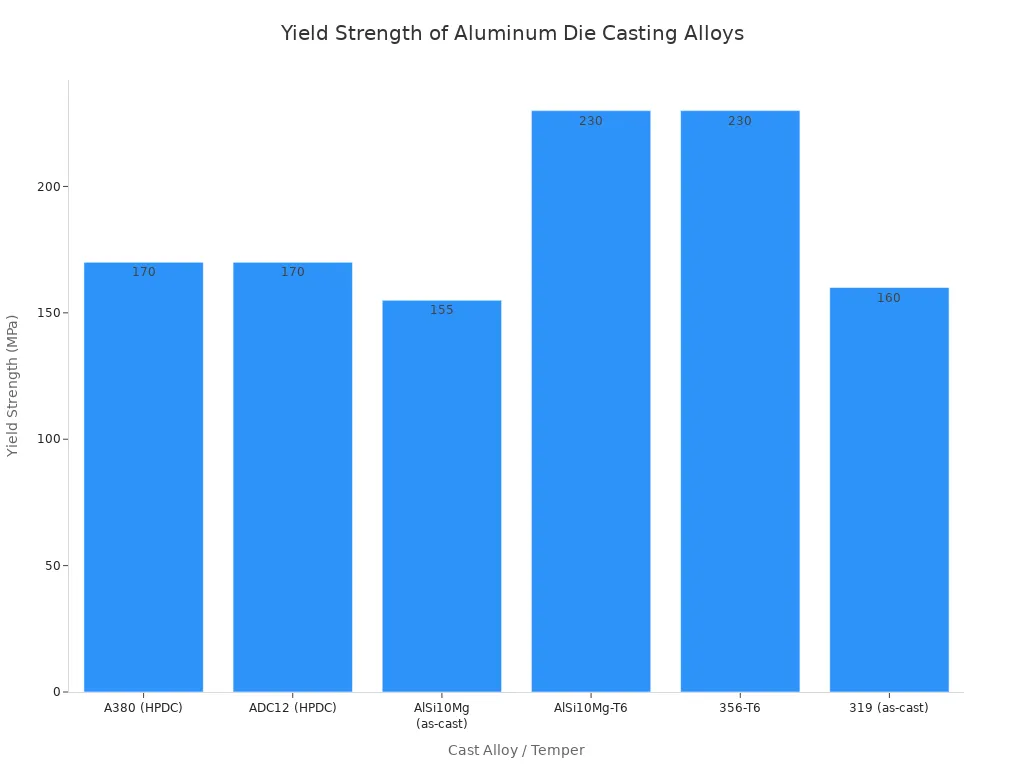
Several factors influence the strength of a material. These include the specific alloy composition, the casting process used, and any post-casting heat treatments. Yield strength, which measures the stress a material can withstand before permanent deformation, also varies. Different aluminum alloys and tempers offer a range of yield strengths. For instance, A380 (HPDC) has a yield strength of approximately 170 MPa (25 ksi). Heat-treatable alloys like AlSi10Mg-T6 can reach around 230 MPa (33 ksi) after precipitation hardening.
| Cast Alloy / Temper | Yield (MPa) | Yield (ksi) | Notes |
|---|---|---|---|
| A380 (HPDC) | ~170 | 25 | General-purpose die casting |
| ADC12 (HPDC) | ~170 | 25 | JIS analogue to A383/A380 |
| AlSi10Mg (as-cast) | 130–180 | 19–26 | Good corrosion; heat-treatable |
| AlSi10Mg-T6 | ~230 | 33 | Precipitation-hardened |
| 356-T6 | ~230 | 33 | Sand/perm-mold & HPDC variants |
| 319 (as-cast) | ~160 | 23 | Engine components |
Wrought T-tempers generally deliver higher yield strength than as-cast Die-Casting grades. However, castings excel in net-shape production and cost efficiency.
Strength-to-Weight Ratio: Magnesium's Advantage
Magnesium Die Casting for Lightweighting
Magnesium alloys offer a superior strength-to-weight ratio compared to aluminum alloys. Magnesium is the lightest structural alloy available. It provides the best available strength-to-weight ratio for any die-cast material. This allows engineers to achieve the required structural performance with significantly lighter parts. Magnesium die casting is therefore highly beneficial for lightweighting applications. Cast magnesium alloys can exhibit a tensile strength of up to 280 MPa. Specific magnesium alloys show competitive tensile strengths:
| Alloy Name | Tensile Strength (ksi) |
|---|---|
| AZ91D | 34 |
| AZ91HP | 34 |
| AM60B | 32 |
Impact on Performance and Efficiency
Magnesium's exceptional lightness directly impacts performance and efficiency. A car constructed from die-cast magnesium parts would be 33% lighter than an identical car made from die-cast aluminum parts. It would also maintain similar or even superior mechanical properties. Magnesium has a specific gravity of 1.74, making it the lightest structural metal. Magnesium alloys typically weigh between 0.064 to 0.067 pounds per cubic inch. Aluminum alloys, in contrast, weigh between 0.091 to 0.108 pounds per cubic inch. This significant weight difference highlights magnesium's superior strength-to-weight ratio. Reduced weight leads to improved fuel efficiency, lower emissions, and reduced inertia in moving parts.
Hardness and Stability
Aluminum's Superior Hardness
Aluminum generally possesses superior hardness compared to magnesium. Hardness refers to a material's resistance to indentation, scratching, or abrasion. This property makes aluminum suitable for applications requiring robust surface durability.
Stability of Aluminum Castings
Aluminum castings also demonstrate good dimensional stability. They maintain their shape and size under various environmental conditions and mechanical stresses. This stability is crucial for components requiring precise tolerances and consistent performance over time. While magnesium alloys have advanced, aluminum's inherent hardness and stability often make it a preferred choice for certain demanding applications.
Corrosion Resistance: A Critical Comparison
Aluminum's Natural Corrosion Protection
Inherent Oxide Layer Benefits
Aluminum naturally forms a passive oxide layer on its surface. This layer provides excellent protection against corrosion. It acts as a barrier, preventing further oxidation and degradation of the metal. This inherent protection makes aluminum a reliable choice for many applications.
Suitability for Harsh Environments
Aluminum alloys demonstrate good corrosion resistance in various challenging environments. For marine settings, 5000-series aluminum alloys, such as 5754, 5083, 5383, and 5086, show excellent resistance. Magnesium enhances its protective oxide layer. However, 2000-series and copper-containing 7000-series alloys are not recommended for marine use. Copper weakens the protective oxide layer. Silicon-based casting alloys (356 & 357) and magnesium-based casting alloys also find use in marine environments. In acidic conditions, hydrogen-based acids like hydrochloric and sulfuric acids are highly aggressive, especially in concentrated forms. Nitric acid, even in concentrations exceeding 50%, shows no detrimental effect and is often used for pickling. Organic acids generally have a much milder impact. Alkaline environments, particularly those with caustic soda and potassium hydroxide, are aggressive. Concentrated ammonia and organic bases have a milder effect.
Magnesium Die Casting and Corrosion Susceptibility
The Necessity of Surface Treatments
Magnesium is susceptible to corrosion even with an oxide layer. Unlike aluminum, this layer fails to adequately protect components in acidic and neutral environments. This leads to rapid corrosion, exposing the underlying metal. Therefore, magnesium's applications are limited unless alloyed with other elements or protected by a surface coating. Even when alloyed with aluminum for improved resistance, it remains vulnerable to corrosion in environments containing carbon dioxide or sodium chloride. Galvanic corrosion is a significant concern. In a sodium chloride solution, magnesium's corrosion potential is over 600 mV more negative than zinc. This makes it a highly active anode when in contact with other metals like stainless steel or titanium alloys. The oxide film on magnesium alloys is also unstable in aqueous solutions. It easily dissolves, exposing the metal to localized corrosion.
Advancements in Magnesium Corrosion Protection
To overcome magnesium's inherent corrosion susceptibility, various surface treatments have been developed. These treatments significantly enhance the material's durability.
| Protection Level | Surface Treatments |
|---|---|
| Excellent | PEO/MAO, hard anodizing, electroless nickel plating, PVD/CVD coatings |
| Good | Environmentally friendly anodizing, well-applied organic coatings |
| Moderate | Phosphate conversion coatings, conventional anodizing (often require topcoats) |
Plasma Electrolytic Oxidation (PEO), also known as Micro-Arc Oxidation (MAO), creates a hard, ceramic-like oxide coating on magnesium alloys. This electrochemical process significantly enhances corrosion resistance and wear properties. Research indicates PEO treatment substantially improves short-term corrosion performance. Electroless nickel plating also offers excellent protection. It applies a nickel-phosphorus or nickel-boron coating through a chemical reaction. This method creates a uniform film, even on complex shapes. It significantly enhances magnesium's applicability and endurance by forming a robust barrier against corrosive environments. This makes magnesium die casting more competitive in industrial and defense sectors.
Thermal Properties: Conductivity and Dissipation
Thermal properties play a crucial role in material selection for many applications. A material's ability to conduct and dissipate heat directly impacts the performance and longevity of components, especially in environments with temperature fluctuations or heat generation.
Aluminum's High Thermal Conductivity
Efficient Heat Dissipation Capabilities
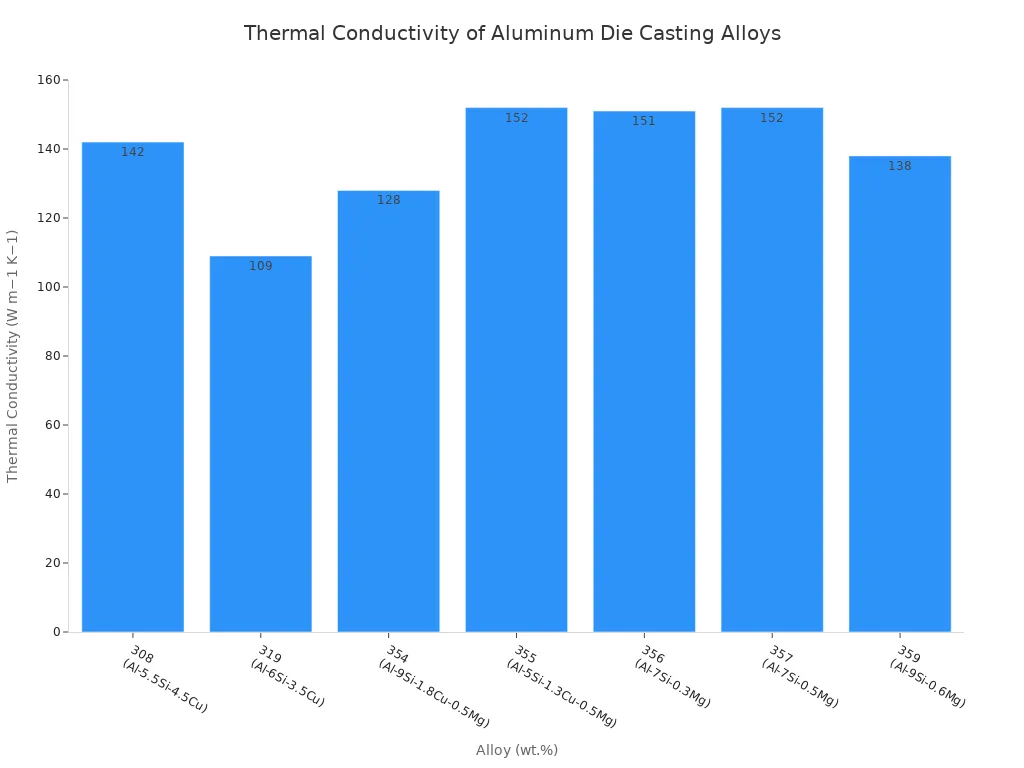
Aluminum alloys generally exhibit high thermal conductivity. This property allows them to efficiently transfer heat away from critical areas. This makes aluminum an excellent choice for applications requiring effective heat dissipation. The thermal conductivity of die-cast materials can range from 110.8 to 126.8 W m−1 K−1 in the as-cast condition. Heat treatments like T4 and T6 can significantly enhance thermal conductivity. They increase it from 126.8 W m−1 K−1 to 151.6 W m−1 K−1 by spheroidizing silicon precipitates and widening heat conduction paths. Traditional die-cast aluminum alloys, such as ADC12, have a thermal conductivity of 92 W/(m·K). However, newly developed high thermal conductivity casting aluminum alloys like DMS1, DMS3, DX17, and DX19 can achieve thermal conductivities as high as 150-210 W/(m·K). DMS5, a replacement for ADC12, has a thermal conductivity approximately 1.6 times that of ADC12.
Applications in Electronics and Automotive
Aluminum's high thermal conductivity makes it indispensable in electronics and the automotive industries. Manufacturers use it for heat sinks, LED housings, and electronic enclosures. In automotive applications, aluminum forms engine blocks, cylinder heads, and transmission casings. These components require efficient heat transfer to maintain optimal operating temperatures and prevent overheating.
Thermal Performance of Magnesium Die Casting
Adequate for Many Structural Uses
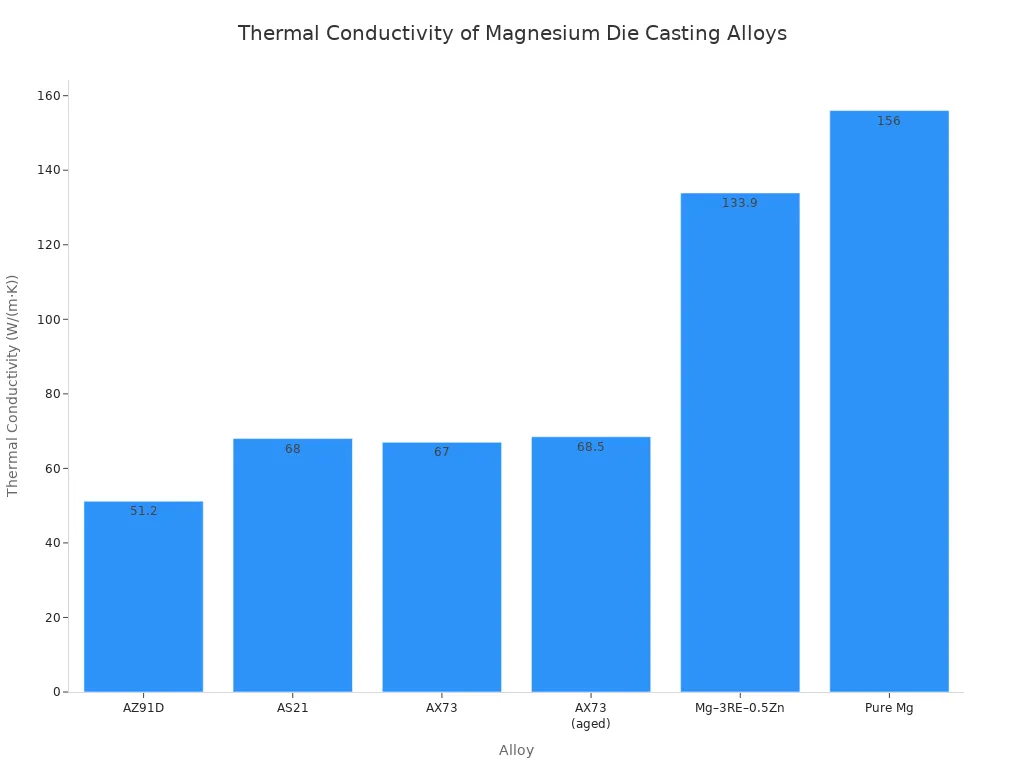
Magnesium alloys typically have lower thermal conductivity compared to aluminum. Most commercially used Mg foundry alloys, particularly HPDC Mg–Al based alloys like AZ91D, AM60, and AS21, exhibit low thermal conductivities due to the solid solution of aluminum. Despite this, magnesium's thermal performance is adequate for many structural applications. Its lightweight nature often outweighs the need for extremely high thermal conductivity in these contexts.
Considerations for Heat-Sensitive Designs
Engineers must carefully consider magnesium's thermal properties for heat-sensitive designs. While standard magnesium die casting alloys may not match aluminum's heat dissipation capabilities, new alloys like Mg–3RE–0.5Zn have been developed with superior thermal conductivity. These advancements expand the potential uses for magnesium in applications where heat management is a concern. For designs where heat buildup is a critical factor, engineers might need to incorporate additional cooling mechanisms or select specific magnesium alloys with enhanced thermal properties.
Cost and Manufacturing Considerations for Die Casting
Material Cost Differences
Fluctuations in Raw Material Prices
Raw material prices significantly influence the overall cost of die-cast components. Magnesium typically costs around $2.00 per kilogram. This price reflects its complex extraction and refinement processes, limited natural reserves, and energy-intensive production. Magnesium alloys generally cost between $3 to $6 per kilogram. This makes magnesium a premium option. In contrast, aluminum is more economical, averaging approximately $2.50 per kilogram. Aluminum alloys range from $2 to $4 per kilogram. Its widespread availability and less intricate extraction and refinement processes contribute to this lower cost.
Impact on Overall Production Budget
The price disparity between magnesium and aluminum directly impacts the overall production budget. Aluminum's lower raw material expense makes it a preferred choice for high-volume manufacturing where cost efficiency is paramount. For projects prioritizing lightweighting or specific performance characteristics, the higher material cost of magnesium may be justified. Engineers must balance material expenses with performance requirements and production volume.
Die Casting Process Complexity
Aluminum's Established Manufacturing Processes
Aluminum die casting benefits from well-established manufacturing processes. Manufacturers have extensive experience with aluminum, leading to optimized production cycles and predictable outcomes. The process is generally straightforward, allowing for efficient mass production with fewer specialized requirements. This maturity contributes to lower overall manufacturing costs and shorter lead times.
Specific Handling for Magnesium Die Casting
Magnesium die casting presents unique complexities. Magnesium's high reactivity with oxygen necessitates careful control of the melt atmosphere, especially during pouring, to prevent oxidation. Its oxide layer is porous and does not effectively prevent further oxidation. This reaction with atmospheric oxygen, water vapor, and nitrogen forms refractory compounds that can lead to 'oxidation slag' in the mold. Safety concerns are also significant. Processing and post-processing can produce flammable magnesium dust and sparks, requiring dust collectors and fire prevention facilities. Magnesium die casting incurs higher tooling and finishing costs compared to aluminum. Lead times for magnesium castings can be longer due to specialized equipment and additional steps like vacuum casting or inert gas shielding.
Machinability and Finishing Options
Ease of Machining for Both Materials
Both aluminum and magnesium offer good machinability, but magnesium holds an advantage. Magnesium is easier to machine, requiring less cutting pressure. It generates less heat during machining, which reduces tool wear. This allows for longer-lasting machining tools and faster machining speeds. Aluminum also has good machinability but generally requires more effort than magnesium.
Finishing Costs and Aesthetic Considerations
Finishing options and their associated costs are important considerations. Both materials can undergo various surface treatments for aesthetic appeal or enhanced performance. Aluminum's natural corrosion resistance often reduces the need for extensive protective coatings, potentially lowering finishing costs. Magnesium, due to its susceptibility to corrosion, frequently requires more advanced and costly surface treatments, such as Plasma Electrolytic Oxidation (PEO) or electroless nickel plating, to ensure durability.
Application Suitability: Where Each Material Excels
Choosing between aluminum and magnesium die casting depends heavily on the specific demands of an application. Each material offers distinct advantages, making it ideal for different product categories. Engineers carefully evaluate these properties to select the most suitable material.
Ideal Applications for Aluminum Die Casting
Aluminum die castings provide a preferred solution for producing lightweight, high-strength components across various industries. They reduce weight, improve durability, and enhance overall product quality.
Automotive Engine Components and Housings
The automotive industry extensively uses aluminum die casting. Manufacturers produce engine blocks, gearbox casings, oil sumps, engine mountings, and structural parts with high-pressure die casting (HPDC). This method delivers unmatched strength and durability. HPDC also helps meet the demand for lighter car components. Specific aluminum alloys like A360, A380, and A319 are commonly used for automotive applications. A356 is also widely used in high-pressure casting due to its castability and strength.
Electronic Enclosures and Heat Sinks
Aluminum's superior thermal conductivity makes it indispensable for electronic enclosures and heat sinks. There is an increasing demand for efficient heat dissipation components in various devices. These components control heat generation, which directly impacts product efficiency and lifespan. In the automotive and electronics industries, heat generation issues are prominent due to increasing efficiency and integration of components. Components with excellent heat dissipation characteristics prevent product degradation and extend lifespan. For example, a developed Al-1.0 wt%Cu-0.6 wt%Fe-2.0 wt%Si alloy manufactures die-casting components requiring high heat dissipation performance, such as heat sinks for automotive audio equipment. Aluminum heat sinks are also widely used in processors, graphics cards, and power devices. They prevent overheating and ensure stable operation of electronic components.
Structural Parts Requiring High Absolute Strength
Aluminum die castings are excellent for structural parts requiring high absolute strength. The construction industry utilizes HPDC castings for window frames, roof superstructures, total building frames, bridges, and skyscrapers. This is because the construction industry requires strong, durable, and long-lasting components. These structural components also need to be lightweight and dimensionally accurate. The aerospace industry also finds HPDC popular for aircraft components. It produces intricate and complex designs meeting strict safety regulations. The lightweight, superior quality, durability, and strength of HPDC parts make them ideal for aerospace manufacturing. Alloys like A360, A380, A383, and A413 are chosen for their toughness, durability, and high strength.
Ideal Applications for Magnesium Die Casting
Magnesium's exceptional strength-to-weight ratio makes it a prime candidate for applications where weight reduction is critical.
Portable Electronic Devices and Laptops
Magnesium die casting excels in portable electronic devices and laptops. It keeps devices both durable and portable. Magnesium also provides superior RFI shielding, protecting sensitive electronics from interference while improving performance. It allows for sleek designs that are both strong and stylish. Examples include handheld detection equipment, such as Waygate Technologies' one-piece magnesium cast housing for handheld remote portable borescopes. Power tools also benefit, like the Makita 5007MG 7.25 inch magnesium circular saw, which uses magnesium for its saw base, blade case, and safety guard. Garden tools, such as the Stihl MS 400 C-M chainsaw, feature a novel lightweight piston, and the MS 261 C-M forestry chainsaw uses a magnesium crankcase. These applications leverage magnesium's lightweighting capabilities, damping capabilities, part consolidation, and electromagnetic interference shielding.
Automotive Interior and Aerospace Components
The automotive and aerospace industries frequently use magnesium for interior and non-critical structural components. Its lightweight nature significantly contributes to fuel efficiency and reduced emissions in vehicles. In aerospace, magnesium components help reduce overall aircraft weight, leading to improved performance and fuel economy. These applications prioritize durability without adding excessive mass.
Products Prioritizing Weight Reduction
Many products prioritize weight reduction for improved performance or user experience. Magnesium die casting is ideal for power tools, industrial equipment, and conveyor systems. These applications require high-performance parts that offer durability without added mass. The material's ability to deliver strength at a fraction of the weight of other metals makes it a preferred choice for engineers seeking to optimize product efficiency and handling.
Summary Table of Properties: Magnesium Die Casting vs. Aluminum
Engineers often compare magnesium and aluminum die castings based on several key properties. This comparison helps determine the best material for specific applications. The following table and descriptions summarize the critical differences.
Key Property Comparison
Tensile Strength Values
Aluminum alloys generally offer higher absolute tensile strength. For instance, common aluminum die casting alloys exhibit robust strength.
| Alloy | Tensile Strength (MPa) |
|---|---|
| A380 | 310–325 |
| A360 | 317–330 |
Another common alloy, A380, shows an ultimate tensile strength of 324 MPa. Magnesium alloys, while strong, typically have lower absolute tensile strength than these aluminum counterparts.
Density and Weight
Magnesium is significantly lighter than aluminum. This difference directly impacts component weight. The element magnesium has a specific gravity of 1.74. Typical magnesium alloys have a density of 1.8 g/ml. In contrast, aluminum alloys are denser.
| Alloy | Density (g/cm³) |
|---|---|
| A360 | 2.66 |
| A380 / 380.0 | 2.73 |
| A383 / 383.0 | 2.74 |
| ADC12 (JIS) | 2.74 |
This density difference makes magnesium die casting ideal for lightweighting applications.
Corrosion Resistance Rating
Aluminum offers superior natural corrosion resistance. It forms a protective oxide layer. This layer makes aluminum rust-proof and highly resistant to environmental degradation. Magnesium, however, is not inherently corrosion-resistant. It requires sprays or coatings for galvanic corrosion protection. Magnesium alloy die-cast parts, like those made from AZ91HP, show natural corrosion resistance in dry environments. However, magnesium is notably susceptible to galvanic corrosion in moist or saline conditions.
Thermal Conductivity Index
Aluminum alloys possess high thermal conductivity. They efficiently dissipate heat. This property makes aluminum excellent for heat sinks and electronic enclosures. Magnesium alloys generally have lower thermal conductivity than aluminum. However, their thermal performance is adequate for many structural uses.
Relative Cost Factor
Aluminum die casting usually costs less than magnesium. Aluminum is readily available and recyclable. This keeps its price steady. Magnesium can cost more due to special handling requirements and more volatile market prices.
| Property | Aluminum Die Casting | Magnesium Die Casting |
|---|---|---|
| Cost | Lower | Higher |
| Material Cost | Lower, steady market | Higher, more changeable |
Neither magnesium nor aluminum possesses universal strength superiority. Aluminum generally offers higher absolute tensile strength, greater hardness, and better corrosion resistance. Conversely, magnesium die casting provides an exceptional strength-to-weight ratio, making it ideal for lightweighting applications. Engineers must carefully weigh trade-offs among strength, weight, cost, corrosion, and thermal properties. The choice between these materials represents a strategic decision, aligning with specific performance requirements and project goals.
FAQ
What is the primary advantage of magnesium die casting over aluminum?
Magnesium die casting offers a superior strength-to-weight ratio. This makes it ideal for applications where weight reduction is a critical design factor. Engineers choose it for lightweighting.
Does aluminum die casting have higher absolute strength than magnesium?
Yes, aluminum alloys generally exhibit higher absolute tensile strength. This property makes aluminum suitable for structural components requiring robust resistance to breaking under tension.
Which material provides better natural corrosion resistance?
Aluminum naturally forms a protective oxide layer. This layer gives it excellent inherent corrosion resistance. Magnesium requires surface treatments to achieve comparable protection.
Why do manufacturers use aluminum for heat sinks and electronic enclosures?
Aluminum possesses high thermal conductivity. This allows it to efficiently dissipate heat. This property is crucial for maintaining optimal operating temperatures in electronic devices and automotive components.
Is magnesium die casting more expensive than aluminum?
Generally, magnesium die casting has a higher material cost. It also involves more complex manufacturing processes. These factors contribute to a higher overall production budget compared to aluminum.
Where does magnesium die casting find its ideal applications?
Magnesium die casting excels in portable electronic devices, laptops, and automotive interior components. It is also used in aerospace parts where weight reduction significantly improves performance and efficiency.
What are the main benefits of aluminum die casting in the automotive industry?
Aluminum die casting is widely used for engine blocks, gearbox casings, and structural parts. It provides high strength, durability, and contributes to lighter vehicle components.
How do engineers address magnesium's corrosion susceptibility?
Engineers use various surface treatments to enhance magnesium's corrosion resistance. These include Plasma Electrolytic Oxidation (PEO) and electroless nickel plating. These treatments create a robust barrier against corrosive environments.